The Pronoun Police Are Patrolling Oregon Schools

The Human Rights Campaign once tweeted that we should all “Begin conversations with “Hi, my pronouns are _____. What are yours?” 

Not so fast, critics have responded.

“Coercing people into publicly stating their pronouns in the name of “inclusion” is a Trojan horse that empowers gender ideology and expands its reach,” said Colin Wright, a fellow at the Manhattan Institute. “It is the thin end of the gender activists’ wedge designed to normalize their worldview. The effort to resist gender ideology is reality’s last stand. We simply can’t ignore fundamental realities of our biology and expect positive outcomes for society. “

The battle is on.

Much of the conflict has arisen in academic settings, including K-12 schools and colleges.

Students at Scripps College in Claremont, CA. have been advised that they can choose which of numerous different pronouns they want professors to use in addressing them.

Pronoun options were:
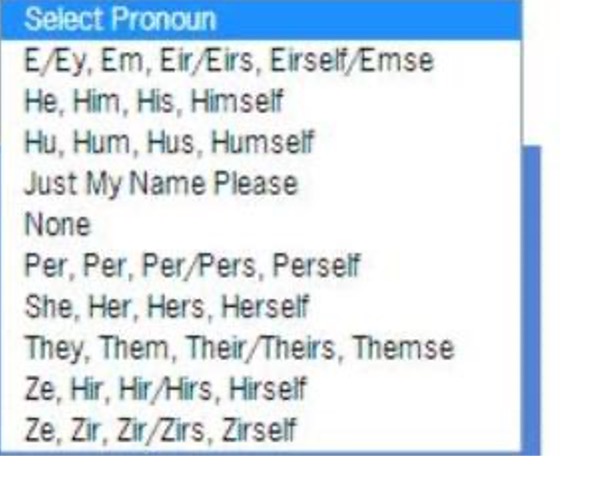
One student said the options were necessary protection from “institutionalized violence.”

Not to be left behind, the State of Oregon has embraced the same pronoun policies, turning appropriate pronoun usage into compelled speech.

In October 2021, Colt Gill, then Director of the Oregon Department of Education, used his Education Update email message to urge Oregonians to “Celebrate International Pronoun Day with ODE.”

“When we collectively share our names and pronouns, we can share the burden of fighting against injustice,” he wrote. “Pronoun sharing within the workplace and throughout school communities is an important opportunity to build trust and connection with transgender, non-binary, two-spirit colleagues, students, friends, and community members.”

Gill told educators:

  • If you are comfortable, share your pronouns when you’re introducing yourself at the start of a meeting: “I’m (Name) and I use she and they pronouns” 
  • Change your Zoom name to include your pronouns, every time: Name, (she/they), ODE 
  • Include pronouns in your ODE email signature 

In January 2023, ODOE issued Supporting Gender Expansive Students: Guidance for Schools. Included in the guidance is the following:

  • Gender expansive students may choose to change the name assigned to them at birth to an asserted name that affirms their gender identity. Gender expansive students may also ask to be referred to by the pronouns that affirm their gender identity.
  • Even if a student does not update their records, they should be referred to by their asserted name and pronouns Intentional or unintentional continuous misgendering of a student by refusing to use their asserted name and pronouns can potentially create a hostile environment. 
  • Schools should engage in student-led support planning for name and pronoun changes. Once the school and student have decided on a supportive action plan, the school should immediately take action to implement the plan.”

The guidance cautioned about disclosing the decisions students make. “To the extent possible, schools should refrain from revealing information about a student’s gender identity, even to parents, caregivers, or other school administrators, without permission from the student.”

When a local news outlet asked ODOE about the policy providing leeway to keep parents in the dark on official school transitions, ODE said this was for a “safety concern.”

On Oct. 19, 2023, the State Board of Education lent its weight to the pronouns dispute, adopting new health K-12 education standards that include:“Demonstrate ways to treat all people with dignity and respect, including people of all genders, gender expressions and gender identities” starting in the 4th grade. 

The new standards will come into full effect in Oregon public schools by the 2025-26 school year. 

Educators and other Oregonians who are less than enthusiastic about the progressive pronoun push may hope the campaign will abate, but it looks like the beatings will continue until morale improves and educators with the courage to challenge the received wisdom of the education establishment will be at risk.

An ever-growing list of pronouns have now become expressions of one’s self-proclaimed identity, a claim that proponents insist everyone must affirm—or else.

Some critics argue that all this is just capitulating to a politically correct, Orwellian effort to validate social progressive doctrines.

Others argue that the controversy is just a way for ideologues to browbeat people, to claim authority over how people speak and to allow language commissars to monitor incorrect speech in schools, workplaces and life.

 Compelling expansive pronoun usage is a dramatic curtailment of freedom of speech, critics assert. As Graham Hillard, managing editor at the James G. Martin Center for Academic Renewal, put it, “When Big Brother arrives in the 21st century, he will appear not on posters but in grammar handbooks, HR manuals, and social media”

In the meantime, how should you navigate the rocky shoals of the pronoun wars without being chastised, harassed, berated and charged with insensitivity?

‘Tis a puzzlement.

Portland’s Striking Teachers and Their Union Leaders are at Escalating Risk of Losing Public Support.

 Portland, Oregon, long a bastion of anything-goes progressivism, can’t take this strike much longer. 

 Facts are stubborn things. A city still recovering from the pandemic, buffeted by economic uncertainty and battered by homelessness, proliferating graffiti, rampant drug use and crime, simply can’t afford to keep its kids home.

The union says it’s fighting for the children, but they will have missed 14 days of classes by Thanksgiving and may miss more. 

This in a district which is already struggling with high rates of student absenteeism. In the 2022-2023 school year, 36.4% of the district’s students were “chronically absent”, absent for more than 10% of the academic year. Chronic absentee rates were 52.9% for Black/African American students, 48% for Hispanic/Latino students, 66.1% for American Indian/Alaska Native students, 59.9% for Native Hawaiian/Pacific Islander, 31.4% for white students and 22.7% for Asian students.

“The fact that absenteeism has gone up is the biggest issue right now and has been overlooked,” says the Lewis-Sebring Director of the UChicago Consortium on School Research, Elaine Allensworth. “People keep focusing on the test scores, but our research shows over and over again that student attendance is an incredibly strong predictor of pretty much every outcome you care about: High school graduation, college ready, college enrollment, college graduation. It’s vital that students actually come to school every day.”

And then there’s the performance of Portland Public Schools kids on state subject competency tests, likely already exacerbated by high absenteeism. Although mostly better than statewide results, they are still disappointing, often showing declining scores as children move through the system. 

At Portland’s elementary schools, for example, 56% of tested students met or exceeded state standards in math in the 3rd grade in 2023, while just 40% met or exceeded state standards in the 8thth grade, 55% met or exceeded English standards in the 3rd grade compared with 54% in the 8th grade and 44% met the standards in science in the 5th grade versus 38% in the 8th grade. 

At the district’s high schools, just 27of 11th graders met or exceeded state standards in Math, 50% met or exceeded the standards in English and 39% met or exceeded the standards in science.

Of course, all this probably matters less now that the State Board of Education unanimously voted to extend the 2021 law that paused a requirement that Oregon students show proficiency in Essential Learning Skills in order to graduate.

The District’s teachers also need to confront a public perception that a massive amount of money is already being plowed into the troubled system. 

Taxpayers are already spending an astronomical amount to support Portland Public Schools, as I pointed earlier this year in The Cost of Sending Kids to Portland Public Schools is More Than You Think, a Lot More. The commonly used number for spending per student is $15,000, but that’s actually way off. All funds available to the District in the 2022-23 school year totaled $1.9 billion. Divide that by 41,470 students and per student expenditures came out to $45,533.

And that was more than the District spent per student in the 2021-22 school year, even though the number of students served declined. In the fall of 2021, the District enrolled 45,005 students in grades K-12, a decrease of 1,932 students from fall 2020. The net loss was even greater than the previous year’s loss of 1,716 students.

A recent “Portland Public Schools Enrollment Forecast” by Portland State University’s Population Research Center projected that the District’s enrollment will likely continue to fall throughout most of the forecast’s horizon, declining to a low of 39,123 in 2035-36. 

How can the union expect spending to keep increasing in the face of enrollment declines.  

Portland residents also aren’t likely to look more favorably on higher taxes or fees to help the district as the strike continues.  Portland’s income tax rate of 14.7% for earners is already second only to New York City, largely because of resident’s previous misguided willingness to support innumerable feel-good programs. Portland’s rate is even more punitive when you consider that an individual hits that high earner mark in Portland at $125,000, while a New York taxpayer would have to earn $25 million.

The Portland Metro Chamber recently noted that total taxes paid by businesses located in the City of Portland increased by about one-third, or from $781 million to $1.031 billion, just from 2019 to 2021, according to calculations by the global tax consultancy Ernst & Young.

Key changes during that three-year period, included implementation of a gross receipts tax for the Portland Clean Energy Fund, a property tax to fund city parks, a rate increase in the Multnomah County business tax, an income tax to support Preschool for All (paid in part by sole proprietors), property taxes for Multnomah County library renovations, and new business and personal taxes associated with Metro’s Supportive Housing Services measure.

The Preschool for All program, for example, is funded by a personal income tax based on the following thresholds:

  • Single taxpayers. All Oregon taxable income over $125,000 is taxed at 1.5%. All income above $250,000 is taxed at 3%. In 2026, the tax rate increases by 0.8%
  • Joint filers. All Oregon taxable income over $200,000 is taxed at 1.5%. All income above $400,000 is taxed at 3%. In 2026, the tax rate increases by 0.8%.

“Portland’s higher level of business taxation dates to the enactment of corporate income taxes levied by the City of Portland and Multnomah County in 1981,” the Chamber said. “ These local-level business income taxes are not common in other cities across the U.S.”

If the Portland Association of Teachers hopes to come out of this with continuing public support, teachers need to get back too work and kids need to get back in class. Parent and student patience is not inexhaustible. 

Civilian Deaths in Gaza Lie at Hamas’s Door

“Far too many Palestinians have been killed, far too many have suffered these past weeks,” U.S. Secretary of State Antony Blinken said Friday in New Delhi.

Do you think Hamas cares?

When Hamas terrorists launched an unprecedented and sadistic surprise attack on Israel  with cold indifference on Oct. 7, brutally butchering and massacring more than 1,200 people, injuring at least 6,900, taking more than 240 people hostage (There is still been no formal master list of hostages held, because Hamas hasn’t provided one), and launching thousands of missiles at Israel from the Gaza Strip, did they expect to overrun the country and eliminate Israelis from the river to the sea? 

Not in the least.

Their aim was to cause chaos and invite massive retaliation, hoping the retaliation could be twisted to undermine Israel’s right to exist and justify Hamas’s cause. 

Israel initially gained wide support in the face of Hamas’s savagery. 

President Biden condemned the atrocities committed by Hamas fighters, including the “slaughter” of men, women and entire families, as well as “stomach-churning reports of babies being killed.”

“The United States unequivocally condemns this appalling assault against Israel by Hamas terrorists from Gaza,” Biden said in a statement. “Israel has a right to defend itself and its people.” 

U.N. human rights chief Volker Turk said he was “shocked and appalled” by the attack. Ursula von der Leyen, head of the European Union’s executive commission, called the attack “terrorism in its most despicable form.” Ukrainian President Volodymyr Zelenskyy said, “Israel’s right to self-defense cannot be questioned.”

But as Israel has retaliated militarily in Gaza in an effort to punish Hamas, and more civilians have been caught in the crossfire, some because Hamas has demanded they stay in place, the public debate has shifted. The portrayal of Israel as the aggressor has emerged, just as Hamas surely hoped it would. 

Now the media is laser focused on the civilian casualties occurring with Israel’s response, all but eclipsing the Oct. 7 barbarities of Hamas. In achieving that shift, Hamas is turning itself into the victim.

Nowhere is that victim status more embraced now that at many American institutions of so-called higher learning. At Harvard, The Palestine Solidarity Committee issued a joint statement with more than 30 other student groups that held Israel “entirely responsible for all unfolding violence.” ” The apartheid regime is the only one to blame,” it continued.

” When antisemitism moves from the shameful fringe into the public square, it is not about Jews, It is never about Jews,” observed Bari Weiss, editor of The Free Press, in a recent speech to the Federalist Society. “It is about everyone else. It is about the surrounding society or the culture or the country. It is an early warning system—a sign that the society itself is breaking down. That it is dying.  It is a symptom of a much deeper crisis—one that explains how, in the span of a little over 20 years since Sept 11, educated people now respond to an act of savagery not with a defense of civilization, but with a defense of barbarism.”

Sarah Katz, an author with a background in Middle East Studies and counterterrorism, argues that statements such as the one from Harvard’s Palestine Solidarity Committee reflect the conflict of ideologies that has arisen between alleged racist perpetrators and racialized victims.

“When applied to Israel and Palestine, Israel as the “powerful Western oppressor” and Palestine as the “brave non-white victim” have captured the hearts and minds of many esteemed institutions,” Katz wrote recently in the Jewish Journal.  “This oppressor/victim binary tends to dismiss any reference to the culpability of any Palestinian entity in events preceding Israeli retaliation.”

As Ben Kawaller put it in a Free Press post, “What’s really righteous is to promulgate a fundamental loathing of anyone belonging to the “oppressor” class.”

It is essential to know all this when confronting the tragedy that is now Gaza. This is not to ignore or downplay the civilian deaths in Gaza, but Hamas does not get to position itself as the honorable resistance movement in Gaza because of them.

A Lesson for the Portland Association of Teachers

The Portland Association of Teachers isn’t going to get what it wants.

Voters in Salem just signalled why.

On Tuesday, Nov. 7, Salem voters smashed to smithereens a proposed payroll tax passed by the city council in July. 

A total of 82.14% of voters rejected the tax, which would have applied to anyone who worked in Salem, including people commuting into the city from elsewhere.

The fact is, voters are worried about their well-being and in no mood to bear increased government spending. Across the board, they feel that their incomes are being eroded by inflation, that their pay raises aren’t keeping up with inflation, and that their hard-earned living standards are threatened.

The teachers union says it’s on strike “for our students” and insists that the public is behind it. Before the strike, the union trumpeted the results of a poll it sponsored that found Oregonians were inclined to stand with educators and supported teacher strikes, especially in the Portland School District.

I don’t think the teachers can count on that support if it means more money out of the public’s pockets.

After all, taxpayers are already spending an astronomical amount to support Portland Public Schools. As I wrote earlier this year, The Cost of Sending Kids to Portland Public Schools is More Than You Think, a Lot More. The commonly used number for spending per student is $15,000, but that’s actually way off. All funds available to the District in the 2022-23 school year totaled $1.9 billion. Divide that by 41,470 students and per student expenditures came out to $45,533. That’s right, $45,533.

The state’s politicians, including the governor, have figured this out and have made it clear the state won’t bail out the district. And rightly so.  As OPB has noted, “It would be unusual — and scandalous in many corners of the state — for the Legislature to find a special pool of money just for Portland schools, particularly since other districts face similar issues.”

Multnomah County residents aren’t likely to look favorably on higher taxes or fees to help the district either. Multnomah County already has the highest marginal tax rates in the United States because of resident’s previous misguided willingness to support innumerable feel good programs. 

“I’m sure that when the voters in Multnomah County supported all of those different proposals and programs, they did it with good intent. But collectively, every time that we vote for an increase, particularly in marginal income tax, that definitely has a dampening impact on investment in our community,” Portland Mayor Ted Wheeler said earlier this year.

Multnomah County has already seen people vote with their feet against rising taxes. 

The county lost population in the year ended July 1, 2022, the U.S. Census Bureau said in its annual report on county-level changes. The county’s population stood at 795,083 on July 1, 2022, down 12,494 (1.3%) from 805,593 a year earlier. This followed a similar decline in 2021. 

Then, of course, the teacher’s union has to recognize that they want more money when the number of students in the system is declining. Enrollment numbers in the Portland Public School District have been dropping every year since 2019, with the biggest loss of students at the elementary school level. No business would give in to demands for higher pay if its sales were dropping like a stone.