In June 2023, Metro President Lynn Peterson announced she was running in the Democratic primary for the 5th Congressional District seat occupied by Kurt Schrader until replaced by Lori Chavez-DeRemer.
“I’ll bring a track record of developing common sense solutions and getting things done to Congress,” Peterson said. “I’m going to fight not only for needed investments in housing, public safety, transportation and education, but also our fundamental rights to vote and seek reproductive health care.”
The race is a top target for Democrats trying to flip the U.S. House, which is now narrowly in Republican hands. The district, which voted for Joe Biden in 2020 and has more registered Democrats than Republicans, stretches from Bend to Portland.
Peterson jumped out of the gate with an endorsement from DeFazio and over 50 endorsements from officeholders and community leaders from throughout the 5th District and the state.
What could go wrong?
Well, money.
In an email blast today, Peterson said, “For the next few months, our fundraising numbers will help set the narrative as we approach the primary and look toward the general election. (emphasis in original) For many, these numbers serve as a proxy metric for viability.”
According to campaign finance numbers posted today by the Federal Election Commission (FEC), Peterson had just $52,834.13 cash on hand as of the end of 2023.
The other four Democratic primary candidates, Janelle Bynum, Kevin Easton, Jamie McLeod-Skinner and Matthew Davie, haven’t filed their campaign finance reports for all of 2023, but Bynum and McLeod-Skinner had healthy balances as of Sept. 30, 2023 (Bynum: $217,842.324; McLeod-Skinner: $154,767.48).
In addition, The Democratic Congressional Campaign Committee gave Bynum a lift when it announced its support for her on January 29, noting that it had put her on its “Red to Blue” list of key candidates running to replace Republican members as part of the Democrats’ strategy to reclaim the House majority.
The primary winner will take on Republican U.S. Rep. Lori Chavez-DeRemer, who won her seat in 2020, defeating Democrat Jamie McLeod-Skinner 51% – 49%.
Chavez-DeRemer hasn’t filed her end-of-the-year campaign finance report with the FEC, but as of Sept. 30, 2023, she had cash on hand of $1,290,581.19. It’s expected that her aggressive fundraising efforts continued in the fourth quarter of 2023, making her a strong candidate in the race against her eventual Democratic opponent.
Despite the Democratic lead in registrations in the district, the Cook Political Report rates the race as a toss-up.
Update 9/24/2025: I see a lot of electric vehicles (EVs) around town, but apparently looks are deceiving. As of May 2025, 119,850 “zero emissions vehicles” (ZEV) were registered in Oregon, equaling 3.2 percent of the total vehicle fleet, according to the Cascade Policy Institute. Of those, only 84,636 were true zero-emission vehicles powered entirely by a battery. The remaining 35,214 vehicles were plug-in hybrids, which still rely on gasoline. The numbers show Oregon has reached just 34 percent of former Governor Kate Brown’s EV Adoption Targets established during her era.
The hoopla was energizing.
On Oct. 26, 2019, PGE celebrated the grand opening of its Eastport Plaza Electric Avenue EV charging station at 4000 SE 82nd Avenue in Portland.
“These charging stations are important to the mission of PGE, because we are committed to doing our part in solving global warming and Climate Change,” said PGE’s President & CEO, Maria Pope.
The Eastport Plaza location joined already operating Electric Avenue operations in Milwaukie, Hillsboro, Wilsonville, and downtown Portland.
Smiling PGE officials, representatives from TriMet, the City of Portland, and Multnomah County enthusiastically cut a ribbon to officially open the new 82nd Ave. charging station.
The national mood on EV’s was optimistic, too.
Global plug-in vehicles come in two basic varieties—all-electric (BEV) and plug-in hybrids (PHEV). Ddeliveries reached 2.1 million units for 2018, 64% higher than for 2017. About 69% of sales were BEV and 31% were PHEV. Global BEV sales in 2019 were increasing at a slower pace than previously, but global plug-in vehicle deliveries still were headed toward 2.3 million units in 2019. Electrification was clearly on the minds of most forward-looking utilities.
More than four years later the mood is considerably less upbeat.
The pace of adoption has markedly slowed, and analysts have suggested the country is no longer likely to hit the federal government’s sales targets. Government targets for EV sales in 2024 call for each car manufacturer to hit 22% electric vehicle sales or face hefty fines. EV experts are warning the growth rate in electric vehicle uptake simply isn’t strong enough to make that target.
Earlier this week, dealers representing about 5,000 stores wrote to President Biden saying the charging infrastructure remains scattershot and unsold EVs are piling up on their lots. The letter urged Biden to “hit the brakes” on an EPA proposal that could codify the agency’s strictest-ever tailpipe emissions limits, proposed last April.
“Mr. President, we share your belief in an electric vehicle future,” the latest letter says. “We only ask that you not accelerate into that future before the road is ready.”
This followed an earlier November letter from about 4,000 dealerships calling on Biden to reconsider the proposed regulations, which they argued would mandate an unrealistic shift to battery-electric vehicles in the U.S.
A recent visit to the Eastport Plaza Electric Avenue charging site offers some reasons why manufacturers and dealers are getting antsy about EVs. And potential buyers, too.
The site has four DC fast chargers and two Level 2 chargers.[1] When I pulled in riding in a Nissan Leaf, one of the charging ports was broken. I was later told it had been broken for months. The three other fast chargers were in use. One vehicle was at 86% charged, one at 39% and the third at 22%. Only the 86% vehicle was occupied.
Broken charger at Eastport Electric Avenue
Choices open to us were to use a slow Level 2 charger or sit and wait for one of the fast charger slots to open up. Unlike at a gas station, there’s no assurance the vehicles ahead of you will move on in a timely manner.
We encountered similar issues at PGE’s Electric Avenue site in the heart of downtown Milwaukie at the corner of SE McLoughlin Blvd. and Jackson St.
As at Eastport, the Milwaukie site has six charging ports, four DC fast chargers and two Level 2 chargers. All four fast charging stations were occupied with no drivers in the vehicles. One vehicle was at 59%, one at 74%, one at 59% and one at 89%. One of the slow Level 2 chargers was being used, with the driver in the vehicle.
It is considered acceptable to leave your vehicle unoccupied while it’s charging, It used to be common EV etiquette, however, that when your vehicle was at 80% you would make way for another vehicle if others were waiting.
The U.S. Department of Energy still says, “Unless you truly need every ounce of driving range available in your vehicle, consider unplugging your electric vehicle when it has reached 80 percent charge or an acceptable charge level for your immediate driving needs.”
EV owners tell me the 80% rule is, however, now commonly abused. Another common abuse is leaving a fully charged vehicle unoccupied for an extended period, with no way for a waiting driver to know how long the wait will be. One EV driver can tell how much longer another EV needs to charge by reading the digital readout on the charger stating the EV’s current degree of charge and the length of time for its charging, but that doesn’t guarantee the vehicle owner will unplug in a timely manner.
The Department of Energy also urges EV owners not to consider charging sites as resting places. “An EV owner will often use a charge point as an hours-long parking spot versus a place to recharge and go,” the Department says. Doing so, of course, adds an extra problem in that extra-long periods of charging time tops off the battery, which is not optimal for EV performance.
Then, of course, there are gas and diesel vehicle owners who see open charging spaces as prime parking spots. “In a crowded parking lot, the sight of any open electric car charging spot can be too tempting for some to resist,” the Department of Energy warns.
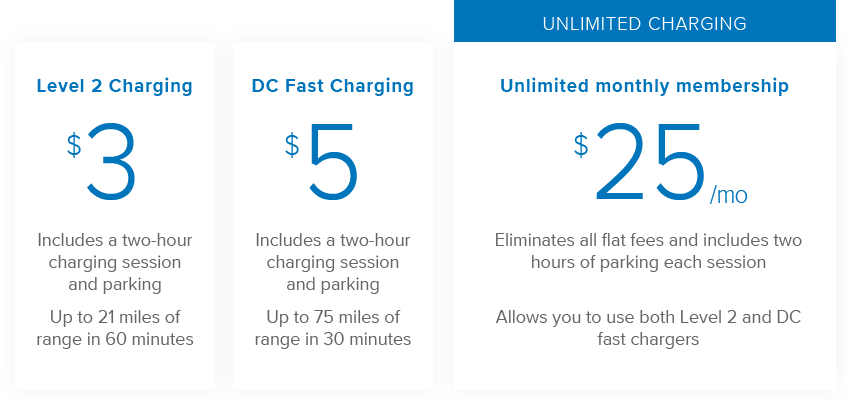
PGE’s charging stations accept all major credit cards, but if you want to sign up for pre-paid or monthly subscription pricing for Electric Avenue chargers, things get a little more complicated because PGE has partnered with Shell Recharge to accomplish that.[2]
First, you have to download the Shell Recharge app to your phone in the Apple App store Google Play store or order a Shell Recharge RFID card.
When you’re ready to charge your vehicle, you have to activate a charging session through the Shell Recharge app or scan your Shell Recharge charging card. If you are at an Electric Avenue charger, you can select “subscription” in the app if you’d like to pay just $25 per month for unlimited charging at Electric Avenue chargers or choose another preferred payment option. When you’re done, your card will automatically be charged for the session.
Charging prices at PGE’s sites are:
Source: PGE
Unlike at a gas station where the price per gallon generally stays the same 24/7, prices may vary during peak times (weekdays from 3 to 8 p.m.) During this period, PGE says $0.19/kWh will be charged to your credit card or Shell Recharge account in addition to your $3, $5 or $25 unlimited pricing structure.
Whatever the price, Oregon’s hyper-projections for electric vehicle adoption are proving to be wishful thinking. And it’s probably not just about EV prices, battery life and range. Unless you have a charging station at home, you are forced to rely on public chargers, and that, as we discovered, can be a frustrating challenge.
On Nov. 6, 2017, Gov. Kate Brown signed Executive Order 17-21 stating “It is the policy of the State of Oregon to establish an aggressive timeline to achieve a statewide goal of 50,000 or more registered and operating electric vehicles by 2020.” (emphasis in original).
In 2019, Senate Bill 1044 set a target of 250,000 registered Zero Emission Vehicles on Oregon roads by 2025. In December 2022, Gov. Brown, in a burst of environmental overreach that slavishly followed California’s lead, announced that all new cars sold in Oregon would have to be emissions-free starting in 2035.
The number of Oregon-registered zero emission vehicles on Oregon roads as of September 2023 was just 70,000.
The likelihood that this number will grow to 250,000 over the next 12 months is nil.
[1] There are three power levels at EV charging stations. Level 1 is the standard wall plug found in homes that delivers 120V. You will generally get only 2-5 miles worth of charging power every hour. Level 2 delivers twice the amount of power with 240V, offering 40-65 miles of charging power every hour. DC Fast Charge is the delivers 480V, which can fill 80% of most car batteries in 30 to 40 minutes.
If there was ever a time for Oregon schools to teach about the holocaust, the time is now.
In a December 2023 YouGov/Economist poll, 20% of young American respondents aged 18-29 said the Holocaust is a myth. Another 30% said they don’t know if it’s a myth. And the proportion of respondents who said they believe the Holocaust is a myth was similar across all levels of education.
And now, denial of the well-documented Oct. 7 Hamas terrorist attack on Israel that left about 1,200 people dead is spreading, despite truly massive real-time documentation of the attacks.
On social media, an expanding group of denialists link Israel itself to the attack, claiming it was a “false flag” event spurred by Israel to cast blame on Hamas. And as the Washington Post has reported, the denialism is “bleeding into the real world.”
“Demonstrators have shouted the claim at anti-Israel protests and have used it to justify removing posters of hostages in cities like London and Chicago,” the Washington Post reported. “At a November city council meeting in Oakland, Calif., multiple residents disputed the veracity of the attack.”
According to the Post, “researchers are warning that Oct. 7 conspiracy theories may follow a similar trajectory to Holocaust denial, which was waning before social media platforms propelled a resurgence a decade ago.”
Fortunately, Oregon is ahead on educating its public school students on the Holocaust.
Claire Sarnowski, when she was a freshman at Lake Oswego’s Lakeridge High School, came up with the idea of mandating Holocaust instruction at Oregon’s public schools after hearing a Holocaust survivor, Alter Wiener, tell his story. Sarnowski approached state Sen. Rob Wagner, who agreed to introduce a bill, SB 664.
The bill passed unanimously in the Oregon House and Governor Brown signed it on June 4, 2019.
The bill required school districts across Oregon to provide instruction about the Holocaust and genocide in social studies classes, starting in the 2020-21 school year, to “enable students to evaluate the morality of the Holocaust, genocide and similar acts of mass violence and to reflect on the causes of related historical events.”
.As so often happens with legislation, the true believers expanded on Sarnowski’s vision and declared that the instruction must also address: the immorality of mass violence; respect for cultural diversity; the obligation to combat wrongdoing through resistance, including protest, and; the value of restorative justice. Like anti-terrorism laws, it was a classic example of mission creep.
But it was at least a start. And now it’s needed more than ever.
The question, of course, is whether schools are aggressively following the law’s mandates and whether students are absorbing the lessons. The State has also mandated drug prevention education in Oregon’s public schools, for example, but an investigative series from the Lund Report, the University of Oregon’s Journalism Project and Oregon Public Broadcasting (OPB) has revealed that what students are being taught varies widely and that many school districts don’t use programs backed by evidence that they are effective at delaying or preventing substance abuse.
And then there’s the question of whether students are acting on what they are learning about the Holocaust.
Rep. Ritchie Torres (D-NY) said recently in a Dr. Martin Luther King Jr. Sermon at Central Synagogue NYC that when he was asked why he spoke out so frequently and forcefully about anti-Semitism, his answer was, “The question is not why have I chosen to be outspoken. The question is why have others chosen to be silent amidst the deadliest days for Jews since the Holocaust?”
Gov. Kotek has apparently decided not to immediately pursue multiple money-raising proposals put forward by her Housing Production Advisory Council to address the affordable housing crisis in Oregon. But you have to wonder, who are these people and what in God’s name were they thinking? How could they have been so oblivious, so tone-deaf to, the public mood?
Oregonians are in no mood for massive tax hikes, particularly to pay for more wasteful programs run by a parasitic government determined to hoover up hard-earned private income .
The proposals in the Council’s ill-advised 20-page draft report, HPAC Policy Recommendations, all of which would have continued until sunsetting in 2032, include:
Increase all personal income tax brackets by ½ percentage point
Establish a special $1 per $1,000 real property tax assessment outside of Measure 5.
Implement a 0.5% retail sales tax
Implement a 0.5% payroll tax
Double the current state fuel tax
Targeted Measure 50 Reform:
Increase annual Maximum Assessed Value change from 3% to 5%.
Authorize voters to increase the permanent levy of their local jurisdiction.
Exempt cities and counties from compression.
Adopt Land Value Tax
Eliminate Mortgage Interest Deduction for Second Homes (i.e., abolish income tax deduction for interest paid on second homes).
Enact temporary property tax exemption for new housing at 120% AMI or below.
Reduce or Eliminate Tax Expenditures (i.e., tax exemptions) not related to housing.
Total projected ANNUAL new revenue from just the first five proposals would be $2.4 billion. If enacted in 2024, and maintained until sunsetting in 2032, they would would fill state coffers by grabbing almost an astonishing additional $27 billion from taxpayers. Measure 50 reform surely would grab millions more.
Who came up with this stuff?
The report notes that four lawmakers sat as members on Kotek’s Council:
I can understand the two liberal Democrats, given their party’s predilection for government spending.
Jama represents Oregon’s 24th Senate District, which includes parts of Multnomah and Clackamas Counties. He co-founded the Center for Intercultural Organizing, now Unite Oregon, and served as the director until 2021. He was appointed unanimously by the Clackamas and Multnomah County Boards of Commissioners to replace Shemia Fagan after she was elected Secretary of State. He won election by 58.7% in 2022.
Dexter represents Oregon’s 33rd House District, which covers the Northwest District and Northwest Heights of Portland, plus Cedar Mill, Oak Hills and most of Bethany. She was appointed in June 2020 after the death of Democrat Mitch Greenlick. She won election by 84.8% in 2022.
It’s harder to understand why Republicans Dick Anderson of Lincoln City and Vikki Breese-Iverson of Prineville signed on to the Advisory Council’s massive tax proposals, unless you accept the proposition that the two parties are actually a duopoly focused on expanding government through mock competition..
Anderson squeaked into office after the incumbent Democrat decided not to run for re–election. He defeated Democrat Melissa Cribbins in the 2020 general election by just 49.4% to 46.5%.
Breese-Iverson, who formerly served as minority leader of the Oregon House, is an even more surprising advocate of higher taxes. Her Prineville home is in conservative Sen. Lynn Findley’s district. He’s one of one of six Republican senators who might be unable to run for reelection in 2024 because of his 2023 walkout. If he doesn’t run, Breese-Iverson may run in his place.
Then there are all the gubernatorial appointees to the Council.[1] With broad experience in affordable housing, finance and architecture, and most with a long Oregon presence, you’d think they would be sensitive to the public mood. They weren’t.
The reality is that the optimism and liberal tolerance so long present in Oregon has been degrading for quite a while.
A January 2022 statewide survey conducted by the Oregon Values and Beliefs Center found Oregonians questioning government spending, with half of respondents saying more than 44 cents of every dollar in state spending is wasted.
“We spent way too much money on programs without any evidence that those programs are SOLVING the problems they are meant to address,” said one male respondent aged 45-54in Multnomah County. “It seems that spending money is seen as a solution, but it isn’t. I want problems SOLVED andthen the program must end. The programs go on forever and accomplish little, if anything.”
Young adults (18-29)—a group likely to exhibit strong support for tax increases to fund social programs—reported the highest perceived waste in the state budget of any demographic group. The median response among young adults was that a whopping 56 cents per dollar of state spending are wasted.
Liberal patience has degraded most noticeably in the Portland Metro area, where about half of Oregon’s population resides.
In a May 2023 poll carried out by GS Strategy Group for People for Portland, 75% of Multnomah County voters said homelessness in the area was “an out-of-control disaster”.
More than half (55%) said “Portland has lost what made it a special place to live”. And even worse, 65% agreed that elected officials in the Portland area were listening to “a small group of insider political activists” on important issues, rather than the public at large.
The erosion of once reliable liberal tolerance for the homeless and community crime was also evident in the overwhelming support (67%) for compelling drug addiction and mental health treatment for people in crisis.
Similar shifts in public mood were evident in a December 2023 survey of Portland voters by DMH Research for the Portland Police Association. About two-thirds of respondents said the city was on “the wrong track” and more than half said they would leave if they could afford to. Almost 70 percent of those surveyed said the city was “losing what made it special” and only about 20% said the city’s best days lie ahead.
Against this backdrop, the members of the Housing Production Advisory Council were way off track in their revenue-raising proposals. Simply put, they clearly failed to “read the room” .
_____________
Gubernatorial appointees to the Housing Production Advisory Council
Ernesto Fonseca is the CEO of Hacienda Community Development Corp., which provides affordable housing, homeownership support, economic advancement and educational opportunities.
Elissa Gertler, former executive director of the Northwest Oregon Housing Authority, is Clatsop County Housing Manager, leading the county’s efforts in developing more affordable housing.
Riley Hill is a longtime local contractor in Eastern Oregon and former Ontario mayor from 2019 to 2022.
Natalie Janney is Vice President at Multi/Tech Engineering, which designs subdivision and multi-family projects throughout Oregon.
Robert Justus was co-founder of housing company Home First. With its development partners, the company has built 1,425 units of affordable housing with a development cost of more than $381 million. Justus stepped away from the company at the end of 2023.
Joel Madsen is Executive Director at Mid-Columbia Housing Authority and Columbia Cascade Housing Corporation. Both work towards promoting and administering affordable housing in the Columbia River Gorge.
Ivory Justice was selected as Executive Director of Home Forward, Oregon’s largest provider of low-income housing, in January 2023. She previously worked as Chief Executive Officer for Columbia Housing and Cayce Housing in South Carolina.
Erica Mills is Chief Executive Officer at NeighborWorks Umpqua in Roseburg. The private non-profit works with residents in Coos, Curry, Douglas, Jackson and Josephine Counties on affordable housing development, education, training, and homeowner assistance as well as lending, loan servicing and other financial services.
Eric Olsen is the owner of Monmouth-based Olsen Design and Development, Inc., a design-build land development company focusing on small to midsize projects with emphasis on residential.
Gauri Rajbaidya is a principal at Portland-based SERA Architects.
Karen Rockwell has been Executive Director with the Housing Authority of Lincoln County since late 2022. She served previously as Executive Director of Benton Habitat for Humanity in Corvallis, a commissioner on the Linn Benton Housing Authority and as vice chair of the Corvallis Housing and Community Development Advisory Board.
Margaret Van Vliet is a Portland-based consultant focusing on strategy development, organizational improvement and project management. Her specialties are housing homelessness and wildfire recovery.
Justin Wood is a Portland developer and vice president of Fish Construction NW Inc.
Government just can’t seem to stop wanting more money.
In a strange twist, now there’s a move to make life less affordable for many Oregonians in order to promote affordable housing.
Oregon Governor Tina Kotek’s Housing Production Advisory Council has just submitted a 20-page draft report, HPAC Policy Recommendations, on ideas on how to address the affordable housing crisis. And, of course, the ideas include raising more money. The Taxpayer Association of Oregon revealed the report on Jan. 10, 2024.
Remember when voters passed Measure 50 in 1997? It introduced maximum assessed value (MAV), which acts as a “cap” on the growth of taxable (assessed) value for most property. MAV growth is limited to 3 percent per year. Combined with permanent tax rates, Measure 50 effectively limited tax increases, except under specific circumstances. Kotek’s Housing Production Advisory Council is proposing raising that to 5%.
Own a vacation property in Bend? Kotek’s Housing Production Advisory Council is proposing eliminating the Mortgage Interest Deduction for Second Homes (i.e., abolishing the income tax deduction for interest paid on second homes).
Drive a gas car? Kotek’s Housing Production Advisory Council is proposing doubling fuel taxes.
On section 7 (Page 16/17) it lists 5 suggestions to raise new revenue (as shown below):
Generate new, state-level revenue to fund critical local infrastructure. a. New revenue generation to be limited to duration of HPAC Timeline (i.e., sunset in 2032) and in support of the related work plan topics described below. Potential sources include:
i. Revenue Source and Annual Revenue Generated (Legislative Revenue Office, 2023, p. B7, FY 23-24 dollars).
Increase all personal income tax brackets by ½ percentage point. a. $699 Million
Establish Special $1 per $1,000 real property tax assessment outside of Measure 5. a. $504 Million
Implement 0.5% Retail Sales Tax. a. $501 Million
Implement 0.5% Payroll Tax. a. $620 Million
Double Fuel Tax. a. $686 Million
The report also proposes:
Reform Oregon’s tax system to encourage development of needed housing and provide adequate revenue for local governments to support housing production. a. Taxes are both a tool to raise revenue for government and to shape taxpayer behavior. Attaining the Governor’s desired housing production goals will require significant new revenue; this recommendation highlights actions that can address revenue shortfalls and encourage a shift in taxpayer behavior to support housing production. b. Potential actions include (but are not limited to): i. Targeted Measure 50 Reform:
Increase annual Maximum Assessed Value change to 5%.
Authorize voters to increase the permanent levy of their local jurisdiction.
Exempt Cites and Counties from compression. ii. Adopt Land Value Tax iii. Eliminate Mortgage Interest Deduction for Second Homes (i.e., abolish income tax deduction for interest paid on second homes). iv. Enact temporary property tax exemption for new housing at 120% AMI or below. v. Reduce or Eliminate Tax Expenditures (i.e., tax exemptions) not related to housing.
The report notes that four lawmakers, from both parties, sit as members on Kotek’s Council. They are:
There are also a number of community members appointed to theCouncil by Governor Kotek.
They need to hear from taxpayers.
_______________________________________
Gubernatorial Appointments:
Co-chair J.D. Tovey – rural Oregon and an enrolled member of the Confederated Tribes of the Umatilla Indian Reservation – land use, building codes and housing development
Co-chair Damien Hall – Metro- land use, and affordable and market housing development
Daniel Bunn– Southern Oregon – land use and financing market housing
Thomas Cody– Metro area – affordable and market housing development
Deborah Flagan – Central Oregon – market housing development and construction
Ernesto Fonseca– Metro area – affordable and market housing development and financing affordable housing
Elissa Gertler– Oregon Coast – land use and financing affordable housing
Riley Hill– rural Oregon – land use and market housing development
Natalie Janney– Willamette Valley area – land use, market housing development
Robert Justus – Metro area – affordable and market housing development
Joel Madsen– Columbia Gorge – affordable housing development and financing
Ivory Mathews – Metro area – affordable housing development and financing
Erica Mills– Southern Oregon – financing affordable and market housing
Eric Olsen– Willamette Valley area – construction, market housing development
Gauri Rajbaidya– Metro area – affordable and market housing development
Karen Rockwell – Oregon Coast – affordable and market housing development
Margaret Van Vliet – Metro area – financing market and affordable housing, and affordable housing development
Justin Wood – Metro – construction and market housing development
That was one of the recommendations of Gov. Tina Kotek’s Portland Central City Task Force convened to consider the city’s most challenging problems and recommend ways to address them.
“Declare a moratorium on new taxes…” urges the Task Force report. “…elected officials should consider a three-year pause, through 2026, on new taxes and fees…”
Oh well, so much for that.
Your Portland property taxes, which were due Nov. 15, probably already went up and will likely go up again in 2024. According to the Lincoln Institute of Land Policy and the Minnesota Center for Fiscal Excellence, Portland ranked fifth highest nationally for effective property tax rate — a homeowner’s tax bill as a percentage of a property’s value — on a median-value home in 2022.
And Portland Commissioners Dan Ryan and Rene Gonzalez are already floating a November 2024 ballot measure that would raise property taxes to cover a $800 million bond for maintenance and new construction projects for the city’s parks and fire departments.
Oregonians are also already paying higher gas taxes. Oregon’s gas tax increased to 40 cents as of Jan. 1, 2024. That’s an increase of two cents per gallon from last year. The new rate keeps Oregon among the ten states in the U.S. with the highest gas taxes. Propane and Natural Gas Flat Fee increases also went into effect for qualified vehicles on Jan. 1.
Portlanders (and many more folks) are also facing increases in electricity rates. PGE customers can expect to pay 18% more on their power bills starting Jan. 1. The 2024 rate increase will cost the average single-family household an extra $24.59 each month.
And then there are all the taxes and fees the 2003 Legislature gleefully enacted.
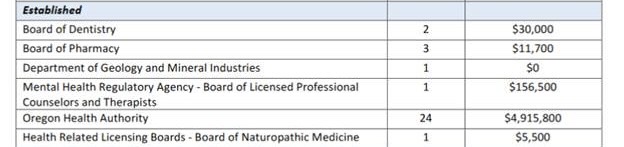
According to the Taxpayer Association of Oregon, Oregon lawmakers passed 185 fee increases (increasing existing fees and establishing new fees) in 2023 that will mean $47 million in higher costs.
Of those, 77 new or increased fees will directly impact the cost of medicine, hospitals and health care, which are all already straining the budgets of Oregonians. Another 47 fee increases will impact Oregon’s agriculture industry and consumers.
A list of 2024 fee increases by agency is below:
And then there are the new fees the 2023 Legislature created:
Portlanders and almost all Oregonians are also going to be paying a new cell phone tax this year. Starting January 1, 2024, a 988 Coordinated Crisis Services Tax will be added to the existing Oregon Emergency Communications (911) Tax. The new tax was implemented by the Oregon Legislature with the passage of House Bill 2757. The $50 million a biennium tax is slated to fund the state’s new 9-8-8 suicide prevention hotline.
DMV fees have gone up, too, touching just about everybody with a vehicle. For example:
Class C driver license or restricted Class C driver license, increased from $54 to $58
Commercial driver license, increased from $75 to $160
Instruction driver permit, increased from $23 to $30
Commercial learner driver permit, increased from $23 to $40
Hardship driver permit application, increased from $50 to $75
Fee for renewal of a commercial driver license, increased from $55 to $98
Fee for knowledge test for a motorcycle endorsement, increased from $5 to $7
Fee for a skills test for any commercial driver license, increased from $70 to $145
And the list of fee increases goes on, nickeling and diming Oregonians.
And of course legislators are busy thinking of new taxes.
For example, because the Oregon Department of Forestry wants more money to fight wildfires, Sen. Elizabeth Steiner, D-Portland, wants to charge every property owner in the state an annual fee to pay for what she perceives as a statewide issue.
And then, of course, there’s always inflation. It has been pushed down by aggressive Federal Reserve action, but in its long-term economic projections from December, the Federal Open Market Committee forecasted core Personal Consumption Expenditures Price Index inflation will drop from 3.2% in 2023 to 2.4% in 2024 and 2.2% in 2025.
But, still, hold on to your wallet. The state is considering tolls on I-205, I-5, U.S. 26 and Highway 217.
Histrionic stories about Prager U, a nonprofit (not a university) which produces and distributes conservative videos and online programming aimed at millions of young people in homes and schools across the country, are commonplace in the media.
“PragerU and its right-wing propaganda machine spreads racist poison,” says Daily Kos.
“…more than a few (of PragerU’s videos ) function as dog whistles to the extreme right ,” says the Southern Poverty Law Center.
Regardless of such reproval, in September 2023 PragerU won state approval to offer online classes to high school students in New Hampshire, in July 2023, the Florida Department of Education approved PragerU materials for use in classrooms as supplemental resources and recently PragerU became a state licensed vendor in Texas. Oklahoma and Montana are also allowing videos from PragerU in classrooms.
Meanwhile, flying under the radar almost unnoticed by media, there’s another outfit pursuing similar outreach efforts, the Lehi, UT-based Libertas Institute.
The Libertarian Institute describes itself as “a 501(c)3 non-profit “think tank” and educational organization” with a “mission to change hearts, minds, and laws to build a freer society…” and an “educational media platform dedicated to promoting pro-American values.”
And now it has set its sights on Oregon.
Founded in 2011, in the policy arena Libertas works on reforming state and local laws in Utah, but it also partners with similar free market-oriented groups and legislators in other states to pursue reforms initiated by Libertas.
Some of its current policy focus areas are affordable housing, legal services, employing ex-offenders, consumer privacy and portable benefits for gig workers.
Reaching outside Utah, Libertas, like PragerU, produces what it considers “educational materials” aimed at children. This includes a variety of print and audio books and YouTube videos, as well as a free-market curriculum that teaches economics to children. To some extent, Libertas is a provocateur in this space.
It also runs a Children’s Entrepreneur Market program “to provide a direct experience for youth to apply their knowledge and experience the benefits of operating a small business”. The program is described as facilitating “A farmers’ market…run entirely by KIDS!”
In December 2023, Libertas appealed for donations so it could expand The Tuttle Twins’ Children’s Entrepreneur Markets into 11 more states, including Oregon.
The Institute supplements all this material with free market-focused books such as “Mediocrity: 40 Ways Government Schools are Failing Today’s Students”.
Libertas also supports homeschooling with its Tuttle Twins Free Market Rules! Curriculum, a comprehensive resource for teaching students about money and economics.
And then there’s the Libertas Institute Hoodie for $27.99. “You’ll become an evangelist for freedom as friends ask you what Libertas is all about — be ready to spread the good word!”, says the Libertas website.
Arguing that there’s a rot inside American culture that needs to be confronted and that liberals have made a squalid mess of things, Libertas asks, “Are your children being brainwashed? …most curriculum is dumbed down and leaves out the essential civic truths that children and adults need to know. That’s why we’ve made it our mission to create books and curriculum materials that teach students the values of a free society — ideas that support your family values.”
The Tuttle Twins books are a core element of Libertas’ proselytizing efforts.Libertas says it has sold 4 million copies of the Tuttle Twins books, endorsed by right-wing radio host Glen Beck, that “help you teach your kids how the world really works…”
The Tuttle Twins Books
Some of the books are available at Oregon libraries. “We had several patron requests for The Tuttle Twins books at our library,” Beka Murcray at the Molalla Public Library told me. “So, we purchased them and they have circulated fairly okay.”
A cartoon on the Tuttle Twins website has a mother wielding a Tuttle Twins shield while protecting her frightened children, absorbing the arrows of socialism, Marxism, collectivism, and media lies.”
In The Tuttle Twins and the Road to Surfdom, the twins “find in their latest adventure, central planning can ruin people’s lives.” In The Tuttle Twins and the Little Pink House, “When a greedy corporation schemes to take over Grandma’s land and push her house into the river, can the twins stop it and come to her rescue?”
According to reports submitted to the IRS, Libertas’ revenue totaled $13,904,104 in 2022 and $14,360,260 in 2021. Of that, $10,841,883 came from “Education Material Sales” in 2022 and $10,638,576 in 2021. “We sell a lot of books and things, but the bulk of the revenue is from our Tuttle Twins books, curricula, and other materials,” Connor Boyak, Libertas’ president, told me in an email. Libertas reported selling1.55 million books in 2021 and 975,000 in 2022.
Some are fulsome in their praise of the books.“The Tuttle Twins is a set of beautiful books that use storytelling to teach about economics, civics, socialism, and entrepreneurship. So basically everything that is NOT taught in public school.” writes Homeschool Curriculum Reviews. “I am learning right along with my kids as we explore how money works, what the free market really is, and what our freedom actually means.”
Others are almost apoplectic in their condemnation of the series. Rob Larson, a professor of economics at Washington’s Tacoma Community College, describes the books in Current Affairs as “…jammed…with pro-market economic vocabulary and stale right-wing life lessons”.
Larson goes on to acidly condemn them as “…among the most wretchedly contrived, grotesquely unethically indoctrinating, cliché-ridden heaps of steaming garbage I’ve ever had the misfortune to read. Written to bring young people into one of the most disgraceful political tendencies in the world before they have the critical thinking skills to recognize it, it is a hideous fraud and an ugly twisted farce.”
Though not yet a broadly recognized brand, Libertas clearly aspires to be one. Having grown its revenue almost ten-fold since its founding and vastly expanded its products and programs, it has simultaneously extended its presence across the country.
Whether you see it as a force for good or malignant propaganda, expect to hear more about this crusading Libertarian outfit in Oregon.









 ThinkingOregon