Post-Election Political Fundraising is Scamming Donors

In politics, the grifting never stops.

Team Scalise (House Majority Leader Steve Scalise’s fundraising committee) just sent me an e-mail citing the importance of Republican efforts to replace recently-resigned Rep. Matt Gaetz with another committed Republican:

                               *** SPECIAL ELECTION FOR MATT GAETZ’S SEAT *** 

It’s official – the special election in Florida’s First Congressional District was just declared and voting starts in January! Every House race is critical but with our Conservative House Majority hanging on by a THREAD, this might be the most important special election of the century. Our Pro-Trump Republican trifecta could be COMPLETELY DESTROYED if Democrats manage to win key races like this.

That’s why we are PLEADING for your help right now. Majority Leader Scalise set a goal of raising one million dollars to help fill Matt Gaetz’s seat with an America First Patriot, win every other special election, AND deliver President Trump’s agenda.

Of course, the message urges me to “DONATE NOW”. Most recipients of the message likely assume any donation they make will go to the campaign to elect a strong Republican to replace Gaetz. Not so.

Work your way through the entireTeam Scalise message and you discover that each individual contribution will be allocated to SCALISE FOR CONGRESS, which shall receive up to $3,300 per election (for a total of $6,600). 

Other politicians are in on the donations scam too.

President-elect Donald Trump has selected Pete Hegseth, a military veteran and Fox News contributor, to lead the Department of Defense. His nomination has generated considerable controversy because he has no managerial experience running a large institution like the Pentagon, has taken conservative positions on a number of hot issues and is enmeshed in an allegation of sexual assault. 

But Rep. Ronny Jackson (R-Texas) is still with him. Jackson just sent me an email:

The WOKE Democrats’ petition to IMPEACH Pete Hegseth has reached MILLIONS OF  SIGNATURES.

If we let Pete Hegseth FALL to the WOKE MOB – they’ll have everything they need to go after President Trump, and eventually YOU.

So, today we’re calling on 3,000,000 PATRIOTS to go on the record and say: 
I STAND WITH PETE HEGSETH.
I STAND WITH PETE HEGSETH

Of course, if you click on “I STAND WITH PETE HEGSETH” you get a plea for a contribution.

Bear with me now. 

The site explains: “Contributions go to Team Ronny (“JFC”), a joint fundraising committee composed of TEXANS FOR RONNY JACKSON (the “Campaign Committee”), TEXAS RED (the “LPAC”), RONNY JACKSON LEGAL EXPENSE TRUST (the “LDF”), and the National Republican Congressional Congressional Campaign Committee (the” NRCC” (each, a “Committee,” and, collectively, the “Committees”).”

But here’s the trick. The first $6,600 of any contributions will go to TEXANS FOR RONNY JACKSON (the “Campaign Committee”), PO Box 53058, Amarillo, TX 79159. 

In other words, Rep. Ronny Jackson has first dibs on any contributions made by people who want to “Stand with Pete Hegseth”. Way to go, Ronny. 

Then there’s this email urging me to rally behind Hegseth:

STAND WITH PETE HEGSETH!

The Radical Left’s petition to DESTROY Pete Hegseth has reached MILLIONS OF SIGNATURES. The Woke Mob will do whatever they can to REMOVE Pete Hegseth as Secretary of Defense from President Trump’s Cabinet. If Pete is gone we can say GOODBYE to America as we know it. An overwhelming and immediate response is needed right here, right now, or we’ll lose Pete Hegseth FOREVER.

Will you stand with Pete Hegseth?

Doing nothing is not an option.

PLEASE SIGN YOUR NAME NOW (and Donate to continue our MAGA Momentum)

The group behind the email urging me to rally behind Hegseth is the GOD, FAMILY, COUNTRY PAC. out of Arlington, Va.  No address. Just a PO box number.

According to Open Secrets, a research and government transparency group tracking money in politics, the PAC (political action committee) raised a total of $5,567 for 2024 campaigns. It spent $4,210. 

But almost all of that spending, $4,194, went toward fundraising costs: $203 to “fundraising fees” and $3,991 to “fundraising consulting.” The fees went to Better Mousetrap Digital, a major digital fundraising company for Republicans, and WinRed Technical Services, a “conduit” that centralizes donations to Republican-affiliated candidates and committees. The recipient of the “fundraising consulting” spending isn’t identified. The money likely went to the people who set up the PAC.

The only human being identified as associated with the PAC is Mr. Jason Young, listed as its Treasurer. But don’t try to reach him if you have any questions. He can’t be found.

Katie Elizabeth Britt, a Republican serving as the junior United States senator from Alabama, is in on the game, too.

As a Senate candidate, Britt publicly aligned herself with former President Donald Trump and gave credence to Trump’s false claims of election fraud in the 2020 presidential election. Trump officially endorsed her, calling her a “fearless America First warrior”. She won the general election in November 2022 and took office in 2023. 

Britt sent me a message urging me to fill out a “MAGA Priority Survey” and, of course, included a plea, “Will you rush support now to show your support to the growing MAGA movement as we head into a critical year ahead?”

In. light, subdued print below the plea her message says, “Your contribution will benefit Britt for Alabama Inc., Trump National Committee JFC, and 1 other.” Click through to the fine print and the first option for the donation is “Britt for Alabama Inc. AL-SEN”. 

I wonder how many more grifters are out there. And how many people have been and continue to be scammed by them.

Trump’s Immigrant Solution: Manzanar Redux?

During World War II, President Roosevelt authorized the military to forcibly relocate people of Japanese ancestry from the West Coast to inland camps. 

Manzanar War Relocation Center near Lone Pine, Calif.; it operated from March 1942 to Nov. 1945. Some 10,000 people were confined there during this time. Resistance to the incarceration at Manzanar soon led to a prison uprising that the Army put down by shooting 11 prisoners, killing two.

In April 1942, officials posted Civil Exclusion Orders No. 25 and No. 26 on telephone poles and store windows throughout Multnomah County. A few weeks later, Civilian Exclusion Order No. 49 was posted in Hood River. The orders gave Japanese-Americans only a few days to put their affairs in order before they had to report for evacuation.

On May 5, 1942, Japanese-Americans in Military Area No. 1 reported to the Portland  Assembly Center, leaving their pets, possessions, and lives behind. The center—built on the site of the Pacific International Livestock Exposition—was surrounded by barbed wire, watchtowers, and military guards armed with machine guns. The center had a peak population of 3,676.

Those living in Military Area No 2, including the Japanese Americans in Hood River, were sent by train to the Pinedale Assembly Center in California’s San Joaquin Valley, a temporary location until later transfer to permanent internment camps. 

Now President-elect Trump and his coterie of illegal immigration hardliners want to use the military again and put arrested immigrants in the country illegally in camps run by the Homeland Security Department. 

Will he follow through with his threats?  Count on it.

“Trump 1.0 was a test for the system, but it was also a trial for an inexperienced leader who had the inclination of a wrecking ball but often lacked the capacity or the cadres to follow through,” Susan B. Glasser wrote in the Nov. 21 New Yorker.  “Trump 2.0 is about an all-out attack on that system by a leader who fears neither Congress nor the courts nor the voters whom he will never have to face again.”

During the Republican primary campaign, The New York Times reported that  Trump’s top immigration policy adviser, Stephen Miller, said military funds would be used to build “vast holding facilities that would function as staging )enters” for immigrants as their cases progressed and they waited to be flown to other countries.

 Earlier this month, Tom Fitton, who runs a conservative group, Judicial Watch, wrote that Trump’s administration would “declare a national emergency and will use military assets” to address illegal immigration “through a mass deportation program.”  Trump responded on his social media platform, Truth Social, reposting Mr. Fitton’s post with the comment, “TRUE!!!”

On Monday, Trump confirmed that he planned to declare a national emergency to carry out his promise to use the military in his mass deportations. 

Trump has also threatened to use the Alien Enemies Act of 1798 – which allows presidents to deport citizens of an “enemy nation” without the typical proceedings – as part of his mass deportation plans. 

Thomas Homan, a contributor to the Heritage Foundation’s controversial Project 25 and Trump’s proposed Border Czar, told Fox Business Network, “They’ll be used to do non-enforcement duties such as transportation, whether it’s on ground or air, infrastructure, building, intelligence.” Horman has also said transportation and supply assets from the Department of Defense, including military planes, could be used.  

Stephen Miller, Trump’s incoming deputy chief of staff for policy, has also floated the idea of “deputising” the National Guard  to carry out large-scale raids and detentions. The military could also be dispatched to the southern border with “an impedance and denial mission,” Miller has said. 

“You reassert the fundamental constitutional principle that you don’t have the right to enter into our sovereign territory, to even request an asylum claim,” Miller said  at the Conservative Political Action Conference  (CPAC) earlier this year. “The military has the right to establish a fortress position on the border to say no one can cross here at all.”

No matter how Trump plans to use the military, the move is likely to bring an avalanche of legal challenges.

Aaron Reichlin-Melnick, a senior fellow at the American Immigration Council, said on Monday that under US law, presidents may declare a national emergency and exert emergency powers only in specific situations. “And ‘use the military for deportations’ isn’t one of those specific things,” Reichlin-Melnick wrote on social media.

Anthony D. Romero, executive director of the American Civil Liberties Union, issued the following statement: on Nov. 18:

“We are crystal clear that the next Trump administration will do everything in its power to make mass deportation raids a reality. As we ready litigation and create firewalls for freedom across blue states, we must also sound the alarm that what’s on the horizon will change the very nature of American life for tens of millions of Americans.”

In 1983, the bipartisan Commission on Wartime Relocation and Internment of Civilians reported that the internment program was a “grave injustice” driven by “race prejudice, war hysteria and a failure of political leadership.” In 1988, President Ronald Reagan signed the Civil Liberties Act, which offered a formal apology to surviving victims.

It’s hard to believe all this current Trump-inspired turmoil is what the 76,744,608 people who voted for Trump this time around wanted.

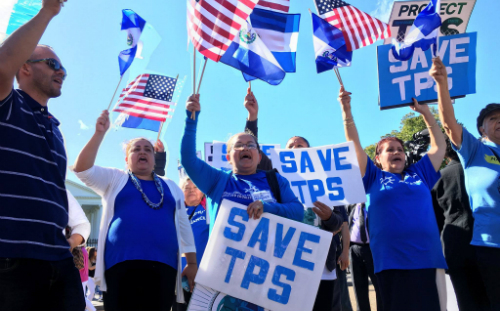
Trump’s Anti-Immigrant Invective Signals Trouble for Those With Temporary Protected Status

Photo: American Friends Service Committee

UPDATE 02/02/2025: The New York Times reported today that the Trump administration has ended Temporary Protected Status, or T.P.S., for more than 300,000 Venezuelans in the United States, leaving the population vulnerable to potential deportation in the coming months, according to government documents obtained by The New York Times. “The Trump administration’s attempt to undo the Biden administration’s T.P.S. extension is plainly illegal,” said Ahilan Arulanantham, who helps lead the Center for Immigration Law and Policy at the U.C.L.A. School of Law. “The T.P.S. statute makes clear that terminations can only occur at the end of an extension; it does not permit do-overs.”

——————————————————-

President-elect Donald Trump has made it crystal clear. 

America’s “immigration crisis” is a “massive invasion” spreading “misery, crime, poverty, disease and destruction to communities all across our land” and the nation’s cities are being “flooded” by the “greatest invasion in history” of undesirables from “every corner of the earth, not just from South America, but from Africa, Asia, Middle East,” Trump bellowed at the Republican National Convention in July 2024.

One action Trump plans to take in response to the “invasion” is to cut back on the Temporary Protected Status (TPS) program. Set up in 1990, the program gave the federal government the ability to grant work permits and deferrals from deportation to nationals of any designated nation going through or recovering from natural or man-made disasters.

If you recall the uproar over unfounded claims that Haitians who live and work legally in Springfield, Ohio, were eating their neighbor’s cats and dogs, those Haitians are TPS holders. In an interview with NewsNation, Trump said the influx of migrants in Springfield “just doesn’t work” and “you have to remove the people; we cannot destroy our country.”

To say the least, the fate of those in Oregon with TPS will be precarious, too, under the upcoming Trump administration.

I asked Oregon’s Office of Immigrant and Refugee Advancement how many people in Oregon are here under the Temporary Protected Status program, but they never responded. But I located a report by the Congressional Research Service (CRS) on the TPS topic. According to the CRS, as of March 31, 2024, there were an estimated 2,705 individuals with TPS in Oregon, fewer than the 9,500 in Washington, but more than the 510 in New Mexico. The current number in many states is likely higher now because the number of TPS individuals in the United States has increased by about 150,000 since March. 

TPS offers qualifying individuals already in the U.S. work authorization and a temporary legal status to remain in the country if their home country is determined unsafe. TPS offers up to 18 months of relief to qualifying individuals based on the status of that country. For example, the TPS program is scheduled to end in March 2025 for El Salvador and in April 2025 for Sudan, Ukraine, and Venezuela. 

TPS designations can be terminated prior to expiration with 60 days notice. TPS status can also be extended by the Department of Homeland Security. For example, on Oct. 17, 2024, the department extended through Aug. 3, 2025, the validity of certain Employment Authorization Documents (EADs) issued to Temporary Protected Status (TPS) beneficiaries under the designation of Haiti.

Since 1990, successive Republican and Democratic administrations have largely automatically renewed certain key TPS designations

The impact of Trump’s plans on current TPS holders could be calamitous. That’s partly because the number of people in the United States under TPS exploded under President Biden.

In 2020, TPS protected about 330,000 people from 10 countries who would otherwise be subjected to disease, violence, starvation, the aftermath of natural disasters, and other life-threatening conditions. The largest group of TPS recipients was from El Salvador (195,000 people) followed by Honduras (57,000 people) and Haiti (50,000 people).

Other countries with TPS holders included Nepal (8,950 people), Syria (7,000 people), Nicaragua (2,550 people), Yemen (1,250 people), Sudan (1,040 people), Somalia (500 people), South Sudan (84 people), Guinea (930 people), and Sierra Leone (1,180 people). 

With President Biden’s term winding down, there are now over 1 million immigrants in the United States under TPS status. Qualifying individuals include people from 16 countries, with Venezuelans, Haitians and Salvadoreans the largest groups of TPS beneficiaries.[1]

Under the Biden administration, new TPS designations have been issued for six countries (Afghanistan, Cameroon, Ethiopia, Myanmar [also known as Burma], Ukraine, and Venezuela), and extended for ten others (El Salvador, Haiti, Honduras, Nepal, Nicaragua, Somalia, South Sudan, Sudan, Syria, and Yemen). The government has also granted or extended a similar protection, deferred enforced departure (DED), for people from Hong Kong and Liberia, with an estimated 3,900 and 2,800 covered respectively.

If a TPS designation ends, beneficiaries return to the immigration status that the person held prior to receiving TPS, unless that status has expired or the person has successfully acquired a new immigration status.

 If the Trump administration is aggressive in ending the TPS program, its beneficiaries in Oregon and elsewhere would return to being undocumented at the end of a TPS designation and become subject to removal. 

“It’s possible that some people in his administration will recognize that stripping employment authorization for more than a million people, many of whom have lived in this country for decades, is not good policy” and economically disastrous, Attorney Ahilan T. Arulanantham, a teacher at the University of California, Los Angeles School of Law, recently told PBS News. “But nothing in Trump’s history suggests that they would care about such considerations.”


[1] Countries Currently Designated for TPS. Select the country link for additional specific country information.

Oregon State Bar Refuses To Prohibit Deceit and Misrepresentation By Its Members

So much for expecting lawyers to be truthful and regulate their own.

The Oregon State Bar’s General Counsel has decided that its member lawyers are not engaged in unethical conduct when they assert to clients that their selection as “Lawyers of Distinction” by a Florida-based business is reliable evidence of their legal skills and achievements, despite the fact that “Lawyers of Distinction” is nothing more than a pay-for-play outfit with just a virtual office.

Apply, pay the annual membership fee and you’re in. It’s like a diploma mill, an outfit that claims to be a higher education institution, but only provides illegitimate academic degrees and diplomas for a fee.

The OSB’s decision to allow its members to mislead clients is an egregious display of malfeasance. It’s straightforward dishonesty, deceit and misrepresentation, prohibited in the Oregon Rules of Professional Conduct (as amended effective January 1, 2024) for Oregon attorneys.

On Oct. 9, 2023, I filed a complaint with the OSB asserting that a number of Oregon lawyers are misrepresenting their credentials by asserting that their selection as “Lawyers of Distinction” is evidence of their legal skills and achievements. On Feb. 17, 2024, I filed a second, more detailed complaint and followed up with an email asking whether the association intended to respond.

On May 20, 2024, Linn Davis, Assistant General Counsel and CAO Attorney, sent a response saying he found no reason to pursue any charges of professional misconduct by Oregon lawyers.

 “You expressed concerns that Oregon lawyers are improperly using membership in “Lawyers of Distinction” to advertise their services,” he wrote in an email. “Lawyers of Distinction” appears to be a marketing firm that uses some criteria to determine what lawyers are eligible for promotion. Listings on the “Lawyers of Distinction” site include a statement regarding the criteria for promotion and a link to apply for consideration. I lack any sufficient basis for believing the statements there to be false regarding the organization or the significance of membership. I also lack evidence that any particular lawyer in Oregon has utilized this marketing tool in a misleading manner. I conclude that there is no sufficient basis to warrant a referral of your concerns to Disciplinary Counsel. Because I find no sufficient evidence of professional misconduct, I will take no further action on this matter.”

WHAT?

Davis couldn’t find any information that challenges the legitimacy of Lawyers of Distinction? 

And OSB’s General Counsel, agrees with Davis, as Nik Chourey, Deputy General Counsel, said in an email to me: “ In this instance, I do not find sufficient evidence of ethical misconduct to warrant further investigation by disciplinary counsel.  Further, I agree with the reasoning set forth in the Client Assistance Office’s letter dismissing this complaint.” 

Give me a break! Where did these folks go to law school?

The Lawyers of Distinction website says :

“…Members have been selected based upon a review and vetting process by our Selection Committee utilizing U.S. Provisional Patent # 62/743,254. The platform qenerates a numerical score of 1 to 5 for each of the 12 enumerated factors which are meant to recognize the applicant’s achievements and peer recognition. Members are then subject to a final review for ethical violations within the past ten years before confirmation of Membership. Nomination does not guarantee membership and attorneys may not pay a fee to be nominated. Attorneys may nominate their peers whom they feel warrant consideration. The determination of whether an attorney qualifies for Membership is based upon the aforementioned proprietary analysis discussed above.”

Phew! Sounds complex and rigorous. 

Don’t believe it.

It’s a scam.

Want evidence?

Some lawyers at the Davis Law Group in Seattle nominated Lucy, the office’s 5-pound teacup poodle, and paid the membership fee. Lucy didn’t go to law school, but she passed her state ‘bark exam” the law firm said, had been recognized by the legal community as a ‘top dog’ and was a member of the King County Bark Association.

Lucy, A Lawyer of Distinction

Lucy, recipient of a “Juris Dogtor”, was accepted. Lawyers of Distinction even sent Lucy a plaque naming her one of the top 10 percent of attorneys in the country and congratulated her on Twitter. Suffice it to say, Lucy was thrilled. 

As for OSB’s assertion that it lacked evidence that any particular lawyer in Oregon has utilized this marketing tool in a misleading manner, are they blind? Do they not know how to search websites? 

 All OSB needed to do was check out the Lawyers of Distinction’s website and the websites of Oregon lawyers who are members.

For example:  Casey Baxter, the founder of Baxter Law, LLC in Bend, lists “Lawyers of Distinction Award” under HONORS & AWARDS on his website; Portland DUI lawyer Andy Green features the Lawyers of Distinction logo on his website; Tammi Caress, the Principal Owner of Caress Law, PC in Portland, has the logo on her firm’s website, too. .

The Oregon Rules of Professional Conduct (as amended effective January 1, 2024) for Oregon attorneys is explicit about how attorneys must communicate about themselves:

Rule 7.1 A lawyer shall not make a false or misleading communication about the lawyer or the lawyer’s services. A communication is false or misleading if it contains a material representation of fact or law, or omits a fact necessary to make a statement considered as a whole not materially misleading. 

Rule 8.4 It is professional misconduct for a lawyer to…engage in conduct involving dishonesty, fraud, deceit or misrepresentation that reflects adversely on the lawyer’s fitness to practice law. 

An Oregon attorney claiming he or she is a exceptional because of membership in “Lawyers of Distinction” is clearly making “a false or misleading communication” and engaging in “professional misconduct” involving “dishonesty” “deceit” and “misrepresentation”.

According to the Florida Division of Corporations, “Lawyers of Distinction Inc.” is a private for-profit company with a principal address of 4700 Millenia Boulevard, Suite 175, Orlando, FL 32839. Securing such an office requires a payment for  a “Platinum Plan” of $69 a month and for a “Platinum Plan with live receptionist” of $194 a month. 

Robert B. Baker, at the same address, is listed as the Owner in the company’s 2023 Annual Report. 

But don’t go visit the office address expecting to be ushered into a space with a clean, modern aesthetic that communicates success. The address is only a virtual office you can buy on a “Platinum Plan” for $69 a month or on a “Platinum Plan with live receptionist” for $194 a month. 

Robert “Robbie” Brian Baker, a member of the Florida Bar (Bar #992460), is also the founder and owner of Baker Legal Team at 2255 Glades Rd., Ste 330-W, Boca Raton, FL 33431. According to the Baker Legal Team website, he has a degree from Boston University School of Law in 1989 and a B.A. from Ithaca College.  He began his career, the website says, as a prosecutor working as an Assistant District Attorney in Kings County, New York. 

As an aside, the firm’s website has the chutzpah to highlight that it’s a member of Lawyers of Distinction. 

If the OSB is honestly committed to accountability, excellence, fairness, and leadership in the legal profession as it claims, it needs to stop trying to dodge its obligations. It needs to insist that its members halt falsely advertising themselves as Lawyers of Distinction or holders of other unearned accolades. 

Portland City Council Voters: Do You Know What You Did?

All you Portland voters. Remember how you voted 58.1% to 41.9% on Measure 26-228 to switch to a ranked choice voting (RCV) system for the Portland City Council?

“In the end, we saw monumental wins that will change the landscape of our local democracy and advance opportunity for communities of color,” enthused the Coalition of Communities of Color after the vote.

“Portlanders made history by demanding a government that is effective, accountable and representative,” said Debra Porta, co-chair of the Charter Commission, which initially recommended voters consider the sweeping changes .

“The passage of Measure 26-228 is an historic step towards a democracy that truly gives all Portlanders a seat at the decision making table and a government that meets their basic needs,” said Sol Mora of the group Portland United for Change, which advocated for the measure. “This victory was powered by the people for the people.”

Well, supporters got what they wanted. But while Measure 26-228 required mote than 50% yes votes in Portland to pass, the 12 new city councilors elected under the the quirky new system didn’t need 50% to win in the 4 new districts.

This is how the RCV reform proposal described the system: 

 “If no candidate receives a majority of the vote in the initial round, subsequent rounds are counted in which (i) candidates retain the number of votes counted for them in the first and any subsequent rounds that already occurred; and (ii) the candidates having the fewest votes are successively eliminated in rounds and their votes are counted as votes for the candidates who are ranked next on the ballots that had been counted for the eliminated candidates. The process of eliminating candidates and transferring their votes to the next-ranked candidate on ballots repeats until a candidate has a majority of the vote.”

The Councilors of each district were elected using a proportional method of RCV known as “single transferable vote” (STV). In this system, voters rank the candidates and if a candidate gets more votes than needed to be elected the extra, or surplus, votes get transferred to the voter’s next choices. The charter reform proposal was so convoluted it took almost 300 words to explain how it would work (See below for complete text).

Under this system, a candidate running for a seat in a multimember district could win a position on the Council with as little as 25% of the vote, or maybe even less.

And that’s exactly what happened.

Eleven of the twelve Councilors were elected with 25% of the vote in their district. One newly-elected Councilor, Jamie Dunphy in East Portland’s District 1, was even elected with just 22.8% of the vote.

District 1’s three final winners were Candace Avalos, Loretta Smith and Dunphy. In the 1st round, Avalos was the first choice of just 19.4% of the vote, Smith was the first choice of 13.1% and Dunphy was the first choice of 11.9%.

One consequence of all this is that the newly elected Councilors may be able to remain in office by consistently satisfying just that small segment of eligible voters and ignoring those who are disenchanted with their performance because it would require 75% of voters to vote against the entrenched councilor to remove him or her.

As Tim Nesbit, a former chief of staff to former Democratic Governor Ted Kulongoski and a critic of the ballot measure before its passage, wrote in the Portland Tribune, “This will be a ‘welcome to the Hotel California’ for candidates who seek office in the first council election to follow. It will be easy to check in to the council, but much harder to be forced to leave.”

Charter reform’s explanation of how “single transferable vote” (STV) would work: 

“Councilors of each district are elected using a proportional method of ranked choice voting known as single transferable vote. This method provides for the candidates to be elected on the basis of a threshold. The threshold is determined by the number of seats to be filled plus one, so that the threshold is the lowest number of votes a candidate must receive to win a seat such that no more candidates can win election than there are seats to be filled. In the initial round, the number of first rankings received by each candidate is the candidate’s vote count. Candidates whose vote counts are at least the threshold are declared elected. Votes that counted for elected candidates in excess of the threshold are called surplus. If fewer candidates are elected in the initial round than there are seats to be filled, the surplus percentage of all votes for the candidates who received a surplus are transferred to the next-highest ranked candidates in proportion to the total numbers of next-highest rankings they received on the ballots that counted for the elected candidate. If, after all surpluses have been counted in a round, no additional candidates have a vote count that is at least the threshold, the candidates with the lowest vote counts are successively eliminated in rounds and their votes are counted as votes for the candidates who are ranked next highest on the ballots that had been counted for the eliminated candidates, until another candidate has a vote count that is at least the threshold or until the number of candidates remaining equals the number of seats that have not yet been filled. The process of transferring surpluses of elected candidates and eliminating candidates continues until all positions are elected.”

On the Cusp of Chaos: Trump’s Deportation Purge

The American people have given Donald Trump ultimate power,” says Paul Glastris, editor in chief of the Washington Monthly, “They’re going to get the Trump agenda, good and hard.”

America’s “immigration crisis” is a “massive invasion” spreading “misery, crime, poverty, disease and destruction to communities all across our land” and the nation’s cities are being “flooded” by the “greatest invasion in history” of undesirables from “every corner of the earth, not just from South America, but from Africa, Asia, Middle East,” Donald Trump bellowed at the Republican National Convention in July 2024. “They’re coming from prisons. They’re coming from jails. They’re coming from mental institutions and insane asylums. We have to stop the invasion into our country that’s killing hundreds of thousands of people a year.”

Did you miss Trump describing migrants as “vermin” who would “poison the blood of the country”? How about when he said in 2023 that some South American countries were deliberately emptying their “insane asylums” and “mental institutions” to send the patients to the United States as migrants.

You likely didn’t miss Trump’s solution? “Carry out the largest deportation operation in American history” the Republican platform said in “one of a series of bold promises that we will swiftly implement” Trump promised.  Huddled masses, yearning to breathe free? Not in Trump country. Deport ’em all.

Easier said than done.

First, let’s talk about numbers.

In 2021, when Joe Biden took office, the figures thrown around for the number of undocumented/illegal/unauthorized/ (whatever word you choose) immigrants in the United States varied by a million or so. The Migration Policy Institute (MPI) put the number at 11.2 million. The Center for Migration Studies said there were approximately 10.3 million.

Curiously, much of the media coverage of the immigration situation today continues to use the 11 million figure, despite the upsurge in border crossings. That may be a sign of lazy reporting, purposefully misleading numbers for ideological reasons, different collections methods or confusion over how to count migrants.

Trump’s numbers have been all over the map. In March 2024, he said 15 million migrants had crossed into the United States border over just the past two years. In August, he said 10 million had come across the border since Biden took office. In later election rallies, he cited a 20 million crossings figure during Biden’s tenure as president. .And in his one televised debate with Kamala Harris he claimed 21 million migrants were crossing the border every single month.

One number often used to track migrants is “encounters” with migrants, including people who tried to cross into the US illegally and people who tried to enter legally but were deemed inadmissible.  According to the Border Patrol, since Biden became president in January 2021, there have been more than 10 million encounters, about 8 million of those at the southwest land border with Mexico, up from 2.4 million encounters during the Trump administration. The number is not, however, a reliable count of people who stay in the US. Some are sent back and some are counted multiple times from multiple attempts to cross the border. The encounters number also, obviously, do not count those who manage to slip across the border and escape undetected.

Compounding the numbers problem, the Wall Street Journal reports that Trump wants to “revoke deportation protections from millions of immigrants, including tens of thousands of Afghans evacuated after the fall of Kabul and hundreds of thousands of Ukrainians allowed in after the Russian invasion.”

Whatever the accurate number, it’s one hell of a lot of people, about equal to the entire population of Georgia.

How exactly does Trump plan to deport them all?

Is he going to demand that the military, the FBI, the Border Patrol, local police, the whole shebang of law enforcement, round them up and put them in detention centers?

On Nov. 18, The New York Times reported Trump had confirmed that he intended to declare a national emergency and use the U.S. military in some form to assist in his plans for mass deportations of undocumented immigrants.

The Times said Trump used his social media platform, Truth Social, to respond to a post made earlier in November by Tom Fitton, who runs the conservative group Judicial Watch, and who wrote that Mr. Trump’s administration would “declare a national emergency and will use military assets” to address illegal immigration “through a mass deportation program.” At around 4 a.m. on the 18th, Mr. Trump reposted Mr. Fitton’s post with the comment, “TRUE!!!”

Trump’s top immigration policy adviser, Stephen Miller, told the Times earlier in 2024 said that military funds would be used to build “vast holding facilities that would function as staging centers” for immigrants as their cases progressed and they waited to be flown to other countries. The Homeland Security Department would run the facilities, Miller said.

Is he going to commandeer railroad lines, planes and riverboats to ferry them to the Mexican border?

How’s Trump going to pay for this massive deportation program? The American Immigration Council, an admittedly pro- immigrant group, says the cost of deporting 13 million immigrants in the U.S. illegally could cost $968 billion over a little more than a decade.

Then there are the courts. Do Trump’ and his henchmen expect the American Civil Liberties Union and immigrant advocacy groups to forego court battles if Trump again tests the bounds of his legal authority. The ACLU’s website already promises, “Starting on day one, we’re ready to fight for our civil liberties and civil rights in the courts, in Congress, and in our communities. We did it during his first term – filing 434 legal actions against Trump while he was in office – and we’ll do it again.”

Of course, no matter what Trump wants to do, not all countries will be willing to accept the return of their citizens. Trump faced that problem in his first term.

In a 2016 speech in Phoenix, Trump said, “There are at least 23 countries that refuse to take their people back after they’ve been ordered to leave the United States, including large numbers of violent criminals. They won’t take them back. So we say, ‘Okay, we’ll keep them.’ “Not going to happen with me, not going to happen with me.”

Not so fast, Mr. Trump. U.S. Immigration and Customs Enforcement (ICE) defines any country that fails to cooperate with the U.S. immigration removal process as “recalcitrant”. According to ICE, “Uncooperative countries significantly exacerbate the challenges presented to ICE by the U.S. Supreme Court’s decision in Zadvydas v. Davis, 533 U.S. 678 (2001). In this case, the Supreme Court ruled that: With narrow exceptions, noncitizens with final orders of removal — including noncitizens determined to pose threats to the community or considered flight risks — may not be detained by ICE beyond a presumptively reasonable period of six months if there is no “significant likelihood of removal in the reasonably foreseeable future”.

The Trump administration may also encounter enforcement resistance from so-called “sanctuary” jurisdictions across the country, which include: Alameda, Berkeley, Fremont, Los Angeles, Oakland, San Francisco (county and city), San Mateo County, Santa Ana, Santa Clara County, and Watsonville in California; Boulder and Denver in Colorado; King County, Seattle, and Walla Walla County in Washington; Portland in Oregon; and even Washington, D.C. The Los Angeles City Council has already voted to prohibit city resources from being used for federal immigration enforcement.

“Americans are being squeezed out of the labor force and their jobs are taken,” Trump said at the Republican Convention. “By the way, you know who’s taking the jobs, the jobs that are created? One hundred and seven percent of those jobs are taken by illegal aliens.” But not all employers will likely be cooperative in immigrant sweeps. The Pew Research Center estimated that unauthorized immigrants represented about 4.8% of the U.S. workforce in 2022.  About two-thirds of U.S. crop-farm workers are foreign-born, for example, and 42% aren’t legally authorized to work in the country,  About two-thirds of U.S. crop-farm workers are foreign-born, and 42% aren’t legally authorized to work in the country, according to a Labor Department report.

“Implementing Trump’s (deportation) plan would be a logistical nightmare and social tragedy, with consequences reverberating beyond the deportees and into the lives of over 20 million people living in mixed-status households, including 5.5 million U.S.-born children suddenly missing one or both parents,” the Center asserts.

Then, no matter how individuals voted, there’s the question of how Americans across the board are going to respond to Trump’s draconian deportation program once it hits their neighborhood. I expect there will be a backlash. I couldn’t put it better than Yascha Benjamin Mounk, Associate Professor of the Practice of International Affairs at Johns Hopkins University’s School of Advanced International Studies. In a post-election podcast conversation with American political scientist Francis Fukuyama, Mounk said:

“When you have very lax policies and high levels of illegal immigration, people say, “clamp down, we want to close the border,” and the moment you start doing the things you actually need to do to clamp down, they start to say, “well, hang on a second, I didn’t want this kid to die. I didn’t want those kids to be separated from their parents. I didn’t want this particular member of the community, who’s been here for 25 years and who seems like a very good and reasonable person, to suddenly be taken and sent back to where they came from.” And so I think even on that issue, which was a winning issue of Trump’s and which he clearly has a popular mandate…he may quite quickly lose public support, nevertheless.”

Well put.