Like a Bad Penny, Former Portland Businessman Andrew Wiederhorn is Back in the News

Andrew Wiederhorn

Like a bad penny, Andrew Wiederhorn just keeps coming back. 

Wiederhorn, once a high-flying business star in Portland, ended up in federal prison for 14 months after being convicted of paying an illegal gratuity to a co-conspirator and filing a false tax return. 

After prison, Wiederhorn moved to Southern California and became the CEO of a publicly traded company, FAT Brands, Inc, that runs the hamburger chain Fatburger.

In May 2024, he re-emerged in the news when the federal government accused him of taking millions of dollars in bogus loans from companies he controlled — loans which were later forgiven. Over 11 years, the government said, Wiederhorn took bogus loans totaling $47 million for his personal benefit. That income, the government said, should have been reported to the IRS. The government argued he should have paid taxes on the money because it was income. 

Now he may have found a savior. The New York Times reported on Sunday, March 30, that on Friday, March 28, Adam Schleifer, a federal prosecutor working on Weiderhorn’s case, was sitting at his computer in Los Angeles when he received an email from a White House official, Saurabh Sharma, saying that he had been terminated. No reason was cited. 

“Given that the case has drawn headlines recently and that Mr. Wiederhorn has donated to political action committees supporting Mr. Trump, his colleagues suspected that may have played a role in his dismissal,” the New York Times reported. 

UPDATE – New York Times, July 29, 2025

The Justice Department moved Tuesday to end two high-profile criminal cases in Los Angeles whose handling by the Trump administration had been criticized by veteran prosecutors as alarming.

The moves by the leader of U.S. Attorney’s Office for the Central District of California, Bill Essayli, came on the same day the administration said it would use a legally untested maneuver to ensure that Mr. Essayli remains in charge of the office beyond his interim appointment, which was set to expire Wednesday.

Mr. Essayli filed court papers asking a judge to dismiss pending criminal charges against Andrew Wiederhorn, the founder of Fatburger, who was fighting accusations of wire fraud and other crimes related to the company. While it is ultimately a judge’s decision whether to dismiss charges, a prosecutor’s request to do so makes it nearly impossible for the case to proceed to trial.

The move to end the Wiederhorn case comes months after White House officials fired the prosecutor in charge of it, Adam Schleifer, whom the right-wing influencer and close Trump ally Laura Loomer had publicly attacked on social media.

Mr. Schleifer’s dismissal unnerved Justice Department veterans, who could not recall any similar instance in which a White House staff member directly dismissed a lower-level career prosecutor. Along with Mr. Schleifer, the White House used the same method to fire a career prosecutor in Memphis.

How Effective Are Oregon’s Members of Congress?

Oregon’s new Democratic Congresswoman is learning quickly how to play the game.

On March 24, 2025, Democratic Rep. Janelle Bynum and two other House members, Reps. Cleo Fields (D-LA) and Sam Liccardo (D-CA), introduced a bill, H.R. 2287. The bill would require the Federal Reserve to study the impact of certain U.S. tariffs on the cost of goods and services in the United States. 

“Every day I hear from my constituents that they’re struggling to afford groceries, rent, healthcare, and other necessities,” Bynum said in a press release. “Lowering costs has always been priority number one for me.”

Liccardo assailed Trump’s controversial tariffs “misguided economic measures” and said the study would allow Congress to advance “common-sense legislation that would provide much-needed relief to hard-working Americans.”

Of course, Bynum’s full-throated plea for a study on an issue of concern to her constituents got media coverage in Oregon – and that was the point. In fact, that was likely the whole point.

When I was a reporter at The Oregonian years ago, after serving on the staff of a House of Representatives subcommittee, I argued against giving a lot of coverage to bills when they were initially proposed by Oregon members of Congress. Far too often, they were just messaging bills, attempts to get publicity on a topic of interest to Oregonians, not serious legislative proposals with a high potential for enactment. 

After all, any member can go to legislative counsel and get a bill drafted. And a lot do. In the 118th Congress (2023-25), 10,564 bills were introduced in the House and 5,649 in the Senate. In contrast, the 118th Congress, which began on January 3, 2023, and ended on January 3, 2025, enacted just 274 public laws. 

What really matters is whether a bill gets a committee or subcommittee hearing and moves through the legislative process or key elements of the bill are incorporated in other legislation that does the same and become law. 

Truly effective lawmakers go beyond press releases.

The Center for Effective Lawmaking (CEL), a joint program of the University of Virginia and Vanderbilt University, does deep dives into the work of every member of Congress and develops Legislative Effectiveness Scores based on a combination of fifteen metrics capturing the bills that each member of Congress sponsors, how far they move through the lawmaking process, and how substantial their policy proposals are.

The Center’s newest report on the Legislative Effectiveness of the 118th Congress (2023-25) was just released. 

Getting a little wonky, the Center provides a comprehensive explanation of its methodology.

For example, a Legislative Effectiveness Score for each member of the U.S. House and Senate captures the proven ability of a legislator to advance his or her agenda items through the legislative process and into law.

In the House, for example, the Center begins by identifying the number of bills that each member of the House of Representatives sponsored and the number of those bills that received any action in committee or action beyond committee on the floor of the House. The Center than categorized all bills as being commemorative, substantive or substantive and significant. A commemorative bill, for example, satisfied any one of several criteria, such as providing for a renaming, commemoration, private relief of an individual, and the like. 

For those bills that received any action beyond committee, the Center identified how many of those bills subsequently passed the House and how many became law. Members also get credit if a substantial portion of the language in their sponsored bills is incorporated into other legislators’ bills that become law. 

None of Oregon’s Representatives made the Center’s top 10 list of lawmakers in the 118thCongress (2023-25). 

Democratic Senator Jeff Merkley, however, came in 5th in the Center’s top 10 list of Senate Democratic lawmakers in the118th Congress. Merkley chaired the Interior, Environment, and Related Agencies Subcommittee of the Appropriations Committee, as well as chairing the Chemical Safety, Waste Management, Environmental Justice, and Regulatory Oversight Subcommittee of the Environment and Public Works Committee. He successfully advanced two sponsored bills into law: the Stop Institutional Child Abuse Act, and the Promoting a Resolution to the Tibet-China Dispute Act.

The Center also highlighted 12 High-Performing Freshmen who scored in the “Exceeds Expectations” category in their first terms in office. Notably, two of them were from Oregon, Republican Rep. Lori Chavez-DeRemer (6th) and Democrat Rep. Val Hoyle (9th). Hoyle was re-elected in November to represent Oregon’s 4th District. Chavez-DeRemer was defeated in her race, but was subsequently appointed Secretary of Labor by President Trump. 

Every member on this High Performing list had at least one of their sponsored bills become law or at least had the language from one of their sponsored bills substantially incorporated into another measure that ultimately became law.

“Given that…research suggests that performance in a legislator’s freshman term is highly correlated with subsequent lawmaking effectiveness, as well as with their overall career trajectory, we might expect to see these Representatives continuing to be effective lawmakers and setting the agendas of the Democratic and Republican parties in the future,” the Center’s report noted. 

So don’t take a slew of bills introduced by a member of Congress as an assurance of their impact. For a real understanding of legislative effectiveness, you have to dig a lot deeper.

The Hegseth Follies: Lies, Insults and Obfuscations

In early March, the Pentagon sent an advisory to all military personnel warning that a “vulnerability” had been identified in the commercial messaging app Signal and warned against using it for classified information., according to the New York Times.

Ignoring that caution, when senior members of President Trump’s administration discussed upcoming military strikes in Yemen on Signal, they unknowingly included the editor in chief of The Atlantic Jeffrey Goldberg, who disclosed the error and the contents of the communications.

“Rather than admit their mistake, apologize, and make sure not to do it again, administration officials are spinning hard and smearing Goldberg,” the Free Press observed today. “The White House has chosen to deflect attention from the substance of the leak and, instead, viciously attack Goldberg and the Atlantic.”

The most noticeable aspect of the comments by President Trump and his administration is the unusual coarsening of political debate. Heated political rhetoric is at every turn. American politics has never been a like pot luck dinner of neighbors, but neither has it always been today’s dumpster fire of venomous insults , caustic personal attacks, and threatening behavior (online and offline).

To say we are seeing an appalling decline of political eloquence is likely not an original thought and perhaps civility in today’s fractured country is a forlorn hope, but surely we can do better than the remarks below in our political discourse. 

Comments by President Trump

The Atlantic is “a failing Radical Left Magazine”.

“I happen to know the guy  (Goldberg) is a total sleazebag” and “a slimeball reporter”. 

“The Atlantic is a failed magazine, does very, very poorly. Nobody gives a damn about it.”

 “I’m not a big fan of The Atlantic. To me, it’s a magazine that’s going out of business.”

 “He’s (Goldberg) made up a lot of stories and I think he’s basically bad for the country.”

Comments by Press Secretary Karoline Leavitt

“The Atlantic has conceded: these were NOT ‘war plans. This entire story was another hoax written by a Trump-hater who is well-known for his sensationalist spin.”

“This administration is working hard on behalf of the American public every day, but the mainstream media continues to be focused on a sensationalized story from the failing Atlantic magazine.”

“If this story proves anything, it proves that Democrats and their propagandists in the mainstream media know how to fabricate, orchestrate, and disseminate a misinformation campaign quite well. And there’s arguably no one in the media who loves manufacturing and pushing hoaxes more than Jeffrey Goldberg.”

“We are not going to be lectured about national security and American troops by Democrats and the mainstream media.” 

Comments by Secretary of Defense Pete Hegseth

“So you are talking about a deceitful and highly discredited so-called journalist (Goldberg) who has made a profession of peddling hoaxes. Time and time again. This is a guy that peddles in garbage.” 

“As I type this, my team and I are traveling the INDOPACOM (the Asia Pacific) region, meeting w/ Commanders (the guys who make REAL ‘war plans’) and talking to troops. We will continue to do our job, while the media does what it does best: peddle hoaxes.” 

Comments by Steven Cheung, White House communications director

“The Atlantic story is nothing more than a section of the NatSec establishment community running the same, tired gameplay from years past.” 

“At every turn anti-Trump forces have tried to weaponize innocuous actions and turn them into faux outrage that Fake News outlets can use to peddle misinformation. Don’t let enemies of America get away with these lies.”

Comment by National Security Adviser Mike Waltz 

Mr. Goldberg is “scum”.

Pay Striking Workers Unemployment Benefits? No Way!

People gathered together for strike

We don’t have enough money for this, we don’t have enough money for that, Oregon legislators moan. And then the Oregon Senate votes for SB 916, a bill to pay striking workers unemployment benefits.

The Oregon Employment Department projects the bill could add $11.2 million in payments to striking workers. The Legislative Revenue Office predicts it could cost $5.6 million in the next two biennia, based on striking activities between 2015 and 2024.

SB 916 would make Oregon the only State in the country to grant unemployment benefits to striking public and private sector workers. Oregonians can be proud of some of the state’s groundbreaking legislation, but this is not one to be praised. 

 Russell Lum, a Political Organizer with the Oregon Nurses Association, said in written testimony to the Senate Committee on Labor and Business, “SB 916 … can bring about fair contracts faster”, but that is unlikely. 

I bet it will cost a lot more as public and private worker unions extend their strikes, safe in the knowledge they will get compensation during their strike.  As Terry Hopkins, the President & CEO of the Grants Pass & Josephine County Chamber of Commerce, said in written testimony to the Senate Committee on Labor and Business, ”By providing UI benefits during strikes, SB 916 could inadvertently incentivize prolonged labor disputes, as the financial pressure to reach a resolution is alleviated for striking workers. This potential for extended disputes not only disrupts the operations of the directly involved businesses but also has ripple effects throughout the supply chain, impacting small businesses that are indirectly connected.”

What makes Democrats’ strong support for this bill particularly egregious is that it is aimed at benefiting unions, an extremely small portion of the labor force, but a sector that overwhelmingly favors the Democrats in campaign contributions.

In 2024, just 15.9% of wage and salary workers in Oregon were union members, according to the Bureau of Labor Statistics. Dig deeper and you find that the union membership rate for public sector workers in Oregon, about 51%, is considerably higher. That is consistent across the country, where unionization is about five times higher nationwide in the public sector compared with the private sector.

The bill has now gone to the Oregon House, where Democrats hold a 36-24 majority. Two Democrats in the Senate showed great wisdom in voting against the bill, Jeff Golden, D-Ashland and Janeen Sollman, D-Hillsboro. “Counties, cities and schools are scrambling to just maintain current services,” Sollman said. “Now is not the time to be adding more uncertainty and more expenses.”

Amen.

Trump is Putting Radio Free Europe Journalists in Harm’s Way

Donald Trump loathes the media. 

Shortly after assuming the presidency in January 2017, he accused the press of being an “enemy of the American people”. He hasn’t held back from continuing his war on the press in succeeding years. 

As an American citizen, and a former journalist at Oregon’s leading newspaper, The Oregonian, I wince every time Trump levels another unseemly attack on the media. 

Now, his decision to withdraw funding from Radio Free Europe/Radio Liberty (RFE/RL), a move endorsed by his sidekick Elon Musk, who has described the media group as “just radical left crazy people talking to themselves,” is angering me even more because it is putting journalists’ lives in danger.

In a sudden, but not out-of-character, slash-and-burn move, the Trump administration sent out an email to employees at Voice of America (VOA) on March 15, 2025 putting them on paid administrative leave “until otherwise notified” and instructing them not to enter the VOA offices or access its internal systems. Radio Free Asia, also funded by the US, has lost its funding as well.

The moves have left exiled Russian journalists working for RFE/RL “high and dry” and at risk of being stranded overseas without any legal status. “If it can’t find funding soon, the company won’t be able to pay its staff and the consequence would potentially put a very large number of journalists who are exiled from authoritarian regimes at grave risk,” a source told The Guardian.

“Many of RFE/RL’s Russian journalists operate from Prague, Riga and Vilnius, with their work visas often tied to their employment,” the Guardian is reporting. “Terminating the broadcaster’s funding would trigger visa expirations, leaving them without legal status within months. Deportation to Russia for any of them would expose them to criminal prosecution. “

According to the Guardian, RFE/RL journalists are regarded as “foreign agents”, making them the target for arrest should they return to Russia.

RFE/RI is suing the Trump administration in an effort to reverse the cancellation of its funding, but its success is uncertain. 

In the meantime, if any of the RFE/RI’s journalists suffer harm because of Trump’s actions, the blood will be on his hands. 

Oregon’s “Illegals Industry”

You may have already heard of the term “homeless industrial complex” . It’s usually a derogatory term referring to a network of organizations involved in addressing homelessness that actually perpetuate it due to the jobs and financial incentives involved in the effort.  While multiple outreach entities rake in millions, the steady supply of people living on the streets persists and even grows.

It’s not so much a nefarious conspiracy as blind ideology, argues an article in CityWatch, an opinion, and news website out of Los Angeles, where homelessness has grown as spending on it has accelerated. 

In the same vein, it looks like many of the efforts in Oregon to help immigrants in the US illegally have spurred the creation of an “Illegals Industry” that, while claiming to be positively managing a problem is spurring it. And in the process, just as with homelessness, government is lighting our money on fire. 

As scholar Clay Shirky says, “An organization that commits to helping society manage a problem also commits itself to the preservation of that same problem, as its institutional existence hinges on society’s continued need for its management”. That’s the Shirky Principle at work: “Institutions will try to preserve the problem to which they are the solution.” 

The current debate in the Oregon legislature over a Food For All Oregonians program proposed by  SB 611  illustrates the the problem Illegals Industrial Complex. The program proposes providing nutrition assistance to residents of Oregon who are under 26 years of age or 55 years of age or older and who would qualify for federal Supplemental Nutrition Assistance Program benefits but for their immigration status. In other words, it would extend to people in the United States illegally food benefits equivalent to those provided under the federal Supplemental Nutrition Assistance Program (SNAP) program. 

Written testimony supporting SB 611 submitted by the Oregon Food Bank to the Senate Committee on Human Services noted that the bill is supported by a coalition of more than 165 Oregon organizations.[1]

The endorsers include churches, unions, groceries, educational institutions, refugee organizations, anti-poverty groups, Planned Parenthood, health services, foster care programs, ethnic interest groups, immigrant aid groups, homeless advocates, farmers markets and a host of other social service groups. 

“Immigration status shouldn’t exclude anyone from being able to feed themselves or their family,” Food for all Oregonians says. 

While all may have a sincere concern for the non-citizens in Oregon, supporting state funding of free food for non-citizens also encourages immigrants to come here illegally, perpetuating the problem. As the Economic Policy Innovation Center, a conservative think tank, puts it, ” Many illegal aliens become eligible for taxpayer-funded welfare programs, costing billions of dollars annually. These benefits… are a significant pull factor for illegal immigration.”

Oregon has already expanded free health insurance that mirrors Medicaid to all residents who qualify, regardless of their immigration status. Non-citizens, including undocumented residents, also have access to Oregon driver licenses, despite Oregonians voting 66% to 44% in 2014 against giving driver’s license privileges to people without proper U.S. government documentation. The Legislature overrode voters in 2019 by pushing a bill through (HB 2015) with a clause that didn’t allow for a citizen referendum.

Several bills are also before the 2025 legislature that would offer other benefits to non-citizens.

SB 703, for example, directs the Department of Human Services to provide grants to non-profit service providers to assist individuals who are non-citizens to change their immigration status or obtain lawful permanent resident status. The bill is sponsored by 4 Democratic senators, 5 Democratic representatives and 1 Republican representative. 

You can be sure Oregon’s Illegals Industry will support all of these bills, regardless of the cost or impact. .


[1] Food for All Oregonians, Campaign Endorsers 

1st Baptist HOPE Food Pantry, 211 Info, Accent Network, Access Care Anywhere, Adelante Mujeres, Afghan Support Network, Afghanistan Oregon Association, AFL-CIO, African Refugee Immigrant Organization (ARIO), African Youth & Community Organization (ayco), APANO, Arab American Cultural Center of Oregon, ARISE and Shine, Basic Rights Oregon (BRO), Beyond, Toxics, Black Oregon Land Trust, Blanchet House of Hospitality, CAMPO, Cascade Aids Project (CAP), Catholic Community Services of Lane County (CCSLC), Central City Concern, Centro Cultural, Children’s Institute, Clackamas Community College, Clackamas Service Center, Clay Street Table, Columbia Gorge Women’s Action Network, Community Alliance of Lane County (CALC), Community Connection of Northeast Oregon, Inc., Community for Positive Aging – Asian Food Pantry, Community Pulse Association, Consejo Hispano, Consolidated Oregon Indivisible Network, Eastern Oregon Association for the Education of Young Children (EOAEYC), Eastern Oregon Center for Independent Living (EOCIL), Eat Drink Washington County, Ecumenical Ministries of Oregon, Educate Ya, Estacada Area Food Bank, Ethiopian and Eritrean Cultural and Resource Center, Eugene-Springfield SURJ, EUVALCREE, Familias en Acción, Family Forward, Farmers Market Fund, Feed’em Freedom Foundation, First Tech Credit Union, Food Corps NW, Food for Families, FOOD For Lane County, Food Roots, Forest Grove Foundation, Friends of Family Farmers, Gorge Grown Food Network, Growing Gardens, Guerreras Latinas, HAKI Community Organization, Hand Up Project, Healthcare for All Oregon, High Desert Food and Farm Alliance, Hood River County Board of Commissioners, Hood River Latino Network (HRLN), Human Services Coalition of Oregon, Innovation Law Lab, Interfaith Alliance on Poverty, Interfaith Movement for Immigrant Justice (IMIrJ), IRCO, Iu Mien Association of Oregon, Ka Aha Lahui Olekona, Klamath Grown, Lane Community College, Latino Community Association, Latino Network, Lending A Helping Hand, Lift UP, Living Islands Non-profit, Maihan Social and Cultural Community, Malheur County Democratic Central Committee, Medford Food Co-op, Metro City Council, Mercy Connections Inc, Micronesian Islander Community (MIC Oregon), Milwaukie Spanish SDA Church, Montavilla Farmers Market, Muslim Educational Trust, National Partnership for New Americans, Neighborhood House, New Seasons, Next Up Action Fund, Nonprofit Association of Oregon, North Coast Food Web, Northwest Center for Alternatives to Pesticides, Northwest Family Services, NOWIA Unete Center for Farm Worker Advocacy, Nutrition Garden RX, OneAdonaI (we help!), Ontario Mini Market, Oregon AFSCME, Oregon Association of Relief Nurseries (OARN), Oregon Center for Public Policy (OCPP), Oregon Farm to School & School Garden Network, Oregon Food Bank, Oregon Health Equity Alliance, Oregon Human Development Corporation, Oregon Hunger Task Force, Oregon Just Transition Alliance, Oregon Latino Health Coalition (OLHC), Oregon Law Center (OLC), Oregon League of Conservation Voters (OLCV), Oregon Organic Coalition, Oregon Public Health Association, Oregon Rural Action, Oregon School Based Health Alliance, Oregon State University-Extension, Oregon Synod, Oregon Worker Relief, Our Children Oregon, Our Community Birth Center, Pacific Refugee Support Group, Partners for a Hunger Free Oregon, Partnership for Safety and Justice, PCUN, People’s Food Co-op, Planned Parenthood Advocates of Oregon, Plaza de Nuestra Comunidad, Portland Central Kitchen, Portland Open Bible Community Pantry, Raíces, Reedsport Collective, Right To Health, Inc, RISEN Community, Rogue Farm Corps, Rogue Food Unites, Rural Organizing Project (ROP), Sanctuary Committee of Temple Beth Israel, Sarah’s Foster Care, Seed to Table Oregon, SEIU Local 503, Sisters of the Road, SnowCap, Social Justice Coalition, Central Lutheran Church, Portland, Somali American Council Of Oregon (SACOO), Somali Oregon Service Center, Springfield Eugene Tenant Association, St. Timothy Episcopal Church, Start Raising Young African Lives, Ten Rivers Food Web, Tides of Change, Tikkun Olam Committee of Temple Beth Israel, Tillamook County Board of Commissioners, Tualatin Food Pantry, Tualatin Valley Gleaners, UFCW, Unite Oregon, United Congolese Community Organization of Oregon, Urban League of Portland, VIVA Inclusive Migrant Network, We Do Better Relief, Welcome Home Coalition, Western States Center, William Temple House, Willowbrook Food Pantry, Working Theory Farm, Zenger Farm

Free Food for Oregon’s Non-Citizens: Another Bad Budget-Busting Idea

With all the budget troubles facing Oregon, the Oregon Center for Public Policy wants it to spend more to feed immigrants in the country illegally. 

The way things are headed in Oregon there soon won’t be any difference between a citizen and someone here illegally except the right to vote. And some even want to change that, based on the 164,781 Multnomah County residents who voted for a 2022 ballot measure that would have allowed people who are not U.S. citizens to vote in county elections. The ballot measure was defeated, but only by a vote of 52.71% to 47.29%.

“Voting exclusion based on non-citizen censorship is arbitrary, it’s unfair and it disproportionately impacts people of color,” ACLU Senior Policy Associate Mariana Garciá Medina said after the 2022 vote. “It silences the voices of community members.” That logic is reflected in the views of today’s supporters of giving free food to immigrants in the country illegally. 

“Right now, some Oregonians face hunger on a daily basis simply because of where they were born,” the Oregon Center for Public Policy says, pleading for residents to “Tell the Oregon Legislature to pass Food for All Oregonians, SB 611“.

The left-leaning think tank, which claims to have a “vision of an equitable Oregon”, apparently doesn’t have a vision of an Oregon that lives within its means. 

Undocumented immigrants in the United States are generally ineligible for federal Supplemental Nutrition Assistance Program (SNAP) benefits, formerly known as the Food Stamp Program. Only U.S. citizens and certain lawfully present non-citizens may receive SNAP benefits, which currently consume $122.1 billion annually, or 53%, of the Department of Agriculture’s budget.

The Food for All Oregonians Program would provide nutrition assistance to residents of Oregon who are under 26 years of age or 55 years of age or older and who would qualify for federal Supplemental Nutrition Assistance Program benefits but for their immigration status.

SB 611’s sponsors are, of course, almost all Democrats. Its chief sponsors are Sen. Wlnsvey Campos and Rep. Ricki Ruiz. Regular Sponsors are 18 more Democrats and one Republican, Rep. Mark Owens. 

The bill would create the Food for All Oregonians Program in the Department of Human Services, require the department to implement the program by January 1, 2027, and mandate that the department conduct statewide outreach, education and engagement to maximize enrollment.  The amount of benefits provided to a household participating in the program would be in the same amount provided to a household of equal size that is eligible for SNAP. 

As expected, the Oregon Food Bank, a hunger relief organization serving Oregon and S.W. Washington, supports the bill. In written testimony submitted to the Senate Committee on Human Services, which noted the bill is supported by a coalition of more than 165 organizations, Oregon Food Bank argued that many people in the state who work in food production, childcare, healthcare institutions, education, transportation and other critical services throughout the state don’t now get feed benefits and that “Immigration status shouldn’t exclude anyone from being able to feed themselves or their family.”

The committee has also received a deluge of supportive testimony from other individuals and organizations.

Some commenters justify their support for the bill by asserting that Washington and California already provide SNAP-equivalent benefits to non-citizens. That is not exactly so.

Washington has a state-funded Food Assistance Program, called FAP, is a state-funded program that provides food assistance to legal immigrants who aren’t eligible for federal Basic Food benefits solely because of their immigration status., but undocumented immigrants are not eligible. [1]

In California, the California Food Assistance Program (CFAP), a state funded program, provides benefits equivalent to SNAP (called CalFresh in CA) to qualified immigrants who are not eligible for CalFresh, but with limitations. Effective October 1, 2025, CFAP will expand to cover persons age 55 or older regardless of their immigration status. 

As for Oregon, SB 611 is being put forward as the state is confronting potential federal funding cuts, everybody and their brother seems to want higher spending on schools, affordable housing, transportation and healthcare, Trump tariffs could lead to a trade war that hurts export-heavy Oregon and fears of a national recession are growing.

But what stands out even more in the current debate over the bill? All of its enthusiastic supporters haven’t the faintest idea what it would cost the state. 

But, what the heck. It’s only money.

Addendum

“It’s only money” appears to be the theory behind another bill now before the Oregon legislature that offers benefits to immigrants in the country illegally. On March 15, Pamela Fitzsimmons, writing for Portland Dissent on Substack, reminded Oregonians of a $15 million pilot project Oregon lawmakers approved in 2022 to provide immigrants facing deportation with free state-funded legal representation and of the 2025 bill , HB 2543, requesting another funding round. Fitzsimmons notes HB 2543 would maintain previous funding levels: $10.5 million from the General Fund to the Oregon Department of Administrative Services to be deposited in the Universal Representation Fund, and another $4.5 million from the General Fund to be transferred via the Judicial Department to the Oregon State Bar to provide legal services on immigration matters.


[1] https://shorturl.at/FniRa

Richard Grenell:Guilty As Charged

Richard Grenell (L) and his patron, President Trump, Feb. 2025

New York Times investigation has found that Richard Grenell, one of hundreds of Trump acolytes rooting around in the moral rot of his regime, played a role in securing the release of Andrew Tate and his brother Tristan, who had been detained in Romania, accused of rape, human trafficking and organized crime.  The Trump Administration and Grenell have previously denied involvement in the sordid affair. 

Asked if the United States had pressed Romania to release the Tate brothers, Trump previously said “I know nothing about that “and that the White House would “check it out”. The brothers got their passports back and on February 27, 2025  flew in a private jet to Fort Lauderdale, Florida. 

The New York Times disclosed today its investigation into the Tate affair had found that in a Jan. 14 text message, Andrew Tate indicated that help was on the way. “I had word from The Trump admin that theyre on top of things,” Mr. Tate wrote to someone close to him, in a message reviewed by The New York Times. “Ive been told I’ll be free soon but Trump needs to see me in Miami,” he added.

The Times found that “the brothers’ release from Romania was the culmination of a yearslong effort by Andrew to forge alliances with Mr. Trump’s advisers and family members,” including Grenell.

“After Mr. Trump’s re-election, some of the Tates’ supporters ascended into the new administration,” the Times reported on Dec. 10. ” One of them, the diplomatic envoy Richard Grenell, twice discussed their case with Romanian officials, The Times found. “

Grenell is well-known now mostly because of his appointment by Trump to be Executive Director of the John F. Kennedy Center for the Performing Arts in Washington, D.C. According to The New Yorker , KennedyCenter staff and others often refer to Grenell as Grendel, a “powerful demon, a prowler through the dark” in Beowulf.

Despite Grenell calling Trump “unserious”, “reckless”, and “dangerous” in 2016, he switched to openly praising Trump after he became the Republican Party’s nominee and Trump appointed him Ambassador to Germany in his first term. The Germans were less than pleased. “By challenging accepted convention and diplomatic protocol — that is, by acting very Trump-like — Grenell has sent Germany’s hidebound political class into a fit of apoplexy,” Politico reported. 

Grenell returned to the US in 2020 when Trump selected him to temporarily replace the acting director of national intelligence (DNI). Occupying the post for just about three months, he used this tour to work with Kash Patel (now Trump’s appointee as FBI Director) to purge top officials and gain a reputation as a deeply political animal. Grenell, who feuded publicly with Congress, was “criticized by Democrats and career intelligence officials as the least-experienced and most overtly political official to serve as the DNI,” CNN reported. 

On Election Day in 2020, Trump told Grenell to fly to Nevada, where he situated himself in a suite at the Venetian Resort and established a war room to question the results of the election in the state, according to the New York Times.  Trump’s team filed a lawsuit and aired false accusations of voting fraud. Trump supplemented the accusations with a tweetthat the state was a “cesspool of Fake Votes,”

The Times reported Grenell told the Venetian team the whole effort was a sham, that the Nevada vote was not stolen and that “… the goal was simply to ‘throw spaghetti at the wall’ to distract the media from calling Nevada while the election to distract the media from calling Nevada while the election battle in neighboring Arizona played out.”

After Trump left office, Grenell worked on behalf of himself and Jared Kushner, Trump’s son-in-law, who was looking to develop multiple hotel and tourism projects. According to the New York Times, he worked with Kushner on plans for a luxury hotel, apartment complex and museum in Serbia and development of  luxury tourist sites on an Albanian peninsula and on a Mediterranean island off the Albanian coast.

The New Republic reported in June 2024 that Kushner’s contract with the Serbian government to bulldoze the bombed-out ruins of the Yugoslav Ministry of Defense complex and convert it into a luxury hotel included a fine-print commitment by Kushner’s firm, Affinity Partners, to build a “memorial dedicated to all the victims of NATO aggression” — an allusion to the U.S.-backed bombing campaign in 1999 that brought the Serbian government of Slobodan Milosevic to its knees in response to its campaign of repression and massacres of ethnic Albanians in Kosovo.

Retired General Wesley Clark, who served as NATO Supreme Allied Commander during the 1999 bombing campaign, told SpyTalk, a Substack site that covers national security issues, the commitment was “a betrayal of the United States, its policies and the brave diplomats and airmen who did what they could to stop Serb ethnic cleansing.”

Grenell also further ingratiated himself with Donald Trump by securing Melania two lucrative speeches in California over two consecutive days in 2022. The California Globe, a right-leaning news website, ran a story about her speeches. The story highlighted her “focus on the welfare of the Nation’s children” and gave her a chance to say readers “…should visit the two marketplaces I built, USAmemorabilia.com and MelaniaTrump.com”. 

The Globe article neglected to mention that Melania was paid $500,000 in fees for the speeches.

The New York Times reported that the payments were $250,000 from Log Cabin Republicans, a Republican organization dedicated to representing LGBT conservatives and allies (Grenell is gay) and a $250,000 payment from Fix California, a conservative 501(c)(4)non-profit founded by Grenell in 2021 to support “free and fair elections”. 

Fix California’s IRS Form 990 filing with the IRS for 2022 shows Melania Trump’s speaking fee, paid through Designers Management Agency Inc. of New York, consumed about 17% of the group’s total revenue in 2022. The Log Cabin Republicans Form 990 shows Melania’s fee consumed about 20% of that group’s revenue in 2022.

When Trump was elected to his second term, Grenell lobbied hard to be named Secretary of State. Politico reported that an associate of Grenell’s even offered payments to some MAGA influencers to promote Grenell’s campaign for the position (Grenell told Politico that “none of this is true.”), but he lost out to Marco Rubio. 

Instead, Trump gave Grenell a more amorphous position, naming him his “envoy for special missions”, a catch-all for a jack-of-all-trades. That did not require Senate confirmation.

Since then, Grenell has popped up all over the place like a fungus. 

On January 31, he surfaced in Venezuela to negotiate with its president Nicolás Maduro for the return of Venezuelan migrants in the US illegally and to secure the release of Americans detained in the country. He returned with six Americans who had been detained in Venezuela in recent months.

On Feb. 8, Grenell surfaced again with a tweet calling for an end to government funding of Radio Free Europe and Voice of America.  “It is state-owned media,” he posted. “These outlets are filled with far left activists. I’ve worked with these reporters for decades. It’s a relic of the past. We don’t need government paid media outlets.”  Elon Musk agreed, posting, “It’s just radical left crazy people talking to themselves while torching $1B/year of US taxpayer money.”

On Feb. 10, Trump purged the board of the prominent John F. Kennedy Center for the Performing Arts in Washington, D.C., replaced them with Trump loyalists, who voted to install Trump as Chairman and then announced that Grenell would be the new interim executive director.

Then on December 18, Grenell voted with other members of the Kennedy Center’s board to rename it the Trump-Kennedy Center. The New York Times reported, ” Even though Mr. Trump had already been calling it that for months in trollish posts online, he acted shocked that his handpicked board had thought to do this for him. “I was honored by it,” he told reporters at the White House. “The board is a very distinguished board, most distinguished people in the country, and I was surprised by it. I was honored by it.”

The New York Times investigation has now reminded Grenell that he can’t hide forever.

Hang on for the ride.

Making It: The Fabric of Success in Portland

A wolf sculpture by native artists Marie Watt and Cannupa Hanska Luger made in collaboration with PGF for exhibition at the Denver Art Museum.

Portland, Oregon may be struggling, but there are some promising green shoots.

All the creative American garment design and manufacturing has gone offshore and it’s likely to stay there. That’s what some pessimists say. Britt Howard, Founder and Creative Director of Portland, Oregon-based PGF, doesn’t buy it.  

When Intel Corp. wanted to celebrate its 50th anniversary in 2018, it turned to PGF. The assignment?  Breathe life into some garment ideas. 

The result? Slick, comfortable updated replicas of “bunny suits” worn in Intel’s super clean microprocessor manufacturing fabs. Then suit up some employees for a lively, eye-catching flash mob on an Intel campus. 

Intel flash mob by PGF

In 1960, 1,233,000 Americans were employed in the manufacturing of apparel, 5.5% of the total manufacturing workforce, according to the U.S. Department of Labor. In 2024, only about 84,000 employees were part of the apparel manufacturing industry in the United States.

Now PGF is bringing back some of those “Made in America” jobs with a full-service creative design and fabrication studio.

“At PGF, we combine expert intuition with creativity, design, and flawless execution,” says Howard, who has been shepherding PGF’s evolution since 2008. 

Britt Howard at PGF

Howard showed she had some real entrepreneurial chops when she was just 25. 

She started Portland Garment Factory in 2008 with $2400 in start-up capital from a supportive friend. A brief contract with the friend essentially said, ‘If you ever get successful, maybe you’ll pay me back.” Eight years later, Howard did so. “And very handsomely,” the friend said. 

Howard started out in a 250 sq. ft. Portland studio. The company began as a sole proprietorship, then shifted to a limited liability company (LLC) one year later. 

After moving around a bit, the company settled in at a building  at 408 S.E. 79th Ave. in Southeast Portland.

Over its first 12 years Howard continued to grow the business, accruing an impressive list of clients, including Nike, Adidas, Cotopaxi and the global advertising agency, Wieden+Kennedy. 

In some cases, the company created prototypes of products a company was considering for mass production. Other work included creating product marketing displays and specialty items that could be featured in retail stores to wow customers with their ingenuity.

The company also created sculptures. In one case, it worked with native artists Marie Watt and Cannupa Hanska Luger to create Each/Other, a monumental wolf sculpture with a fabric “hide” attached to the steel frame that was exhibited at the Denver Art Museum.

The company made a foray into making baby clothes, too. “We used to make retail products, such as thousands of baby clothes, but we almost went out of business,” Howard said. “The seller wanted to put out a product that sold for $6, but it cost us $40 to make it because of all our overhead. It was really hard to make affordable garments in the United States.”

That was one reason why Howard changed the name of her company to PGF in 2018.  “I really needed to recalibrate because we couldn’t survive as just a garment manufacturing company,” Howard said. “We needed to get away from making retail products and get into more commercial work.”

As time went by, everything seemed on track and the company’s future looked bright. 

Then, disaster!

Early on the morning of April 19, 2021, a massive three-alarm fire, later determined to have been set by an arsonist, tore through the company’s building, destroying just about everything. 

Aftermath of the fire

The potential for failure was breathing down Howard’s neck. But Howard wasn’t out.

A broad network of friends and supporters came to her rescue, starting with a team of nine women who set up a GoFundMe account to help Howard resume her business. 

“The morning of April 19th, an arsonist set fire to PGF and everything was burned from the brick walls to sewing machines to skews of clothing for clients,” the account said. “Britt lost years and years of hard work and she needs help from us to re-build her business which employs many women and is a pillar in our community.  She has gotten so many fashion labels started, contributed charitably and taken risks to help people build their brands.  This money will go toward replacing all the machines that were lost, a deposit for a new location and securing the jobs of her beloved employees.”

An astonishing 1200 donors responded with contributions ranging from $5 to $5,000, generating a total of $119,125. 

“Britt has created a Portland mainstay, and Portland needs PGF!,” a $100 donor wrote. “Not to mention, she’s an inspiration and positive force of nature in the B Corp and broader business community here. Sending PGF love.” 

While grieving her loss, Howard embarked on a what she saw as an urgent need for recovery. Within 10 months, with the GoFundMe money, insurance coverage and a mortgage, in hand, Howard was able to buy another headquarters building in Southeast Portland, a 10,000 sq. ft. corrugated metal-clad building that had previously been a gym.

PGF Building

The three-level building is usually a beehive of activity for 17 employees, including designers, artists, expert fabricators and a Marketing and Community Coordinator.

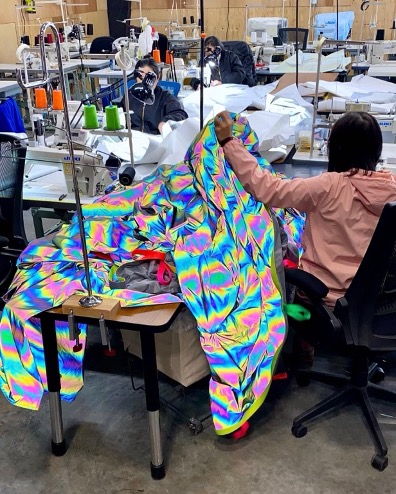
Many of the fabricators are Vietnamese who have been with PGF for more than 10 years. “They are skilled sewers and they are really proud of the work they do,” Howard said.  

Sewers at work at PGF

“We’re now a full -service cut-and-sew manufacturing company,” Howard said. “We make soft goods, that includes wearables, clothing, accessories, curtains, upholstery items, sculptures. We also do design work in-house and we source the material, so we’re completely one-stop.”

Reflecting her commitment to responsible business practices, Howard has also secured certification of PGF as a B Corp, a company that meets high standards of verified social and environmental performance, and public transparency to balance profit and purpose.

Part of PGF’s commitment to sustainability is the reuse of materials. In 2023, for example, it created cushions using fabric scraps from past PGF projects and designed to invoke 90’s zine culture married to frenetic, modern-era multimedia art. All the cushions were stuffed with pulverized factory scraps, the result of PGF’s zero-waste manufacturing initiative.

To reward and retain her employees, Howard provides them with generous benefits, including health insurance. A particularly useful benefit that came into play when the fire hit PGF’s building in 2021 was payroll protection insurance. That allowed Howard to give paychecks to her employees for 10 months until the business could restart.

Howard has also focused on improving PGF’s operations, hiring a COO for five months in 2023. “She really helped me turn around a lot of the problems we were having, to look at them in a different way, “Howard said. “She created a reporting tool that’s very specific to this business and changed the structure of the business so more responsibility is placed on designated managers instead of everybody reporting to me,” Howard said.

In its new building, PGF has continued to create specialized products for a wide range of clients, including kimono-style uniforms for volunteers at Portland’s Japanese Garden, jackets for Oregon’s Tillamook Cheese company to highlight the launch of a shredded cheese product and Mad Hatter and White Rabbit costumes for an outdoor electronic dance music festival.

It has even created custom blue Nike tracksuits for the cast of the sports comedy-drama Ted Lasso to wear at the PEOPLE’s Post Screen Actors Guild Awards Gala in Feb. 2024.

With the pandemic, the 2023 fire and the fluctuating economy, Howard says business has been uneven in the past several years, but she maintains her optimistic spirit, tempered with acknowledgement that trouble can lurk just around the corner.

In a sign of her continuing optimism and willingness to take risks, in April 2024, Howard bought the assets of Cotton Cloud Futons in Portland’s Slabtown district and rebranded the company’s manufacturing space as “Oregon Natural Fiber Mill.”  She hopes the acquisition will enhance her company’s commitment to sustainable textile manufacturing.

Oregon Business covered the deal, noting that the factory milled U.S.-sourced cotton and wool into usable materials with a focus on organic cotton, regular cotton and polyester and that its equipment included a 100-year-old Garnett machine, a massive textile processing mechanism that converts waste into a uniform fiber to be used in other applications.

Never satisfied with standing still, Howard is aggressively pursuing new opportunities “It’s not a chill business, but we’re here to stay,” she says. “There’s lots going on, lots of opportunities everywhere. I just have to know where to put my energies.”

Paying Strikers: Oregon Democrats Keep A Foolish Idea Alive

Forrest Gump must have been thinking of Oregon’s Democrats when he said that.

They’re continuing to push a bill, SB 916, that would allow striking workers in Oregon to collect unemployment benefits. Because the Unemployment Insurance Trust Fund is funded through a payroll tax that is paid by employers, Oregon employers would be paying workers not to work.

The unemployment insurance program, as the state explains, ”provides partial wage replacement benefits to eligible workers who are unemployed through no fault of their own.” It is not, and was never intended to be, a source of money to compensate workers for refusing to work.

My heavens. The Democrats are shilling for the unions again with a blatant gift. What a shock!

What makes their strong support for this bill particularly egregious is that it is aimed at benefiting an extremely small portion of the labor force, but a sector that overwhelmingly favors the Democrats in campaign contributions.

In 2024, just 15.9%  of wage and salary workers in Oregon were union members, according to the Bureau of Labor Statistics. Dig deeper and you find that  the union membership rate for public sector workers in Oregon, about 51%, is considerably higher. That is consistent across the country, where unionization is about five times higher nationwide in the public sector compared with the private sector.

Supporters of SB 916 often try to bolster their cause by alluding to the fact that New York and New Jersey already allow unemployment benefits to be paid to strikers, but they neglect to mention that both states bar public employees, such as teachers, from striking.

If you want to know who’s responsible for this appalling bill, it was sponsored by Democratic Senators Kathleen Taylor, Wlnsvey Campos, James I. Manning, Jr., Chris Gorsek, Mark Meek, and Deb Paterson, as well as Democratic Representatives Dacia Graber and Ben Bowman.  The bill was passed out of the Senate Committee on Labor and Business on Feb. 6, with Democrats Senator Khanh Pham, Senator Kathleen Taylor and Senator Aaron Woods voting aye and Republicans Senator Daniel Bonham and Senator Cedric Hayden voting nay.