Portland’s Next Mayor? Who Cares?

Portland’s Next Mayor?

In all the turmoil and media attention focused on Portland’s new ranked choice voting election in November, much of the focus has been on the contest for mayor.[1]

Why?

The next mayor is going to be a eunuch. No, I don’t mean a castrated man. I mean the word metaphorically, in the sense an ineffectual or powerless person.

It’s the new 12-person City Council that will have the power to enact laws. The new mayor won’t even sit on the City Council or vote on council items (except to break a tie).  The mayor, and the new city administrator, who will be appointed by the mayor with council approval, will be in charge of carrying out City Council actions and crafting the city budget.

The mayor will also be tasked with appointing a city administrator, city attorney, and police chief, but that will also be only with the City Council’s approval. And to top it all off, the mayor won’t have veto power over council decisions. 

The mayor will serve more as a $175,463-a-year figurehead than a legislator, Tate White, a member of the city’s government transition team, told OPB earlier this year. “They’re going to be partnering with other jurisdictions, they’ll be standing at press conferences, they’re going to be the people meeting with representatives from sister cities when they come and visit, it will be far more ceremonial,” she said.

But don’t count on the new 12-person City Council, with three representatives per four new geographical districts and only one staff person for each City Council member, to be all that cooperative, efficient or effective. It might be more functional than New York City’s 51-member City Council, but likely not much. After all, a City Council member can be elected with as little as 25% + 1 votes, so their constituencies will be pretty damn small.[2] One consequence could be a Councilor able to remain in office by consistently satisfying just that smaller segment of eligible voters.

Jeff Jacoby, an award-winning columnist for the Boston Globe, calls the ranked choice voting process “democracy on the Rube Goldberg model”, where  ideas that supposedly simplify people’s lives wreak havoc instead.


[1] Mayoral candidates include three current members of Portland City Council: Rene Gonzalez, Mingus Mapps and Carmen Rubio. Others running are: Saadiq Ali, early childhood educator Shei’Meka As-Salaam, inventor James Atkinson IV, REAP youth advocate Durrell Kinsey Bey, financial advisor Nancy Congdon, Yao Jun He, advocate for the unhoused and community activist Michael O’Callaghan, artist and performer Liv Osthus, city hall veteran and green energy advocate Marshall Runkel, owner and president of TITAN Freight Systems Keith Wilson and maintenance supervisor Dustin Witherspoon. 

[2] Charter reform’s explanation of how “single transferable vote” (STV) will work: 

“Councilors of each district are elected using a proportional method of ranked choice voting known as single transferable vote. This method provides for the candidates to be elected on the basis of a threshold. The threshold is determined by the number of seats to be filled plus one, so that the threshold is the lowest number of votes a candidate must receive to win a seat such that no more candidates can win election than there are seats to be filled. In the initial round, the number of first rankings received by each candidate is the candidate’s vote count. Candidates whose vote counts are at least the threshold are declared elected. Votes that counted for elected candidates in excess of the threshold are called surplus. If fewer candidates are elected in the initial round than there are seats to be filled, the surplus percentage of all votes for the candidates who received a surplus are transferred to the next-highest ranked candidates in proportion to the total numbers of next-highest rankings they received on the ballots that counted for the elected candidate. If, after all surpluses have been counted in a round, no additional candidates have a vote count that is at least the threshold, the candidates with the lowest vote counts are successively eliminated in rounds and their votes are counted as votes for the candidates who are ranked next highest on the ballots that had been counted for the eliminated candidates, until another candidate has a vote count that is at least the threshold or until the number of candidates remaining equals the number of seats that have not yet been filled. The process of transferring surpluses of elected candidates and eliminating candidates continues until all positions are elected.”


Don’t Let Janelle Bynum Recast Herself as a Law-and-Order Candidate

Democrat Janelle Bynum, who is running against Rep. Lori Chavez-Deremer (R-OR) in the 5th Congressional District, knows the tide has turned so she’s trying to reposition herself as a law-and-order conservative. Don’t let her do it.

In a previous post, I wrote of how Bynum has the gall to say in her latest TV ad , “In Salem, I brought Republicans and Democrats together to re-criminalize fentanyl and other hard drugs. In Congress I’ll work with local law enforcement to get the officers and resources Oregon needs.”

She neglects to mention she supported decriminalization in Measure 110 before she opposed it. 

Specifically, she supported Measure 110, the 2020 ballot measure that decriminalized drugs.

That’s not all.

She says in her ad, “I won’t rest until our communities are safe”.  She undermined that pledge in 2017 when she voted to reduce voter-approved sentencings for ID Theft and Property Crimes in (HB 3078).  On the same day, she allowed car thieves to have short sentences and supported reduced sentencing for drug possession, cutting off court-ordered drug treatment for 2,500 addicts a year (HB 2355). 

As a Feb. 2024 report by the Oregon Criminal Justice System said, HB 3078 was enacted, primarily to reduce the number of persons incarcerated in Oregon’s prison system due to property offenses and identity theft. 

Section 5 of the bill changed sentences for Identity Theft and Theft in the First Degree for sentences imposed on or after January 1, 2018. These offenses were essentially removed from the sentencing structure created through the adoption of Measure 57 by Oregon voters in 2008 (creating statutory minimum sentences for certain property crimes). 

It worked.” “…prison usage remains at a lower trajectory than before, thanks in part to HB 3078,” the report said. 

 The Oregonian reported in 2018 the Dept. of Corrections was patting itself on the back for having 2500 less people in the system because of HB 3078. But some critics contended that meant cutting 2500 people a year on average from state sponsored treatment, and that spurred more homelessness and crime. 

Moreover, when crimes went from a felony to a misdemeanor and then in Measure 110 to a class E violation, all those with addictions were no longer precluded from gun ownership.

 On June 29, 2017, Steve Doell with Crime Victims United wrote in a guest column in The Oregonian that the bill “exemplifies the willingness of the legislature to sacrifice safety for savings.” 

In 2019, Bynum further muddied the waters when she voted to pass SB 1008, overturning much of voter-approved Measure 11, that required minimum-mandatory sentences for certain violent crimes and mandated that cases involving juveniles 15 years and older, accused of specific violent crimes, were to be to be handled in public in adult court. SB 1008 allowed a judge to see them in juvenile court in a non-public setting.

“Enough extremism” says one of Bynum’s ads. She should have thought that before she jumped on the social justice bandwagon.

Donald Trump. Meet Lonesome Rhodes.

Andy Griffith in “A Face in the Crowd”

The blistering movie A Face in the Crowd deliciously exposes how Americans are seduced by people who swindle us. “This parable about a small-town con man who attains the power to sway the nation to his whims is America: our fanaticism, whimsy, and desire for elusive authenticity at the expense of our souls,” April Wolfe wrote in a spot-on review of the 1957 movie.

Andy Griffith, in his first film role, long before he played Andy Taylor, the low-key widowed sheriff of Mayberry, plays a charismatic hayseed who rises to popularity in a television show and, with an exaggerated sense of his new persuasive power, goes berserk. 

Russ Buettner and Susanne Craig, investigative reporters for The New York Times, recently wrote a lengthy, perceptive and revealing inside story of how the producers of “The Apprentice” crafted a TV version of Donald Trump — measured, thoughtful and endlessly wealthy — that ultimately fueled his path to the White House.

The story meticulously exposed how the producers of The Apprentice turned Trump from a slightly garish, smug New York real estate schmuck with a history of business failures who worked out of a musty, messy office into business royalty, an astute, self-made billionaire.

“The facts never really mattered,” the New York Times story noted. “Drama mattered. Comedy mattered. Entertainment value mattered. Mr. (Mark) Burnett (the show’s executive producer) liked to call it “dramality.” And Mr. Trump was dramatic, occasionally funny, and always entertaining.”

So when he came down the escalator in June 2015, staging the announcement of his candidacy for president, he was a new man, remade by reality television.

Since producing The Apprentice, Burnett has made other successful shows, including “Shark Tank” and “The Voice”, but as Patrick Radden Keefe  wrote in The New Yorker in 2018, “…his chief legacy is to have cast a serially bankrupt carnival barker in the role of a man who might plausibly become the leader of the free world. “I don’t think any of us could have known what this would become,” Katherine Walker, a producer on the first five seasons of “The Apprentice,” told Keefe. “But Donald would not be President had it not been for that show.”

The New York Times story agreed. 

But Burnett and his associates kept their opinion of Trump to themselves, giving him free reign to elevate his prominence based on lies.

Commenters on the Times story savaged Burnett and his associates for foisting Trump on the American public. 

“Mark Burnett created this mess the country is in,” one commenter posted in the paper’s online comments section. “The dumbing-down of America is from all reality TV and especially this egocentric reality “star” turned president. It’s all a complete disgrace that has ruined the fabric of our country.”

“You couldn’t print what I think of these garbage people,” another commented. ”Between Burnett’s greed… and all these enablers, they tipped over the first Domino to end what is left of our Democracy.” 

“He was always a 2-bit husband, father and criminal,” wrote another. “Then, the megalomaniac and pathological narcissist gets a gig on probably one of the most scripted and controlled shows ever produced and becomes a 2-bit actor. Ratings and fakery will take you a long way in TV.” 

“He’s a phony who starred in a show that presented him as a wildly successful businessman while his real business “empire” was failing with numerous bankruptcies despite his $400 million inheritance,” said another. “His political success is also a product of the same fake narrative coupled with a vast army of low information voters who enjoy his racist tinged insult comic act.”

But Burnett and his cronies weren’t the only ones willing to hide the reality of Trump from the public.  Hangers-on who rode Trump’s coattails to the White House and then stayed on in Trump’s administration were guilty, too.

They were perfectly willing to advance an empty vessel of a man created by television, just like the admirers of Chance, a simple gardener whose TV-informed utterances are mistaken for profundity in Peter Sellers’ 1979 movie, Being There.

The essential difference between Chance and Trump is in their relative naïveté.. Chance is a picture of childlike innocence thrown out among vultures. Trump is no innocent. Nor are the hangers-on who have attached themselves to his star like remora, fishes noted for attaching themselves to sharks for food and locomotion.

The remora men (they are mostly men) who have attached themselves to Trump, likely knowing full well of his destructive narcissism, includes key campaign advisors Roger Stone, Corey Lewandowski, Paul Manafort, Steve Bannon, Brad Parscale, and Hope Hicks, his Chiefs of Staff, Reince Priebus, John Kelly and Mark Meadows, as well as cabinet members including Secretary of State Mike Pompeo, Secretary of Defense Jim Mattis, Attorney General Jeff Sessions, Secretary of Transportation Elaine Chao and Ambassador to the United Nations, Nikki Haley.

Then, of course, there were the Republican members of Congress who derided Trump and his incendiary rhetoric in private and gave him rapturous praise in public. I recall reading a story about how, after Trump left a private meeting with key members of Congress when he was president, they could be heard laughing at him.

They have all been in a position to tell the truth to the American people, to the mob Trump has spawned, but they have chosen not to. They are as guilty as Burnett, more-so because they had an obligation to the country.

They all have displayed the same self-serving weakness as the men and women who were well aware of President Biden’s declining mental and physical state, kept it from the public and still backed him in his ego-driven selfish run for another term. “Taken together, this is all a troubling portrait — of unelected staffers trying to shield the public from Biden’s declining mental health so they can preserve their access to power and ability to make policy,” Philip Klein wrote in the National Review.  

We deserve better. 

Talk About a Flip-Flop: Janelle Bynum and Measure 110

Janelle Bynum, meet John Kerry.

Back in 2004, Sen.  John Kerry was the subject of a lot of ribbing when he said, in response to a question about his vote against an $87 billion supplemental appropriation for military operations in Iraq and Afghanistan, “I actually did vote for the $87 billion before I voted against it.” The George W. Bush campaign seized on the comment, using the footage in television ads to illustrate its charge that Kerry flip-flopped on issues, particularly the war in Iraq

Democrat Janelle Bynum, who is running against Rep. Lori Chavez-Deremer (R-OR) in the 5th Congressional District, has a lot in common with Kerry.

Sounding like a law-and order Republican, Bynum has the gall to say in her latest TV ad , “In Salem, I brought Republicans and Democrats together to re-criminalize fentanyl and other hard drugs. In Congress I’ll work with local law enforcement to get the officers and resources Oregon needs.”

She neglects to mention she voted for decriminalization before she voted against it.

Specifically, she supported Measure 110, the 2020 ballot measure that decriminalized drugs.

“It tells us a couple of things. No. 1, Oregonians are compassionate people,” Bynum said in response to a question about Measure 110 in a November 2023 interview. “Number two, it also tells the legislature that the people were hungry for a certain approach. And it’s not the legislature’s job to question the people; it’s the legislature’s job to implement the will of the people.”

On April 1, in response to a public outcry, Governor Tina Kotek signed HB 4002, recriminalizing hard drugs and rolling back some parts of measure 110. It was all so predictable.

Take responsibility, Janelle. You were one of the people who made that necessary.

Misguided Charity: Portland’s Free Food Fridges

When will Portland learn?

There’s a movement afoot in Portland to provide free food to the homeless from front yard refrigerators. Willamette Week thinks it’s a great way “to Be a Better Neighbor”. I don’t.

It’s a misguided feel-good effort at charity by naïve social justice warriors that perpetuates their presence while not resolving the situation on the ground. And of course the homeless services complex never shrinks because the client base never diminishes.

A while ago I went to a free lunch for the homeless in an underground Portland parking garage. Tables spread out across the center of the garage displayed a bounty of meal options put together by multiple volunteers, from sandwiches and lasagna to potato chips and hot ethic dishes. Homeless people streamed in, wearily assembled in slow-moving lines, grabbed hold of what they wanted and found a spot on the concrete floor to sit and eat.

It wasn’t uplifting. It was depressing.

Nobody was there to help the struggling people get their lives back on track, to inquire about the welfare of their children, to make them aware of accessible pathways towards lasting change.

The fridges are little more than an incentive for too many of the homeless to stay in a downward spiral of addiction and helplessness. 

” The concept is simple,” says Willamette Week. ” Find a fridge, hook it up to a power source, put it in your front yard, and stock it with free food.”

There’s even an outfit, PDX Free Fridge, that will give you advice on how to start a free fridge effort and publicize it.

There’s a saying of uncertain providence, “Give a Man a Fish, and You Feed Him for a Day. Teach a Man To Fish, and You Feed Him for a Lifetime”. The free food tribe are giving the homeless a fish. 

It’s a classic case of when helping the homeless doesn’t really help, but reinforces a culture of helplessness. 

It reminded me of when I saw a group of fresh-faced, eager suburban teenage girls handing out sandwiches from the trunk of their car to homeless people at the Tom McCall Waterfront Park. That might have eased their  consciences, but how, exactly, did that drive change?

A woman who directed a social service agency in the Portland area that served low-income families once told me the whole free food approach was “antiquated”, a long-ago discredited tactic. 

And, of course, all of this ignores the fact your neighbors may be less than supportive of cluttering up front yards with old refrigerators that serve as magnets for the homeless under the guise of compassion. I guess that doesn’t matter when you’re on the side of goodness.

The Tragedy of Matthew Perry’s Drug Addiction and Death Isn’t a One-Off.

The tragedy of Matthew Perry’s drug addiction and death isn’t a one-time regrettable incident. Americans are addicted to a slew of drugs because of aggressive marketing by pharmaceutical companies.

Watch television for any length of time and you will see that these drug-pushers dominate advertising time. 

The U.S. and New Zealand are the only countries that allow direct-to-consumer prescription drug advertisements, according to USC’s Center for Health Policy and Economics. The result? Drug utilization is” highly responsive” to advertising exposure and “…those who initiate treatment due to advertising are on average less adherent, which suggests that some of the increase in utilization might be unnecessary.”

Direct to consumer prescription drug advertising also exposes prospective users to often ignored risks. 

Ever heard of Tardive dyskinesia? If you watch television, you probably have seen the commercial for Austedo XR featuring a woman with shaking hands trying to grip a coffee cup. 

Tardive dyskinesia is caused by long-term use of neuroleptic drugs, which are used to treat psychiatric conditions.

What you might not pay much attention to is the drug’s possible side effects, which include Irregular heartbeat, Neuroleptic Malignant Syndrome, Restlessness and Parkinsonism. 

Or how about LYBALVI® to treat manic or mixed episodes in adults that happen with bipolar 1 disorder, either alone for short-term (acute) or maintenance treatment or in combination with valproate or lithium.

The list of possible side effects seems endless, including increased risk of death in elderly people with dementia-related psychosis.

In a television commercial for Abbvie’s Rinvoq, prescribed to treat arthritis in adults, a woman enjoys a trek through a rock canyon and a man teaches children how to tap dance. 

It all sounds so simple. Take this and you’ll get better.

But the truth is the drug has a lot of potential hazards, including:

  • Increased risk for developing serious infections that may lead to hospitalization or death. Reported infections include active tuberculosis (TB), invasive fungal infections, bacterial, viral, including herpes zoster, and other infections.
  • Lymphoma and other malignancies.
  • A higher rate of major adverse cardiovascular events (MACE) (defined as cardiovascular death, myocardial infarction, and stroke).
  • Thrombosis, including deep venous thrombosis, pulmonary embolism, and arterial thrombosis, with many of these adverse effects serious and some resulted in death.
  • Gastorintestinal (GI) perforations. 

The message of most commercials? Adam Lenkowsky, executive vice president, chief commercialization officer and head of U.S. oncology at Bristol Meyers Squibb said at a Jan. 4, 2024, investor event that the point of the commercials is to “bring patients into treatment”. 

In other words, in theory, the companies aren’t really pitching their drugs directly to consumers. Instead, they want prospective patients to badger doctors to prescribe it.

Such appeals must drive doctors crazy. After all, if the promoted drug was a realistic treatment option, a skilled doctor would likely have already thought of it. The commercials are an attempt to get in the middle of the patient-doctor relationship in a way that favors the drug company. 

The FDA requires that drug advertisements “…must present a fair balance of drug benefits and risks, with the most important risks provided in an audio (i.e., spoken) format.”  But counterintuitively, “… in giving a laundry list of side effects associated with any given prescription drug…consumers may actually be more likely to believe that the drug is effective in treating the condition for which it is designed,” argues Cohen, Placitella & Roth, a Pennsylvania and New Jersey law firm that handles pharmaceutical litigation. 

In 2015, the American Medical Association called for a ban of direct-to-consumer advertising (DTCA) for prescription drugs. Nevertheless, spending by the pharmaceutical industry on television advertisements has continued to accelerate, with national health care costs largely driven by drug spending.

It’s time to renew, and act on, AMA’s call.

Buried in Political Fundraising Texts? Grin and Bear It.

Like the bubonic plague, a pestilence of political fundraising messages has descended on me. 

“WOW, we’re blown away!” said a frenetic message I recently received from the Democratic Congressional Campaign Committee (DCCC). “Since Kamala Harris announced Governor Tim Walz as her running mate, Top Democrats have UNLOCKED a 400% match through MIDNIGHT Tonight!!!…So please: Will you rush a 4X-MATCHED $3 to the DCCC…”

The Republicans are after me, too.

“Patriot – please don’t ignore this message; we’re grasping at straws here…,” said a recent text message from the National Republican Senatorial Committee (NRSC). “The Democrats are already out-raising and out-spending our America First candidates… Can we count on you to give $10 to ensure Senate Republicans can fight back against Joe Biden and his extremist Democrats in the Senate?”

And in a text message reminiscent of Mission Impossible, where instructions to a secret agent self-destruct after playing, I got a text from Donald Trump Jr. pleading for money and adding, “Please handle this message with care & delete after reading.”

I’m registered as “unaffilated” with a party, but still get most of the online entreaties from Republican-affiliated groups. That may be because, according to research conducted by YouMail, Republicans are outpacing Democrats in political text messaging in 2024 by a ratio of at least 2 to 1. 

“Lara Trump viewed your profile yesterday and nominated you for LIVING LEGEND STATUS,” said one message from the Republican National Committee. “This is the highest honor the co-chair can bestow, and she selected YOU.”

Kellyanne Conway, who served as Senior Counselor to President Trump during his term, has pleaded with me to complete a National Security Survey and, by the way, “Will you contribute your most generous gift to support our campaign to take back the Senate and elect a Republican majority?”

Why, you might ask, are the Democratic and Republican parties so damn aggressive in their fundraising? After all, the Biden—now Harris—campaign committee raised $284.1 million and Trump’s campaign committee raised $217.2 million in total between January 2023 and June 30, 2024, the most recent date for which Federal Election Commission filings are available.

Initial numbers from July suggest, however, that the money race has tightened. The Harris campaign reported it raised $310 million last month and had $377 million in cash on hand, while the Trump campaign reported raising just $138 million in July, but still had $327 million in cash on hand.

And both parties expect to spend a lot more.

A report from AdImpact predicted that the 2024 cycle will be the most expensive presidential campaign ever, with total spending expected to reach $10.69 billion, 19% more than spending in the 2019-2020 presidential cycle.

Since text messaging is the primary tool for fundraising, expect a lot more of it. 

And don’t expect to stop the deluge by replying “STOP”. That’s a useless effort that tells the sender your phone number is both active and responsive. Blocking the sender’s phone number won’t do much either, because all it does is stop messages from that specific blocked number.

So hang in there. It will end on Nov. 5. 

One more thing:

A common feature of political fundraising texts is an attempt to lure you in with a promise your donation will be matched (equaled or multiplied) by an unknown source. It’s likely a ruse. Don’t believe it.

According to OpenSecrets, a nonpartisan, independent nonprofit that tracks money in U.S. politics, “…legal experts say it is hard to see how donation matching could happen given campaign contribution limits. And there are no accountability mechanisms to determine whether campaigns actually follow through with their promises.”

“I think these promised matches are largely a marketing ploy from direct mail fundraising,” Michael Kang, a law professor at Northwestern whose expertise includes campaign finance, told OpenSecrets. “They stir up contrived urgency.”

Liberal Media Jump on the Kamala Harris Bandwagon

Gag me with a spoon.

Talk about shifting on a dime.

President Biden withdraws from the 2024 race, Vice President Kamala Harris picks up the mantle and the liberal media jump on board.

Even Biden’s withdrawal statement is being cast mostly as a brave, selfless, patriotic effort, like a “don’t speak ill of the dead” obituary, rather than an admission that the Democratic Party’s leaders and wealthy donors had abandoned him. 

It wasn’t long ago that the press delighted in portraying Harris as a largely ineffectual, slightly dim and somewhat daffy politician with a habit of speaking in a kind of garbled incoherent word salad and a failed policy effort as Biden’s border czar.  

Last week, New York Times columnist David Brooks cautioned that “…as of 18 months ago, she would not have made an effective president or even a good candidate. She ran a disastrous presidential campaign and has been a mediocre vice president, even measured by the low standards of the office. She could always repeat the normal Democratic positions but had no distinctive view for where the country needed to go.”

Now, with Biden out, the media is transforming Harris from a somewhat awkward and cringy figure in the Democratic Party to a “cool” pop culture personality with a sterling reputation in a matter of days, commented CNN commentator Van Jones. 

New York Magazine went over the top in its latest issue with this cover:

The New York Times has even attempted to turn the tide on Harris’ sometimes derided laughter, saying “The Trump campaign sees Harris’s laugh as a vulnerability to exploit. But far from a liability, it is one of her most effective weapons.”

In a flash, Harris has gone from an unaccomplished player in foreign affairs to a widely admired wonderkind. A New York Times story on her foreign policy chops was even headlined, “A Global Reputation For a Steely Resolve And Deft Diplomacy.”

“…the consensus among foreign officials and diplomats is that Ms. Harris has a firm grip on international affairs,” the Times enthused in a July 27 article quoting Chancellor Olaf Scholz of Germany: “She is a competent and experienced politician who knows exactly what she is doing and has a very clear idea of her country’s role, of developments in the world, and of the challenges we face.”

When Biden tweeted his exit, the Democratic Party and its acolytes “…declared a triumph of democracy and the end of popular “disillusionment,” observed author and reporter Matt Taibbi. “Attention shifted to the real candidate, Kamala Harris, who was not only MLK, Gandhi and Captain America, but a woman of color with a Jewish husband…” 

Party stalwarts are jumping on board with superlatives, too. “I’ve known Kamala Harris a long time,” wrote Hillary Clinton. “This brilliant prosecutor will make the case against convicted felon Donald Trump.”

On July 28, Lydia Polgreen, an opinion columnist with the New York Times, wrote that “…Harris had been significantly underrated, that the chatter about her flaws for the past four years maybe didn’t tell her full story and that she had some unique talents and traits that made her a stronger candidate than her record might suggest.”

Rather than hold Harris’ missteps against her, Polgreen turned them into positives. 

“I see a woman who struggled to compete for power against her peers, buried under an array of vague and unstated expectations about whether she gave the right answers, had the right ideas, was smart or specific enough,” Polgreen wrote. “Like any woman of ambition, I deeply relate to these experiences. As strange as it might seem, I have come to think these experiences could make her the ideal candidate in a surreal campaign against a man who is so certain of himself, who admits to no mistakes, who has no humility and who, for many of us, is utterly unrelatable.”

Jenny Holland, who writes “Saving Culture (from itself)” on substack, says “The establishment blob is so desperate to avoid a Trump presidency that they are willing to support a woman who is so flippant and unserious that she would embrace a youth culture trend of “brat”, which means being “just that girl who is a little messy and maybe says dumb things sometimes, who feels herself but then also maybe has a breakdown but parties through it.” 

Still, Harris may want to tread lightly before embracing her newfound adulation as a given. The press can be your friend, but it can also turn on you. 

Identity Politics is Alive And Well at The New York Times

I’m a member of Tau Kappa Epsilon fraternity, one of the largest men’s collegiate fraternities in North America.  If I ran for office, would you assume all 12,000 voting-age collegiate members of my fraternity and all the living TKE alumni would support me?  

Ronald Reagan was a member of Tau Kappa Epsilon fraternity, too. When he ran for president, did the news media assume the votes of all his TKE fraternity brothers were a sure thing?

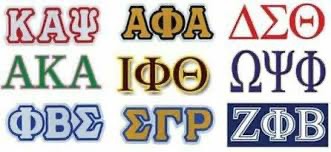
The New York Times seems to think that members of all the Black Greek-letter sororities and fraternities at US colleges are a ready-made bloc of Kamala Harris supporters in her quest for the presidency because she’s been a member of the Black sorority Alpha Kappa Alpha since her undergraduate days at Howard University. 

“As Vice President Kamala Harris’s presidential campaign rushes to shore up its base, its efforts will be bolstered by a ready-made coalition: the more than two million members of Black Greek-letter organizations who have quickly united to mobilize Black voters nationwide,” the Times reported today.  

“A united Black Greek front has the potential to offer even more significant political advantage, as their voter engagement programs reach millions every four years,” the Times added. 

Maya King, the Times reporter who wrote the story, says in her bio, “As a native Southerner, I have been most fascinated by the ways the region has changed politically, culturally and demographically over the last few presidential election cycles — and how those changes are connected.”

But King barely acknowledged those changes in her article. The cheerleading article barely mentioned that there have been signs of deteriorating Black support for the Democratic ticket and growing Black consideration of Donald Trump. 

In November 2023, the Times reported that Black voters were  more disconnected from the Democratic Party than they have been in decades, frustrated with what many saw as inaction on their political priorities and unhappy with President Biden, a candidate they helped lift to the White House. Polls by the Times and Siena College found that 22 percent of Black voters in six of the most important battleground states said they would support former President Trump in the 2024 election, and 71 percent would back President Biden.

Erosion of Black support for the Democratic Party has also been found by the Pew Research Center. The Center reports that although the majority of Black voters across education levels are Democrats, there has been a decrease in affiliation with the Democratic Party in recent years. While 93% of Black voters with college degrees identified with or leaned toward the Democratic Party in 2012, that number decreased to 79% in 2023.

Biden’s withdrawal from the 2024 presidential contest and Harris’  ascension may well change some Black voters’ preferences, but it’s not likely to be a universal shift. Harris, for example, is a progressive Democrat, but only 28 percent of black Democrats consider themselves liberal, according to the Pew Research Center, while 70 percent identify as moderate or conservative.

On June 25, the Times reported on data  captured by a new Harvard study that shows Black voters  have slightly shifted toward Trump since 2020. “One possible explanation is that some Black voters’ economic gains have allowed them to focus more on noneconomic issues — such as abortion and L.G.B.T.Q. rights — on which they are more conservative than typical Democrats,” the Times said.

The fact is, Black candidates can’t rely on group solidarity. “It’s certainly true that black voters support black Democratic candidates at higher rates, … but analysis of past elections and campaigns shows that black voters have never prioritized simple descriptive representation over other factors, like party affiliation, campaign viability, candidate electability, preexisting relationships with the black community and a sense of authenticity,” according to the New York City-based Brennan Center for Justice. 

For the New York Times to publish a story assuming Black solidarity for a Black presidential candidate who’s a member of a Black sorority is irresponsible journalism.

As James Bennett, who was the editorial page editor at The New York Times from May 2016 until his forced resignation in June 2020 over a controversial op-ed, has said, “The reality is that the Times is becoming the publication through which America’s progressive elite talks to itself about an America that does not really exist.”

Trump/Vance Threaten The Competence of the Federal Civil Service

Donald Trump has made it clear he wants to overhaul the federal civil service and erode merit system principles. Sen. J.D. Vance, R-Ohio, Trump’s pick for vice president, has said that if Trump wins re-election, he should “…fire every single mid-level bureaucrat” and “replace them with our people.”

At campaign events, Trump has promised to “obliterate the deep state,” what he believes is a network of non-elected government employees working under cover to bypass elected officials and further their own contrary agenda.

I’m sure it sounds straightforward, simple and appealing to Trump’s ideological followers who think career civil servants would work to stymie Trump’s conservative policies if he’s re-elected.

But firing all the federal government’s mid-level bureaucrats and replacing them with political appointees would be a disaster for America.

I know that because I’m a former mid-level federal bureaucrat. I know that much of the work in multiple government agencies by U.S. civil servants is highly specialized, complex, and essential for an efficient government that serves the people. 

Under the U.S. General Service (GS) pay scale, the GS-1 through GS-7 range generally marks entry-level positions, mid-level positions are in the GS-8 to GS-12 range and top-level positions (senior managers, high-level technical specialists, or physicians) are in the GS-13 to GS-15 range.

I served in that mid-level band. As a Foreign Affairs Officer with the National Marine Fisheries Service during part of my professional career, I worked with the Department of State on international fisheries negotiations, principally with Russia, Canada and Asian nations. In preparing for that job, I earned a bachelor’s degree in International Relations, a master’s degree in Political Science and a master’s degree in Marine Affairs. I had also written a proposal for the United Nations Conference on the Law of the Sea and worked for an international marine conservation non-profit in Canada.

Many others on my team had similar backgrounds. During my time in government I worked with a wide range of exceptional people with broad experience and academic backgrounds doing specialized work that advanced American interests. 

“Almost all Western democracies have a professional civil service that does not answer to whatever political party happens to be in power, but is immune from those sorts of partisan wranglings,” says Kenneth Baer, who served as a senior Office of Management and Budget (OMB) official. “They bring… a technical expertise, a sense of long history and perspective to the work that the government needs to do.”

Gutting the civil service and replacing experienced workers with political hacks, as Trump and Vance advocate, would be irresponsible.

Don’t let it happen.