Hitting the COVID-19 Jackpot

Individuals and small businesses all over America have been hit hard by the COVID-19 epidemic. Some have been fortunate enough to receive financial support from people sympathetic to their plight.

Shelley Luther hit the jackpot.

shelley-luther-08

Salon owner Shelley Luther after she was released from jail in Dallas, May 7, 2020.

The Dallas, TX owner of Salon à la Mode was arrested for opening her business despite COVID-19 restrictions. A GoFundMe page to help her went live on April 23, 2020, the day before her arrest.

“Shelley Luther is an American Hero that has decided to resist tyranny by opening her business against an unlawful State Executive Order,” read the description for the Shelly Luther Fund campaign.

A Texan, Rick Hire, says the Woke Patriots organization is behind the campaign. In a 30-minute May 9  YouTube video, Hire says he founded the organization to deal with challenges to constitutional rights and the group picked Luther to be the first beneficiary of a GoFundMe campaign.

The GoFundMe page was a hit right out of the gate. When an initial goal of $250,000 was rapidly surpassed, the goal was raised to $500,000. The total raised now sits at $500,040 and the window for donations has closed.

Most of the contributions have been well under $100, but some big givers have stepped up, too. Dan Patrick, the Lieutenant Governor of Texas, gave the most, $7,500, to cover Luther’s court-imposed fines.

Texas Governor Greg Abbott allowed personal care service facilities like salons to resume operations on May 8, so the restriction that spurred Luther’s protest is no longer in place. But the brief tempest made Luther $500,040 richer. Not only can she spend the money pretty much however she wants, but it may not even be taxable income.

Luther says she wants to spread her newfound wealth to those who need it. That probably won’t include the people who work at her salon. On May 3, Luther was approved for a government loan under the Paycheck Protection Program. The entire loan can be forgiven in full if at least 75 percent of it is used to pay her employee’s salaries.

What a deal!

Guest Opinion: Gov. Brown’s Covid-19 Emergency Declaration is Unconstitutional

NOTE: On May 18, 2020 a Baker County, OR judge invalidated the governor’s restrictions on businesses and social gatherings, along with every other executive order Brown has issued under a state of emergency she ordered due to the COVID-19 pandemic. https://bit.ly/3dYTwM6

By Glen Wagner   GWagnersmall


One thing I have not seen addressed enough in regards to Oregon Governor Brown’s actions related to the COVID-19 situation is the literal unconstitutionality and illegal nature of her Emergency Declaration or her blatant continued violation of the constraints placed on her from the Oregon Constitution.

Willamette University professor Paul Diller has bloggedabout the matter, arguing that Brown’s emergency orders should have an expiration date, and Willamette Week has written about his argument, but that’s it.

In my view,  a basic reading of Section 6.1 of Article X-A of the Oregon Constitution (found at https://www.oregonlegislature.gov/bills_laws/Pages/OrConst.aspx) clearly states that emergency powers shall not extend beyond 30 days from the time of proclamation, after which the articles will expire.

Section 6.2 of Article X-A says that a 3/5 approval of the Legislative Assembly is required to extend the date beyond 30 days. Section 6.5 of Article X-A says that the Governor cannot issue a second proclamation for the same emergency.

Gov. Brown declared the COVID-19 emergency on March 8th. Per the Oregon Constitution, the emergency legally ended on April 8th. As far as I know, the Legislative Assembly did not vote to approve a time extension. Therefore, any of the Governor’s current actions justified by this emergency declaration are fundamentally unconstitutional.

Gov. Brown’s Emergency Declaration states it is to last 60-days. The declaration itself is in violation of Section 6.1 of Article X-A in the state constitution.

The governor’s Emergency Declaration further claims the 60-day term “can be extended or terminated by the Governor”. Per ORS 401.204 the Governor (or the Legislature) can terminate the emergency, but it does NOT give the Governor the authority to extend it. Article X-A Section 6.2 makes it clear ONLY the Legislative Assembly can do this.

According to ORS 401.165.1 the declaration needs to specify an area “no larger than necessary to respond to the emergency.” 433.441.2(b) Says it should state the political subdivision or geographical area subject to the proclamation. Governor Brown’s Emergency Declaration states the emergency to be “state-wide”.

While public health information is listed within the declaration, it is not a foregone conclusion that all counties in the state had equal risk of infection and not all asked for an emergency to be declared. The purpose of the limited geographical nature of an emergency is to ensure focus of state resources and limit emergency powers to a specific area. In can be argued that by making it immediately state-wide the states and county resources were de-focused and spread thin rather than concentrated at the points of highest risk such as in urban areas. While not in violation of the law, it is surprising no one in the legislature raised any challenge to this scope determination.

ORS 433.441.2(d) Says the proclamation must contain a duration IF LESS THAN 14 days; in other words, there is a statutory limit on the Public Health Proclamation of 14 days. Governor Brown’s Emergency Declaration clearly violates this requirement by stating a 60 days duration.

ORS 433.441.5 Says the proclamation expires when the Governor declares it or NO MORE THAN 14 days after the proclamation. The Governor can extend the duration by another 14-day period (1) for a total of 28 days. This is in compliance with the Constitution’s Article X-A since it is within 30 days. It does NOT give the right to the Governor to extend the duration indefinitely. Therefore, Governor Brown’s Emergency Declaration of 60-days and that the Governor can extend the time frame is in violation of this statute.

ORS 433.452 Says that it is reasonable for the state to detain an individual who has been exposed to the reportable condition only for the time necessary to collect contact tracing information. The individual is to be educated on the nature of their exposure. Nowhere can I find in this statute where the Governor is given the authority to detain ANY or ALL individuals who have not been shown to have been exposed to the reportable condition. Her order indicated only 14 people in a state with a population of over 4 million had contracted COVID-19 and only in a small geographical location. There was no justification for and no legal right for the Governor to issue a stay at home order for healthy individuals. Likewise, even if this order had been legal it should have expired on April 8th like everything else.

Therefore, the Governor has exceeded her authority to detain unaffected individuals and for durations far exceeding anything allowed in the state constitution or statutes.

The Governor just issued an extension to her originally unconstitutional declaration, which is an actual illegal act to the aforementioned references. In addition, she cites two statutory references: ORS 401.165 and ORS 401.204 as justifications of her right to extend the emergency for another 60 days.

401.165 only states the Governor’s ability to issue a declaration, which she already did on March 8th. 401.204 pertains to ENDING the emergency, not extending it. And then to sound all legal she says it is all under ORS 401.025. All this section does is define some terms for the rest of the statute. Basically, they included these references to give an air of legitimacy when in fact they have no bearing on the extension proclamation at all. This shows culpability and intent to continue to violate our laws.

Where is the push-back?

Kate Brown needs to bite the bullet on a Covid-19 budget

brownbudget4

Gov. Kate Brown wants all state agencies to submit plans for 8.5 percent cuts in their general fund dollars for the two-year budget cycle because of the expected impacts of the Covid-19 pandemic.

What a complete waste of time.

A smarter, bolder governor would abjure equal across-the-board cuts in favor of cuts targeted at lower priority, low-quality or ineffective programs.

The order for across-the-board budget cut scenarios is a lazy cop-out that substitutes simple, seemingly fair cuts for hard decisions that might raise political hackles.

If all programs are kept in place and just reduced in size and scope, opportunities to eliminate waste are lost and saved but ineffective programs tend to grow again when higher state revenues return.

As George W. Bush said, “There comes a time when every program must be judged either a success or a failure. Where we find success, we should reward it, repeat it, make it the standard. And where we find failure, we must call it by its name. Government action that fails in its purpose must be reformed or ended.”

Indiscriminate equal across-the-board cuts also ignore differential effectiveness between state government programs and differences in policy priorities. They are agnostic as to what the state should really be doing with its revenue and lock in current policy priorities.  They also penalize the leanest and most efficient agencies that have less fat to cut.

Some programs may also be able to sustain their core functions with a specific percentage cut, while others can’t.  You can’t, for example, cut the length of a bridge by 8.5 percent.

Uniform 8.5 percent cuts will mean that valuable, impactful projects and investments will be cut as much as in equal measure with bloated, duplicative projects and state employees doing great work will be cut along with those doing shoddy work.

In addition, although government frequently tries to cloak all spending in the “investment” bucket, it is true that some spending is intended to be more an investment in the future than a short-term outlay.  An across-the-board spending cut that applies to even productive public investments may reduce current spending, but make future budget problems worse.

“At this point, the reduction plans are a planning exercise that will give the Governor a series of options to consider,” Liz Merah, a spokeswoman for Gov. Brown, said to OPB.

Exercise is right, as in performance without a purpose.


Rep. Earl Blumenauer: still a man of the people?

It looks like a career in elective office has been very good to Earl Blumenauer.

When he went to Congress as a Democrat representing Oregon’s 3rd District in 1996, he was a man of modest means.

Earl_Blumenauer_1997

Rep. Earl Blumenauer (D-OR) in 1997, his first full year in office.

But the Congressman’s net worth has been steadily increasing for years and he’s now a multi-millionaire according to OpenSecrets.org, a project of the nonpartisan Center for Responsive Politics.

He’s done so well that in 2018, the most recent year of OpenSecrets’ comprehensive data, he was the 31st wealthiest of the 435-member House of Representatives, with an estimated net worth of $12,561,042.

He’s achieved his wealth while, other than a stint at Portland State University, his work history consists entirely of holding elective office.

Blumenauer was sort of a wunderkind, first elected to office when he was barely out of college.

His first job after graduating from Lewis and Clark College in 1970 was assistant to the president of PSU. During his eight-year tenure there he was elected to the Oregon Legislature in 1972 and earned a law degree from Lewis and Clark in 1976.

He was elected to the Multnomah County Commission in 1978, where he worked until 1985. He was elected to the Portland City Commission in 1986, where he served until 1996. His annual salary as Commissioner in his last year was $70,610.

Blumenauer was elected to the U.S. House of Representatives in May 1996 in a special election to fill the vacancy caused by the election of then-Rep. Ron Wyden to the Senate. He was elected to a full term that November.

Based on the Financial Disclosure Report**  Blumenauer filed with the Clerk of the House for 1996, and using the Center for Responsive Politics’ formula for analyzing lawmakers’ finances, Blumenauer’s estimated net worth in 1996 when he took office in Congress was $504,009.

His assets included investments in a number of mutual funds, Nike stock, deposits in money market funds, Bank of America and Portland Teachers Credit Union, and investments in real estate in Portland, OR and Washington, D.C.

His Washington, D.C. property was a duplex at 510 6th St. SE he purchased on Sept. 6, 1996 for $169,000 to use as his residence. His other real estate investments were principally in Portland apartment buildings, some through Limited Liability Companies (LLCs).

Blumenauer’s potential retirement benefits from his employment in Congress and his potential PERS benefits are not required to be reported in Financial Disclosure Reports. He did, however, list his PERS account among his assets in his filing for 1999, putting its value at $250,001 – $500,000. Most Members of Congress also receive an annual salary, currently $174,000. They are not required to disclose this information either.

The numbers indicate that Blumenauer wasn’t a pauper, but neither was he filthy rich.

To say the least, he’s done quite well for himself since then.

Blumenauer, who tries to position himself as a bow-tied everyman on a bike, is, by any measure, a very wealthy man.

Some of the increase in his wealth may be related to his 2004 marriage to Margaret D. Kirkpatrick, who served as Senior Vice President of Environmental Policy and Affairs at Northwest Natural Gas Company from January 1, 2015 until January 19, 2016. Financial Disclosure Reports do not break out the individual sources of a member’s wealth.

His 2018 assets included his D.C. residence, an investment in the Joinery Holding Co. with a value of at least $250,000 and a vacation house in Deer Isle, ME.

Blumenauer’s 2018 assets also included over $1 million in Northwest Natural Gas stock, investments in U.S. Treasury notes, a number of mutual funds, the OnPoint Community Credit Union, the Congressional Federal Credit Union, and Portland real estate.

His reported real estate investments in 2018  included:

  1. The Pettygrove House, 1400 N.W. 23rd

PettygroveHouse

  1. 1701 N.W. Glisan

GlisanHouse2

  1. 2441 N.E. Weidler St.

weidlerHouse

Multnomah County records  and a title report showed that Blumenauer and his wife, Margaret D. Kirkpatrick, also jointly own residential property at 2241 N.E 30th Ave. in Portland, but neither the purchase transaction nor the value of the asset have ever been noted in Blumenauer’s Financial Disclosure Reports to Congress.

County records show that Isaak Regenstreif, a Portland consultant who describes himself on his website as “a connector and a problem solver,” purchased the property on May 1, 1989 for $182,500. He then sold it to Margaret Kirkpatrick on March 22, 2002 for $82,627. Zillow estimates the current market value of the property as $1,403,523.

If Blumenauer included this property in his list of assets on his Financial Disclosure Report to Congress, that would further increase the estimate of his net worth by the Center for Responsive Politics.


30thHouseblumenauer

2241 N.E 30th Ave., Portland


Blumenauer’s Financial Disclosure Report for 2010 showed he began investing that year in a mutual fund listed as T Rowe Price Retirement 2020, putting in between $100,001 –  $250,000. In 2012, he made a number of investments in Blackrock 2020 Retirement. Both are target-date funds designed to meet the investment objectives of people planning to retire in 2020.

It doesn’t look like Blumenauer , who’s now 71, intends to stick with that retirement year, but whenever he retires, it will be as a very rich man.

___________________________

*Rep. Blumenauer’s estimated net worth was calculated by the Center for Responsive Politics, a non-partisan, non-profit that tracks money in U.S. politics, on OpenSecrets.org. Net worth was calculated by summing the filer’s assets and then subtracting any listed liabilities. Filers report the amount of each of their assets, transactions and liabilities as falling within one of several ranges. The minimum possible values for each asset were added together as were the maximum possible values. Likewise, minimum and maximum liability amounts were summed. The maximum debt figure was then subtracted from the minimum asset figure and the minimum debt figure was subtracted from the maximum asset figure. The resulting range represents the extremes of how much a filer could be worth, and his or her actual net worth should fall somewhere within that range. The midpoint or average of the two limits was also calculated and used for purposes of ranking the filers by wealth. Retirement accounts from employment with the federal government are not reported in Financial Disclosure Reports. Most Members of Congress also receive an annual salary, currently $174,000. They are not required to disclose this information.

Rep. Earl Blumenauer’s Estimated Net Worth/House Wealth Rank

2016: Net worth: $9,950,020; House rank: 20th

2015: Net worth: $6,997,519; House rank: 59th

 2014: Net worth: $7,632,520; House rank: 46th

2013: Net worth: $6,828,015; House rank: 58th

2012: Net worth: $6,809,015; House rank: 48th

2011: Net worth: $6,057,014; House rank: 47th

2010: Net worth: $4,924,520; House rank: 64th

2009: Net worth: $4,302,516; House rank: 76th

2008: Net worth: $3,615,019; House rank: 75th

2007: Net worth:  $3,739,518; House rank: 81st

2006: Net worth: $4,077,518; House rank: 82nd

2005: Net worth: $3,569,016; House rank: 88th

2004: Net worth: $3,357,511; House rank: 81st

1996: Net worth: $504,009; House rank: NA

**Financial Disclosure Reports include information about the source, type, amount, or value of the incomes of Members, officers, certain employees of the U.S. House of Representatives and related offices, and candidates for the U.S. House of Representatives. The reports are filed with the Clerk of the House as required by Title I of the Ethics in Government Act of 1978, as amended (5 U.S.C. app. § 101 et seq.)


And Democrats think Biden is the best they can offer?

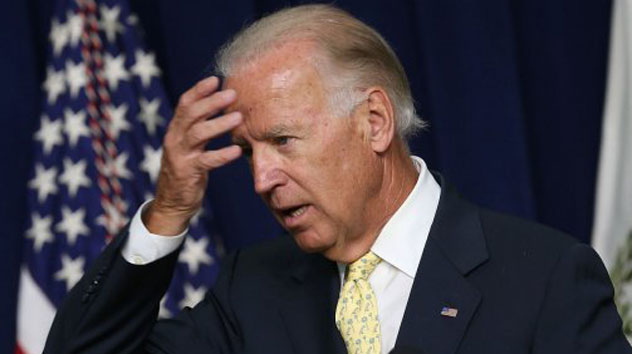
Biden confused

In September 2019, at the third Democratic presidential debate, an ABC moderator asked Joe Biden:

“…as you stand here tonight, what responsibility do you think that Americans need to take to repair the legacy of slavery in our country?”

Biden answered:

“Well, they have to deal with the — look, there’s institutional segregation in this country. And from the time I got involved, I started dealing with that. Red-lining banks, making sure that we are in a position where — look, you talk about education…make sure that we bring in to help the teachers deal with the problems that come from home. The problems that come from home, we need — we have one school psychologist for every 1,500 kids in America today. It’s crazy. The teachers are — I’m married to a teacher. My deceased wife is a teacher. They have every problem coming to them. We have — make sure that every single child does, in fact, have 3-, 4-, and 5-year-olds go to school. School. Not daycare. School. We bring social workers into homes and parents to help them deal with how to raise their children. It’s not that they don’t want to help. They don’t — they don’t know quite what to do. Play the radio, make sure the television — excuse me, make sure you have the record player on at night, the — the — make sure that kids hear words. A kid coming from a very poor school — a very poor background will hear 4 million words fewer spoken by the time they get there.”

Good grief!


Bloomberg’s money: now what?

bloombergmoney2

Democrats, eager to position themselves as the good guys in the campaign finance debate, weren’t real happy about all that Bloomberg money flowing into the primary campaign.

Bloomberg spent an estimated $500 million in just 100 days on slick TV ads, mailers, about 2400 staff spread around the country and for political-data and polling. Critics, including his Democratic primary opponents, accused him of trying to buy the nomination.

But now that Bloomberg has abandoned his campaign, will the Democrats become more accepting of his pledge to keep spending millions to help Democrats win the presidency and other races in the general election?

Bernie Sanders has said he wants to win with small dollar individual contributions. He’s also said he wouldn’t welcome Bloomberg’s big money help. Joe Biden, who has a history of decrying the role of wealthy people and special interests in elections, has been considerably more flexible in practice.

According to the Federal Election Commission (FEC) and Open Secrets, a nonpartisan website by the Center for Responsive Politics that tracks the effects of money and lobbying on elections and public policy, Sanders has raised $134,069,993, about one-third of that in large contributions.

In contrast, the Biden for President committee has raised $68,281,49, about two-thirds of that in large contributions:

A pro-Biden SuperPAC, Unite the Country, has raised an additional $7,919,417 from just 163 donors, with employees of the top three donors (Masimo Corp; Blum Capital Partners; Marcus & Millichap) giving $1 million each. A Leadership PAC, American Possibilities, has donated $432,948 more.

If Bloomberg decides to follow through on his pledge to spend millions to defeat Trump, there are no limits on what he can spend. Since he’s worth an estimated $60 billion, he could be a very big player.

He would be prohibited from coordinating his spending decisions with the eventual Democratic nominee, but that is honored more in the breach than the observance. .

Biden says on his presidential campaign website that he will “reduce the corrupting influence of money in politics.”

“Biden strongly believes that we could improve our politics overnight if we flushed big money from the system and had public financing of our elections,” his website says. “Democracy works best when a big bank account or a large donor list are not prerequisites for office, and elected representatives come from all backgrounds, regardless of resources. But for too long, special interests and corporations have skewed the policy process in their favor with political contributions.”

So much for empty rhetoric.

If Biden wins the Democratic nomination, neither he nor the Democratic Party will try to stop Bloomberg from pouring his money into the campaign to defeat Trump. You can bet on it.

“Legislative walkouts are undemocratic.” Nonsense.

housewalkout2

In an opinion column in the Feb. 27, 2020 Lake Oswego Review, State Senator Rob Wagner (D-Dist 19) said the walkouts of Republicans in the House and Senate to block Democrats’ climate change legislation “…are an attack on democracy itself.”

“Serving as state senator is a job I take seriously,” Wagner wrote. “I view it as a great honor and a great responsibility. Walking out on the job is irresponsible. Shutting down democracy is irresponsible. Accepting a paycheck while refusing to work is not only irresponsible, it’s unethical and it’s disrespectful.”

Sounds all very noble, a sincere effort to position himself as an honorable servant of the people, an exemplar of moral superiority. The reality is quite different. Legislative history reveals that Wagner is more a political opportunist and a hypocrite.

The fact is legislative walkouts (even jump-outs) by Democrats and Republicans have a long history in Oregon and other states, going back at least to 1840. In December of that year,  Abraham Lincoln, then a state representative in Illinois,  jumped out of a first-floor window of a church a serving as temporary legislative chambers to avoid a quorum call on a Democratic banking bill that he and fellow Whigs fiercely opposed

In Oregon, House Democrats walked out for five days in 2001 over redrawing state legislative districts.  Senate Democratic Leader (now governor) Kate Brown, D-Portland, called the House Democrats’ actions “very appropriate under the circumstances.” Democratic Representatives Mark Hass (current State Senator) and Laurie Monnes Anderson (current State Senator) supported the walkout.

In April 1995, ten Senate Democrats walked out over an award named after the late Sen. Frank Roberts, a Democrat.

In 1971, House and Senate Democrats walked out over voting age and other issues.

The current controversy goes back to voter approval of Ballot Measure 71 in the Nov. 2010 general election. Until that point, the Oregon Legislature was restricted to meeting in regular session only during odd-numbered years.

Measure 71 amended the state’s constitution to add an even-year regular session and placed limits on the length of sessions in both even and odd years.  Odd-year sessions were limited to 160 calendar days, even-year sessions to 35 calendar days.

Proponents of Measure 71 argued that the state was too complex for the legislature to make budget decisions on a two-year basis and some critical policy decisions either couldn’t or shouldn’t be held off for extended periods.

The common assumption was that the short sessions would provide a venue for urgent actions and facilitate a smoother running government while still keeping the longer sessions for consideration of consequential laws of wide public interest.

The 2020 short session is, however, hardly limiting itself to a few urgent bills. According to LegiScan, the session has 283 bills before it. In addition to the controversial cap-and-trade bill (Senate Bill 1530), bills have been introduced with widely varying degrees of apparent urgency. These include bills that would:

  • Prohibit anybody from conducting or participating in a contest, competition, tournament or derby that has the objective of taking coyotes for cash or prizes.
  • Regulate kratom, a tropical tree with leaves that contain compounds that can have psychotropic (mind-altering) effects.
  • Require secure storage of guns and give local governments the authority to decide if guns should be allowed on their grounds.
  • Direct Oregon Health Authority to assess supply and demand of behavioral health professionals in state.
  • Describe evidence that Health Licensing Office may consider to determine if applicant for residential care facility administrator license has earned high school diploma or equivalent.
  • Recognize 2019 Oregon Women of Achievement for outstanding leadership and service to people of Oregon.
  • Makes unlawful practice for place of public accommodation to refuse to accept United States coins or currency as payment for goods and services.
  • Recognize and honor artistic and civic contributions of Michael A. Gibbons.
  • Allow expanded practice dental hygienist to perform interim therapeutic restoration.
  • Recognize University of Oregon Ducks quarterback Justin Herbert for outstanding season and remarkable career.
  • Require the Department of Transportation to study development of uniform standards for speed bump height and markings.
  • Congratulate Rogue Creamery for winning top prize at World Cheese Awards.
  • Establish a Task Force to Promote Social Equity in the Cannabis Industry.
  • Establish a product stewardship program for mattresses.
  • Authorize Oregon Business Development Department to award matching grants to membership organizations and business accelerators in outdoor gear and apparel industry.
  • Prohibit abortion unless physician has first determined probable post-fertilization age of unborn child, except in case of medical emergency. Prohibits abortion of unborn child with probable post-fertilization age of 20 or more weeks, except in case of medical emergency
  • Require health care practitioner to exercise proper degree of care to preserve health and life of child born alive after abortion or attempted abortion. Requires health care practitioner to ensure child born alive is transported to hospital.
  • And of course, allow Oregon voters to decide whether to change the constitution so a majority of the legislature constitutes a quorum, rather than the current two-thirds.

The problem for Democrats during this short session is that Article IV, section 12 of the Oregon Constitution says “two thirds of each house shall constitute a quorum to do business.” With the Republican walkout, there’s no quorum, so business is halted.

Just as Congressional rules can be effectively wielded in political battles, it is hardly undemocratic for a party to rely upon Oregon’s constitution to advance or hinder legislative action. Moreover, the Democrats should be cautious in pushing for change. If they convince voters to amend the constitution to consider a simple majority a quorum in the future, that could come back to bite them if Republicans regain control.


Presidential pardons have a long, sad history

trumpturkeypardon

Presidents have long been pardoning more than just turkeys.

“The clemency orders that Mr. Trump issued this week were the result of a process that bypassed the formal procedures used by past presidents and was driven instead by friendship, fame and a shared sense of persecution.” That was the New York Times’ take this morning.

In singling out Trump, the paper seems to have forgotten recent history. As contemptible and unwise as Trump’s actions are to many, he is hardly the first president to take questionable actions in this arena.

President Obama issued 212 pardons and 1,715 commutations, including one of a 35-year prison sentence given to former U.S. Army soldier Bradley/Chelsea Manning for the largest leak of classified data in U.S. history to WikiLeaks.

President Clinton, never one to be embarrassed by his actions, pardoned his brother Roger Clinton after Roger served a year in prison after pleading guilty to cocaine distribution charges.

In August 1999, Clinton also commuted the sentences of 16 members of FALN, a Puerto Rican paramilitary organization that had set off 120 bombs in the United States, mostly in New York City and Chicago. The commutation was opposed by the U.S. Attorney’s Office, the FBI, and the Federal Bureau of Prisons and Congress condemned Clinton’s action by votes of 95–2 in the Senate and 311–41 in the House.

One pundit recently commented that at least Trump didn’t pull a fast one on his last day in office. That was when Clinton’s did his most egregious pardon. On January 20, 2001, against the advice of White House aides ,he pardoned Marc Rich, a former hedge-fund manager. Rich had fled the U.S. during his prosecution and was living in Switzerland at the time. Rich owed $48 million in taxes and had been charged with 51 counts of tax fraud.

At the time of the pardon, Rich was No. 6 on the government’s list of most wanted fugitives and had been on the lam, albeit a luxurious one, for 16 years, ever since his 1983 indictment by a grand jury.

Rich’s ex-wife had donated to the Democratic National Committee, the Clinton Presidential Library and Hillary Clinton’s New York Senate campaign, raising considerable suspicion about the pardon and leading former President Jimmy Carter to call the pardon “disgraceful.”

A New York Times editorial called the pardon “a shocking abuse of presidential power.” The liberal New Republic said it “is often mentioned as Exhibit A of Clintonian sliminess.” Not that such allegations ever seemed to bother the Clintons.

And the Clintons reaped benefits from the pardon even after Rich’s death in 2013, as Rich’s former business partners, lawyers, advisers and friends continued to shower millions of dollars on the Clintons.

Of course, Clinton isn’t the only “last day in office” pardoner. Remember Peter, Paul and Mary? In 1970, Peter Yarrow was convicted of taking “improper liberties” with a 14-year-old fan, for which he spent three months in jail. On his last day in office, President Jimmy Carter granted Yarrow a pardon.

President George H.W. Bush was roundly condemned for pardoning, commuting the sentences and rescinding the convictions of six people convicted in the Iran-Contra arms-for-hostages scandal during Reagan’s presidency,

Reagan stepped up, too, pardoning New York Yankees owner George Steinbrenner after he pleaded guilty to illegally contributing to Nixon’s campaign.

Then there’s Nixon. In 1974, President Gerald Ford granted a “full, free and absolute pardon” to his predecessor Richard Nixon “for all offenses against the United States.” This broadly unpopular action was the only time a president has received a pardon. It caused a huge firestorm because Nixon was so unpopular and because there was suspicion that Ford secretly promised to pardon Nixon in exchange for him resigning and allowing Vice President Ford to succeed him.

So much for punishing bad behavior.

Hubris will bring down Donald Trump

“Pride goeth before destruction, and a haughty spirit before a fall.”

 King James Version of the Bible. Book of Proverbs, 16:18

TrumpAcquitted

President Trump was ecstatic. Standing before a crowd of in the East Room of the White House, he held aloft a copy of the Washington Post. “Trump acquitted” the headline declared in bold letters. For about an hour, Trump celebrated and embraced the applauding crowd of administration officials and supporters.

“Now we have that gorgeous word,” said a triumphant Trump. “I never thought a word would sound so good. It’s called: total acquittal.”

What’s next?

Probably overreach and misfortune.

If history is any guide, the president and his sycophantic hangers-on will want to run a victory lap.

The first sign of that has already emerged, dismissal of some of those Trump believes have undermined him and his cause.

These moves were presaged by Eric Ueland, the White House’s legislative affairs director, who said to a group of Capitol Hill reporters, “I can’t wait for the revenge.”

The first targets were Lt. Col. Alexander Vindman, who testified in the House impeachment hearings, and his brother, Lt. Col. Yevgeny Vindman, Both were bounced from the National Security Council and Trump appeared to suggest that the Army should discipline Alexander. Then Gordon Sondland, the U.S. ambassador to the European Union, was fired after refusing to resign.

Trump also rescinded his nomination of Jessie Liu, former U.S. Attorney for D.C., who presided over the case against former Trump campaign adviser Roger Stone, and criticized D.C. District Judge Amy Berman, whom Liu worked with. Stone was convicted in November 2018 on seven counts of obstructing and lying to Congress and witness tampering.

Another likely Trump move will be taking new and excessive risks, with Trump and his most devoted followers sucked into delusions that they are on a roll and are now invincible.

As the writer P. G. Wodehouse put it. “I’m not absolutely certain of the facts, but I rather fancy it’s Shakespeare who says that it’s always just when a fellow is feeling particularly braced with things in general that Fate sneaks up behind him with the bit of lead piping.”

The behavior of previous presidents is instructive.

For Lyndon B. Johnson, the lead piping that confronted his hubris was the Vietnam war.

After President John F. Kennedy’s assassination in 1963, Johnson used his political cunning to push a historic civil-rights bill and a massive Great Society program through Congress. Then he trounced Republican Barry Goldwater in the 1964 election, carrying 44 of the 50 states and the District of Columbia.

He was on a roll, confident of public support as he simultaneously poured money into the Great Society and ramped up the America’s military commitment in Vietnam. Then the anti-war protests began, small at first, mostly on college campuses, then massive, furious and country-wide.

Eventually worn down and dispirited, the once ebullient Johnson announced soberly on March 31,1968 that he would not seek a second full term.

For Ted Kennedy, it was hubris that led to Chappaquiddick.

On July 17, 1969, he saw himself as a rising star, primed to carry forward the legacy of his brothers, Robert Kennedy, gunned down a year earlier, and President John F. Kennedy, assassinated in 1963.

Then everything changed. On the night of July 18, 1969, Ted Kennedy left a party and recklessly drove an Oldsmobile Delmont 88 off Dike Bridge on Chappaquiddick Island, killing his passenger, 28-year-old Mary Jo Kopechne.

Ten hours later, and only after consulting with his advisors, Kennedy reported the accident to police, To the disgust of many who thought him guilty of much more, he managed to escape with only a two-month suspended sentence for leaving the scene of an accident.

But the fatal accident left a stain that couldn’t be erased.

“(The) accident that killed Mary Jo was the end of the Kennedy moment, when the dreams of Camelot and the deferred hopes of martyrdom went skidding off the road and disappeared into the abyss,” wrote Peter Canellos, editor-at-large of Politico.

Richard Nixon experienced a fall from grace after reaching the mountaintop, too.

After narrowly losing the presidential race to John F. Kennedy in 1960, Nixon waged a successful campaign against Vice President Hubert Humphrey and Alabama Governor George Wallace in 1968 in a close election.

On November 7, 1972, Nixon reached the peak of his success when he ran against Sen. George McGovern and won in an electoral landslide. McGovern carried only Massachusetts and Washington, D.C.

Just 21 months later, on August 8, 1974, Nixon went from the heights to the depths, becoming the first U.S. president to resign his office.

nixon2

Nixon departing from the White House after his resignation.

Behind his downfall was a paranoid White House more than willing to bend the rules. At one point that included burglarizing the office of Daniel Ellsberg’s psychiatrist in an effort to uncover evidence to discredit Ellsberg, who had leaked the Pentagon Papers.

Then there was Watergate. In a 1973 Fortune analysis, Associate Managing Editor Max Ways described the Watergate affair as a failure of management.

“These footless ventures would remain forever incomprehensible unless we turned to the beliefs and emotional patterns of the participants.,” Ways wrote. “Their attitudes were shaped in part by the general ambience that enveloped the White House and the Committee to Re-elect the President, and that ambience included a lot of fear, suspicion, and hostility. Although the word “paranoia,” used by many people, is too strong, it is correct to say that a high level of self-pity influenced the style of the Nixon White House.

The seeds of this attitude were sown long before Watergate. Self-pity was evident, though excusable, in many of Nixon’s periods of adversity, and it had not melted away in the warm sun of ambition fulfilled.”

George W. Bush and his close advisors were also overly confident that the country was behind them and would hang tough after Bush responded to the Sept. 11 terrorist attacks with aggressive military action in Afghanistan and Iraq.

USinAfghanistan

U.S. soldiers in Afghanistan.                                                                                                                       “After 18 years of war, thousands of lives lost, and hundreds of billions of dollars squandered, the United States accomplished precisely nothing.”                                                      ForeignPolicy.com

“In considering war on Iraq,” Newsweek said, “the sibling of danger was opportunity…The thinking went that if the United States could change the regime in Baghdad, it might create a new model of democracy in the Middle East. After all, democracy was on the rise globally …”

In concert with that thinking, Newsweek cited a belief in the prowess of the high-tech United States military and its ability to ensure that wars in Afghanistan and Iraq would be “decisive, quick, easy, and low-cost.”

They weren’t.

Why will Trump fall from grace after his impeachment victory? History and his character foretell it.

In his book “Truman,” David McCullough said it was Truman’s character that defined the man.

“He stood for common sense, common decency,” McCullough wrote. “He spoke the common tongue. As much as any president since Lincoln, he brought to the highest office the language and values of the common American people. He held to the old guidelines: work hard, do your best, speak the truth, assume no airs, trust in God, have no fear.”

This is about as far as you can get from a description of President Donald Trump.


The Iowa caucus: What a tangled web progressive Democrats weave

The Iowa Democratic caucus was a mess. Right in the middle of it was Shadow Inc, the developer of the app that malfunctioned big time in reporting on the caucus results. But it doesn’t end there.

caucusfail

Now bear with me.

According to the Poynter Institute’s Politifact, Shadow began as Groundbase, a tech developer co-founded by Gerard Niemira and Krista Davis with an initial investment from another progressive nonprofit, Higher Ground Labs. Niemiura and Davis had previously worked for the tech team on Hillary Clinton’s 2016 presidential campaign.

According to the New York Times, Groundbase was nearly bankrupt when ACRONYM, a Democratic organization working to advance progressive causes, acquired the company on January 17, 2019. ”Some news this morning,” ACRONYM tweeted. “We’ve acquired SMS tool Groundbase & are launching Shadow, a company focused on building the technology infrastructure needed to enable Democrats to run better, more efficient campaigns.”

Niemira is now Shadow’s Chief Executive. In July 2019, Shadow said, “Since we initially announced our acquisition by ACRONYM earlier this year, Shadow has been hard at work to publicly launch and bring you new tools to help progressive campaigns and causes win up and down the ballot.”

Tara McGowan, ACRONYM’s founder and CEO, worked on the CBS program 60 Minutes, as a digital producer with Barack Obama’s 2012 presidential campaign and as Digital Director for Priorities USA, a super PAC that supported Hillary Clinton in the 2016 presidential race.

Vox reported today (Feb. 5, 2020) that after the Iowa debacle ACRONYM scrubbed its website of mentions of launching Shadow and says it’s just one of multiple investors along for the ride. “Acronym’s decision to distance itself from Shadow — or perhaps lying about it altogether — is making the situation worse, not better,” Vox said.

ACRONYM is a dark money group, so donations received by its 501(c)(4) nonprofit don’t have to be reported. That means who’s donating and how much is a mystery. But ACRONYM’s super PAC, PACRONYM, does have to report contributions to the Federal Election Commission (FEC).

The Center for Responsive Politics, a nonpartisan, independent and nonprofit campaign finance research group, reports on Open Secrets 2018 and 2020 election cycle contributions of $500,000 from movie director Steven Spielberg and $500,000 from his wife, Kate Kapshaw, $2,000,000 from the National Democratic Redistricting Committee, $300,000 from ACRONYM, $50,000 from Michael Dubin, founder of Dollar Shave Club, and $100,000 from Jeffrey Katzenberg, former Chairman of Walt Disney Studios and  co-founder and former CEO of Dreamworks.

But wait. There’s more.

Another operation under ACRONYM’s umbrella is a for-profit digital media outfit, Courier Newsroom.

On Jul 24 2019, Vice reported that the Democratic super PAC, Priorities USA, planned to invest $100 million in four so-called “news” outlets put out by Courier Newsroom that would be staffed by Democratic operatives and would publish state-specific information across social media in Michigan, Pennsylvania, Florida, and Wisconsin.

The local news outlets would complement national media that are aligned with the Democratic Party such as The American Independent , which describes itself as “the No. 1 digital platform for progressive news” (formerly ShareBlue) and Media Matters For America, which says it is “a web-based, not-for-profit, 501 (c)(3) progressive research and information center.”

Courier Newsroom currently has three properties:  The Dogwood in Virginia, Copper Courier in Arizona and UpNorth News in Wisconsin.

Typical of the stories on the sites is a Feb. 4, 2020 item in UpNorth News: “Trump Gave Rush Limbaugh the Presidential Medal of Freedom on Rosa Parks Day – The conservative radio host has a decades-long history of making racist, xenophobic, and sexist comments. In contrast, Parks, who received the award in 1996, was a key leader in the Civil Rights Movement.”

Courier Newsroom’s homepage initially gives no clue that it’s a highly partisan publication. “At COURIER, we empower individuals and communities through local reporting that helps people understand and affect the issues impacting their lives,” the homepage says. It’s only way down after the listing of staff that this appears: “COURIER is owned and operated by Courier Newsroom, a progressive media company owned by the non-profit ACRONYM.”

What a tangled web progressive Democrats weave.