Peak Cringe: A Melania Trump Documentary Is Coming

In today’s political culture, supplicants don’t bother with subtle appeals for favors; they just pay up.

Talk about obsequiousness. 

On Sunday, Amazon announced that its Prime Video streaming service would release a “behind the scenes” documentary about Melania Trump’s life that will be shown in theaters and stream on Amazon Prime later this year. To top it off, Melania Trump will be the film’s executive producer, ensuring it will be a hagiography. 

Adding insult to injury, Amazon has agreed to pay $40 million to Trump for the documentary, according to Puck News, and it will be directed by Hollywood director and producer Brett Ratner,   accused in 2017  by six women, including actress Olivia Munn, of sexual misconduct, according the Los Angeles Times

Amazon, founded by Jeff Bezos, who is also the owner of the Washington Post, said it was “excited to share this truly unique story.” 

In May 2025, the New Yorker ran a story noting that just before Christmas, Bezos and Lauren Sánchez, his fiancé, dined with Donald Trump and Melania at Mar-a-Lago. During the meal, according to the Wall Street Journal, Melania told Bezos and Sánchez about a documentary project she was developing based on her own life. Two weeks later, Amazon licensed the film for forty million dollars, nearly three times more than the company had ever spent on a documentary. As much as twenty-eight million dollars of the licensing fee will go directly to the First Lady.

Talk about trying to curry favor with Donald Trump, a famously self-absorbed impulsive, vindictive politician. As Semafor Business said, “An open-air bazaar has replaced a black market of influence-peddling. It’s unsettling to reporters who are used to having to dig around for evidence of pay-to-play.”

If a First Lady documentary is worth doing, others have a considerably stronger claim.

Betty Ford, President Gerald Ford’s wife,  Ford was noted for raising breast cancer awareness following her 1974 mastectomy and was a passionate supporter of the Equal Rights Amendment (ERA). She also was involved in HIV/AIDS causes and served as the first chair of the board of directors of the Betty Ford Center, which provides treatment services for people with substance use disorders.  

Nancy Reagan, wife of President Ronald Reagan, was an accomplished former actress and a passionate advocate for decreasing drug and alcohol abuse, initiating a campaign to “just say no” to drugs.

Eleanor Roosevelt, wife of President Franklin Roosevelt, was, in her time,  one of the world’s most widely admired and powerful women. During her husband’s presidency she was aggressive advocate of liberal causes, defending the rights of defense of the rights of Blacks and the poor and wrote a widely read daily syndicated newspaper column. After his presidency, she was appointed a delegate to the United Nations,  where she served as chairman of the Commission on Human Rights (1946–51) and played a key role in the drafting and adoption of the Universal Declaration of Human Rights.

There’s even an interesting story to tell about President Woodrow Wilson’s second wife, Edith Wilson. For all intents and purposes she conspired to serve as the “acting president”  for an astonishing 17 months after her  husband suffered a paralyzing stroke in the fall of 1919

First Lady Dolley Madison, the wife of President James Madison, is often credited with saving the portrait of George Washington and other White House treasures when the British attacked the Capitol in 1814. Hillary Clinton, wife of President Bill Clinton, went on to serve as U.S. Secretary of State, a New York Senator and a Democratic candidate for the presidency. Rosalynn Carter, wife of President Jimmy Carter,  was committed to the improvement of mental health care and after her husbands term in office became a strong participant in efforts that, as she said, would result in “good for others” including Habitat for Humanity.

Can you think of one thing that distinguishes Melania Trump, the “I really Don’t Care. Do You?” First Lady, and her life enough to justify a boot-licking Amazon documentary?

I didn’t think so.
The Spotify Conundrum: Mixing Music and Morality

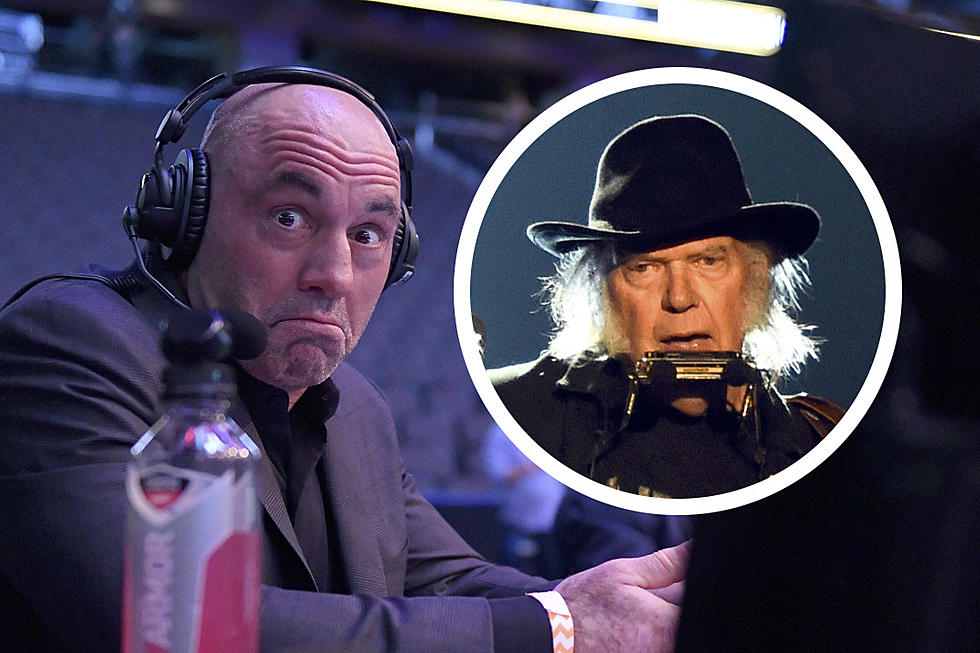
Rogan Responds to Spotify Controversy, Young Defects to Amazon

Mixing music and morality can get tricky.

Last week, musician Neil Young set off fireworks when he demanded that his music be pulled off the audio streaming service Spotify because he objected to its high visibility podcaster, Joe Rogan, spreading alleged Covid misinformation.

Claiming the moral high ground, Young wrote in a letter published on his website on Jan. 24, “I am doing this because Spotify is spreading fake information about vaccines — potentially causing death to those who believe the disinformation being spread by them.”

Others have jumped enthusiastically on Young’s condemnation train, including Joni Mitchell,  Nils Lofgren, India Arie, Dwayne Johnson, Kevin James, Jewel, Jamie Kennedy, Tulsi Gabbard, Troy Aikman, Kat Von D, Domanic Monaghan, Candice Owens, Jillian Michaels, Tomi Lahren and Andrew Dice Clay.

On Feb. 3, Roxane Gay, an author and a contributing Opinion writer for The New York Times decided she needed to join the fray, wrote an opinion column for The New York Times announcing shew was pulling her podcast, “The Roxane Gay Agenda,” from Spotify.

Also signing on to the crusade — David Crosby, Graham Nash and Stephen Stills. “Until real action is taken to show that a concern for humanity must be balanced with commerce, we don’t want our music — or the music we made together — to be on the same platform,” they said in a statement.

Even Tedros Adhanom Ghebreyesus, director-general of the World Health Organization, endorsed Young’s action on Twitter. 

So where did uber-moral Young direct his listeners as one of the acceptable alternative music streaming services?  Amazon. Clearly he did not consider the negative consequences of his well-intentioned actions.

In a Twitter post, Young included a link for new subscribers signing up for Amazon Music and saying they can receive four months free.  “Amazon has been leading the pack in bringing Hi-Res audio to the masses, and it’s a great place to enjoy my entire catalog in the highest quality available,” Young said.

Talk about jumping out of the frying pan and into the fire!

Amazon is hardly a paragon of virtue either.

The company has been accused of:

  • Using data about products offered by independent sellers on the company’s platform to develop competing products.
  • Vigorously opposing trade unions at its massive warehouses.
  • Directly or indirectly benefiting from forced labor of Uyghur peoples in internment camps in Xinjiang, China and at factories in major supply chains.

In other words, Amazon is a poster child for questionable business practices.

Amazon is also already a dominant player, with Amazon Marketplace accounting for about 25% of all online spending in America, meaning a quarter out of every dollar spent online goes to the marketplace. You’d have to combine the next five mass-market retailers (Walmart, eBay, Apple, The Home Depot and Target) to equal its size.

And it keeps spreading out, invading every part of our lives. In 2020, Amazon announced Amazon Pharmacy, a new store on Amazon that allows customers to complete an entire pharmacy transaction on their desktop or mobile device through the Amazon App. In January 2022, Amazon, already  the largest clothing retailer in America since it started selling clothing in 2002, announced it planned to open Amazon Style, its first clothing, shoe and accessories’ store, later this year at a posh shopping complex in Los Angeles. 

Do all these high minded critics of Spotify really think Amazon is a more ethical socially conscious company than Spotify? Is it really wise to direct even more business its way, as Young suggests?

I think not.

Dear Sen. Wyden: If you want $15 an hour, then walk the talk.

If Sen. Ron Wyden (D-OR) really believes the minimum wage across the United States should be $15 an hour, he and his wife should start in their own back yard.

The Strand Bookstore in New York City, which is owned by Sen. Wyden’s wife, Nancy Bass Wyden, doesn’t even pay all of its employees at least $15 an hour.

NOTE (Added 3/1/21): I’ve discovered that the general hourly minimum wage in New York City has been $15 since Dec. 31, 2019. I don’t understand how Glassdoor can show employee wages reported by employees as less than that. This suggests that either the employees are not being truthful in reporting their wages or the Strand is breaking the law)

The Strand’s main site is a massive store, “home of 18 miles of books,” at 828 Broadway in Manhattan.

Based on salary data shared by Strand employees with Glassdoor, a website where current and former employees anonymously review companies and submit their salaries, multiple job categories pay less than an average of $15 an hour. This includes booksellers (ave. hourly pay: $14), visual merchandisers (ave. hourly pay: $14 – $16), sales staff (ave. hourly pay: $12 – $13), sales associates (ave. hourly pay: $12), booksellers (ave. hourly pay: $11 – $12), and web fulfillment staff (ave. hourly pay: $13 – $14). Indeed.com, another website with salary postings, says only 47% or employees who have reported on the site think they are paid fairly by Strand and reviewers give the company a rating of only 2.9 on a scale of 5 in Pay and Benefits.

And these are average hourly wages, meaning some employees probably earn less, even though the hourly workers are unionized, affiliated with UAW Local 2179.

Even with the wages the Strand already pays, in Oct. 2020 Nancy Bass Wyden pleaded for public support in light of the business lost because of the pandemic, saying, “…we are now at a turning point where our business is unsustainable.”

Her employees don’t seem to be behind her. In July 2020, one employee commented on Glassdoor “The Strand brand markets as progressive, but its mere marketing. The business is profitable, but in one of the most expensive cities in the world, the business owner (Nancy Bass-Wyden, wife of Sen. Ron Wyden, who owns the building and rents sections of it out) pays her workers the bare minimum. Equality isn’t overcharging people for pink-totes and rainbow pins. Salaries should live up to slogans. Pay better, be better, do better. Micromanage less.”

All this in a city that has the highest cost of living in the United States, 35% higher than in Portland, OR. In other words, if Sen. Wyden thinks workers across America should be earning a minimum of $15 an hour, workers in New York City should be making quite a bit more.

In the same context, for example, workers earning $15 an hour in Hawaii are in quite a different position than workers earning $15 in Mississippi. That’s because an income of $47,520 in Hawaii has the equivalent purchasing power of an income of $36,480 in Mississippi.

Similar disparities occur when looking at Metropolitan Statistical Areas (MSAs). As the Federal Reserve Bank of St. Louis pointed out in a recent blog post, a dollar in one city isn’t necessarily the same as a dollar in another: Average per capita personal income nationwide is about $43,996. In terms of purchasing power, the equivalent income in St. Louis, Missouri, is below $40,000 due to the relatively low cost of living. Meanwhile, in comparatively expensive New York, New York, the equivalent income is almost $54,000. In other words, as the cost of living goes up, it takes more dollars to buy the same basket of goods and services.

That’s part of the problem with all this talk from Wyden, other Democrats and some big companies, such as Amazon, about raising the federal minimum wage across the U.S. to $15. “Companies listed on Wall Street may support a much higher minimum wage because it would give them a competitive advantage, but a hike would make it that much harder for Main Street to even continue to exist,” Kevin Kuhlman, vice president of federal government relations for the National Federation of Independent Business, told Roll Call

Of course, if Sen. Wyden wants to set a wage of $15 an hour for members of Congress, we could talk about that.

Satire from The Borowitz ReportAmericans Favor Fifteen Dollars an Hour for CongressAcross the nation, service employees demonstrated their conviction that Congress deserves a maximum hourly wage of fifteen dollars.By Andy Borowitz

Photograph by Pablo Martinez/AP