US Action in Venezuela: Menacing and Unpredictable

The largest U.S. military presence in the Caribbean in decades is now operating, with nearly 20% of the Navy’s deployed warships in the region, according to a Stars and Stripes’ analysis. The deployment also includes the 22nd Marine Expeditionary Unit based in Camp Lejeune and Marine Corps Air Base New River. The 22nd MEU consists of Marine Medium Tiltrotor Squadron 263 (Reinforced), Combat Logistics Battalion 26 and the Battalion Landing Team, 3rd Battalion, 6th Marine Regiment.

Additionally, a squadron of Marine Corps F-35 Lightning II fighter aircraft has been sent to Puerto Rico, where the former Naval Station Roosevelt Roads has become a staging area for U.S. forces in the region, according to Task & Purpose, a military-focused news publication.

Other American aircraft, including an AC-130J Ghostrider, an Air Force gunship designed for close air support, air interdiction and armed reconnaissance, have been spotted operating in El Salvador. The aircraft, known for being the most heavily armed gunship in history, “plays a critical role in supporting ground operations, providing close air support to troops in contact, conducting armed reconnaissance missions, and engaging enemy targets” according to The Aviationist.

An AC-130J Ghostrider being refueled

The New York Times has reported that U.S. officials ran a war game during President Trump’s first term to assess what the Venezuelan strongman Nicolas Maduro’s fall might unleash. “The results showed that chaos and violence were likely to erupt within Venezuela, as military units, rival political factions and even jungle-based guerrilla groups jockeyed for control of the oil-rich country.”

Nevertheless, asked if he would rule out U.S. troops on the ground in Venezuela, Trump said on Monday “No, I don’t rule out that, I don’t rule out anything.”

And then, of course, no matter what happens, will it matter? Mary Speck, former executive director of the Western Hemisphere Drug Policy Commission, wrote today in the Dispatch, “The United States—for all its military might—cannot defeat “narco-terrorism” unilaterally by ousting a corrupt and brutal dictator. Whatever the end game of the U.S. military deployment in the Caribbean, the region’s drug cartels have nothing to fear.”.

What is the balance of risk? ,” opinion columnist Bret Stephens wrote in November 19s New York Times. “Unintended consequences must be weighed against the predictable risks of inaction…And Trump’s hesitation will be read, especially in Moscow and Beijing, as a telling signal of weakness that can only embolden them, just as President Biden’s withdrawal from Afghanistan did.”

“Any morally serious person should want this to end,” Stephens opined. “The serious question is whether American intervention would make things even worse.”

As Puck observed on Nov. 20, “Trump’s plan for Venezuela may be a mystery even to himself. “I think he thinks about what will make him look tough, but he doesn’t think much beyond that,” said John Bolton. “He never does.”

What does the Trump administration want to achieve in this dramatic effort and what will be the cost? America waits.

U.S. Forces Now in the Caribbean

Up to 15,000 U.S. troops are in the area.
USS Newport News SSN-750
Four F/A-18E/F Super Hornets, assigned to Strike Fighter Squadrons 31, 37, 87, and 213 from embarked Carrier Air Wing Eight aboard USS Gerald R. Ford (CVN-78), and a U.S. Air Force B-52 Stratofortress operate as a joint force with the Gerald R. Ford, Nov. 13, 2025. US Navy photo
  • The “Tomcatters” of Strike Fighter Squadron (VFA) 31 – F/A-18E – from Naval Air Station Oceana, Va.
  • The “Ragin Bulls” of VFA 37 – F/A-18E – from Naval Air Station Oceana.
  • The “Golden Warriors” of VFA 87 – F/A-18E – from Naval Air Station Oceana.
  • The “Black Lions” of VFA 213 – F/A-18F – from Naval Air Station Oceana.
  • The “Gray Wolves” of Electronic Attack Squadron (VAQ) 142 – EA-18G – from Naval Air Station Whidbey Island, Wash.
  • The “Bear Aces” of Airborne Command and Control Squadron (VAW) 124 – E-2D – from Naval Air Station Norfolk, Va.
  • The “Rawhides” of Fleet Logistics Squadron (VRC) 40 Det. – C-2A – from Naval Air Station Norfolk.
  • The “Spartans” of Helicopter Maritime Strike Squadron (HSM) 70 – MH-60R – from Naval Air Station Jacksonville, Fla.
  • The “Tridents” of Helicopter Sea Combat Squadron (HSC) 9 – MH-60S – from Naval Air Station Norfolk.

Carrier Air Wing 8
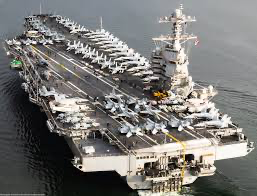

USS Gerald R. Ford (CVN-78) with 9 embarked squadrons of Carrier Air Wing Eight
Arleigh Burke-class guided-missile destroyer USS Bainbridge (DDG 96)
Arleigh Burke-class guided-missile destroyer USS Mahan (DDG 72)
Air and missile defense command ship USS Winston S. Churchill (DDG 81)

Littoral combat ship USS Wichita (LCS-13)

Guided missile cruiser USS Lake Erie (CG – 70)
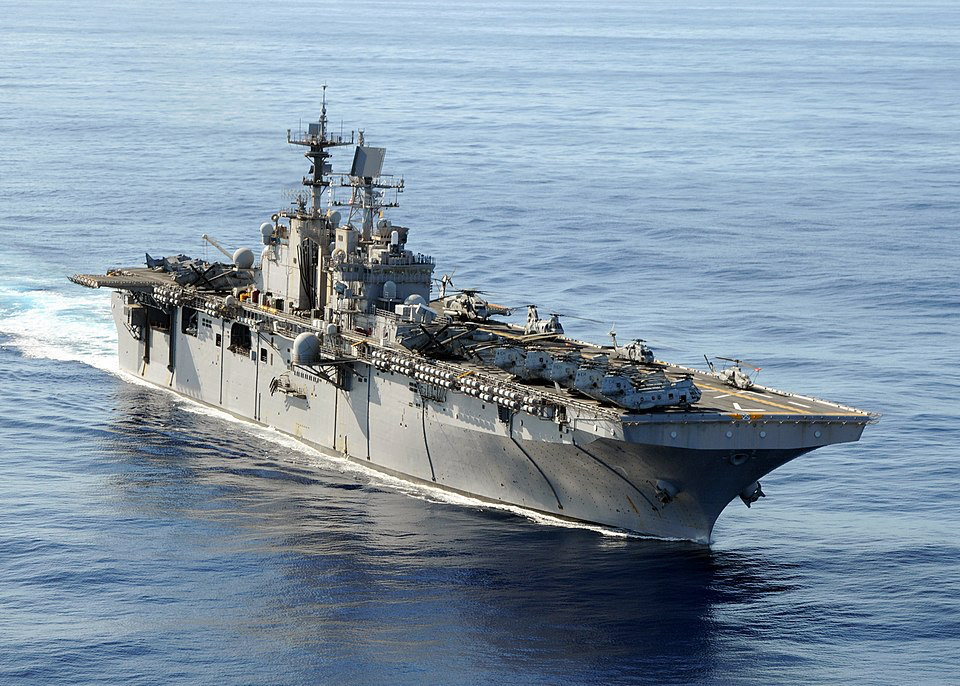
Wasp-class amphibious assault ship USS Iwo Jima (LHD-7)
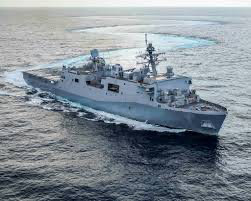
Amphibious transport dock ship USS Fort Lauderdale (LPD-28)

Amphibious transport dock ship USS San Antonio (LPD-17)

Guided missile destroyer USS Gravely (DDG-107)

Guided missile destroyer USS Stockdale (DDG-106)

“Militarily, the table is set quite effectively for air strikes,” retired Navy Adm. James Stavridis, who led U.S. Southern Command, or SOUTHCOM, from 2006 to 2009, recently told Task & Purpose. “Now it’s up to [President Trump] to decide.”

Eileen Gu Wants to Have Her Cake and Eat It, Too

Olympian standout, Eileen Gu, clearly wants it all. The 18-year-old California native wants the Olympic medals, the modeling jobs, the rich sponsorships, and public adulation. But she also wants to be both an American and Chinese hero.

The perky, confident young woman, who goes by the name Eileen Gu in the US and Gu Ailing in China, was born in San Francisco, CA to a Chinese mother who was born in Beijing and emigrated to the United States. 

Neither Gu nor her mother have disclosed any information about her father other than to say he is an American-born graduate of Harvard University.  For some unexplained reason, American media have not verified that information, simply noting that there is no public record of her father. Even The New York Times has apparently accepted Gu declining to comment when asked if she knows anything about her father. It’s not clear why much of American media is treating her with such kid gloves.

In June 2019, when she was a 15-year-old child, Gu announced that she would switch country affiliations and compete for China in the Beijing Games. “This was an incredibly tough decision for me to make,” Gu wrote on Instagram, “The opportunity to help inspire millions of young people where my mom was born, during the 2022 Beijing Olympic Winter Games is a once-in-a-lifetime opportunity to help to promote the sport I love. Through skiing, I hope to unite people, promote common understanding, create communication, and forge friendships between nations.”

But had she given up her American citizenship?

In February 2021, Forbes reported that Gu had announced on Instagram that she had become a naturalized Chinese citizen and planned to compete for China in the 2022 Beijing Games. But that was incorrect. Gu had said only, “I have decided to compete for China in the upcoming 2022 Winter Olympics.”

The International Olympic Committee requires athletes to hold passports for the countries they represent, and China says it does not accept dual citizenship.

” …state media have previously reported that the 18-year-old renounced her U.S. citizenship after she became a Chinese national at the age of 15,” Reuters reported. But Gu herself has repeatedly dodged questions on her citizenship. And so far, she’s gotten away with it. 

“She tends to avoid questions of geopolitics in interviews,” the New York Times reported earlier this month. “When I’m in the U.S., I’m American, but when I’m in China, I’m Chinese,” Gu has said.

“Nobody can deny I’m American, nobody can deny I’m Chinese,” Gu was quoted in the South China Morning Post.

In December 2021, when the media asked Gu about China during a slope-side interview in Colorado, her sports agent, Tom Yaps, tried to end the interview. “I’ll pass,” Gu said. “There’s no need to be divisive.”

ESPN reported  on Feb. 1, 2022 that after The Wall Street Journal inquired about a story on Red Bull’s website that mentioned Gu had indeed given up her U.S. passport, the passage disappeared from the story without explanation.

Conjecture on her citizenship status arose when she registered for the US Presidential Scholars Program in 2021. Applicants are required to be US citizens or legal permanent U.S. residents to be eligible for the program. Gu did not, however, get into the program. 

Gu will also face questions when she registers for Stanford, where she has been admitted. The U.S. Department of Homeland Security requires that international students have F-1 or J-1 visas. 

Wherever the citizenship issue settles, Gu has already felt the sting of some Americans who see her as abandoning the US for personal gain.

And if China continues to treat Gu as one of their own, there may be ramifications if she falters down the road that she likely did not consider at the tender age of 15. (It’s interesting that the media has not paid much attention to the fact that Gu made her decision at such a young age, in contrast to the media attention given to concerns about all the pressure put on Kamila Valieva, the 15-year-old Russian phenom who was allowed to compete even after disclosure that she tested positive in December for trimetazidine, a drug that boosts blood flow to the heart.)

Figure skater Zhu Yi knows how things can turn. A U.S. born athlete with Chinese parents who is competing at the Olympics for China, Zhu Yi came under blistering attack in China when she crashed into a wall during a team event and was blamed for pushing her team into fifth place.

“There’s no next time,” a Weibo user, posted under a video of Zhu crying at the end of her performance. “How shameful.” The comment was liked more than 45,000 times.

“Go back to America,” read another comment accompanied by a US flag emoji.

Gu may also face Chinese criticism if she continues her outspoken support for girls and women in a country where gender roles are much more rigid and feminist activism is discouraged.

She has racked up an impressive number of sponsorships deals with Chinese companies, including Bank of China, China Mobile, Luckin’ Coffee, that are said to be worth millions. She has also become a highly bankable model in China and globally. In China, she’s been on the cover of Chinese editions of GQ and Elle. And as guest editor of Vogue China’s Gen-Z-focused bimonthly issue, Vogue+.

But Chinese sponsors, like American corporations, can be fickle and gun shy in the face of controversy. And controversy can come out of nowhere in Xi Jinping’s China.