The largest U.S. military presence in the Caribbean in decades is now operating, with nearly 20% of the Navy’s deployed warships in the region, according to a Stars and Stripes’ analysis. The deployment also includes the 22nd Marine Expeditionary Unit based in Camp Lejeune and Marine Corps Air Base New River. The 22nd MEU consists of Marine Medium Tiltrotor Squadron 263 (Reinforced), Combat Logistics Battalion 26 and the Battalion Landing Team, 3rd Battalion, 6th Marine Regiment.
Additionally, a squadron of Marine Corps F-35 Lightning II fighter aircraft has been sent to Puerto Rico, where the former Naval Station Roosevelt Roads has become a staging area for U.S. forces in the region, according to Task & Purpose, a military-focused news publication.
Other American aircraft, including an AC-130J Ghostrider, an Air Force gunship designed for close air support, air interdiction and armed reconnaissance, have been spotted operating in El Salvador. The aircraft, known for being the most heavily armed gunship in history, “plays a critical role in supporting ground operations, providing close air support to troops in contact, conducting armed reconnaissance missions, and engaging enemy targets” according to The Aviationist.

The New York Times has reported that U.S. officials ran a war game during President Trump’s first term to assess what the Venezuelan strongman Nicolas Maduro’s fall might unleash. “The results showed that chaos and violence were likely to erupt within Venezuela, as military units, rival political factions and even jungle-based guerrilla groups jockeyed for control of the oil-rich country.”
Nevertheless, asked if he would rule out U.S. troops on the ground in Venezuela, Trump said on Monday “No, I don’t rule out that, I don’t rule out anything.”
And then, of course, no matter what happens, will it matter? Mary Speck, former executive director of the Western Hemisphere Drug Policy Commission, wrote today in the Dispatch, “The United States—for all its military might—cannot defeat “narco-terrorism” unilaterally by ousting a corrupt and brutal dictator. Whatever the end game of the U.S. military deployment in the Caribbean, the region’s drug cartels have nothing to fear.”.
“What is the balance of risk? ,” opinion columnist Bret Stephens wrote in November 19s New York Times. “Unintended consequences must be weighed against the predictable risks of inaction…And Trump’s hesitation will be read, especially in Moscow and Beijing, as a telling signal of weakness that can only embolden them, just as President Biden’s withdrawal from Afghanistan did.”
“Any morally serious person should want this to end,” Stephens opined. “The serious question is whether American intervention would make things even worse.”
As Puck observed on Nov. 20, “Trump’s plan for Venezuela may be a mystery even to himself. “I think he thinks about what will make him look tough, but he doesn’t think much beyond that,” said John Bolton. “He never does.”
What does the Trump administration want to achieve in this dramatic effort and what will be the cost? America waits.
U.S. Forces Now in the Caribbean


- The “Tomcatters” of Strike Fighter Squadron (VFA) 31 – F/A-18E – from Naval Air Station Oceana, Va.
- The “Ragin Bulls” of VFA 37 – F/A-18E – from Naval Air Station Oceana.
- The “Golden Warriors” of VFA 87 – F/A-18E – from Naval Air Station Oceana.
- The “Black Lions” of VFA 213 – F/A-18F – from Naval Air Station Oceana.
- The “Gray Wolves” of Electronic Attack Squadron (VAQ) 142 – EA-18G – from Naval Air Station Whidbey Island, Wash.
- The “Bear Aces” of Airborne Command and Control Squadron (VAW) 124 – E-2D – from Naval Air Station Norfolk, Va.
- The “Rawhides” of Fleet Logistics Squadron (VRC) 40 Det. – C-2A – from Naval Air Station Norfolk.
- The “Spartans” of Helicopter Maritime Strike Squadron (HSM) 70 – MH-60R – from Naval Air Station Jacksonville, Fla.
- The “Tridents” of Helicopter Sea Combat Squadron (HSC) 9 – MH-60S – from Naval Air Station Norfolk.
Carrier Air Wing 8
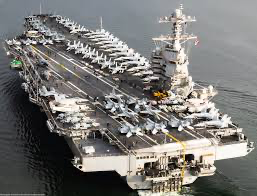
USS Gerald R. Ford (CVN-78) with 9 embarked squadrons of Carrier Air Wing Eight


Littoral combat ship USS Wichita (LCS-13)

Guided missile cruiser USS Lake Erie (CG – 70)
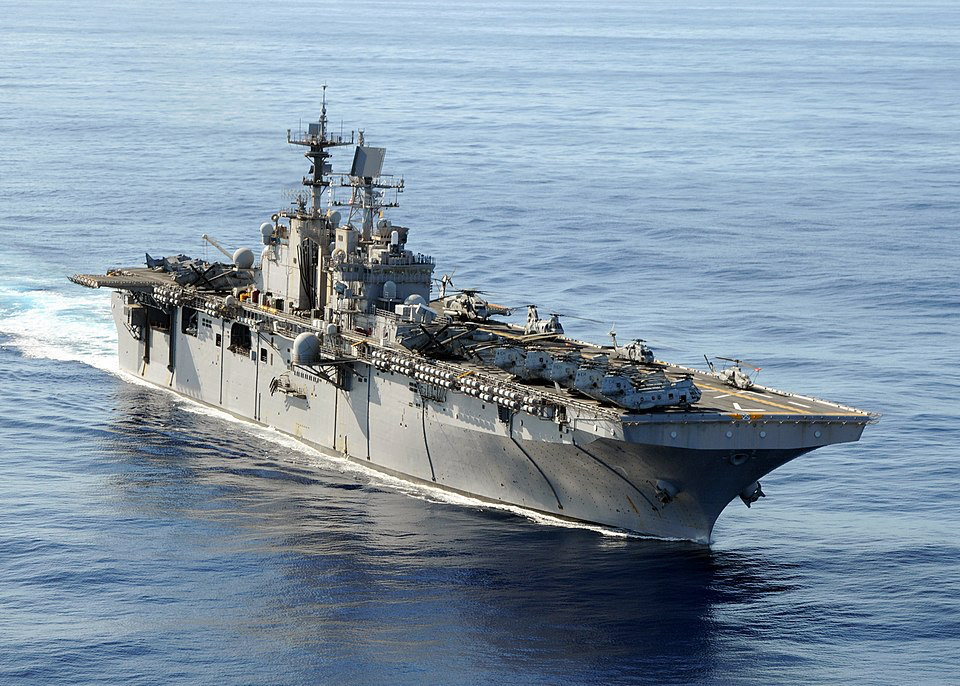
Wasp-class amphibious assault ship USS Iwo Jima (LHD-7)
Amphibious transport dock ship USS Fort Lauderdale (LPD-28)

Amphibious transport dock ship USS San Antonio (LPD-17)

Guided missile destroyer USS Gravely (DDG-107)

Guided missile destroyer USS Stockdale (DDG-106)
“Militarily, the table is set quite effectively for air strikes,” retired Navy Adm. James Stavridis, who led U.S. Southern Command, or SOUTHCOM, from 2006 to 2009, recently told Task & Purpose. “Now it’s up to [President Trump] to decide.”

 ThinkingOregon