Build Back Better’s Subsidy of Local Newspapers: a big Mistake

Print Your Custom Newspaper | PRINTNEWSPAPER

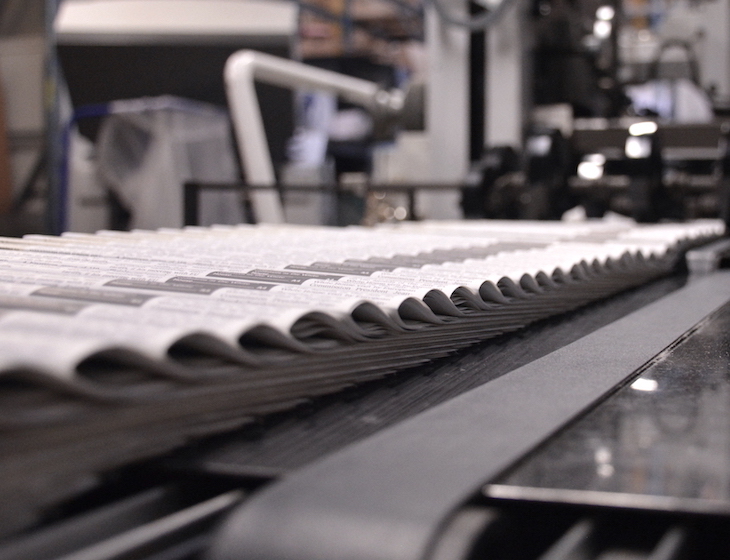
Once upon a time, printed newspapers serving local audiences were in high demand.

But over 2200 newspapers in the United States have closed in the past 15 years and the carnage continues. 

Circulation has declined drastically. Pay has been cut. Advertising revenue has plunged. Newsroom employment has plummeted. The vast majority of remaining print newspapers have a circulation of less than 15,000, according to a review by the University of North Carolina’s journalism school.

It’s a grim picture, made worse by the fact that, as Harvard’s Shorenstein Center has pointed out, “Printed newspapers are a manufacturing business. For some, the non-newsgathering cost structure can be the majority of total operating expense. This means that in a world of declining demand for print editions of local newspapers, legacy costs become an increasing share of declining revenue. Much of the underlying reality of the current market failure for local news coverage can be traced to this simple fact.”

But the newspaper industry and some members of Congress think they have found a solution — a federal taxpayer bailout.

This is the wrong solution. And, frankly, it’s embarrassing.

America’s journalism industry, which until now has prided itself on its independence, got a tax break in the Build Back Better bill passed by the House on Nov. 19.

The bill would provide a payroll tax credit for companies that employ eligible local journalists. The measure would allow newspapers, digital news outlets, and radio and television stations to claim a tax credit of $25,000 the first year and $15,000 the next four years for each of up to 1,500 journalists. 

The theory is this would incentivize some publishers to hire or retain local reporters. The Democrats project the cost of putting journalism outlets on the public dole will be $1.7 billion over the next five years, with an estimated $38 million of that injected into approximately 113 newsrooms in Oregon.

Supporters say there will be guardrails to prevent the tax breaks from going to partisan or fake-news sites. Good luck.  The battles over eligibility will be never-ending.

I’m a former newspaper reporter and the struggles of local print news in our Internet-juiced landscape are undeniable, but why print journalism enterprises, or other journalism forms, deserve taxpayer bailouts like this is beyond me. And, unfortunately, you are not likely to read about criticisms of the bailout in your local paper. No surprise there.

Some tax credit supporters argue that government support for media goes back a long way, that the two have always been joined at the hip, so this new idea just continues long-established practices. The latest help is the pandemic-related small business loan program, for example, provided millions to news organizations.

Fundamentally, this argument is that print media already get some subsidies so they should get more. A dubious assertion that too many are willingly embracing.

Media figures also argue that the Build Back Better subsidies will only be temporary anyway. But let’s be honest. When was the last time you saw a government subsidy discontinued?[1]

It’s a given that when the subsidy ends in five years, newspaper publishers and others raking in the subsidies will be back in Congress hat in hand seeking an extension. The Congressional Budget Office estimates that if the subsidies continue for ten years, the cost will be $3 billion, far from small change. 

It’s also defies logic that taxpayers should subsidize already well-off newspapers. 

One of the vocal tax-break supporters, for example, is The Washington Post, owned by tech billionaire Jeff Bezos since 2013. According to Americans for Tax Reform,  if the tax break becomes law, Gannett, one of the nation’s largest remaining newspaper chains, could gain as much as $127.5 million in tax benefits over five years.

And why should the government give breaks to papers owned by super-rich hedge funds? 

Hedge fund Alden Global Capital, for example, is one of the country’s largest newspaper owners. It has been buying up newspapers, imposing draconian cost cuts, and implementing widespread layoffs. Its current target is the local newspaper chain Lee Enterprises, whose Oregon titles include the Albany Democrat-Herald, the Corvallis Gazette-Times and the Lebanon Express. 

Local print newspapers have been a key element of our civic life for generations, but Build Back Better’s tax breaks are not the solution to the challenges they face. And despite the special show of neediness among many newspaper people these days, we won’t be doing them a favor if we succumb to their pleading.

Maybe a little creative destruction is in order, instead.

—————–

[1] The situation with the federal child tax credit (CTC) is a classic example of the never-ending subsidy.  The CTC is not new, but it was expanded in the March 2001 American Rescue Plan (ARP). Before the ARP, parents were eligible to receive up to $2,000 in tax credits every year for each child under 17 they claim as a dependent. The benefit began to phase out at $200,000 of annual income for single filers and $400,000 for married couples filing jointly. Families had to earn just $2,500 a year to qualify. Parents claiming the credit would receive it as one single refund at tax time, and the credit was partially refundable, meaning families with a tax burden smaller than the size of their credit could still receive up to $1,400 per child.

The ARP increased the program’s benefits, raising the maximum credit to $3,000 for every child aged six to 17, and $3,600 for children under 6. The new credit was fully refundable. In 2021, half was paid out in monthly installments, with the rest to be meted out in families’ annual tax return. 

The ARP expanded the CTC only through 2021. Democrats figured it would prove to be so popular they could extend it indefinitely. So far, they haven’t been able to secure enough votes to do so, but efforts to do so were still underway at the end of 2001. 

The House’s  “Build Back Better” plan: A Costly Collection of Misfires

Build Back Better Is Worse - YouTube

Democrats say Americans love their $2.2 trillion Build Back Better bill passed by the House on Nov. 19. That must be because they don’t know what’s in it.

While the media has largely concentrated on overarching themes of the legislation, gone largely unnoticed are all sorts of provisions most folks would probably find unpalatable if not downright unseemly.

Take a look at the catalog of misfires:

  • Think the Democrats are all about the little people? The current state and local taxes (SALT) deduction allows taxpayers who itemize their deductions to reduce their federal taxable income by the amount of state and local taxes they paid that year, up to $10,000. The House bill would raise the cap to $80,000 through 2030, mostly benefiting the wealthy from high-tax states such as California, New Jersey and New York. Even liberal Jason Furman, a Harvard economist who served as chair of President Barack Obama’s Council of Economic Advisers, has said the provision’s benefit to “the super-rich” is “obscene.” 
  • Just 6.3% of private sector workers in the U.S. were union members in 2020. The House bill adds a $4500 credit exclusively for Electric Vehicles (EVs) built in the United States with unionized labor. This heavily favors the Big Three American auto manufacturers, all of which operate unionized factories in the U.S. Excluded from the credit: Tesla, Rivian, and every foreign automaker that operates a U.S. assembly plant, none of which are unionized. Vehicles such as the Ford Mustang Mach-E full-electric sport utility vehicle, which is built in Mexico, wouldn’t meet the domestic production requirement either. Canada, the European Union, Germany, Japan, Mexico, France, South Korea, Italy, and other countries recently sent a letter to U.S. lawmakers saying the tax credit proposal would also violate international trade rules. In a separate letter, Canadian Trade Minister Mary Ng told U.S. lawmakers and the Biden administration that the credits, if approved, “would have a major adverse impact on the future of EV and automotive production in Canada.” Way to go Democrats. Piss off a lot of automakers and allies to placate the UAW.
  • “We’re for working parents,” the Democrats crow. The House bill would guarantee that families making up to 250 percent of a state’s median income would not have to pay more than 7 percent of their annual income on childcare. Sounds good, but it will inevitably federalize child care, favor big corporate providers, raise childcare costs overall and increase the burden on families making more than the cap. 
  • In another sop to unions, the House bill would allow union members to deduct up to $250 of dues from their tax bills, allowing them to exclude the cost of dues from their gross income. The Joint Committee on Taxation says this would cost taxpayers $1.8 billion. A lot of union dues money goes into supporting political campaigns and lobbying. OpenSecrets, a non-partisan analyst of political money, says Democrats got 90% of union donations in 2020 federal races. 
  • Americana’s journalism industry, which prides itself on its independence, got a piece of the Build Back Better pie in the House bill, too. The House bill would provide a payroll tax credit for companies that employ eligible local journalists. The measure would allow newspapers, digital news outlets, and radio and television stations to claim a tax credit of $25,000 the first year and $15,000 the next four years for each of up to 1,500 journalists. The theory is this would incentivize some publishers to hire or retain local reporters. The projected cost of putting journalism outlets on the public dole – $1.7 billion. I’m a former newspaper reporter and the struggles of local news are undeniable, but this is embarrassing. Why large and small journalism enterprises deserve taxpayer bailouts like this is beyond me. Supporters say there will be guardrails to prevent the tax breaks from going to partisan or fake-news sites. Good luck.  

Who knows what other godawful provisions lurk in the 2000+ page Build Back Better bill. As House Speaker Nancy Pelosi said of another contentious legislative process, “We have to pass the bill so that you can find out what is in it …”

Biden’s Federalization of Child Care Will Be Costly

“You can’t handle the truth!” Colonel Nathan R. Jessup roared in A Few Good Men.

President Biden and the Democrats in Congress apparently think the same way in explaining the costs of their Build Back Better budget proposals. Supposedly, the cost of the House Democrats’ budget reconciliation bill is $1.75 Trillion.

But this is a fiction based on smoke and mirrors.

On Thursday, the Penn Wharton Budget Model reported that if all the provisions of the bill (except green energy tax cuts) are made permanent, new spending would increase by $3.98 trillion, more than double what President Biden’s White House said.

On Friday, Nov. 5, the House passed a $1 Trillion infrastructure bill, but put the social policy bill on hold because a half-dozen Democrats withheld their votes until a nonpartisan analysis by the Congressional Budget Office (CBO) could tally its price tag, which could be delayed until at least mid-November. In other words, even the Democrats don’t know what their social policy bill would cost.social policy

One area that stands out in terms of unknown real costs is projected spending on child care. 

Child Care Services Association — Ensuring affordable, asccessible,  high-quality child care

On Friday, Nov. 5, the House passed a $1 Trillion infrastructure bill, but put the social policy bill on hold because a half-dozen Democrats withheld their votes until a nonpartisan analysis could tally its price tag, which could be delayed until at least mid-November. In other words, even the Democrats don’t know what their social policy bill would cost.

The childcare part of the package attempts to spur more workers to join the childcare workforce and raise providers’ wages by spending around $100 billion over the first three years.

The bill would guarantee that families making up to 250 percent of a state’s median income would not have to pay more than 7 percent of their annual income on child care.

“How can we compete in the world if millions of American parents, especially moms, can’t be part of the workforce because they can’t afford the cost of childcare or eldercare,” Biden said in October. 

All well and good, but what’s going to be the actual cost to the federal government if the Democrats’ bill passes and gets signed by the President? The House will be out on recess next week, returning the week of Nov. 13. If there is a CBO score by then, it’s possible that the House could move immediately to a final vote on the bill.

First of all, the program would supposedly come to an end in six years, but that’s just part of the Democrats’ budget trickery. The assumption that spending on the child care program will cease in six years reduces its overall cost during the 10-year budget window that Congress uses to determine whether a bill will add to the federal deficit. But Democrats are counting on parents becoming so fond of the government largesse that Congress will extend the program.

President Biden has said the child care subsidies would save the average family $14,800 per year on child care expenses. In other words, the federal government would pick up $14,800 in childcare costs now paid by the average American family. 

,Using Oregon as a test case, median family income in 2020 was $76,554. On that basis, no Oregon family making less than $191,385 would pay more than 7% of their income on child care. Families earning more than $191,385 would, however, likely pay more once all the government’s mandates kicked in. Higher wages for childcare workers, for example, would likely be passed on to parents by child care providers.

Under the House bill, all the teachers and staff participating in the child care workforce, would have to be paid at least $15 an hour. Many child care workers are now so low paid that more than 15 percent are below the poverty line in 41 states, according to a Sept. 2021 report from the U.S. Department of the Treasury. Similarly, nearly half of child care workers use public assistance, such as the Children’s Health Insurance Program (CHIP), Supplemental Nutrition Assistance Program (SNAP), and Temporary Assistance for Needy Families (TANF).

According to ZipRecruiter, as of Oct 30, 2021, the average annual pay for a child care worker in Oregon was $18,969 a year or approximately $9.12 an hour. 

Under the Democrats’ bill, child care staff with the qualifications of kindergarten teachers would have to be compensated as such, according to The White House. Kindergarten teachers Oregon must have finished a degree program that includes a teacher education component. Teaching kindergarten also requires passing several exams before earning a license. According to ZipRecruiter, as of Oct 30, 2021, the average annual pay for a kindergarten teacher in Oregon was $33,785 a year or $16.24 an hour.

The U.S. Bureau of Labor Statistics says there are 494,360 child care workers in the United States. Oregon has about 13,000 of those. 

According to the White House, child care providers will also “receive funding to cover the true cost of quality early childhood care and education–including a developmentally appropriate curriculum, small class sizes, and culturally and linguistically responsive environments that are inclusive of children with disabilities.”

Under the House bill, the federal government would also pay for child care workers to receive job-embedded coaching and professional development to help child care workers grow their skills during their careers.

The federal government would have to pony up a lot of new money to pay for all this. Not only that, but the states would have to step up, too. States would not be required to match any funds for the first three years, giving them time to ramp up their programs while funded entirely by the federal government. After three years, states would have to provide a 10% match to the federal funds. Where’s that money going to come from?

In addition, President Biden has said he would “ensure families have access to the quality care their children need by working in partnership with states to ensure providers meet rigorous quality standards. These standards will include a developmentally appropriate curriculum, small class sizes, and support positive interactions between educators and children that promote children’s socio-emotional development.”

To say that the Democrats want to federalize child care would be an understatement.

Although the goal of affordable child care seems worthwhile, I can’t help but think this particular proposal is going to have major unintended consequences if it becomes law.

For example, it is likely the proposal will lead to higher childcare costs overall, particularly for those not under the subsidy umbrella. As the Acton Institute has written, “There is little reason to expect that large increases in government subsidies toward childcare would lead to declining overall costs. All prices are relative prices. Increasing the demand for childcare services through subsidies while directing that demand to more formal, regulated, and already stressed institutions is a recipe for…cost explosions.”

Jonathan Bydlak of the R Street Institute makes the same point. “The idea of using subsidies to essentially engineer some sort of outcome is not exactly a great idea,” he says. “Any time you end up subsidizing something that represents a market manipulation. There’s always a potential, as we’ve seen in areas like education, for example, where… education costs are almost certainly higher as a result of the ways in which we subsidize that system.”

Many have argued that years of government subsidies for college have raised the spending power of the average person for higher education, but not necessarily to their benefit. Colleges and universities, those people say, have taken note of families’ increased spending power and raised their tuitions accordingly, resulting in the sky-high tuition rates that exist today.

At one point recently, President Biden said his Build Back Better plan would cost nothing because rich people and corporations would pay the bill. “The fact of the matter is, my Build Back Better Agenda costs $0,” Biden said.

If you believed that, or if you think the Democrats’ proposed child care program is only going to cost $100 billion over its first three years, you’re smoking some pretty potent weed.