Yes, I know, the election isn’t even over, but stop for a moment and think what it’s going to be like after Hillary Clinton’s ascendancy.
For one thing, are you ready for Senator Elizabeth Warren (D-MA) and her anti-business agenda?
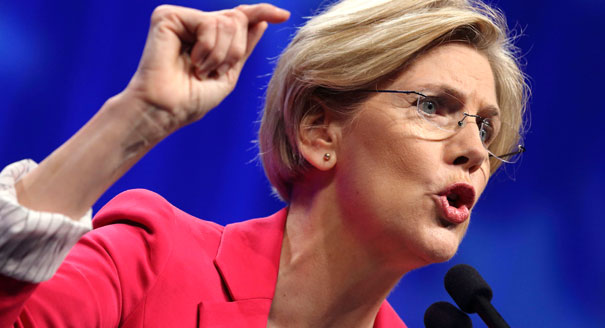
Senator Elizabeth Warren (D-MA)
Warren, a fierce slash-and-burn progressive, is already flexing her muscles, getting ready for Hillary’s administration.
Her first demand? That President Obama dismiss Securities and Exchange Commission (SEC) Chairman Mary Jo White.
Warren claims she wants White out because she won’t devise and enforce an SEC rule that would force companies to disclose their political donations. But White will likely leave the SEC anyway when the next president assumes office. Warren’s real objective is to make sure she has a voice in selection of the next chairman in a Clinton Administration and that the new chairman advances Warren’s full left-wing agenda.
The effort to force disclosure of corporate political contributions has been underway for some time, with limited success.
In October 2013, White declined to pursue a rule, saying said disclosure rules pushed by outside groups “seem more directed at exerting societal pressure on companies to change behavior, rather than to disclose financial information that primarily informs investment decisions.”
In May 2015, the nonprofit Campaign for Accountability filed a lawsuit seeking to force the U.S. Securities and Exchange Commission to adopt a rule requiring publicly traded companies to disclose political contributions.
In August 2015, 44 senators (42 Democrats, including Warren, plus independents Bernie Sanders and Angus King) signed a letter to White urging her to require that public companies disclose their spending on political campaigns, but White has not complied and in Jan. 2016, U.S. District Judge Rosemary Collyer in Washington, D.C. dismissed the Campaign for Accountability’s lawsuit.
That has left disclosure advocates with only the options of pressuring individual companies to take action or submitting shareholder proposals on the issue.
The vast majority of shareholder proposals have failed to garner sufficient support. But the effort to put pressure on companies is robust, led by the Center for Political Accountability (CPA). The CPA issues an annual report, the CPA-Zicklin Index, that claims to benchmark the political disclosure and accountability policies and practices of leading U.S. public companies. The Index’s list of companies is based on the S&P 500.
In its Sept. 2016 report, the CPA said 153 companies engaged by CPA and/or its investor partners have adopted political disclosure and accountability policies using the Center’s proposed model. Overall, the report said, 305 companies have adopted some level of political disclosure and accountability.
CPA hopes its steady pressure, combined with some public wins, will force companies into compliance. “As the number of companies adopting disclosure and accountability policies grows, companies do not want to be seen as outliers,” says CPA Director Bruce Freed.
Critics of the CPA assert that the disclosure push is driven more by a desire to inhibit business participation in the political process, to mute the business community’s voice in political and public policy debates, than to increase transparency.
“The strategy of pressuring companies to voluntarily disclose the details of their spending on public policy engagement for the purpose of reducing that engagement is, in fact, their ultimate goal,” U.S. Chamber of Commerce President and CEO Tom Donohue, Business Roundtable President John Engler and National Association of Manufacturers President and CEO Jay Timmons said in an Oct. 2015 letter to business leaders across the country.
Critics of the disclosure push also say the criteria by which companies are judged in the CPA-Zicklin Index are often arbitrary and vague and incorporate moving targets year-to-year.
In a classic case of do as I say, not as I do, the CPA does not disclose the identities of its own contributors. The sections of Annual CPA reports to the I.R.S. where contributor’s names can be listed are blank and a request to CPA Director Bruce Freed for such information went unanswered.
An SEC disclosure rule will be just one of Warren’s objectives in a Clinton Administration, many of which will differ from Clinton’s agenda. As The Nation, a long-time progressive magazine, put it, “The inalterable really is that (Warren’s) agenda is fundamentally different from the agenda Clinton will want too pursue.”
Clinton will likely try to squirm out of some of the more rigid progressive demands, but Warren won’t give up.
As Warren told a New Populism conference:
“The game is rigged. The rich and the powerful have lobbyists, lobbyists and lawyers and plenty of friends in Congress. Everyone else, not so much. Now we can whine about it. We can whimper. Or we can fight back.
Me? I’m fighting back.”

 ThinkingOregon