Say “No” to Oregon Republican Push for No Taxes on Tips

What’s in the water in Salem?

On one side you have a phalanx of Democrats proposing the ludicrous idea of paying strikers unemployment benefits, which would make Oregon the only State in the country to grant unemployment benefits to striking public and private sector workers.

Not to be outdone in making nonsensical proposals, now you have a raft of Republicans, mimicking President Trump, proposing that the state forego taxing tips.

Here’s a tip – exempting tips from state taxes is a bad idea.

In their determination to position themselves as supporters of the working man (and woman), 21 of Oregon’s House Republicans have proposed a bill, HB 3914, to end taxation of tips, which are generally perceived as discretionary payments determined by a customer that employees receive from customers.

As written, the bill would not count “service charges” as tips. A restaurant, for example, recently added an automatic service charge equal to 18% of my bill. Even if that was intended to cover for a “no tipping” policy, it would be part of the server’s wages because it was not discretionary.

The 129-word Oregon bill gets right to the point, “There shall be subtracted from federal taxable income any amount of tips properly reported as wages on the taxpayer’s federal income tax return.”  That would automatically subtract tips from taxable income in Oregon, too. 

The bill deserves a quick death.

According to the IRS, “All cash and noncash tips received by an employee are income and are subject to Federal income taxes. All cash tips received by an employee in any calendar month are subject to social security and Medicare taxes and must be reported to the employer.” So, tip income is taxable income.

Charges automatically added to a customer’s check by an employer and subsequently distributed to employees are not tips; they are “service charges”. These service charges, which are appearing more often on Oregon restaurant bills, are non-tip wages and are subject to Social Security tax, Medicare tax, and federal income tax withholding.

Many consumers think the expanding pressure on customers to leave tips is already out of hand. A no tax on tips policy would likely expand the use of tipped work even further, potentially leading to consumers being asked to tip on virtually every purchase everywhere. 

A  New York Times article about tipping generated a lot of comments, many of which lamented the seeming spread of tipping expectations to multiple businesses and regardless of the amount of actual service by an employee. “Collectively, we cringe when the iPad is swiveled into our face at the coffee counter or deli; we know it is extortion rather than appreciation for services rendered,” said one person.  

There’s also a sense that some businesses are customizing the tip configuration on screen to exploit customers. Most people tip between 15-20%. If you buy a $2.85 espresso and the screen offers 15%, 20% and 25% tip options, you are likely to hit 15%, generating a tip of 43 cents. If a business wants to jack that up, however, it can give you $1, $2, or $3 options on purchases below $10, instead of a percentage. If you pick $1, you have paid a 35% tip. Devious, but effective.

Despite the massive increase in tipping expectations in recent years at multiple businesses, tax experts say a relatively small share of the workforce depends on tips. Only about 2.5% of American workers are in occupations that depend on tips, according to the IRS.  Among those workers, 37% earn less than the federal standard deduction. So, they already don’t have to pay federal income taxes.

Other tipped workers benefit from the earned income tax credit (EITC) and/or child tax credit (CTC) to the extent that they don’t have any federal income tax liability. In addition, because tipped workers would keep more of their income, employers could use this law as a justification for lowering workers’ base pay if it is currently above the minimum wage.

In fact, exempting tips from taxation can actually lead to situations where low-income workers end up effectively losing income through losing eligibility to tax credits such as the Earned Income Tax Credit (EITC) and Child Tax Credit (CTC).

The Budget Lab at Yale, a non-partisan policy research center, estimates that less than 3 percent of families would benefit from a broad-based income tax deduction for tips in 2026, but it would still cost the federal government more than $100 billion over the next decade. Restricting eligibility to workers in the leisure and hospitality industries would reduce the cost by more than 40 percent, but that would still leave a big hit on the deficit unless taxes were raised elsewhere.

Even the liberal Oregon Center for Public Policy opposes the no tax on tips idea.

In October 2024, Daniel Hauser, Deputy Director of the Center, said that ending taxes on tips “makes the tax system less fair” because workers receiving tips would get a tax break, but not low-paid workers in general.

If you have two workers, one a bartender who earns about $10,000 of his $40,000 annual income in tips and the other a warehouseman who makes all of his $40,000 income in wages, it wouldn’t make sense to give the bartender a tax break but leave the warehouse worker hanging out to dry, Hauser argued. 

 It also “creates openings for people to think about, how can my income be categorized as a tip and get this tax break too?,” Hauser wrote.  Third, he said, “if the goal is to help the economic security of low-income workers, it’s not very effective…and there are much better ways for us to try and help low-income families in Oregon.” 

He’s right.
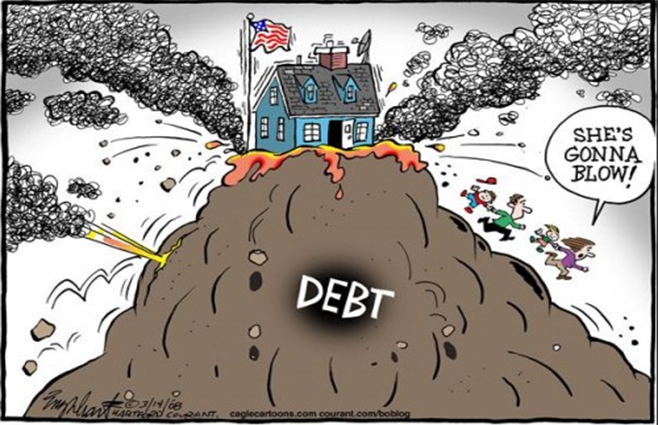

The Covid Rescue Act is just a start. Next up: exploding debt.

Before President Biden signed the 630 page $1.9 trillion American Rescue Plan Act of 2021, Democrats focused most of their public messaging on the $1400 checks that would be going out to everybody and their brother (and sister). Who doesn’t like free money, the Democrats figured. After President Biden signed the bill, Democrats shifted some of their messaging to highlighting an expansion of the child tax credit (CTC).

Before the new law, the CTC allowed qualifying families to reduce their income tax bills by up to $2,000 for each child through age 16. The new law increases the credit to $3,000 a child and makes parents of 17-year-olds eligible to for the 2021 tax year. The credit rises to $3,600 for children under the age of 6 as of the end of 2021.

For a qualifying family with one child, the previous credit would have cut a $5,000 tax bill to $3,000. Under the new law, the credit will cut the tax bill to $2,000, and to $1,400 if the child is under age 6. The benefit amount will gradually diminish for single filers earning more than $75,000 per year, or married couples making more than $150,000 a year.

Though framed as an expansion of the current tax credit, it is essentially a guaranteed income for families with children, because it will provide most parents a monthly check of up to $300 per child. That’s because unlike the current program, where the money is distributed annually as a tax reduction or check, the new program will send out monthly checks to provide a more stable cash flow.

Kiplinger illustrated the program by assuming a family of five with three children ages 12, 7 and 5. Assuming the family qualifies for the higher child credit and doesn’t opt out of the advance payments, they could get $800 per month from the IRS from July through December 2021, for a total of $4,800. They would then claim the additional $4,800 in child tax credits when they file their 2021 return next year.

But neither the Democrats nor the media are talking about how much the benefit will cost. You have to be a very aggressive, persistent searcher to find a number. 

According to the Joint Committee on Taxation, the CTC expansion in President Biden’s rescue bill will cost a whopping $110 billion just in 2021. 

But that probably won’t be the final cost because Democrats want to make the new CTC program permanent. Left-leaning groups are already lobbying for permanency. 

“Substantially increasing the CTC on a permanent basis would help secure economic stability for working families, reduce inequality, and sustainably boost economic growth,” says one such organization, the Center for American Progress. “It would be one of the most effective investments we can make as a society.”

Democrats have already introduced bills in the House and Senate to make the CTC changes permanent. 

The Committee for a Responsible Federal Budget figures the ultimate price tag of the $1.9 trillion American Rescue Plan Act could be twice as high if some of the policies in the bill are extended beyond their presumed expiration dates, substantially increasing deficits and debt.

As Jared Bernstein, a top economic advisor to Biden told the Wall Street Journal last month, “When you’re worried about fiscal sustainability, the things that hurt you are not the temporary measures,” Mr. Bernstein said in an interview late last month. “It’s the things that are permanent [and] that aren’t paid for.”

On March 22, 2021, the New York Times reported that President Biden’s advisers were expected to present a proposal to him recommending a series of bills that would propose a $3 trillion economic package. This would be in addition to extension of the so-called temporary tax cuts meant to cut poverty that are already on the books, which could cost an additional billions of dollars. 

Since neither the Democrats nor Republicans seem much concerned about exploding deficits and debt, it’s doubtful that policies in the American Rescue Plan Act that lawmakers decide to make permanent or the cost of the $3 trillion package will be fully offset with tax increases or spending restraint.

“In addition to trying to make permanent some of the temporary provisions in the package, Democrats hope to spend trillions of dollars to upgrade infrastructure, reduce the emissions that drive climate change, reduce the cost of college and child care, expand health coverage and guarantee paid leave and higher wages for workers,” The New York Times reported.

Hang on. It’s going to be a rough, and expensive, ride. 

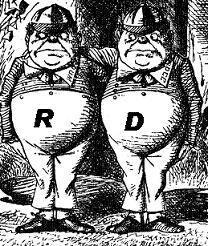
Tweedledee. Tweedledum: The two parties spend with abandon.

tweedledumTweedledee

Tweedledee. Tweedledum. This is what we get when the two parties work together, a massive spending spree.

A $1.1 trillion federal spending bill and a $650 billion tax package unveiled today show that neither party gives a damn about holding down spending. It’s not that all the items to be funded are wasteful or unneeded, but the package will push spending above previously agreed limits by $66 billion in 2016 and permanently extend a vast array of tax benefits that will add at least a half-trillion dollars to the federal deficit, once a matter of great concern.

deficit

  • Bowing to pressure on Republicans and Democrats from medical device manufacturers across the county, including in Oregon, anti-Obamacare zealots, and ticked-off unions with expensive healthcare plans, the legislation will postpone for two years (which probably means forever) a 2.3 percent excise tax on medical devices manufacturers, that was expected to raise $29 billion of net revenues over 10 years and a so-called “Cadillac Tax” tax on expensive employer-sponsored healthcare plans, that was projected to raise about $30 billion over 10 years to cover new spending under Obamacare. Then, to add insult to injury, the legislation makes the Cadillac tax refundable when it restarts. The lost taxes will blow a hole in planned funding to cover the cost of Obamacare.
  • The Defense Department will get $1111 billion for new military equipment, including F-35 Joint-Strike Fighters, Black Hawk helicopters, attack submarines and guided missile destroyers.
  • A 40-year-old oil export ban will be rescinded and, in trade, Democrats will get expensive extensions of wind and solar power tax incentives.
  • A research and development tax credit will be expanded and extended permanently.
  • The $1,000 Child Tax Credit will be extended permanently.
  • The Earned Income Tax Credit will be permanently extended.
  • A federal health program for first responders and construction workers who worked at the World Trade Center site after 9/11 and a separate victims compensation fund will be extended at a cost of $8 billion.
  • A National Oceans and Coastal Security Fund will be created to “support work that helps Americans understand and adapt to forces like sea level rise, severe storms, and ocean acidification” associated with climate change.
  • The American Opportunity Tax Credit, an annual credit for tuition and other qualified expenses, will be permanently extended.
  • A $250 annual deduction on qualified expenses of teachers will be indexed for inflation and permanently extended.
  • Five tax credits tied to charitable donations by individuals and businesses will be permanently extended.
  • Funding for the IRS will be frozen, punishing the IRS for targeting conservative groups, but also further limiting its ability to go after tax scofflaws and, this, reducing tax receipts.
  • A $255 per month pre-tax benefit for parking and public transportation expenses will be permanently extended.

But aside from all the spending, Congress did accomplish a few good things.

There will be a pay freeze for Vice President Biden, for example.

Also, earlier this year the dour, stick-in-the-mud Capitol Police said sledding by gleeful children and adults on the snow of Capitol Hill would no longer be allowed. The package asks that the Capitol Police rescind that prohibition so the jollity can resume.

Capitol-Sledding