U.S. vs. China: Cutting Our Own Throats

Under Xi Jinping, general secretary of the Chinese Communist Party (CCP), China’smilitary might , including its nuclear capabilities, have been expanding rapidly while it “has demonstrated an increasing willingness to use military coercion and inducements to achieve its aims”, according to the U.S. Department of Defense.

China’s dominance in global manufacturing is greater than it’s ever been. Its government subsidies are giving industries leverage to out-compete with American products. It had a nearly $1 trillion trade surplus with the rest of the world in 2024. 

China has an aggressive, global spy network and influence operation aimed at expanding and solidifying its power.

China is supporting the Russian war machine and is openly preparing for a war to take over Taiwan. 

China is aggressively bullying the Philippines and other countries with its claims on the South China Sea. 

The U.S is falling further and further behind China in shipbuilding, threatening maritime security around the world. A new report by the U.S. Trade Representative found, that U.S. international trade is “carried out on vessels made in China, financed by state-owned Chinese institutions, owned by Chinese shipping companies, and reliant on a global maritime and logistics infrastructure increasingly dominated by China.”

All together, China presents a clear and present danger to the United States,

But American consumers continue to subsidize the Community regime by procuring the countries products as though there’s a fire sale, American companies continue strengthening their ties to China and the strongest signal President-elect Donald Trump is sending to China isn’t, “I’m determined to protect American security”, but “Let’s make a deal”. 

Nothing illustrates that better than Trump’s words and actions with respect to TikTok, owned by the Chinese company ByteDance.

In April 2024, with bipartisan concern about the national security threat TikTok posed to the United States and its use as a tool to spread misinformation and propaganda, the House of Representatives voted 360 to 58 in the House and the Senate voted 78 to 18 for a bill requiring the sale of the social media platform to a U.S. company or face a shutdown.

Trump actually tried to ban the app himself in his first term by signing an executive order in August 2020 asserting that the app was capturing mass amounts of information about Americans and raising risks for the country.

“These risks are real,” the order said. “This data collection threatens to allow the Chinese Communist Party access to Americans’ personal and proprietary information − potentially allowing China to track the locations of Federal employees and contractors, build dossiers of personal information for blackmail, and conduct corporate espionage.”

In March 2024, however, Trump flipped his position, saying he was opposed to banning the app or forcing a sale. “Frankly, there are a lot of people on TikTok that love it,” Trump said on CNBC . “There are a lot of young kids on TikTok who will go crazy without it.”

On January 18, TikTok  did shut down, but after Trump promised to issue an executive order on Monday to “extend the period of time before the law’s prohibitions take effect,” it came back up. It announced, “In agreement with our service providers” the company “is in the process of restoring service. We thank President Trump for providing the necessary clarity and assurance to our service providers that they will face no penalties providing TikTok to over 170 million Americans and allowing over 7 million small businesses to thrive.”

The law allows Trump to grant a 90-day reprieve to TikTok, but only if he can certify at that point “evidence of significant progress” toward a sale. During that 90 days, of course, China’s alleged efforts to undermine United States security would continue, an issue of apparently little concern to Trump.

Trump’s inclination to pacify China and TikTok, reminds me of the protests of young Americans against the TikTok shutdown, favoring their personal TikTok addiction over American security.  These same self-absorbed young people are likely many of the same people who  are sustaining China’s economy by buying massive amounts of cheap fast fashion from Chinese companies like Temu and Shein, despite extensive reports  that the apparel hides the dirty laundry of environmental damage and labor exploitation.

Trump’s moves are not, however, going unchallenged.

Sen. Pete Ricketts (R-Nebraska), chair of the Senate Foreign Relations Committee, has urged US companies to halt operations with TikTok. “For TikTok to come back online in the future, ByteDance must agree to a sale that satisfies the law’s qualified-divestiture requirements by severing all ties between TikTok and Communist China,” Ricketts said.

Also breaking with Trump, U.S. Senator Tom Cotton, chair of the Senate Intelligence Committee, also issued a stern warning for companies deciding to work with TikTok after its resumption of service. “Any company that hosts, distributes, services, or otherwise facilitates communist-controlled TikTok could face hundreds of billions of dollars of ruinous liability under the law, not just from DOJ, but also under securities law, shareholder lawsuits, and state AGs, Cotton posted on X. “Think about it.”

Meanwhile, TikTok’s CEO is planning to attend a Trump victory rally at the Capitol One Arena in Washington, D.C. tonight (Sunday) and is expected to sit on the dais for Trump’s inauguration on Monday.

It’s a good time to remember Franz Stangl, the commandant of the Nazi concentration camp Treblinka in occupied Poland from Sept. 1942 to August 1943. Gitta Sereny, an Austrian born journalist, biographer and historian. wrote “Into That Darkness” based on interviews with Stangl after the war. Trying to understand how he acclimated to running the camp, she asked him how he managed to do it.  “It was the small steps. Small compromises,” he said. ” You see, if you can get people to stop believing in absolute right and wrong, you can get them to do anything.”

Americans succumbing to the allure of Chinese goods, American companies allowing their drive for profits to justify strengthening China’s economy and American politicians setting aside their legitimate concerns about the challenges from China are guilty of small steps, too.

Stay tuned.

Addendum

In still engaging wholeheartedly with China, American companies are repeating how so many have responded (or not) to Russia’s aggression in Ukraine.  According to Foreign Policy, as of 2023, around 800 multinational companies from Western and like-minded countries were still operating in Russia—either because they decided to stay or because they were still generating revenues there despite having pledged to leave. Around 60 percent of those global firms that operated in Russia before the full-scale invasion began in February 2022 still continue to do so. Second, Germany, the United States, and France are—by far—the top three countries of origin for Western firms that retain a presence in Russia, accounting for around half of them.

What is undeniably true , according to Foreign Policy, is that the hundreds of Western firms staying in Russia are helping Moscow finance the war in Ukraine. The data is eye-popping. In 2022 and 2023, firms from the G-7, European Union, and like-minded economies generated around $370 billion in revenues on Russian soil, which was more than Moscow’s military budget over the same period. In the first two years of the war, Western firms transferred more than $11 billion in corporate taxes to Russian state coffers, with Austrian bank Raiffeisen alone accounting for one-tenth of this amount. The data is not available yet for 2024, but a ballpark estimate suggests that Western firms probably paid another $4-6 billion in corporate taxes, bringing the total to roughly $16 billion funneled to the Kremlin since the invasion began.


Donald J. Trump’s Dec.16, 2024 Press Conference: Falsehoods, Distortion, Fakery and Deceit

“Nuttiness may be subjective, but truthfulness is not”

Bill Scher, Politics Editor, Washington Monthly

On Dec. 16, Donald J. Trump held his first press conference since his Nov. 5, 2024 election. Wishing to be of service to those of you who were too busy or not inclined to tune in, I reviewed the entire deluge of Trump’s rambling thoughts:

  • We had no wars when I left office and now the whole world is blowing up.

Truth: When Trump left office in early 2021, US troops were still deployed in combat missions in Afghanistan and Iraq. About  200,000  US troops were deployed overseas, including 6,000 – 7,000 American troops spread across Africa, with the largest numbers concentrated in the Sahel and the Horn of Africa,  about 50,000 troops at roughly two dozen bases across Japan and about 2,000 Marines in  northern Australia 

  • “Lot of people don’t realize, but we did 571 miles of wall (on the Mexican border).  I built much more than I said I was going to build.”

Truth: Early in his 2016 election campaign, Trump pledged to build a wall along the entire 2000-mile length of the border with Mexico. He later clarified he’d build a wall covering half of that distance. In his State of the Union address in February 2020, he pledged to build “substantially more than 500 miles” by January 2021.

Various types of fencing totaling 654 miles, running through California, Arizona, New Mexico and Texas, were already in place before Trump became president in 2017.  At the end of Trump’s first term, the Trump administration said it completed more than 400 miles of border wall, but only 80 miles of new wall barriers were actually built where there were none before. The vast majority of the construction replaced existing structures at the border that had been built by previous US administrations.

  • “We’re also going to create clean coal. Clean coal is something that has really taken over. …we’re going to be doing a lot of clean coal for the people of West Virginia and others, Wyoming.”

Truth: The idea of “clean coal” is generally considered not viable, as current technology cannot fully mitigate the environmental impacts of burning coal, making it essentially a marketing term with little practical application; while some technologies can reduce emissions, the process remains too expensive and energy-intensive to be considered truly “clean” on a large scale, with many experts stating that “clean coal” is a myth

  • “So we’re looking to save maybe $2 trillion and it’ll have no impact. Actually. It’ll make life better, but it’ll have no impact on people.  We will never cut social security or things like that. It’s just waste, fraud and abuse.” 

Fact: This would certainly run counter to Trump’s actions in his first term, during which he added $8 trillion to the national debt,  despite having promised to run budget surpluses.  The federal government is now burning through $6.8 trillion annually and the Committee for a Responsible Federal Budget says Trump’s proposed policies would add an estimated $7.7 trillion to debt over the next decade. Cutting $2 trillion in one year would be impossible, as well, given that Trump has already said he’s not going to touch Social Security or Medicare., the two largest government programs, and interest payments, which account for 13% of federal spending, can’t be cut either (Unless the government plans to default on the national debt). Discretionary spending accounts for only about 25% of total expenditures, but that includes defense, which Congress has no inclination to cut.

  • We’ll immediately restore the sovereign borders of the United States and stop illegal immigration.”

Truth: Over the past 30 years, the Border Patrol’s budget has grown more than sevenfold, the number of agents stationed along the southwest border has quadrupled, the border wall has been strengthened and lengthened, and increasing amounts of technology have been used to deter illegal migrants, but they have kept coming, more and more of them from countries other than Mexico. Also complicating the situation, a substantial number of the illegal immigrant population in the United States came legally on work visas and stayed after they expired.  The government has been terrible at finding and deporting these people. 

  • “We had no problems, we had no inflation. We had no inflation. We had at less than 1%. A perfect number.”

Truth: The Consumer Price Index rose 7.8% during Trump’s first term. The CPI rose an average of 1.9% each year of the Trump presidency according to the Bureau of Labor Statistics. That was about the same as the average under Obama (1.8%) and below the average of 2.4% during George W. Bush’s years.

  • Trump responding to a question, “Do you believe there’s a connection between vaccines and autism? Do you believe there’s a link?” Trump: We’re looking to find out. …There’s something wrong. And we’re going to find out about it.”

Truth: Many studies have looked at whether there is a relationship between vaccines and Autism Spectrum Disorder (ASD.), but to date, the studies continue to show that vaccines are not associated with ASD, according to the federal Centers for Disease control and Prevention. 

Two studies, referred to as the Wakefield Studies, have frequently been cited by those claiming that the MMR vaccine causes autism. Both studies are considered critically flawed. In the first study, published in 1998, Wakefield’s hypothesis was that the measles, mumps and rubella (MMR) vaccine  caused a series of events that include the development of autism. The study was subsequently retracted; in scientific terms, this means that the paper is not part of the scientific record because it was found to be based on scientific misconduct. In this case, the studies were deemed fraudulent and data misrepresented. The second study, published in 2002, which examined the relationship between measles virus and autism, was also critically flawed. Meanwhile, several studies have been performed that disprove the notion that MMR causes autism.

  •  Trump responding to a question – “Do you think schools should mandate vaccines?” Trump – “I don’t like mandates. I’m not a big mandate person.”

Truth: Mandating vaccinations of schoolchildren saves lives. Schools and broader communities rely on high immunization rates to keep vaccine-preventable diseases from spreading. When more children are immunized, the risk for everybody declines, particularly for people with weakened immune systems and chronic medical conditions like lung, heart, liver, kidney disease or diabetes. The more parents who decline to vaccinate their children, the greater the risk that infection will spread in the community.

  • “Europe doesn’t use pesticides, and yet they have a better mortality rate than we do.”

Truth: Pesticides are still widely used in Europe, with the agricultural sector relying on significant volumes of chemical pesticides to maintain crop yields, although the EU has regulations in place to limit their use and is actively working to reduce pesticide reliance because widespread pesticide use is major source of pollution, according to the European Environment Agency.

  • ” They’re still counting the vote in California.

Truth: California did take longer to count votes in the recent federal elections than other states, but the California Secretary of State had certified the 2024 election results prior to Trump’s news conference.  

  • “We got the biggest tax cuts in history.”

Truth: Trump’s tax cut s in the Tax Cuts and Jobs Act of 2017 was not the largest in history, either in percentage of gross domestic product or in inflation-adjusted dollars.  When the Congressional Budget Office reviewed tax cuts enacted between 1981 and 2023, it found that two other tax cut bills were bigger – former President Ronald Reagan’s 1981 package and legislation signed by former President Barack Obama that extended earlier tax cuts enacted during former President George W. Bush’s administration. Reagan’s 1981 tax cut was the largest in U.S. history, reducing revenues by $19 trillion over a decade. 

  • The US took in hundreds of billions of dollars in tariffs “from China” during Trump’s first term and “no other president took in 10 cents, not 10 cents.”  before he was president.

Truth: First, according to the Peterson Institute for International Economics the revenue from tariffs on Chinese imports come from the importers, not China. Importing businesses pay the tariffs and then have to decide whether to bear some of the costs or pass any portion of the cost on to consumers through higher prices.

Second, according to the Institute, Americans have been paying tariffs on imports from China for decades., going as far back as the late 19th and early 20th centuries and more recently during the Clinton, Bush, and Obama administrations. 

And we’re going to have four more years of this.

Admoniti estis.

America’s Elites Showcase TikTok, National Interests Be Damned.

Supporting Tik Tok is chic. 

At least that’s the message I get from the decision by Vogue’s Anna Wintour to choose Shou Chow, TikTok’s chief executive, as an Honorary Chair of this year’s over-the-top Met Gala in New York City tonight. 

TikTok declined to reveal to The New York Times its financial contribution to the Met Gala, but sponsors in previous years are known to have each kicked in roughly $5 million (TikTok and China are probably delighting in how cheaply the glitterati can be bought off).

The New York Times even took note of Chow’s high profile at the Met Gala with an article in Sunday’s paper, “TikTok’s Boss Takes On a Flashy Gig”.

All the official co-chairs of the splashy event – Zendaya, Jennifer Lopez, Bad Bunny and Chris Hemsworth – are likely on board, too, caring less about matters of substance than celebrity visibility.

All this at the same time as Washington, D.C. is focused on TikTok’s corrosive influence in the United States, its massive collection of potentially sensitive user information and its ownership by the Chinese company ByteDance. Those concerns have prompted the U.S. government to pass legislation banning the social media platform unless it is sold to a government-approved buyer.

China has criticized the congressional action, saying it undermines US claims of support for free speech, an ironic assertion since speech is tightly controlled in China, where the government maintains a vise-like grip on media, the internet, and personal expression and any dissent can result in arrest, torture and imprisonment. Moreover, American platforms such as Facebook, YouTube and X (formerly Twitter) have been banned in China for years.

(TikTok filed a federal lawsuit on May 7, 2024 challenging the constitutionality of the new law. The lawsuit accuses the government of trampling on TikTok’s First Amendment rights—as well as the free-speech rights of Americans—under the banner of national security)

Still, the style elite seem perfectly happy to help TikTok elevate its presence and influence, national interests be damned.

It may be because in their jaded eyes they see moral equivalence between the United States and authoritarian countries such as China, even though the evidence is clear that, as Douglas Murray, a British political commentator, wrote in The Free Press, “We have enormous moral authority, and…there is an oceanic gulf separating the many failures and shortcomings of the United States and the intentional and wanton taking of human life that is all too common in more authoritarian climes.”

It brings to mind Donald Trump’s admiration of authoritarian leaders. In a 2023 interview with Tucker Carlson on Fox, Carlson asked, “How smart is [Xi]? Could you tell?” “Top of the line,” Trump replied. “President Xi is a brilliant man. If you went all over Hollywood to look for somebody to play the role of President Xi, you couldn’t find [them], there’s nobody like that: the look, the brain, the whole thing.”

You may think that elites elevating questionable or authoritarian figures shouldn’t be of any concern. But people who enable dark forces, and even cheer them on, are ignoring the threat that China poses to democracy and rule of law around the world. 

China’s abdication of its responsibilities under the 1985 Sino-British Joint Declaration, where China promised to preserve the judicial system, legislative and executive autonomy, and all the key freedoms to which Hong Kong people had become accustomed, is hard evidence of China’s intentions.

The fact is that dismissal of China’s threat is naive. China is seeking to displace the United States and restore China to its rightful place. Lionizing people like Shou Chow ignores that reality. 

What Hath God Wrought: The Devastating Impact of Fast Fashion

Talk about shooting yourself in the foot.

A swarm of trade liberalization polices in the 1990s, including the North American Free Trade Agreement (NAFTA) in 1994, effectively wiped out most import restrictions and duties on foreign-made clothing, all in the name of global prosperity. 

It was supposed to be a good thing, but it is also a validation of the statement that you can’t have it all. The embrace of free trade has meant trade-offs.

Most significantly, it has almost demolished the U.S. apparel manufacturing industry, driving garment production to Asia and Latin America. Then it stimulated an explosion of environmentally destructive fast fashion. And behind most pieces of fast fashion is a story — too often a grim story about low pay, long hours and exploitation.

In the early 1800s, most garments worn by Americans were homemade. After the Civil War, U.S. factories that had produced uniforms transitioned to producing men’s suits, then to making cloaks and jackets for women. By the end of the 1860s, Americans bought most of their clothing rather than making it themselves.

Department stores rose up in the 1880s. By 1915, ready-to-wear departments had become regular features, supplemented by the arrival of mail-order catalogs from companies such as Montgomery Ward and Sears, Roebuck & Company.

Still, even by 1960, about 95% of clothes sold in the United States were made domestically. By 1980 it was about 70%. But by 2000, the amount of clothing sold in the United States that was made domestically had plummeted to 29%.  And in 2022, only about 2% percent of the apparel sold in the United States was made domestically.

Even companies that proudly proclaim their American heritage have largely abandoned their roots.

“For more than 150 years, Pendleton has set the standard for American style,” Pendleton Woolen Mills proudly proclaims. But is the iconic family-owned and operated Portland, OR-based company, rooted in late 19th century Salem, OR, still an American institution?

The honest answer – Barely. Pendleton has shifted its production, without much fanfare, almost entirely out of America.

Similarly, Made in Oregon points proudly to how has built a reputation as a purveyor of high-quality, local products. But, in fact, its ubiquitous stores have opened their shelves to products , including clothing, that are manufactured offshore if they are “designed” in Oregon, an exception you can drive a truck through. 

Not only is most American clothing now imported, but we have vastly increased the amount of clothing we buy. 

In 1960, the average American bought fewer than 25 garments each year. Now Americans buy an average of 68 items of clothing a year. Some of that is because of our culture of consumerism, driven by pervasive advertising and the availability of easy credit and the availability of a wide range of clothing products. But it’s also driven by the emergence of fast fashion, where fast-changing trends have replaced the previous focus on quality and durability. 

And that has meant an estimated 11.3 million tons of textile waste in the United States end up in landfills on a yearly basis. That’s equivalent to approximately 81.5 pounds per person per year, according to Earth.org, an environmental news site. 

Good On You, an organization that rates clothing and accessory brands, defines fast fashion as “…cheap, trendy clothing that samples ideas from the catwalk or celebrity culture and turns them into garments at breakneck speed to meet consumer demand…so shoppers can snap them up while they are still at the height of their popularity and then, sadly, discard them after a few wears.” In essence, fast fashion plays into the idea that outfit repeating is a fashion faux pas.

And this is a message fashion writers perpetuate. A Feb. 19, 2024 New York Times article, for example, tried to advise on what’s in and out:

“For women, it’s time to retire the ankle boots known as mojo booties,” the article advised. “People really wear them to anything — jail, a funeral,..Just no, girl. This is not an all-weather moment. No-show or ankle socks were once ubiquitous. Now, showing ankles is “pretty polarizing. Try layering socks over leggings, or a crew sock or quarter-length sock that shows a little bit over flats or sneakers…Infinity scarves are out, but blanket scarves, skinny scarves and mid-width waffle-knit or cashmere scarves in neutral colors are good options…”

It’s all reminiscent of Joan Didion’s trenchant observation years ago, in a 1979 New York Review of Books essay on Woody Allen, to be exact, about “…a new class in America, a subworld of people rigid with apprehension that they will die wearing the wrong sneaker, naming the wrong symphony, preferring ‘Madame Bovary.’ ”

This is at the heart of the rapidly expanding offshore clothing companies that free trade has enabled. It has allowed offshore employment to expand, improving living standards in many other countries, but not without cost.

In order to mass produce millions of inexpensive garments in a hurry,  factories are often sweatshops where laborers, too frequently children,  work for low wages and long hours in dangerous conditions. 

The shift in garment production offshore has also cost American jobs and raised sustainability concerns.

Americans employed in manufacturing apparel – 1960: 1,233,000

Americans employed in manufacturing apparel – 2022: 93,000

In 1960, 1,233,000 Americans were employed in the manufacturing of apparel, 5.5% of the total manufacturing workforce, according to the U.S. Department of Labor. By 2022, only about 93,000 employees were part of the apparel manufacturing industry in the United States.

Meanwhile, apparel from stores such as Forever 21, Zara, and H&M are mass-produced by legions of workers laboring for long hours in third world countries in sweatshop-like conditions.

Then there’s Temu, an online marketplace operated by the Chinese e-commerce company PDD Holdings. Temu, which racked up  roughly $9 billion in U.S. gross merchandise value and  spent $1.7 billion on marketing in 2023,  has emerged as a major player in the fast fashion universe in the United States. “Temu is disrupting U.S. e-commerce with tried- and-true tactics used by Chinese companies: earning razor-thin profits or losing money in exchange for market share and gradually squeezing out competitors,” says the Wall Street Journal.

Another fast-fashion behemoth is Shein, founded in Nanjing, China in 2008 as ZZKKO. Now headquartered in Singapore, while keeping its supply chains and warehouses in China, it has become the world’s largest fashion retailer. 

Shein plans to go public in 2024 (It confidentially filed for an initial public offering in Nov. 2023), though there is continuing controversy over allegations of Shein’s (and Temu’s) use of forced labor from the autonomous region of Xinjiang in China. In late 2023, Rep. Jennifer Wexton (D- VA) led a bipartisan call for the SEC to halt Shein’s IPO until it verifies that the company does not use forced labor within its supply chain.

Meanwhile, Shein and Temu “are accelerating the fashion cycle to unimaginable speeds,” Quartz,  a website focused on international business news, reported in January 2024.  The speed is being accelerated by Tik Tok, which is addictive by design. “The rise of TikTok has led to trends changing so quickly that brands and consumers cannot keep up,” Stacey Widlitz, a retail analyst, recently told the New York Times. “Everything Gen Z consumes is driven by influencers,” she said. “As fast as something comes in is as fast as something can go out.”

“The downside to all that cheap speed is, of course, the exploitation of everyone involved in its production and consumption,” said Quartz.  

The State of Fashion report, an annual publication from the industry outlet Business of Fashion and the management consultancy McKinsey and Company, notes that Shein is now producing an astonishing number of new items—2,000 to 10,000—every day,  and they are each shipping out more than a million packages to the United States daily, The Wall Street Journal reported in December.

Shein and Temu keep the costs of their fast fashion clothing down by taking advantage of a U.S. shipping provision called the “de minimis exception,” which waives duty fees for any packages with a retail value of less than $800. Since the typical order from Shein and Temu is much smaller than that, Shein and Temu paid no duty fees on imports to the U.S. in 2022, according to a congressional report. Sneaky, but legal. 

In the face of all this, there are still some America-based apparel manufacturers. Their growth and the emergence of more companies is possible with technological advancements in manufacturing and the increase in environmental and social consciousness. Reshoring apparel production is likely to be constrained, however, by supply chain issues as well as high labor costs and overhead expenses that will make it difficult for U.S. producers to price their goods competitively and maintain profitability.

So, what to do if you care about all this?

You are not helpless. You can learn to ignore Tik Tok influencers who must not be aware of Freya India’s admonition that “these people “… who do post everything are not people to aspire to. If they influence you of anything it should be to not copy their deranged behaviour and document your entire life online.”

As somebody commented on a recent New York Times story about Gen Z fashion, “Tik Tok ‘influencers’ aren’t style icons, they’re the new mall rats with a megaphone.”

 There are apps out there that give you the power to help create an ethical and  sustainable fashion industry.

GoodOnYou, for example, rates more than 3,000 clothing and accessory brands on whether they are doing the right thing for people, the environment and animals in producing ethical and sustainable clothing. Download the Good On You App

Then you can change your habits:

  • Stop buying so damn much fast fashion.
  • Be mindful of your consumption habits.
  • Remember that the most sustainable clothing is already in your wardrobe. Love the things you own.
  • Repair, rather than replace, damaged clothing.
  • Look for clothing that: 

– is manufactured in an environmentally conscious way.

– is designed and manufactured with human rights in mind.

– can be rented, loaned or swapped

– has been repaired, redesigned or upcycled

– is of high quality & timeless design

– is “Fair Trade Certified”

– is versatile and will see you through more than one season. 

Thanks to RedressRaleigh.org for some of these suggestions.

.

Oregon’s EV Predictions Are A Pipe Dream

Oregon’s hyper-projections for electric vehicle adoption are proving to be wishful thinking.

On Nov. 6, 2017, Gov. Kate Brown signed Executive Order 17-21 stating “It is the policy of the State of Oregon to establish an aggressive timeline to achieve a statewide goal of 50,000 or more registered and operating electric vehicles by 2020.” (emphasis in original). 

In 2019, Senate Bill 1044 restated the Zero Emission Vehicle (ZEV) adoption target as 50,000 registered on Oregon roads by 2020.

It didn’t happen.

According to information provided by the Oregon Department of Transportation on Dec. 25, 2023, there were just 5,537 registered and operating electric vehicles in Oregon in 2020, 13,572 in 2021 and 23,163 in 2022.

Senate Bill 1044 also set a target of 250,000 registered Zero Emission Vehicles on Oregon roads by 2025.

That ain’t gonna happen either.

As of July 2023, there were 51,355 Battery Electric Vehicles (BEVs), vehicles powered solely by an electric battery, with no gas engine parts, registered and operating in Oregon, according to the Oregon Department of Energy.[1] The number of Oregon-registered zero emission vehicles on Oregon roads as of September 2023 was just 70,000.  The likelihood that this number will grow to 250,000 over the next 12 months is nil.

In December 2022, Gov. Brown, in a burst of environmental overreach that slavishly followed California’s lead, announced that all new cars sold in Oregon would have to be emissions-free starting in 2035.

The way things are going, that’s a pipe dream.

The fact is adoption of zero emission EVs is falling far behind earlier exuberant expectations. Sales are growing, but the rate of growth is slowing and unsold inventory is piling up for multiple brands., despite car companies offering discounts and low-interest rates in an attempt to propel demand. The only segment seeing significant growth in demand is hybrids, which are not zero emission vehicles.

“The first wave of buyers willing to pay a premium for a battery-powered car has already made the purchase, dealers and executives say, and automakers are now dealing with a more hesitant group, just as a barrage of new EV models are expected to hit dealerships in the coming years,” according to the Wall Street Journal.  

Some resistance to EVs may also be emerging because of their environmental costs, particularly the need for minerals for the batteries. And as The Washington Post has pointed out, mining the minerals is only the first step. 

“The ore is almost never pure and needs to be refined, or processed, to become the minerals that go into batteries, the Post reported. ” When it comes to processing, there is one major player: China, which handles more than half of the minerals critical to EV batteries. These elements aren’t used only to power EVs; they also appear in everything from building materials to toys. But as the demand for EV components soars, so could dependency on China’s refining infrastructure.”

Resistance to EVs in Oregon may also be related to the insufficiency of charging ports. Oregon is hoping to install about 370 new electric vehicle charging ports across the state in 2024 as part of an Oregon Department of Transportation rebate program.

In the meantime, car companies are cutting back on plans for battery plants and EV production. 

In mid-December, for example, Ford announced it was cutting its 2024 F-150 Lightning products by half. Ford has delayed about $12 billion in new EV investments, reducing some Mustang Mach-E production and postponing opening one of two planned Kentucky planned battery plants. 

The high cost of EVs is one major factor that will likely continue to hold back their widespread adoption in Oregon. EVs remain much more expensive than internal combustion engine vehicles, especially in North America. High interest rates will also restrain purchases. Consumer frustrations with the availability of EV chargers, excessive charging times, questions about reliability and high repair costs are also undermining early robust sales predictions. 

While maintenance costs for EVs are proving to be lower than for internal combustion vehicles (EV-owners spend half as much maintaining their vehicles as their gasoline-owning counterparts, according to Consumer Reports), repairs after collisions can cost thousands of dollars because the fixes tend to require more replacement parts, the vehicles are more complicated and fewer people do such repairs.

The market is reflecting the concerns about EVs as investors have responded to the changed outlook for them. The iShares Self-Driving EV and Tech ETF | IDRV, set up in July 2019, seeks to track the investment results of an index composed of developed and emerging market companies that may benefit from growth and innovation in and around electric vehicles, battery technologies and autonomous driving technologies. A $10,000 investment at the fun’s inception would have more than doubled in value to $22,815 as of Nov. 2, 2021, but had declined to $14,432.58 as of Dec. 13, 2023.

So don’t bet the farm on EV predictions by politicians and bureaucrats. Their track record so far isn’t great.


[1] There were also 23,328 Plug-in Hybrid Electric Vehicles (PHEVs) similar to a Hybrid, but with a larger battery and electric motor, plus a charging port and a gas tank, which cannot truly be considered Zero Emission Vehicles. 


The West and Russia are Already at War…and the West Must Win

Whenever there’s an article about the West supplying more sophisticated and lethal weapons to Ukraine, there’s almost always a reference to hesitation because escalating the conflict could risk a direct confrontation with Russia. 

As much as political and military leaders might want to argue against the risk of such a confrontation, the reality on the ground, and in the air, is that it is already occurring.

In this month’s Foreign Affairs, in an article titled The Free World Must Stay the Course on Ukraine, the prime ministers of  Poland,, the Czech Republic and Slovakia wrote:

“Europeans were inspired by the visit of U.S. President Joe Biden to Warsaw and Kyiv in February. Biden reaffirmed that while the United States is far away, it is committed to freedom in Europe—and understands, as we do, that Ukraine is fighting for the freedom of all of us. Ukraine does not want to be at war with Russia. Nor do we. But it has become increasingly clear that Russia decided a long time ago that it is at war with us.”

Evidence of Russian aggression in Ukraine and elsewhere is pervasive.

Over the past several months, heavily armed Russian warplanes have repeatedly violated longstanding agreements with the U.S. by flying dangerously close to American jet fighters over Syria and over U.S. forces working in the country, US officials have said.

Russia and the United States have an agreement recognizing certain zones where the US can operate against ISIL (ISIS) fighters in Syrian areas where neither the U.S. coalition with local Kurdish troops nor the Syrian army exerts full control. Russia came to the aid of Syria’s president, Bashar Al-Assad, in 2015 in the Syrian civil war.

In March, an armed Russian Su-27 Flanker jet fighter crashed into a U.S. Reaper drone after spraying it with jet fuel on Tuesday morning over the Black Sea.  The drone fell into international waters in the Black Sea.

Despite established rules designed to prevent any sort of conflict between Russian and U.S. forces operating parallel to one another in Syria, Russian pilots are locking onto U.S. aircraft with their radars and taking other provocative actions on a daily basis, according to officials with U.S. Air Forces Central Command, Task & Purpose news reported on May 2, 2023.

A Russian Su-35 Flanker fighter jet is seen maneuvering unprofessionally within 2,000 feet of a U.S. Air Force fighter jet during an intercept in Coalition Force airspace over Syria on April 18, 2023. (U.S. Air Force/Staff Sgt. Jermaine Ayers).Source: Task & Purpose

“Russian forces have violated deconfliction protocols with Coalition forces almost 100 times in two months, conducting armed overflights of ground forces in Syria 26 times, flying within 500 feet of U.S. aircraft, and in the last week, jamming U.S. aircraft electromagnetic systems,” Air Force Lt Gen Alexus Grynkewich, head of AFCENT, told Task & Purpose“These behaviors significantly interfere with AFCENT’s ability to execute operations safely and effectively and increase the likelihood of miscalculation.”

According to the Rand Corporation, Chairman of the Joint Chiefs of Staff Mark Milley reportedly has kept a list of “U.S. interests and strategic objectives” in the Ukrainian crisis since late 2021 which includes: “contain war inside the geographical boundaries of Ukraine.” That has already been violated. 

NBC News reported on April 11 that Ukrainian agents have pursued drone attacks inside Belarus and Russia and leaders in Kyiv have considered further targets outside Ukraine, according to recently leaked secret Pentagon documents.

One document marked “Top Secret,” noted attacks allegedly orchestrated by Kyiv on a military airfield outside Minsk, Belarus, and a gas compressor station in the Moscow suburbs. 

On March 2, the Russian government accused Ukraine of sending gunmen to attack villagers in the Bryansk region, days after blaming a series of drone attacks inside the country on Ukraine.

The increasing tension with Russia may play a part in what appears to be an erosion of American support for Ukraine as the battle goes on.

In WWII, The United States declared War on Japan on Dec. 8, 1941. “No matter how long it may take us to overcome this premeditated invasion, the American people in their righteous might will win through to absolute victory,” President Roosevelt declared.  On December 11, Congress approved a resolution declaring war with Germany. The unconditional surrender of the German Third Reich was signed on Monday, May 7, 1945. Japan signed an official Instrument of surrender on September 2, 1945. 

In other words, for almost five years the Americans persevered in the face of a brutal war with international repercussions. 

Russia took control of the Ukrainian region of Crimea in March 2014. It escalated the fight in Feb. 2022 when it invaded and occupied larger portions of Ukraine. President Biden declared the attack “unprovoked and unjustified”, issued severe sanctions against top Kremlin officials and began a NATO-led military assistance program to Ukraine. In other words, aggressive U.S. military involvement  in the Ukraine war has extended for slightly more than 13 months.

Yet many Americans are already wearying of the conflict. 

An April Wall Street Journal poll found that while the number of voters who believe the U.S. is providing the right amount of support has remained stable, at about 35%, more and more think Washington is too involved. 

About 38% of voters said the U.S. was doing too much to help Ukraine, a big jump from 6% in March 2022. Meanwhile, only 20% said the U.S. should do more, down from 46% in March 2022.The erosion in support is particularly noticeable among Republicans. About 60% of Republicans said the U.S. was doing too much to support Ukraine, up from 48% in October 2022, compared with just 15% of Democrats. Even 42% of independents said the U.S. was doing too much.

In my view, this erosion of support is a dangerous trend. If we do not see this through Russia will be emboldened, the independence of former Soviet Republics will be threatened, China’s aggressiveness will be encouraged and western influence on the global stage will be challenged.

In a recent interview with the New York Times, Bernard-Henri Lévy, a prominent French intellectual, explained why he was dodging Russian sniper fire in Ukraine to make a documentary there. “In Ukraine, I had the feeling for the first time that the world I knew, the world in which I grew up, the world that I want to leave to my children and grandchildren, might collapse,” he said.

Yes, it might… if we lose our will to win in Ukraine.

Demographics are Debilitating a Resurgent China

UPDATES

A United Nations forecast published (July 12, 2024) shows how quickly China is aging, a demographic crunch that the U.N. predicts will cut China’s population by more than half by the end of the century. Wall Street Journal, July 11, 2024.

With the number of babies in free fall—fewer than 10 million were born in 2022, compared with around 16 million in 2012—China is headed toward a demographic collapse. China’s population, now around 1.4 billion, is likely to drop to just around half a billion by 2100, according to some projections. Wall Street Journal, Jan. 2, 2024.

_____________________________

America is fixated on the threat of China as an emerging world power. But we ignore the fact that China’s long-term prognosis is not good.

Data released today revealed that China’s population has begun to shrink after a long decline in its birthrate that will likely continue. For the first time since 1961, China’s population actually shrank last year, by 850,000, to 1.412 billion. “The trend, coupled with an increase in life expectancy, has hastened a worrying event: The day when the country will not have enough people of working age to fuel a growing economy,” the New York Times reported.

There’s no question that China has achieved unprecedented economic success, but decisions on population growth made in the 1970s are coming back to haunt the country. That was when the government set a goal of limiting most families to one child in order to deal with  huge and rapidly growing population.

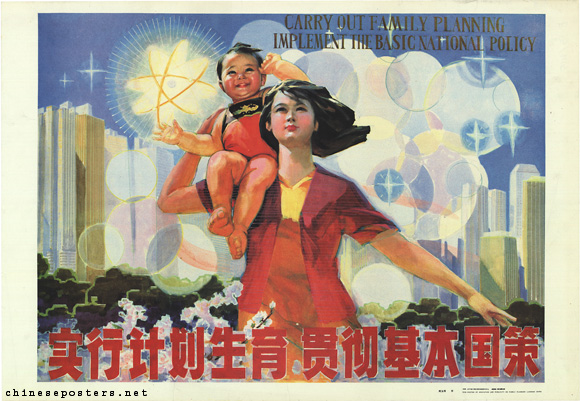
The policy was formalized on September 25, 1980 in a public letter published by the Central Committee of the Chinese Community Party, calling upon all families in China to adhere to the one-child policy.

But however well intended, the policy has had significant unintended consequences that will burden China for years to come and threaten its political and economic power: too sharp a drop in birth rates and too many old people.

In 1979, Liang Zhongtang, a Chinese economist and demographer, insisted that the one-child policy would be a “terrible tragedy” that would turn China into a “breathless, lifeless society without a future,” but he was ignored.

OneChildPoster

The rigorous enforcement of the policy quickly got ugly, with a particularly devastating impact on female babies, as families favored having male children.

NPR reported on the consequences of the one-child policy in China’s Rudong County in Jiangsu province.

The county launched a family planning pilot program in the 1960s. “Having a second child wasn’t allowed, so we had to work on (pregnant women) and persuade them to have an abortion,” Chen Jieru, the Communist Party secretary of a village at the time, told NPR.

The result? The policy, in combination with an exodus of young people to cities for better opportunities, left the county’s young population shriveled while the elderly population has exploded.

The increasing number of the elderly is soon going to be a problem across China. There are now five workers to each retiree, but in a little more than 20 years that is projected to shift to 1.6 workers to every one retiree. “It spells shrunken tax coffers, reduced consumer spending and all-around diminished productivity,” said Mei Fong in her recently issued book, “One Child – the story of China’s most radical experiment.”

A senior Chinese economist, Liu Mingkang, speaking at the Asia Global Dialogue in 2012, said China’s population growth will end as soon as 2020 when its population will peak at 1.6 billion.

Youhua Chen, a demographer at China’s Nanjing University, gained some notoriety by warning about a sharp drop ahead for China’s population. The decline will be accompanied by soaring health care and pension costs, and collapsing real estate markets, he warned.

Prof. Chen has predicted that China’s population will peak at about 1.4 billion and then fall precipitously to 500 million. His graph is below.

GraphImage

Title: Figure 1   Estimated China Population Growth 1950-2100   (Black line): Low (Plan, Program, Prospects…)   (Pink line): Medium (Plan, Program, Prospects…)   (Blue line):  High (Plan, Program, Prospects)   Graph courtesy of Mei Fong, Fellow, New America

If Prof. Chen is right, this means lots of problems.

“These problems will compromise economic development, strain social harmony, and place the traditional Chinese family structure under severe pressure; in fact, they could shake Chinese civilization to its very foundations,” said Nicholas Eberstadt, Henry Wendt Scholar in Political Economy with the American Enterprise Institute.

China has recently loosened the one-child restrictions, but it hasn’t resulted in a baby boom. So the prediction still holds that in the near future India may overtake China as the world’s most populous state, and India, which some are already calling an emerging superpower, will keep growing while China declines.

According to RAND, a research organization that develops solutions to public policy challenges , the Chinese government has implemented a range of pro-natalist policies aimed at reversing fertility decline, including the universal two-child policy in 2015 and the three-child policy in 2021, yet these policy measures have not corrected China’s plummeting total fertility rate or birth rate. A 2025 RAND report, Pronatalist Pivot: Assessing China’s Policy Efforts to Boost Fertility, assesses China’s policy responses to demographic challenges from 2015 to 2025 and considers how China’s experience can inform U.S. policy responses to fertility decline and related demographic challenges.

“When you see a country’s population decline, the country will definitely degrade into a second-rate one,” said Yao Yang, an economist with Peking University’s China Center for Economic Research.

“I’m sorry” isn’t enough for the UCLA basketball players

Talk about privilege.

UCLAPlayers

UCLA basketball players Cody Riley (L),  LiAngelo Ball (C) and Jalen Hill (R) at a news conference on Nov. 15, 2017.

UCLA freshman basketball players Cody Riley, LiAngelo Ball and Jalen Hill are hardly run-of-the-mill children. They were recruited to the UCLA not because of their academic promise, but because they were top-notch basketball players. That’s what got them their free ride at the school.

And their detention in Hangzhou China wasn’t because one of them mischievously left a store with a pack of gum without paying for it. Far from it. They were arrested for allegedly stealing sunglasses from a Louis Vuitton store. Such sunglasses typically run $600 – $2000.

And their heists went beyond that. Chinese police have surveillance footage of the three shoplifting in three, yes three, stores in a high-end shopping center. These guys were on a shoplifting spree.

Anybody else pulling this stuff in China would be in prison. But these guys avoided prison sentences because of their celebrity and the intervention of no less than the President of the United States.

“Everyone’s making it a big deal,” said LiAngelo’s father, LaVar. “It ain’t that big a deal.”

But it was a big deal. And these aren’t naïve college kids from the sticks. For example, LiAngelo’s older brother, Lonzo, is a Los Angeles Lakers point guard and his 16-year-old brother, LaMelo, is a high school sophomore who has already committed to play basketball at UCLA and has launched his own $395 Melo Ball 1 sneakers.

A suspension after the ritualistic “I’m sorry” shouldn’t let these three off the hook. Their basketball careers at UCLA shouldn’t be suspended. They should be over.

A different world: the unintended consequences of China’s one-child policy

The deaths of female babies by drowning, sex-selective abortion, malnutrition, denial of health care and abandonment.

These are some of the grim consequences of China’s one-child policy.

chinaforcedabortion

In 2012, CNN reported that Feng Jianmei, 22, was detained and coerced into having an abortion in the seventh month of her pregnancy, according to her husband.

But they aren’t the only ones.

China, once fixated on explosive population growth and worried about the economy’s ability to cope with it, now has a new problem, too sharp a drop in birth rates and too many old people.

The ramifications for China and the rest of the world could be severe.

In 1979, Liang Zhongtang, a Chinese economist and demographer, insisted that the one-child policy would be a “terrible tragedy” that would turn China into a “breathless, lifeless society without a future,” but he was ignored.

In 1980, the Central Committee of the Chinese Communist Party, fearfully contemplating a population of one billion, initiated a one-child policy.

OneChildPoster

The rigorous enforcement of the policy quickly got ugly, with a particularly devastating impact on female babies, as families favored having male children.

“Chinese women’s reproduction is utilized as a feature of socialist modernization, a sacrifice for the good of the state,” said Winter Wall, founder and Managing Member at W3 Global Consulting in Denver, CO. “Reproductive rights in Chinese society have been co-opted by the government as a component of a broader push towards socialist modernization.”

While most Americans think of China in terms of the cheek-to-jowl masses of people crowded into Bejing, there’s much more to the story.

NPR reported this past year on the consequences of the one-child policy in China’s Rudong County in Jiangsu province.

The county launched a family planning pilot program in the 1960s. “Having a second child wasn’t allowed, so we had to work on (pregnant women) and persuade them to have an abortion,” Chen Jieru, the Communist Party secretary of a village at the time, told NPR.

The result? The policy, in combination with an exodus of young people to cities for better opportunities, has left the county’s young population shriveled while the elderly population has exploded.

The increasing number of the elderly is soon going to be a problem across China. There are now five workers to each retiree, but in a little more than 20 years that is projected to shift to 1.6 workers to every one retiree. “It spells shrunken tax coffers, reduced consumer spending and all-around diminished productivity,” said Mei Fong in her recently issued book, “One Child – the story of China’s most radical experiment.”

A senior Chinese economist, Liu Mingkang, speaking at the Asia Global Dialogue in 2012, said China’s population growth will end as soon as 2020 when its population will peak at 1.6 billion.

Youhua Chen, a demographer at China’s Nanjing University, has also gained some notoriety by warning about a sharp drop ahead for China’s population. The decline will be accompanied by soaring health care and pension costs, and collapsing real estate markets, he has warned.

Prof. Chen has predicted that China’s population will peak at about 1.4 billion and then fall precipitously to 500 million. His graph is below.

GraphImage

Title: Figure 1   Estimated China Population Growth 1950-2100   (Black line): Low (Plan, Program, Prospects…)   (Pink line): Medium (Plan, Program, Prospects…)   (Blue line):  High (Plan, Program, Prospects)   Graph courtesy of Mei Fong, Fellow, New America                                                                                                                                                                                                                                                                                                                                                                                                                                                  

If Prof. Chen is right, this means lots of problems.

“These problems will compromise economic development, strain social harmony, and place the traditional Chinese family structure under severe pressure; in fact, they could shake Chinese civilization to its very foundations,” said Nicholas Eberstadt, Henry Wendt Scholar in Political Economy with the American Enterprise Institute.

There are already signs of a slowing Chinese economy that will be exacerbated by the aging of the population. China’s economy is “like a speeding bicycle that has to keep going just to keep from falling over, “ said the Center for Strategic and International Studies in a report on China’s Long March to Retirement Reform.

Gordon G. Chang, writing in World Affairs, has posited that the decline in China’s population will also exacerbate China’s economic challenges, particularly its competition with India.

China has recently loosened the one-child restrictions, but it hasn’t resulted in a baby boom. So the prediction still holds that sometime in the next 10 years, India will overtake China as the world’s most populous state at some point before 2025, Chang says, and India will keep growing while China declines. India’s India’s workforce will pass China’s by 2030, according to the UN.

“When you see a country’s population decline, the country will definitely degrade into a second-rate one,” said Yao Yang, an economist with Peking University’s China Center for Economic Research.

In light of all this, it’s India, not China, that could end up dominating the middle of this century.

That will change things…a lot.

Dear Senator Merkley: anybody can write a bill

Anybody in Congress can write a bill.

That, in itself, isn’t much of an accomplishment. The real test is whether you can get your bill passed. Jeff Merkley, after 6 years in the Senate, doesn’t seem to understand that.

Senator Jeff Merkley

Senator Jeff Merkley

In an effort to portray himself as an accomplished legislator, Merkley has a TV ad out asserting, “….I wrote a bill to make China play fair on trade.” The problem is Merkley’s bills never passed.

When I served in Washington, D.C. as staff on a subcommittee of the House of Representatives, I worked with the Legislative Counsel’s office to draft dozens of bills at the request of the subcommittee chairman and ranking minority member. That’s the easy part. The tough part is getting something through the entire legislative process in the Senate and House and signed into law. That is the grueling work, depending on persistence, personal relationships, hard work and knowledge of the legislative process.

As a newspaper reporter after leaving Washington, I argued on numerous occasions against writing up lengthy stories on bills submitted by Oregon’s members of Congress just because they’d been put in the hopper. It’s a too common tactic by legislators to garner media coverage on a topic without actually having to do anything substantive.

The public is too often fooled by this tactic because they either don’t understand the legislative process or don’t assiduously follow the progress, or lack thereof, of proposed legislation.

Merkley’s clearly trying to pull a fast one. The ad should come down.