On July 9, 2023, The New York Times ran a 4,314-word story about Supreme Court Judge Clarence Thomas’s connections with an exclusive club, the Horatio Alger Association of Distinguished Americans Inc..
“His friendships forged through Horatio Alger have brought him proximity to a lifestyle of unimaginable material privilege,” the reporters wrote, leading into multiple examples of benefits he received from a broad cohort of wealthy and powerful friends and insinuations that Thomas had been compromised.
Citing the Association’s website, the story said the non-profit group, portrayed as a group of wealthy and influential believers in meritocratic success, has awarded more than $245 million in college scholarships to roughly 35,000 students since its founding in 1947. The Association has been tax-exempt since Oct. 1952.
What the reporters didn’t do was look deeper at the Association. It has quite a dubious history.
In 1988, while a business reporter at The Oregonian newspaper, I researched and wrote a story about the Association, which had inducted two prominent Oregonians. The story (which won plaudits from the Columbia Journalism Review) noted that from 1985 through 1987 — the latest period for which tax records were available at the time — the Association raised $2.1 million. During those three years, The organization spent $1.7 million. Just $315,000 of that went to scholarships.
Rather than funding scholarships, most of the association’s outlays went to executive salaries, office expenses, books devoted largely to laudatory stories of the members’ lives, annual banquets at places such as New York’s Waldorf Astoria Hotel and the Westin Galleria Hotel in Houston and contracts with a New York public relations firm.
The amount of salary and benefits going to the association’s executive director alone, which increased from $98,126 in 1985 to $120,154 in 1987, exceeded or almost equaled the amount of scholarships awarded in each of the past three years. Those scholarships totaled $100,000 in both 1985 and 1986 and $115,000 in 1987.
In 1987 the Association spent more on printing and publications than on scholarships. Its principal annual publication was a hard-cover book titled “Only in America Opportunity Still Knocks.” The book devoted 132 of its 192 pages to a membership list and biographies featuring informal snapshots of the members and outlines of their paths to success.
A review of the Association’s recent federal tax filings reveals it still engages in questionable financial behavior.
The IRS requires that tax-exempt organizations, nonexempt charitable trusts, and section 527 political organizations file an annual Form 990 to provide the IRS with the information required by 26 U.S. Code § 6033. In its recent filings it stated its purpose as: “(1) To provide scholarship assistance to help promising high school students (who fit the Horatio Alger profile) attend college, and (2) to spread the message that America’s free enterprise system provides the greatest opportunities in the world for personal achievement and success.”
The Alexandria, VA-based Association’s recent Form 990s (2020, 2021) reveal it has grown substantially since I wrote about it in 1988, reporting total revenue of $27,092,429 in 2020 and $20,322,852 in 2021. But its scholarship distributions still fall far short of its annual revenue.
In 2020, its scholarship grants totaled $11,223,951, just 41% of its revenue. In 2021, grants totaled $12,287,913, 60% of its revenue, which was at least better than in 2010, when its revenue totaled $19,682,336 and its grants to individuals totaled just $4,721,307.
Where has all the rest of its revenue gone?
In 2021, a whopping $2,446,876 went to salaries, other compensation and employee benefits, including $1,348,080 to Executive Director Terrence J. Giroux. Another $318,936 went to a Philadelphia, PA public relations firm, Brian Communications. A total of $552,717 was spent on “event management”, slightly less than the $1,062,380 spent on event management and production in 2020. (The Association’s Form 990s say some of that money went to Linder & Associates, but that is a property management company in Los Angeles, California. The money probably went, instead, to Linder Global Events, an event management agency based in Washington, D.C.)
The Red Bank Film Factory of Red Bank, NJ was paid $471,271 and Destin Productions LLC of Limassol, Cyprus took in $330,000 for a television marketing campaign in 2021
Another $8,527,523 went to “Other Expenses”, including legal, accounting, advertising, office expenses, travel, conferences, conventions and meetings.
According to the Association’s 2021 Form 990, $2,739,296 went just to “Member support and meetings, including the annual board of directors meeting, annual awards week in Washington, D.C. and specialized forums.”
In other words, given the amount of its revenue, the Association falls far short of expectations in its scholarship handouts, while spending extravagant sums on compensation and other functions, such as public relations and fancy dinners for its mostly wealthy members.
Media coverage of the Association, while frequently citing its distinguished members, such as author Maya Angelou, former Intel CEO Craig Barrett, Michael Bloomberg and NBC News anchor Tom Brokaw, also has failed to mention that its ranks include some questionable characters, such as:
- Roger Ailes, who resigned as chairman and CEO of Fox News after being accused of sexual harassment by several female Fox employees, including on-air hosts
- Elizabeth Holmes, former CEO of Theranos. Holmes was convicted in 2022 on four counts of wire fraud for swindling doctors and patients to use her company’s blood-testing services while knowing that Theranos was incapable of producing accurate results, according to the indictment. She was also accused of defrauding investors of more than $700 million with the fabricated claims.
- Joe Allbritton, a Washington, D.C. power-broker who turned a blind eye to evidence that Riggs Bank, of which he was chairman and chief executive officer, was “handling the proceeds of foreign corruption and paid paid a $16 million criminal fine over charges the bank had failed to report suspicious transactions with foreign account holders.” The judge who imposed the fine described the bank as “a greedy corporate henchman of dictators and their corrupt regimes.”
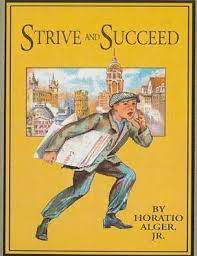
America loves stories about someone picking themselves up by their bootstraps, as in Horatio Alger’s books about impoverished boys and their rise from humble backgrounds to lives of success, although, truth be told, you can’t really do that. Truth be told, the Horatio Alger Association of Distinguished Americans Inc. isn’t all it’s stacked up to be either.
 ThinkingOregon