
“Tell me lies. Tell me sweet little lies.” Fleetwood Mac

On this, March 20, the 18th anniversary of when the United States and coalition forces began the war in Iraq, causing hundreds off thousands of military and civilian deaths, the one person responsible for this unnecessary and tragic war needs to be acknowledged.
When David Halberstam wrote The Best and the Brightest about the people who dragged the United States into the war in Vietnam, he didn’t intend to praise them. He meant, instead, to strike a sardonic tone, to mock the elite, highly educated and well-born men (and they were mostly men) who promoted the Vietnam fiasco.
The policymakers Halberstam highlighted in “Best and the Brightest” were high-level actors such as President John F. Kennedy and his brother, Robert F. Kennedy, Robert McNamara, Dean Rusk, McGeorge and William Bundy, George Kennan, George Ball, Clark Clifford, Walt Rostow, John McCone, and others.
The U.S. war in Iraq was a replay, just with different faces.
The players who dragged the United States down the twisted road into the conflagration in Irag were first and foremost the president himself, George W. Bush. His supporting cast included a long list of enablers, including: Vice President Dick Cheney; Deputy Secretary of Defense Paul Wolfowitz; Undersecretary of Defense for Policy Douglas Feith; Cheney’s chief of staff Lewis “Scooter”Libby; Secretary of Defense Donald Rumsfeld; David Wurmser, a member of Feith’s Policy Counterterrorism Evaluation Group; and Richard Perle, who served as chairman of the Defense Department’s Defense Policy Board. The weight of the unnecessary war should still hang like an albatross on the necks of these so-called public servants.
Not surprisingly, that’s not where the official White House-appointed commission created to find out where things went wrong laid the blame.
“We conclude that the Intelligence Community was dead wrong in almost all of its pre-war judgments about Iraq’s weapons of mass destruction,” said the March 31, 2005 Report to the President of The Commission on the Intelligence Capabilities of the United States Regarding Weapons of Mass Destruction. “This was a major intelligence failure. Its principal causes were the Intelligence Community’s inability to collect good information about Iraq’s WMD programs, serious errors in analyzing what information it could gather, and a failure to make clear just how much of its analysis was based on assumptions, rather than good evidence. On a matter of this importance, we simply cannot afford failures of this magnitude.”
“Finally, it was a failure to communicate effectively with policymakers; the Intelligence Community didn’t adequately explain just how little good intelligence it had—or how much its assessments were driven by assumptions and inferences rather than concrete evidence,” the Commission added.
Bullshit.

It wasn’t the intelligence community that owned all the screw ups. There’s no question that deficiencies in intelligence gathering, including a lack of useful human intelligence and reliance on unreliable Iraqi defectors, played a major role in making bad decisions. CIA Director George Tenet contributed to the manipulation of intelligence to maintain his access to, and influence on, Bush and other administration officials.
But if you read the books, reports, essays, etc. written by people not appointed by the Bush administration, the real blame belongs on the shoulders of the top policymakers, all the way up to President George W. Bush, whose eyes were wide shut, refused to see things in plain view. He was determined to go to war and embraced questionable intelligence data to make it happen.
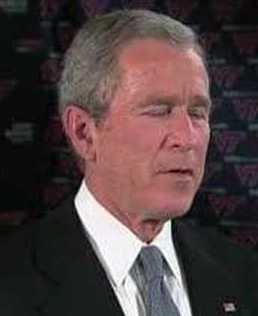
The result was a war that twisted and perverted whatever it touched, over there as well as over here, as Luke Mogelson wrote in a New Yorker essay about Peter Van Agtmael’s book, “Sorry for the War.”

Bush and his cadre of neoconservatives thought they were doing the right thing, pushing for the transformation of Iraq in the belief that would have a bandwagon effect on the fractious middle east.
President George W. Bush said on Nov. 6, 2003 at the 20th Anniversary of the National Endowment for Democracy: “Iraqi democracy will succeed –- and that success will send forth the news, from Damascus to Teheran –- that freedom can be the future of every nation. The establishment of a free Iraq at the heart of the Middle East will be a watershed event in the global democratic revolution.”
But in the end Bush and his acolytes were like the young idealist Alden Pyle in Graham Greene’s The Quiet American, set in Saigon during the French fight to retain Vietnam in colonial rule. “I never knew a man who had better motives for all the trouble he caused . . . impregnably armored by his good intentions and his ignorance,” the novel’s narrator, Thomas Fowler, said of Pyle.
Yes, subsequent analysis has revealed serious intelligence shortcomings.
- Rafid Ahmed Alwan al-Janabi, known by the Defense Intelligence Agency cryptonym “Curveball”, reportedly told German intelligence that Iraq possessed stockpiles of biological weapons and had manufactured ingeniously simple mobile trailers to produce them. He was not considered a credible, reliable source and later admitted he had fabricated the story.
- President Bush, Secretary of State Colin Powell and other senior administration officials asserted that Iraq had attempted to acquire more than 100,000 high strength aluminum tubes for gas centrifuges to be used for enriching uranium that could be used to make nuclear weapons. Evidence showed that was not the case. In fact, the dimensions and the aluminum alloy were identical to those of tubes acquired for small rockets by Iraq.
- The Bush administration alleged that a Sept. 11 hijacker, Mohamed Atta, met with an Iraqi intelligence agent, Ahmed Khalil Ibrahim Samir al-Ani, at a café in Prague five months prior to the 9/11 attacks. There was no evidence to support that claim.
- The administration claimed that Iraq had trained al Qaeda members in bomb-making and poisons and deadly gases, strengthening a claim of close ties between Saddam Hussein and al Qaeda. A June 21, 2002 CIA report, “Iraq and al-Qa’ida: Interpreting a Murky Relationship,” stated that “the level and extent of this assistance is not clear.” The document noted the “many critical gaps” in the knowledge of Iraqi links to al Qaeda because of “limited reporting” and the “questionable reliability of many of our sources.”
- The Bush administration claimed that Iraq attempted to obtain processed uranium from Niger in Africa as part of its effort to reconstitute its nuclear weapons programs. Former Ambassador Joseph Wilson, sent to Niger by the CIA to investigate reports about Iraq’s attempts to acquire uranium from that country, concluded the claim was not credible and others asserted that documents allegedly detailing uranium transactions between Iraq and Niger were “not authentic.”
- The Bush administration said Iraq was exploring ways of using unmanned aerial vehicles that could be used to disperse chemical and biological weapons across broad areas, potentially for missions targeting the United States. The Air Force, it was later revealed, had maintained that Iraqi drones with chemical and biological weapons were not capable of posing any real threat to the U.S., or even to the countries bordering Iraq.
- President George W. Bush and key members of his administration insisted that Iraq was reconstituting its nuclear weapons program and that Saddam Hussein possessed weapons of mass destruction (WMD) that posed an immediate threat to the United States and its allies. There was no program for development of WMDs, nuclear or otherwise. The United States failed to find weapons stocks or active production lines.
But the fact is intelligence, or the lack thereof, on Iraqi weapons programs isn’t what drove President Bush’s decision to go to war in Iraq.
As Paul R. Pillar, who served as National Intelligence Officer for the Near East and South Asia at the CIA from 2000 to 2005, wrote in an article published in the March/April 2006 edition of Foreign Affairs, “What is most remarkable about prewar U.S. intelligence on Iraq is not that it got things wrong and thereby misled policymakers; it is that it played so small a role in one of the most important U.S. policy decisions in recent decades.”
The decision to topple Saddam Hussein was “driven by… the desire to shake up the sclerotic power structures of the Middle East and hasten the spread of more liberal politics and economics in the region,” Pillar wrote.
Where intelligence raised doubts about the reliability of information the policymakers were using to justify war, they disregarded it.
And American media mostly cheered them on, led by reporters for the major media outlets, particularly the New York Times and Washington Post. Then there was Congress, which, despite some misgivings, essentially gave President Bush a blank check to do his thing.
So Bush did.
As Johann Wolfgang von Goethe so eloquently put it, “A man is not deceived by others; he deceives himself.”



 ThinkingOregon