
Portland-based Northwest Natural is already grappling with efforts by climate activists to phase out natural gas use in Oregon homes in favor of electricity and a misguided Multnomah County lawsuit alleging the company is responsible for a ”substantial portion” of greenhouse gas pollution in Oregon. Now it has another problem – concerns about ballooning CEO compensation.
With all the racket going on in the world and Oregon these days, it can be hard to focus on seemingly small things like this, but the soaring level of executive pay and the country’s increasing economic inequality are worth paying attention to.
Richard G. Reiten, President and Chief Operating Officer of Portland General Electric Company (PGE), was selected to run Northwest Natural In 1996. I remember that appointment because I wrote about it as a reporter at The Oregonian. “The president of Portland General Electric is switching to gas” was the story lead on Nov. 6, 1995.
In 1997, Reiten’s first year as president and CEO of Northwest Natural, his compensation totaled $496,888 (Salary: $367,500; Bonus: $115,200; Other Compensation: $14,188).
Reiten, 63, was succeeded by Mark S. Dodson on January 1, 2003. His 2003 compensation totaled $662,396. (Salary: $390,000; Bonus: $250,000; Other Annual Compensation: $1,585; Other Compensation: $20,811).
Gregg S. Kantor succeeded Dodson as CEO on Jan. 1, 2009. His 2009 compensation leapt to $2,175,300 (Salary: $446,000; Bonus: $234,800; non-equity incentive plan: $330,200; Option Awards: $136,500; Change in pension value and nonqualified deferred compensation earnings: $994,400; Other compensation: $33,400).
Kantor was succeeded by David H. Anderson, who became CEO in August 2016. In 2017, his compensation totaled $3,537,654 (Salary: $641,700; Bonus: $173,300; Non-equity incentive plan: $437,700; Stock Awards: $834,900; Change in pension value and nonqualified deferred compensation earnings: $1,000,000; Other compensation: $58,300).
In 2023, Anderson’s compensation again totaled $3,537,654 (Salary: $830,000; Bonus: $328,145; Stock awards: $1,449,015; Non-equity incentive plan: $475,855; Change in pension value and nonqualified deferred compensation earnings: $404,515; All other compensation: $50,124. That’s $9692.20 a day.
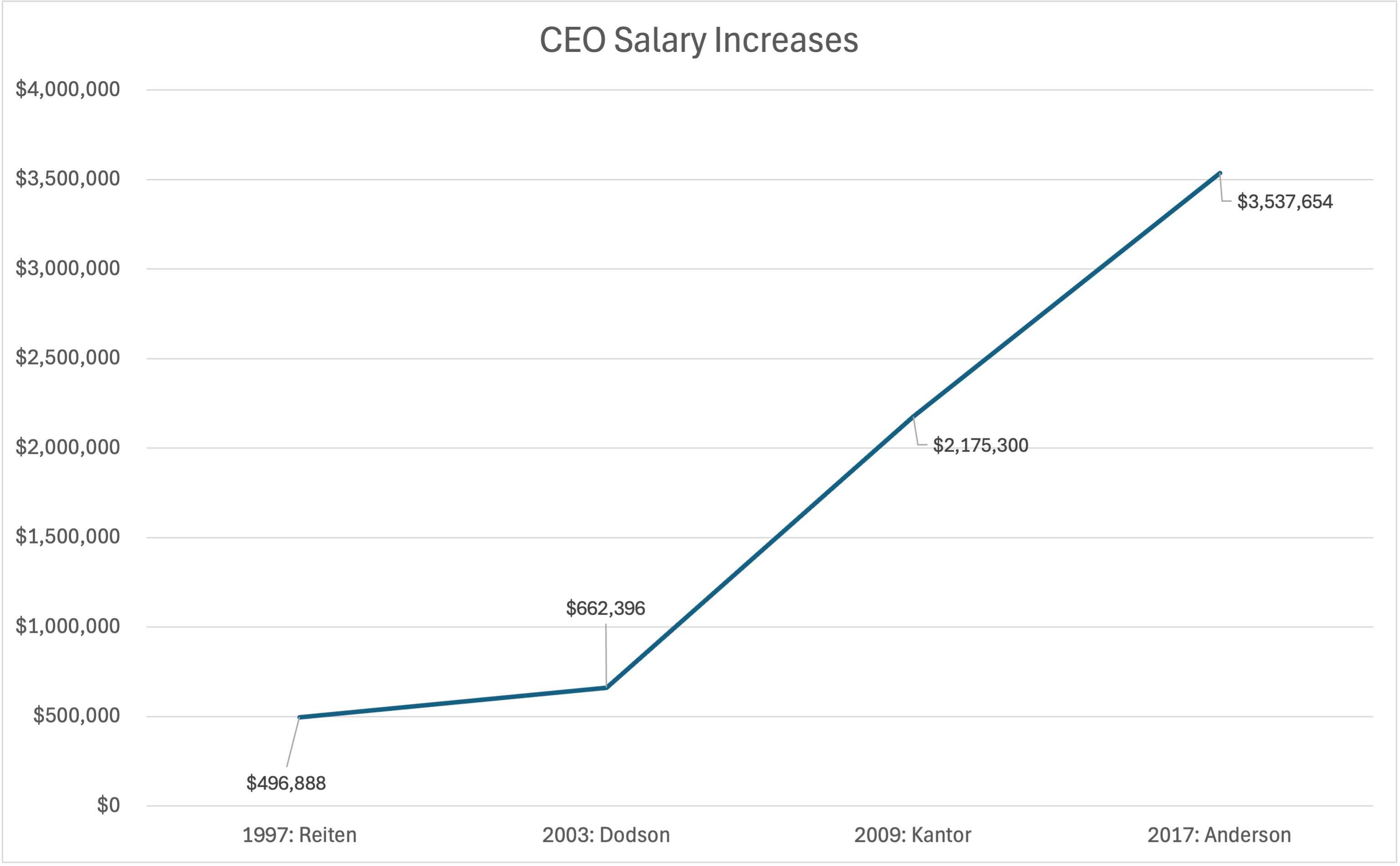
All this despite the fact Northwest Natural, despite its local prominence, is actually a relatively small company, with just about 1200 employees and net income in 2023 of $93.9 million.
In May 2024, Northwest Natural announced that Anderson would retire on April 1, 2025. The Board of Directors designated Justin B. Palfreyman as the successor to Anderson. Palfreyman’s expected compensation was not disclosed.
So how would you have done if you’d invested in Northwest Natural in 1997, when Richard Reiten became CEO?
Northwest Natural stock hit a peak price of $70.88 in 2019, but has since slipped to $38.88 on Oct. 7, 2024. If you had bought a block of shares at the start of 1997 and sold them almost 28 years later on Oct. 7, 2024, you would have realized a total gain of just $15.13 per share or 64%.
If you invested $100 in the S&P 500 at the beginning of 1997 and reinvested all your dividends, you would now have about $1,173.11. This is a return on investment of 1,073.11%, or 9.40% per year. Even adjusted for inflation, the $1,173.11 nominal end value of the original $100 investment would have a real return of roughly $498.12 in 1997 dollars, or an inflation adjusted return of 498.12%.
It looks like Northwest Natural’s shareholders haven’t done quite as well as its CEO’s.

 ThinkingOregon