America’s Rising Inequality Threatens National Stability

I wandered through Nordstom’s downtown Portland store the other day.

Take a look at some of the shoes I came across:

OK, but what’s so special about all these shoes? Even single one of them, including the sneakers, costs $850 or more. The Black Libelli Booties (top right) are $1795. The Fendigraphy white leather slides (bottom) are $1100.

And, by the way, big spenders looking for socks to wear with their $1000 sneakers can buy a pair of black-and-white Bottega Veneta “ghost pattern” crew socks at Nordstrom for $420. That’s right, $420.

If that’s just a bit too much, the striver can also get a pair of Balenciaga Logo Cotton Blend Socks at Nordstrom for $210 a pair or a pair of Off-White Arrow Cotton Blend Crew Socks for $120.

“The logic is, if you’re paying $1,000 for a pair of shoes, what’s $200 more?” Jian DeLeon, the men’s fashion director at Nordstrom, told the Wall Street Journal. “Lavish socks are “something you don’t need, but it’s the ultimate expression of luxury.” When you pair fancy shoes and socks, he said, it shows you’re going the “extra mile.”

It’s hard not to wonder who is buying this exorbitantly priced stuff and what it says about our economy.

Per capita income in the Portland Metro Area is just $40,138 and median household income is only $77,511.

The annual income of 31% of households is $50,000 or less. Another 31% of households have annual incomes of $50,000 – $100,000. It is probably reasonable to assume that the members of this 62% of households in the Portland Metro Area are not the ones buying $895 and over pairs of shoes.

That leaves 38% of Metro Area households earning $100,000 a year and more.

Household income

ColumnPortland-Vancouver-Hillsboro, OR-WAOregonUnited States
Under $50K31.2%±0.5%299,055±4,61338.1%±0.4%626,425±6,571.739.1%±0.1%47,785,414±58,302.5
$50K – $100K30.8%±0.5%295,189±4,384.331.4%±0.3%516,210±5,646.930%±0.1%36,648,022±63,450.6
$100K – $200K28.1%±0.4%268,728±4,128.523.2%±0.3%381,343±4,795.522.7%±0.1%27,817,092±73,446.1
Over $200K9.9%±0.2%95,005±2,1407.2%±0.2%118,601±2,8408.3%±0%10,103,691±51,548

I assume the buyers of high-priced items like the shoes above come from that segment of the population. But are enough of them so blasé about overall economic conditions to be drawn into buying extravagant goods?

The answer seems to be yes.

The middle class, once the economic stratum of a clear majority of American adults, has steadily contracted in the past five decades, according to a new Pew Research Center analysis of government data. The share of adults who live in middle-class households fell from 61% in 1971 to 50% in 2021. Although household incomes have risen substantially since 1970, those of middle-class households have not climbed nearly as much as those of upper-income households. 

On Sept. 27, 2022, the Congressional Budget Office issued a study of trends in the distribution of family wealth between 1989 and 2019. In that period, total real wealth held by families tripled from $38 trillion to $115 trillion.

But the distribution of that growth was uneven.

Money moved toward the families in the top 10%, and especially in the top 1%, shifting from families with less income and education toward those with more wealth and education. In the 30 years examined, the share of wealth belonging to families in the top 10% increased from 63% in 1989 to 72% in 2019, from $24.3 trillion to $82.4 trillion (an increase of 240%). The share of total wealth held by families in the top 1% increased from 27% to 34% in the same period. In 2019, families in the bottom half of the economy held only 2% of the national wealth, and those in the bottom quarter owed about $11,000 more than they owned. 

As the New York Times recently observed, “Higher-income households built up savings and wealth during the early stages of the pandemic as they stayed at home and their stocks, houses and other assets rose in value. Between those stockpiles and solid wage growth, many have been able to keep spending even as costs climb. But data and anecdotes suggest that lower-income households, despite the resilient job market, are struggling more profoundly with inflation.”

Even during the pandemic, when most Americans fared well financially, the rich saw most of the gain. According to the Federal Reserve, while American households overall saw about $13.5 trillion added to their wealth, the top 1% got a third of that and the top 20% 70% of it.

As the Wall Street Journal recently reported, even though the United Status is technically in a recession, and consumer confidence isn’t great, the demand for expensive luxury goods, such as handbags and jewelry, is off the charts

“Spending by Americans and Europeans is roaring, despite headlines of all-time-low consumer sentiment in the eurozone and greater caution in the U.S.,” reported the Journal. “Many luxury brands have more than doubled the size of their sales in America compared with prepandemic levels. Because of their wealthier customers, luxury brands might be more immune to the challenges other businesses now face.”

Luxury company LVMH Moët Hennessy Louis Vuitton (LVMH), whose brand stable includes Christian Dior, Louis Vuitton and Tiffany, reported a rise in sales at all its divisions in the first half of 2022. Growth was strongest in the fashion and leather goods unit, the company’s biggest, where first-half sales rose 31% year-over-year to €18.1 billion. U.S. revenues gained 24%.

U.S. credit card data from Bank of America shows that shoppers earning less than $50,000 a year are rethinking their priorities as inflation hits everyday expenses, but this has been more than offset by demand from core luxury spenders.

Then there’s the desire of some people to be noticed, to display their wealth, even if the items on display are rather bizarre or not particularly attractive. I call this the “Sure it’s ugly, but it’s expensive” syndrome.

It’s the weirdness itself that has appeal.

It’s not that people want an ugly or bizarre watch or pair of shoes. What they want is to stand out, to have their friends, neighbors and even strangers see their distinctive, peculiar, expensive accoutrements.

Oh well, at least people blowing all their money on overpriced things are keeping the people who make them employed. And that’s good, right?

More Merkley drama: the Stop Cruelty to Migrant Children Act

razzledazzle

Not one to miss a chance to put himself in the spotlight, Sen. Jeff Merkley (D-OR) grandly announced on July 11 that he led a group of 40 senators in introducing the Stop Cruelty to Migrant Children Act.

Merkley was in so much of a hurry to claim leadership on the bill that he has issued a press release, a section-by-section breakdown of the bill (S. 2113) and a one-pagesummary, but the bill hadn’t even been written.  According to Congress.gov, text had still not been received for S.2113 as of July 16, 2019.

Nevertheless, the bill has been referred to the Committee on the Judiciary Committee. Suffice it to say, however, the bill isn’t going anywhere.

One reason – not a single Republican has signed on as a cosponsor. In this, Merkley is continuing to earn his reputation as one of the Senate’s most partisan Members.

The Bipartisan Index measures the frequency with which a Member co-sponsors a bill introduced by the opposite party and the frequency with which a Member’s own bills attract co-sponsors from the opposite party. The Index reflects how well members of opposite parties and ideologies work together.

According to the Bipartisan Index of senators released by The Lugar Center and Georgetown University’s McCourt School of Public Policy, Merkley had the third most partisan track record in the entire Senate in the most recent analysis covering the 115th Congress (2017-2018)

That was even worse than Merkley did in the 113th Congress, when he was ranked the 7th most partisan senator.

Another reason Merkley’s migrants bill is already dead in the water — – how many Republicans does Merkley seriously think are going to support a bill demanding that the Administration “Stop Cruelty to Migrant Children”?

Then there’s the expansive scope of the bill.

The bill would create “non-negotiable standards” for the treatment of migrant children, including:

  • Ending family separations except when authorized by a state court or child welfare agency, or when Customs and Border Protection and an independent child welfare specialist agree that a child is a trafficking victim, is not the child of an accompanying adult, or is in danger of abuse or neglect;
  • Setting minimum health and safety standards for children and families in Border Patrol Stations.
    • Requiring access to hygiene products including toothbrushes, diapers, soap and showers, regular nutritious meals, and a prompt medical assessment by trained medical providers.
    • Requiring children receive three meals a day that meet USDA nutrition standards.
    • Ending for-profit contractors from operating new Office of Refugee Resettlement (ORR) standard shelters or influx facilities.
      • Ensuring that temporary influx facilities are state-licensed, meet Flores standards, and are not used to house children indefinitely.
      • Expanding alternatives to detention and the successful Family Case Management Program.
      • Lowering case manager caseloads, mandating lower staffing ratios, and ending the information sharing agreement between ORR and Immigration and Customs Enforcement (ICE).
      • Ensuring unaccompanied children have access to legal counsel and continue to be placed in a non-adversarial setting for their initial asylum case review.

Additionally, the legislation would provide resources to non-profit centers that are helping to provide humanitarian assistance.

It all sounds all very high-minded, but it would be onerous. For example, at a time when shelter facilities are bursting at the seams, ending for-profit contractors from operating new Office of Refugee Resettlement (ORR) standard shelters or influx facilities would mean rapidly securing replacements.

Then there’s the bill’s cost. But you won’t find that in the hastily issued press release, the section-by section breakdown of the bill, the one-page summary or in a text of the bill itself. That’s because as of July 16, 2019, a Congressional Budget Office Cost Estimate for the measure has not been received.

But Merkley and the 39 senators signing on as co-sponsors don’t really care. They know the bill is nothing more than an exercise in stage management, part of legislative theater.

As they sang in Chicago:

Razzle dazzle ’em
Give ’em a show that’s so splendiferous

Row after row will grow vociferous

Give ’em the old flim flam flummox
Fool and fracture ’em

How can they hear the truth above the roar?
_________________

S.2113 is sponsored by Sen. Merkley and co-sponsored by Senators Charles E. Schumer (D-NY), Patty Murray (D-WA), Dianne Feinstein (D-CA), Dick Durbin (D-IL), Mazie Hirono (D-HI), Bob Menendez (D-NJ),Chris Coons (D-DE), Amy Klobuchar (D-MN), Patrick Leahy (D-VT), Maria Cantwell (D-WA), Jack Reed (D-RI), Michael Bennet (D-CO), Tammy Baldwin (D-WI), Bernie Sanders (I-VT), Chris Van Hollen (D-MD), Elizabeth Warren (D-MA), Ben Cardin (D-MD), Ron Wyden (D-OR), Brian Schatz (D-HI), Catherine Cortez Masto (D-NV), Sheldon Whitehouse (D-RI), Jacky Rosen (D-NV), Richard Blumenthal (D-CT), Edward J. Markey (D-MA), Kirsten Gillibrand (D-NY), Mark Warner (D-VA), Tim Kaine (D-VA), Kamala D. Harris (D-CA), Chris Murphy (D-CT), Tammy Duckworth (D-IL), Maggie Hassan (D-NH), Tina Smith (D-MN), Jeanne Shaheen (D-NH), Cory Booker (D-NJ), Bob Casey (D-PA), Angus King (I-ME), Debbie Stabenow (D-MI), and Sherrod Brown (D-OH).


Sock it to ’em: the left dreams of more taxes and more government

The left’s collective veneration of the state and readiness to surrender self- reliance to its generosity are becoming ever more evident as the presidential race accelerates.

After exhaustive research, the New York Times has concluded that if the federal government raised taxes on the wealthy it could generate a lot of money. You don’t say.

tax-cartoon

The Times also figured out that the potential amount of revenue the government could raise from the wealthy would depend on how much the government raised their taxes. That’s groundbreaking.

Not only that, The Times said, but the government could raise one hell of a lot of revenue from high earners “…while still allowing them to take home a majority of their income,” How very thoughtful.

The Times effused over the things the government could do with a ton of additional tax revenue, like eliminating undergraduate tuition at all the country’s four-year public colleges and universities, as Senator Bernie Sanders has proposed. The potential next step — student loan forgiveness?

With the base of the Democratic Party moving swiftly to the left, you can expect more of these “we can do it because the wealthy will pay for it” proposals.

In the end, the Times took 2085 words to conclude that the more you tax rich people, the more taxes the government will collect (assuming the well-off don’t figure out how to avoid paying the taxes) and the more the government can spend on all sorts of stuff.

What the Times didn’t do is address the question of whether it would be a good thing for the government to reap enormous revenue increases and vastly expand its penetration into our daily lives.

Do we really want a massive expansion of government that would be a successor to the New Deal and the Great Society?

When you invite the government to pay for more things, the government becomes your partner, or, more likely, your boss. Is that what Americans want?

When government gives you things, they always come with new federal rules and regulations accompanied by known and unknown costs. Is that the American dream?

The Times also didn’t address the growing fiscal problems we are already facing:

  • Federal spending still exceeds revenue by over 400 billion dollars a year
  • deficits are expected to resume growing
  • even with declines in discretionary spending imposed by sequestration, entitlements are expected to grow in the future.

“You wouldn’t know that we have an unsustainable fiscal path from the debate we’re having right now,” Rudy Penner, a former director of the Congressional Budget Office, told the Wall Street Journal.

A message to the left and the NY Times. Be careful what you wish for.


(P.S. – Yes, I know, you also have conservatives proclaiming how they want to cut taxes when we can’t even pay our bills now, but that’s another story)

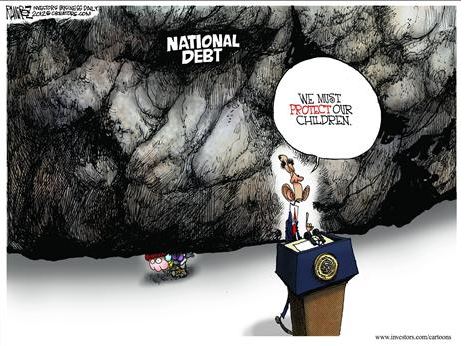
The real war is on our children

Democrats are again pulling out from their rhetorical basement accusations that Republicans are waging a “war on women”. Meanwhile, they’re ignoring another war that’s real, the “war on our children” that government spending addicts are prosecuting.

Our children are going to pay a heavy price for the fiscal insanity that has already led to national debt in excess of $17 billion.

Obama-National-DebtThe increase in our national debt over the past 25 years. years has been mind-boggling. In 1990, it was $3.2 billion, in 2000 $5.7 billion. By 2010 it was $13.6 billion. Now it has leaped to $17.5 billion.

But Democrats, in the spirit of “see no evil”, want to keep the issue under wraps and focus on other things. During a February 2014 House Financial Services Committee hearing, Rep. Maxine Waters (D-CA) and Rep. Keith Ellison (D-MN) even complained about two real-time running national debt clock displays in the hearing room. Ellison said it was just intended to send an ideological message.

Obama says his FY2015 budget proposal is an “opportunity agenda”. Yes, an opportunity for $564 billion more debt, an opportunity to increase total national debt to nearly $25 trillion over the next 10 years and an opportunity to pander to Americans who want it all without paying for it.

As Alabama Sen. Jeff Sessions, the top Republican on the Senate Budget Committee, said, Obama’s budget is a declaration that “deficits don’t matter, debt doesn’t matter, and that reality itself doesn’t matter.”

Some Democrats are arguing that annual deficits are dropping, so we can all back off worrying about the problem.

But the most recent Congressional Budget Office (CBO) budget forecast projects that after a few years of lower deficits they’ll climb again for an indefinite period. In addition, the national debt will increase annually by much more than the amount of the deficit because a considerable amount of federal borrowing is not counted in the budget.

As a result, the CBO projects $7.9 trillion will be added to the nation’s cumulative public debt over the next decade.

That’s because revenue will keep up with economic growth, but spending will grow even more. “Spending is boosted by the aging of the population, the expansion of federal subsidies for health insurance, rising health care costs per beneficiary, and mounting interest costs on federal debt,” the CBO said.

According to the CBO, interest payments will soon become the third largest item in the federal budget, after Social Security and Medicare. Right now, interest on the debt costs $233 billion. CBO projects that interest costs will reach $880 billion by 2024. As interest costs grow, they could crowd out investment in other priorities, including education, research and development, and other programs that could help our economy grow.

Large and growing federal debt that restrains economic growth will give policymakers less flexibility to respond to unexpected challenges, and eventually increase the risk of a fiscal crisis.

A Peter G. Peterson Foundation survey released on March 25, 2014 concluded that 67 percent of people say their concern about the national debt has increased over the past few years and 79 percent say that addressing the national debt should be among the President and Congress’ top 3 priorities.

And yet, Democrats continue to resist deficit-lowering efforts.

Deficit reduction surged as a policy priority during Obama’s first term: Between 2009 and 2013,  the share citing the deficit as a top priority rose 19 points, according to a January 2014 report from the Pew Research Center for the People & the Press. In the most recent 2014 survey, majorities of Republicans (80%) and independents (66%) continued to say reducing the budget deficit should be a top priority for the president and Congress, but just 49% of Democrats viewed it as a top priority, the lowest percentage since Obama took office. Going back 20 years, the gap between Republicans and Democrats on the issue has never been as large as it is today, Pew said.

Not exactly a hopeful sign for the emergence of bipartisan cooperation on the issue.