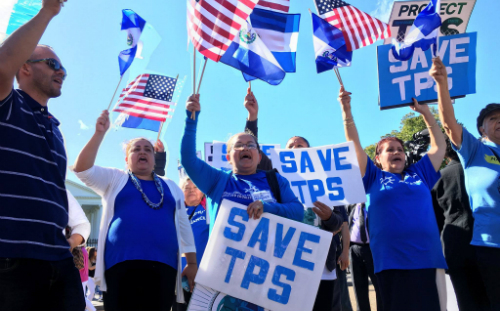
Trump’s Anti-Immigrant Invective Signals Trouble for Those With Temporary Protected Status

Photo: American Friends Service Committee

UPDATE 02/02/2025: The New York Times reported today that the Trump administration has ended Temporary Protected Status, or T.P.S., for more than 300,000 Venezuelans in the United States, leaving the population vulnerable to potential deportation in the coming months, according to government documents obtained by The New York Times. “The Trump administration’s attempt to undo the Biden administration’s T.P.S. extension is plainly illegal,” said Ahilan Arulanantham, who helps lead the Center for Immigration Law and Policy at the U.C.L.A. School of Law. “The T.P.S. statute makes clear that terminations can only occur at the end of an extension; it does not permit do-overs.”

——————————————————-

President-elect Donald Trump has made it crystal clear. 

America’s “immigration crisis” is a “massive invasion” spreading “misery, crime, poverty, disease and destruction to communities all across our land” and the nation’s cities are being “flooded” by the “greatest invasion in history” of undesirables from “every corner of the earth, not just from South America, but from Africa, Asia, Middle East,” Trump bellowed at the Republican National Convention in July 2024.

One action Trump plans to take in response to the “invasion” is to cut back on the Temporary Protected Status (TPS) program. Set up in 1990, the program gave the federal government the ability to grant work permits and deferrals from deportation to nationals of any designated nation going through or recovering from natural or man-made disasters.

If you recall the uproar over unfounded claims that Haitians who live and work legally in Springfield, Ohio, were eating their neighbor’s cats and dogs, those Haitians are TPS holders. In an interview with NewsNation, Trump said the influx of migrants in Springfield “just doesn’t work” and “you have to remove the people; we cannot destroy our country.”

To say the least, the fate of those in Oregon with TPS will be precarious, too, under the upcoming Trump administration.

I asked Oregon’s Office of Immigrant and Refugee Advancement how many people in Oregon are here under the Temporary Protected Status program, but they never responded. But I located a report by the Congressional Research Service (CRS) on the TPS topic. According to the CRS, as of March 31, 2024, there were an estimated 2,705 individuals with TPS in Oregon, fewer than the 9,500 in Washington, but more than the 510 in New Mexico. The current number in many states is likely higher now because the number of TPS individuals in the United States has increased by about 150,000 since March. 

TPS offers qualifying individuals already in the U.S. work authorization and a temporary legal status to remain in the country if their home country is determined unsafe. TPS offers up to 18 months of relief to qualifying individuals based on the status of that country. For example, the TPS program is scheduled to end in March 2025 for El Salvador and in April 2025 for Sudan, Ukraine, and Venezuela. 

TPS designations can be terminated prior to expiration with 60 days notice. TPS status can also be extended by the Department of Homeland Security. For example, on Oct. 17, 2024, the department extended through Aug. 3, 2025, the validity of certain Employment Authorization Documents (EADs) issued to Temporary Protected Status (TPS) beneficiaries under the designation of Haiti.

Since 1990, successive Republican and Democratic administrations have largely automatically renewed certain key TPS designations

The impact of Trump’s plans on current TPS holders could be calamitous. That’s partly because the number of people in the United States under TPS exploded under President Biden.

In 2020, TPS protected about 330,000 people from 10 countries who would otherwise be subjected to disease, violence, starvation, the aftermath of natural disasters, and other life-threatening conditions. The largest group of TPS recipients was from El Salvador (195,000 people) followed by Honduras (57,000 people) and Haiti (50,000 people).

Other countries with TPS holders included Nepal (8,950 people), Syria (7,000 people), Nicaragua (2,550 people), Yemen (1,250 people), Sudan (1,040 people), Somalia (500 people), South Sudan (84 people), Guinea (930 people), and Sierra Leone (1,180 people). 

With President Biden’s term winding down, there are now over 1 million immigrants in the United States under TPS status. Qualifying individuals include people from 16 countries, with Venezuelans, Haitians and Salvadoreans the largest groups of TPS beneficiaries.[1]

Under the Biden administration, new TPS designations have been issued for six countries (Afghanistan, Cameroon, Ethiopia, Myanmar [also known as Burma], Ukraine, and Venezuela), and extended for ten others (El Salvador, Haiti, Honduras, Nepal, Nicaragua, Somalia, South Sudan, Sudan, Syria, and Yemen). The government has also granted or extended a similar protection, deferred enforced departure (DED), for people from Hong Kong and Liberia, with an estimated 3,900 and 2,800 covered respectively.

If a TPS designation ends, beneficiaries return to the immigration status that the person held prior to receiving TPS, unless that status has expired or the person has successfully acquired a new immigration status.

 If the Trump administration is aggressive in ending the TPS program, its beneficiaries in Oregon and elsewhere would return to being undocumented at the end of a TPS designation and become subject to removal. 

“It’s possible that some people in his administration will recognize that stripping employment authorization for more than a million people, many of whom have lived in this country for decades, is not good policy” and economically disastrous, Attorney Ahilan T. Arulanantham, a teacher at the University of California, Los Angeles School of Law, recently told PBS News. “But nothing in Trump’s history suggests that they would care about such considerations.”


[1] Countries Currently Designated for TPS. Select the country link for additional specific country information.

Mark-to-Market: A Terrible Idea from the Oregon Center for Public Policy

The liberal Oregon Center for Public Policy (OCPP), in its never-ending quest to soak the well-off, is advocating a big change in how capital gains are taxed. 

The problem is the idea is misguided, unworkable and would hit Oregon’s middle class as well.

And if If you think the federal tax code is complex and labyrinthine now, you ain’t seen nothin yet if mark-to-market is put in place.

In the name of addressing income inequality, OCPP is proposing that capital gains on assets be paid annually rather than when the assets are sold, as under current law. In other words, if the value of your assets such as stocks, bonds, real estate, a business, or even a work of art. goes up, you would owe taxes on the increase, even if you didn’t sell anything. The proposed approach is called “mark-to-market”.

“Oregon currently has several tax breaks favoring capital gains income that collectively cost the state more than $1 billion per budget period,” the OCPP says in a just posted issue brief. “Lawmakers should reject any proposal to further cut taxes on capital gains income and reign in tax breaks that benefit capital gains income.”

The current system “allows the wealthy to amass vast fortunes,” OCPP argues. “Because such assets are highly concentrated in the hands of the rich, the income produced by the sale of those assets flow to the top,” the issue brief says. 

One major problem with the mark-to-market proposal is that, despite OCPP’s attempt to position it as a tax-the-rich idea, it would affect all investors.

OCPP’s proposal would also be a nightmare to implement, particularly because it would require taxpayers to value assets annually. 

And a share’s price at the end of a year reflects an unrealized gain or loss unless it is sold. As the Wall Street Journal has explained, ” A tax on unrealized capital gains thus amounts to a tax on unrealized future profits that in many cases will never be realized, except at losses—especially if added taxation increases the likelihood of unrealized profits. Remember Kmart, RadioShack and Blockbuster? Their stockholders once had unrealized capital gains.” At the end, they had nothing.

Changes in stock prices of publicly traded companies are usually easy to determine. Figuring the changing value of many other assets can be a lot tougher.

“Ownership of private businesses, artwork…and other luxuries, among other assets, are difficult to appraise,” according to the National Taxpayers Union Foundation. “These assets may have limited markets for them, or no markets at all, making valuation a guessing game. In such a scenario, naturally the incentive for a taxpayer will be to minimize the value of such assets while the incentive for revenue officials will be to maximize the value, setting up a highly-adversarial relationship that could lead to administrative difficulties from lack of independently-verifiable comparisons.”

OCPP’s proposal could also artificially drive down market prices. Savvy stock market investors, knowing their taxes will be impacted by their portfolio’s value at the end of each year, will be inclined to sell assets, driving down stock prices to minimize tax liability. 

In an October 28, 2021 paper, the Congressional Research Service said another concern about mark-to-market is liquidity. Some high-income individuals may have no problem coming up with the necessary cash. Others, particularly middle-income taxpayers, might have a hard time doing so. 

As S-Corporation Association of America put it, “…unrealized gains are not income.  You can’t spend them.  If you could, they’d be realized gains.  And while the (Washington) Post and other observers are fond of talking up the ability of billionaires to borrow, most S corporation owners don’t have unlimited borrowing capacity.  Depending on how leveraged their business is, they might have no capacity at all.”

Or as the National Taxpayers Union Foundation has opined, “Just because an investor’s underlying assets appreciate in a given year does not mean that the investor has sufficient cash to pay any tax liability.”

In short, OCPP’s mark-to-market proposal is a half-baked idea. It deserves a quick demise.

ADDENDUM:

On Jan. 17, 2023, the Washington Post reported that a group of legislators in statehouses across the country has coordinated to introduce bills simultaneously in seven states later this week, with the same goal of raising taxes on the rich.

“The point here is to make sure we do at the state level what is not being done at the federal level,” said Gustavo Rivera (D), a New York state senator who is part of the seven-state group.

The state legislators said they would like to try such ideas as a test case for future national policy while acting collectively to minimize the threat of people moving to a nearby lower-tax state. Sponsors told The Washington Post that they will introduce their bills on Thursday, January 19, in California, Connecticut, Hawaii, Illinois, Maryland, New York and Washington.,

Skeptics of wealth taxes say the idea might be even worse on a state level than a national level, since the rich can easily move to another state, the Post reported.

“High net-worth individuals are fairly mobile, and it is much easier to change residency to another state than it is to leave the country,” said Jared Walczak, who works on state tax policy at the right-leaning Tax Foundation.

In addition, he says, assessing the value of a person’s wealth would be challenging for state bureaucrats and sometimes lead to unfair results, as in the case of Silicon Valley founders, whose companies may have huge valuations on paper that are hard to assess or tax in a straightforward way.

“Just because a company might sell for hundreds of millions of dollars in the future doesn’t mean that its current owners have any significant wealth,” Walczak said. The on-paper net worth of billionaires fluctuates drastically as companies’ stock prices or valuations rise and fall, making it hard to figure out how much they should pay if taxed on that wealth, he added.

In four states, lawmakers say they will float versions of a tax on wealthy people’s holdings, or so-called “mark-to-market” taxes on their unrealized capital gains. But other states will pitch more conventional tax proposals.