Reducing the home mortgage interest deduction: enough with the crocodile tears


homemortgageinterest

A Christie’s International Real Estate warning.

The tax bill just passed by the Senate would let new homeowners continue to claim a deduction for the interest they pay on mortgage debt of up to $1 million. Under the House bill, existing homeowners could continue writing off interest paid on mortgage debt up to $1 million, but new mortgages would be subject to a $500,000 cap.

The House provision would be calamitous, tragic, disastrous, critics argue.

Reducing or eliminating the mortgage interest deduction “will hurt millions of hard-working American families and marginalize homeownership,” said Granger McDonald, Chairman of the National Association of Realtors.

Slicing the home mortgage interest deduction could lead to a housing recession, said Jerry Howard, CEO of the National Association of Home Builders.

Let’s get real here.

The change proposed by the House wouldn’t really mean much to many taxpayers. You have to itemize deductions to claim the deduction on your tax return now. Only about one-third of taxpayers now itemize and only three-quarters of those claim a mortgage interest deduction, according to the Urban-Brookings Tax Policy Center.

But that would change because the tax bill would almost double the standard deduction, from $12,700 to $24,000 for married couples and from $6,350 to $12,000 for single filers. With this change, fewer taxpayers would benefit from the mortgage interest deduction. The Tax Policy Center figures the share of households claiming the home mortgage interest deduction would drop to 4 percent. That’s right. Just 4 percent.

That drop would also reflect the fact that, despite a lot of high cost homes in the Portland Metro Area, it’s pretty easy to buy a home for less than $500,000 in most of the rest of Oregon and the nation.

For example, the median home value is $251,100 in Tillamook, $336,600 in Corvallis and $162,300 in Pendleton.

According to the Mortgage Bankers Association, Americans who applied for a mortgage to buy a home in January 2017 were looking for a loan sized at an average of $309,200. The median home value in the United States is only $203,400, according to Zillow.


State Home Values

NAME MEDIAN Zillow Home Value Index
California $469,300
New York $267,100
Florida $192,600
Illinois $163,100
Texas $159,000
Pennsylvania $155,000


Georgia $149,300
Michigan $126,100
Ohio $122,400

Only 5.4% of all loans originated in 2017 have been for more than $500,000, according to ATTOM Data Solutions. That’s just 325,000 loans, most of which went to the wealthy.

Want to know the median list price by city, state, zip code, and neighborhood? Zillow’s Home Value tool provides that data.

The three states with the highest percentage of home mortgage loans over $500,000 in 2017 have been Washington, D.C. (35.1%), Hawaii (15%) and California (11.5%), followed by Delaware, Massachusetts and Washington state at about 9%.

They’re the ones who would see their ox gored under the House bill, and it’s the members of Congress from these states in the forefront of wanting to preserve the $1 million level.

In Democrat-dominated California, the pain would be noticeable. In the San Jose metropolitan area, 75% of new mortgage loans as of early November 2017 were for more than $500,000 and the median home price was more than $1 million, according to an analysis by CoreLogic Inc. In the San Francisco metro area, 60% of new loans were for more than $500,000.

“I think that harming the ability for Americans to own their home is like attacking motherhood and apple pie,” Rep. Judy Chu (D-Monterey Park), who represents an area that includes Pasadena and much of the San Gabriel Valley, told the Los Angeles Times.

So what the Senate is doing is defending a tax break that mostly benefits a small number of affluent homeowners and distorts the housing market?

The distortion occurs because the tax reduction increases the price of housing. Well-off buyers are willing to pay more because they anticipate deducting their mortgage interest, effectively lowering their monthly house payments.

”… there’s good evidence that cutting back the mortgage-interest deduction would lower prices in high-cost areas, where newcomers find it difficult to move nowadays,” asserts Howard Husock, vice president for research and publications at the Manhattan Institute.

So enough with the weeping and wailing. Reducing the home mortgage interest deduction would be a good thing.

DeFazio and Schrader: are they vulnerable in 2018?

What are they smoking?

That was my first thought when I learned Republicans think Rep. Peter DeFazio (D-OR) and Rep. Kurt Schrader (D-OR) will be vulnerable in 2018.

The National Republican Congressional Committee’s Chairman Steve Stivers announced on Feb. 8 that DeFazio and Schrader would be among the party’s initial 36 offensive targets in the House of Representatives for the 2018 midterm elections.

defaziovulnerable

Rep. Peter DeFazio

The Committee’s goal is to keep Republicans in control of the House

kurtschrader

Rep. Kurt Schrader

so they can pursue their agenda in areas such as healthcare reform, a stronger national defense, and job growth.

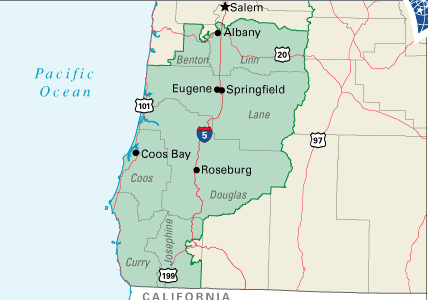
DeFazio has represented Oregon’s 4th Congressional District since 1987. The district, in the southwest portion of Oregon, includes Coos, Curry, Douglas, Lane, and Linn counties and parts of Benton and Josephine counties.

oregon4thdistrict

Oregon’s 4th District

In his first race, DeFazio won with 54.3 percent of the vote. He won his next 16 races with comfortable leads, with a high of 85.8 percent in 1990 and a low of 54.6 percent in 2010. After a 2011 re-districting gave Democrat-heavy Corvallis to the 4th district, DeFazio won 59.1- 39 percent.

Democrats figured the Corvallis shift guaranteed DeFazio a permanent seat and his seat did seem safe when he won in 2014 with 58.6 percent and in 2016 with 55.5 percent.

Further hurting Republicans has been their failure to put up a strong opponent.

With a weak bench, the Republicans have run the same man, Art Robinson, against DeFazio in each of the past four elections. You’d think they would have learned. The first time, 2010, Robinson lost by 10 points, the second time by 20, the third by 21, the fourth by almost 16.

So, is DeFazio really vulnerable as the National Republican Congressional Committee believes? Maybe.

Consider how Donald Trump did in DeFazio’s district.

Trump handily defeated Hillary Clinton in Coos, Curry, Douglas, Linn and Josephine counties. In Douglas county, Trump racked up 64.6 percent of the vote versus Clinton’s 26.3 percent.

Hillary carried only two liberal enclaves, Lane County, home of the University of Oregon, and part of Benton County, home of Oregon State University, but that was enough.

In the end, Hillary barely carried the 4th District with just 46.1 percent of the vote versus Trump’s 46 percent, a margin of just 554 votes.

That suggests the Republican problem is their candidate and his/her messaging, not the dominance of Democrats.

If the Republicans could recruit a strong moderate candidate able to make persuasive arguments, DeFazio could be in trouble.

As for Schrader, he has represented Oregon’s 5th Congressional District since 2008. The district, in the northwestern portion of Oregon, includes Lincoln, Marion, Polk, and Tillamook counties as well as portions of Benton, Clackamas, and Multnomah counties.

5thdistrictschrader

Oregon’s 5th District

In his first race, Schrader won with 54 percent of the vote. He won his subsequent races with 51.3 percent, 54 percent, 53.7 percent, and 53.5 percent. In 2011, the Oregon State Legislature approved a new map of congressional districts based on updated population information from the 2010 census, but it hasn’t had a meaningful impact on Schrader.

In 2016, Trump took Marion, Polk and Tillamook counties. Clinton carried Lincoln, Benton, Clackamas, and Multnomah counties, winning heavily populated Multnomah 73.3 to 17 percent. In the end, Clinton carried the 5th District with 48.3 percent of the vote versus Trump’s 44.1 percent.

Schrader’s winning margins to date have been consistent and comfortable, but not breathtaking. They would likely have been higher without the presence of multiple other party candidates in the general elections, who have been draining principally liberal votes. In 2016, for example, the Pacific Green Party took 3.4 percent of the votes. In 2014, three other parties captured a total of 6.7 percent of the vote.

Although voter registration trends aren’t consistently matching actual election trends, Schrader’s district is becoming increasingly Democratic, though also more non-affiliated.

In Nov. 2012, there were 158,885 registered Democrats, 148,464 Republicans and 89,539 non-affiliated voters in the district. By Nov. 2016, it had shifted to 176,868 registered Democrats, 155,430 registered Republicans and 135,233 non-affiliated voters.

Is Schrader as vulnerable as the National Republican Congressional Committee believes? I don’t think so. Even though he’s been in Congress fewer terms than DeFazio, his district is likely safer for a Democrat, and becoming more so.

How about DeFazio?

I know, he’s been in office for 30 years and just keeps rolling along, seemingly invincible. But I think he’s more vulnerable than he looks. He hasn’t so much been winning as the Republicans have been losing with uninspiring, ideologically rigid candidates.

My advice to the National Republican Congressional Committee. Don’t divide your limited resources in an effort to capture both seats. Instead, focus on finding a strong moderate candidate to run against DeFazio in 2018, building a war chest sufficient for a credible race and running a sophisticated campaign.

Dennis Richardson showed a Republican can win in Oregon. If the right things fall in place, the 4th District could be next.