Shemia Fagan and Oregon’s Political Rot

Political parties “…are likely in the course of time and things, to become potent engines, by which cunning, ambitious, and unprincipled men will be enabled to subvert the power of the people and to usurp for themselves the reins of government…” said George Washington. 

Washington may have preferred that the United States go forward with no parties, but since we’ve got them, the next best thing is to prevent one-party rule that strangles wise and fearless public policy and emboldens the perpetual winners.

That’s where Oregon has failed over a long time and all at once.

The Shemia Fagan scandal is just the latest illustration of rot in the body politic.

Secretary of State Fagan wouldn’t have signed up for a $10,000 a month consulting contract with Aaron Mitchell and Rosa Cazarest, owners of the La Mota chain of cannabis dispensaries, if she hadn’t thought she could get away with it.  The cannabis entrepreneurs are, after all, high-profile Democratic donors.

Before the Fagan scandal erupted, the Democratic recipients of La Mota funds happily accepted them. Willamette Week’s Sophie Peel did some spade work, revealing La Mota contributions to the following Democrats:

Gov. Tina Kotek – $68,365

Secretary of State Shemia Fagan – $45,000

Senate President Rob Wagner (D-Lake Oswego) – $12,500

Senate Democratic Leadership Fund – $10,000

State Treasurer Tobias Read – $1,800

Rep. Andrea Valderrama (D-Portland) – $500

Labor Commissioner Christina Stephenson – $7,500

Multnomah County Chair Jessica Vega Pederson – $1,000

Rep. Dacia Grayber (D-Tigard) – $1,000

Rep. Hoa Nguyen (D-Portland) – $500

Rep. Annessa Hartman (D-Gladstone) – $500

Multnomah County District Attorney Mike Schmidt – $2,000

U.S. Rep. Earl Blumenauer – $3,500

Prior to the Fagan scandal, none of the Democrats who were recipients of La Mota money were  apparently bothered by the fact the company was failing to pay its bills and taxes, according to an investigation by Willamette Week. Only after the Fagan scandal erupted did Democrats decide campaign contributions from La Mota were dirty money and scrambled to show their purity by pledging to donate those contributions to other worthy charitable causes.

Oregon’s Democratic Party also wouldn’t be so cavalier about all the campaign contributions it took from disgraced executives at FTX, the now bankrupt crypto company if they didn’t think they could get off scot free.

In their unbridled pursuit of power, Tina Kotek and the Democratic Party of Oregon chose to keep company with Nishad Singh, the 27-year-old wunderkind director of engineering at FTX. They welcomed his $500,000 contribution to the party’s campaign coffers in 2022. 

But the wheels of justice have turned since Singh made the contribution. On Feb. 28, 2023, he pleaded guilty to six criminal counts, including conspiring to commit securities and commodities fraud, during a hearing in federal court in Manhattan. 

He also pleaded guilty to defrauding the U.S. in a campaign-finance scheme in which he made illegal donations to political-action committees and candidates using funds from disgraced cyypto manager Sam Bankman-Fried’s crypto hedge fund Alameda Research.

John Ray III, the new boss of the bankrupt crypto exchange FTX, wants the $500,000 back, but the Democratic Party of Oregon has so far refused. 

Fagan’s behavior is also reminiscent of the sudden downfall of Jennifer Williamson, a former House majority leader and a leading contender to be Oregon’s next secretary of state in 2020. Williamson suddenly dropped out of the race, attributing her action to a forthcoming story in Willamette Week about questionable expenditures of campaign funds when she served in the House.  

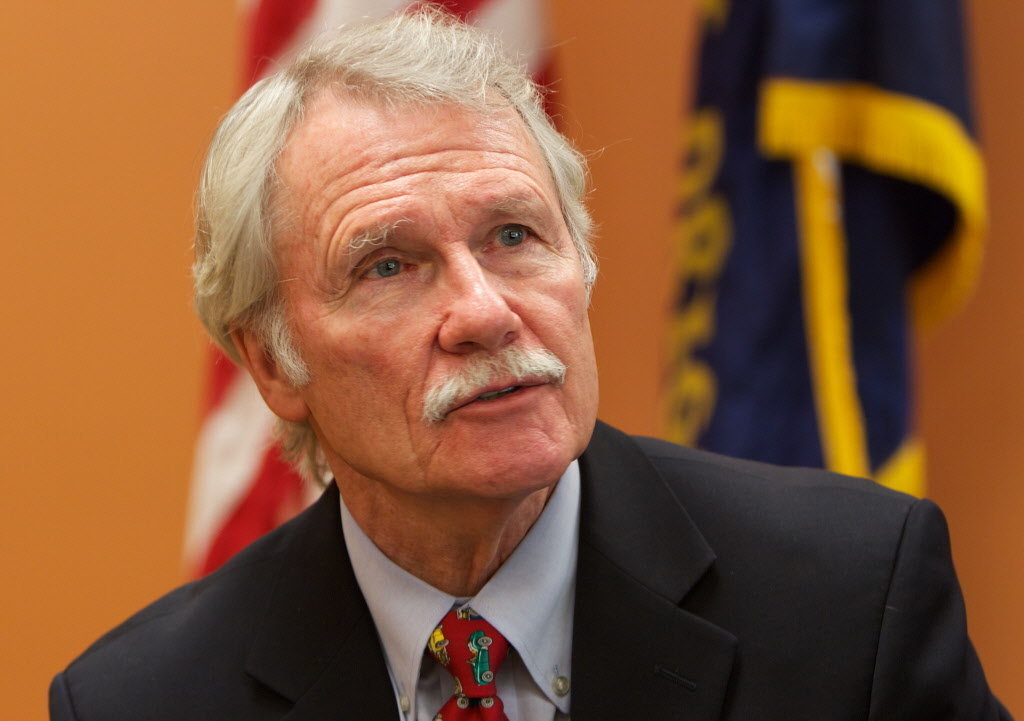
Then there was Democrat Governor John Kitzhaber, who resigned in February 2015  amid a growing influence-peddling scandal involving him and his fiancee, Cylvia Hayes, becoming the state’s first governor to resign in disgrace.


Gov. Kitzhaber and Cilvia Hayes

Kitzhaber ‘s resignation came in the face of a state criminal investigation and a string of demands from top state officials to step down.

There have also been questionable actions by other Democratic leaders. 

At one extreme, there was Neil Goldschmidt, a former governor, former Secretary of Transportation under President Jimmy Carter and ex-mayor of Portland. Goldschmidt, while Portland’s mayor during the mid-1970s, had sex on many occasions with a 14-year-old girl. Goldschmidt tried to define his actions as “an affair”. 

He started having sex with the girl when he was 35 and married. She was a babysitter for his young children and the daughter of a neighbor who worked in his office. 

A key element tying all these scandals together is the long Democratic rule in Oregon. It has led too many in the party to act with impunity, just as Richard J. Daily and the Democratic political machine ran Chicago with bare-knuckle politics for 21 years as dozens of politicians fed on the city’s political corruption.

Oregon hasn’t elected a Republican governor since 1982, when Gov. Vic Atiyeh won re-election.  Republican s have also failed to achieve majorities in the Senate and House for ages.

Oregon has been ill-served by the concentration of political power in Democrat’s hands for so long that the party has an overpowering stench to it. As former U.S. Senator Pat Toomey (R-PA) put it, “Unchecked power pushes parties to excess regardless of which party is in power.”

In Oregon, it’s been the Democrats for far too long.
If it matters to Oregonians, it’s in (The Washington Post) Willamette Week

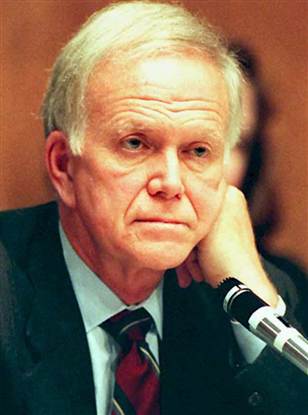
For those of you who don’t remember, Bob Packwood was the first.

Former Senator Bob Packwood (R-Ore)

Former Senator Bob Packwood (R-Ore)

On Nov. 22, 1992, the Washington Post reported that 10 women had accused Sen. Bob Packwood of sexual harassment. Even though one of The Oregonian’s own reporters was among the 10, and the paper had gotten tips about Packwood’s behavior, incredibly it had failed to aggressively pursue the matter. The Oregonian’s failure to break the story was mortifying for the entire paper.

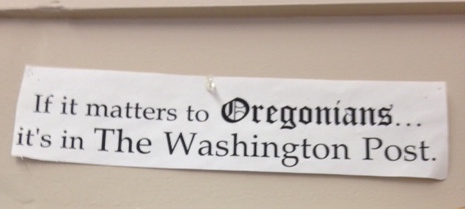
Adding to the shame was a bumper sticker that began appearing around Portland:

washPoststicker

Oregonian editor, Bill Hilliard, later told the Washington Post, in a massive understatement, that his paper “should have been a little more aggressive… We were worried about ruining a man’s career.”

Neil Goldschmidt was second.

Neil Goldschmidt

Neil Goldschmidt

Nigel Jaquiss, a reporter at Willamette Week, was researching the role of former Oregon Governor, and later power player, Neil Goldschmidt, in efforts to take over Portland General Electric. He was making good progress on the story, but got hints there was more.

“It was shaping up to be a pretty good story,” Jaquiss told the American Journalism Review, “but I kept getting pushed by people… ‘There’s more you ought to be looking at… There’s a girl..'”

Jaquiss’ aggressive digging eventually revealed that Goldschmidt, when he was the married Mayor of Portland, had begun raping a neighbor’s 14-year-old daughter on a regular basis over a three-year period. Sources said Goldschmidt often took the girl to her parents’ basement, to hotels and other private spots for sex.

When Willamette week posted a summary of the story on its website, it spread like wildfire. The Oregonian had been beaten again.

Not only had The Oregonian been beaten again, this time by a local alternative weekly, but The Oregonian made things even worse. When it ran the Goldschmidt story it appeared to many readers to soft-pedal Goldschmidt’s actions as “an affair” with “a high school student”. Oregonians went ballistic.

A memo of a staff meeting at the Oregonian revealed that there was a lot of internal angst, too. The memo noted: “Steve Duin felt strongly that our coverage today was too reverential. We are dealing with a child molester. He made a very impassioned plea for doing the who knew what when story — lots of people became rich riding Goldschmidt’s coat tails — and why they kept it secret. He suggested that readers might think we’d learned nothing from Packwood and that we are hands off people in power.”

And now the Kitzhaber-Cylvia Hayes scandal.

John Kitzhaber and Cylvia Hayes

John Kitzhaber and Cylvia Hayes

Again, it was Nigel Jaquiss and Willamette Week that broke the story and followed up with bombshell after bombshell.

The Oregonian followed up with some revelations, but it was late to the party. It’s most significant role in the evolving saga was to run an editorial on Feb. 4, 2015 calling on Kitzhaber to resign, arguing, “…it should be clear by now to Kitzhaber that his credibility has evaporated to such a degree that he can no longer serve effectively as governor.”

What’s happening to The Oregonian, once the state’s dominant paper of record, now a mere shadow of its former self?

It may sound hackneyed, but great newspapers like the Oregonian were once the indispensable guardians of our freedom. Seasoned reporters have served as watchdogs to ensure good government and reinforce good citizenship. The Oregonian has been a key ingredient of  civic dialogue and discourse in the state.

David Simon, a former Baltimore Sun reporter who created the award-winning HBO series The Wire, warned at a U.S. Senate hearing on the “Future of Journalism”, that “high-end journalism is dying in America.”  Oregon can’t afford for The Oregonian to be among those at death’s door.


Disclosure: I worked as a reporter at The Oregonian during the 80s and 90s.

Killing Trust: Kitzhaber the unobservant

John Kitzhaber’s latest tour of duty in the governor’s chair has exposed him as an empty suit in terms of faithfully overseeing the government he runs.

kitzhaberjpg

First, he hired education czar Rudy Crew. Remember him?

Rudy Crew (R) with Governor Kitzhaber

Rudy Crew (R) with Governor Kitzhaber

Crew checked in to his $280,000 a year job as Oregon’s first chief education officer in June 2012. Hailed by Kitzhaber as a man with a track record of leadership and innovation, his collapse as a leader was quick and dramatic.

Crew spent a year travelling extensively, often first class, on the state’s dime to speak at non-Oregon related events, took vacations at every turn, and made the scrambled eggs-and-bacon circuit around the state, telling the same heartwarming stories over and over again, while he continued to make money on the side. On July 1, 2013, Crew checked out and headed back East, a failed experiment in every way.

“How big of a setback was the Rudy Crew fiasco?” Portland Business Journal Publisher Craig Wessel asked Kitzhaber in January 2014. “It had to be difficult.”
“It was,” Kitzhaber responded. “It was an embarrassment.”

It was more than that. It was a complete failure to exercise good judgment and to oversee the performance of a key figure in Kitzhaber’s administration.

Then there’s Cover Oregon, another debacle.

coveroregonAd

Millions were spent there on a disastrous website, ubiquitous advertising and highly paid top staff (The total compensation of the each of the top ten highest paid of Cover Oregon’s employees in early 2014 was between $154,000 and $229,000, more than their boss, Kitzhaber.) In April 2014, Cover Oregon’s board of directors voted to close the state-run exchange and adopt the Federal HealthCare.gov exchange in 2015.

Cover Oregon’s troubles were compounded when the state tried shenanigans to avoid making public a scathing report on the program by consultant, Clyde Hamstreet. The report was made available to the media only after it was requested under Oregon Public Records Law.

“In retrospect, I should have been more engaged in the (Cover Oregon) project,” Kitzhaber said in November 2013. I’ll say.

Then there’s the matter of First Lady Cylvia Hayes.

Cylvia Hayes at an Oct. 9. 2014 press conference where she admitted entering into an illegal marriage in 1997.

Cylvia Hayes at an Oct. 9. 2014 press conference where she admitted entering into an illegal marriage in 1997.

On Oct. 8, Willamette Week raised serious questions about her business dealings and possible conflicts of interest while associated with Kitzhaber. Subsequent stories have disclosed that, unknown to Kitzhaber, Hayes accepted $5,000 as payment for illegally marrying an Ethiopian immigrant in 1997, allowing the man to remain in the U.S.

On Oct. 12, Kitzhaber asked the Oregon Government Ethics Commission to determine whether Hayes is subject to state ethics laws and, if so, whether she has broken them.

A better question is why is he only paying attention now? Where has he been since his third term began on ensuring that all of Hayes’ business relationships comported fully with state ethics rules?

Pay attention, John.