College Protests and the Law of Unintended Consequences

An intervention in a complex system always creates unanticipated and often undesirable outcomes.

Rabbi Danya Ruttenberg understands unintended consequences. “[W]e all know that sometimes people mean well but cause harm nonetheless—out of ignorance, out of carelessness, out of deeply ingrained ways of thinking they haven’t examined, out of an emotional reaction that got the better of their lofty intentions, or … well, the list goes on,” she says.

There’s a message here for today’s rabid pro-Palestine student protesters convinced that their actions will bring about change.

If they are trying to emulate the protests against the Vietnam war in 1960s, the bloodiest and most dramatic of which occurred at the 1968 Democratic Convention in Chicago, they’re forgetting something. Those protests may have helped drive out President Lyndon Johnson, but they undermined the candidacy of the Democratic candidate for president, Hubert Humphrey, and invigorated the conservative supporters of Republican Richard Nixon.

In his first months in office, Nixon had the U.S. military increase, not decrease, its pressure on the battlefield and, in violation of international law, ordered secret bombings of North Vietnamese camps in Cambodia.

After he took office, another 21,200 Americans died in Vietnam and elsewhere in Southeast Asia, about one-third of all American deaths in the war (58,220), along with an estimated half a million Vietnamese., 

Nixon’s aggressive pursuit of the war also led to more protests on college campuses with deadly consequences. During one of those protests at Kent State University on May 4, 1970, National Guardsmen shot and killed four students. Just 10 days later, another two students at Jackson State University were killed by police.

Paul Berman, an American writer on politics and literature, wrote in yesterday’s Washington Post, about being involved as a Columbia University student in a late April 1968 campus uprising. He wrote about how professors upbraided him, warning about the potential dangers of the protests.

“The professors were haunted by Germany and its history, ” Berman wrote.” In 1968, the defeat of the Nazis was only 23 years behind us, and the era of World War II and the catastrophe of the Jews had not yet definitively disappeared into the past — at least, not in the professors’ eyes. They wanted me to understand that Germany’s leftists in the 1930s had failed to understand Nazism’s danger. Foolish left-wing radicalism had helped undermine the German universities, which ought to have been a place of anti-Nazi resistance. They wanted me to understand, all in all, that what people think they are doing might not be what they are actually doing, and, in the name of high ideals, society might be weakened, and the worst of disasters might be brought about.”

I bring all this up to remind today’s aggrieved student protesters that their aggressive actions may not lead events to where they want them to go. 

First, despite the protesters’ assumption that their peers have their back, the annual Harvard Youth Poll, run by the Institute of Politics (IOP) at Harvard’s Kennedy School, found that  Americans between the ages of 18 and 29 are not prioritizing the Israel-Gaza conflict. 

The poll found that young people are more worried about inflation, health care, housing and gun violence. The survey listed 16 issues facing the U.S., asking respondents which of two randomly paired issues most concerned them. The conflict in the Middle East ranked near the bottom at 15th.

The general public also can’t be counted on to support the protesters. Americans are actually quite divided about how – and whether – the U.S. should be involved in the Israel-Hamas war. According to the Pew Research Center, among US adults, only 22% say Hamas’ reasons for fighting Israel are valid and roughly six-in-ten Americans (58%) say Israel’s reasons for fighting Hamas are valid. 

In this environment, the student protests, particularly if they continue with violent events at the Democratic National Convention in Chicago, may, as in 1968, lead to a conservative backlash that helps defeat President Biden and elect Donald Trump.

For most of the protesting students, that would surely be a worst case of unintended consequences. 
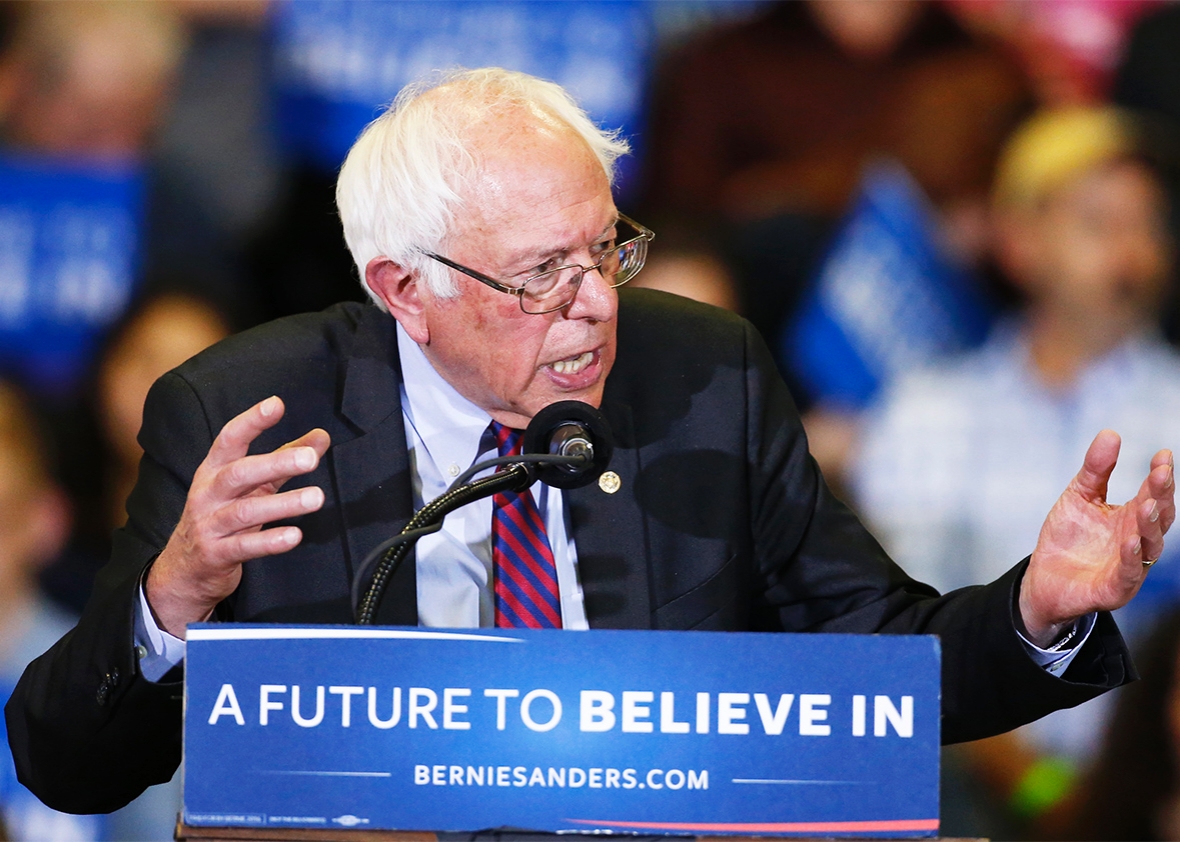
Should I stay or should I go: Bernie’s conundrum.

sanderspic

Hillary Clinton and her allies want Bernie Sanders to withdraw from the race. For additional pressure, the liberal media, including Talking Points Memo,the Washington Post, Daily Kos and the NY Times are piling on in unison. With increasing vehemence, they all argue Sanders should quit because he can’t win the Democratic nomination.

“…Sanders’ campaign is now taking a scorched-earth approach toward its opponents—even if that means helping Donald Trump win the White House,” wrote David Nir in today’s Daily Kos.

Sanders’ continued presence in the race increases divisiveness in the party, his critics assert, makes it harder for Hillary to focus on Trump and forces Hillary to keep spending millions to secure her nomination that would be better spent in the general election.

On March 17, the New York Times reported that the previous week President Obama had privately told a group of Democratic donors that Sanders was close to when his campaign against Clinton would end and that the Democratic Party must soon come together to back her.

According to the Times, people at the donor event “took his comments as a signal to Mr. Sanders that perpetuating his campaign, which is now an uphill climb, could only help the Republicans recapture the White House.”

So let’s look at what Hillary did in her own 2007-2008 contest with Obama.

The objective of each of the candidates in the primaries and caucuses was to secure the support of 2,117 delegates, a majority, to the August 2008 Democratic National Convention.

At the end of 2007, Clinton led in the national polls with 42% of likely voters, over Obama at 23% and John Edwards at 16%.

On Jan. 3, Obama unexpectedly won the Iowa caucuses with 38% of the vote, over Edwards, 30%, and Clinton, 29%. That gave Obama 28 pledged delegates, Clinton 14 and Edwards 3.

At the conclusion of the next three primaries (New Hampshire, Nevada, South Carolina) on Jan. 26, the pledged delegate vote count was Obama 88, Clinton 46 and Edwards 3. This was after Obama won by a more than two-to-one margin over Clinton in South Carolina, taking 55% of the vote to Clinton’s 27% and Edwards’s 18%. After his shellacking, John Edwards suspended his candidacy on January 30, 2008.

With the Super Tuesday primaries looming, Senator Ted Kennedy endorsed Obama, a high profile endorsement that buoyed Obama’s hopes. On Tuesday, Feb. 5, with 23 states and territories and 1,681 delegates up for grabs, Obama captured 847 delegates and Clinton 834. That put Obama at 1036 pledged delegates and Clinton at 1056.

Earlier in 2008 it had been expected that the nominee would be known after Super Tuesday, but Obama and Clinton were essentially tied in pledged delegates.

During Feb. 9-19, Obama swept 11 state contests and expanded his pledged delegate lead by 120. By the end of February, Obama had 1,192 pledged delegates, Clinton 1,035. But Clinton led among super-delegates, 240 to 19.

In the March primaries and caucuses, both candidates hung in there, with Obama winning 210 pledged delegates and Clinton 205, putting Obama slightly ahead with a total of 1,562½ pledged delegates and Clinton with 1,421½.

 On March 29, Obama’s lead prompted Sen. Pat Leahy, D-Vermont, to call for Clinton to drop out of the race. “I think that her criticism (of Obama) is hurting him more than anything John McCain has said,” Leahy said. “I think that’s unfortunate.”

 As the contest continued into April, a consensus began to grow that Clinton didn’t have much of a chance to overcome Obama’s lead in pledged delegates. Coincident with that growing feeling, some Democrats began to argue that Clinton staying in the race was damaging Obama’s likelihood of success in the general election.

Clinton did go on to win in Pennsylvania, but Obama won in North Carolina and the two almost tied in Indiana on May 6. At that point, Obama led Clinton by 164 pledged delegates and there were only 217 pledged delegates left to be decided, leading to more calls for Clinton to drop out of the race.

Even comedians got in the act. “Hillary Clinton says she isn’t dropping out because there are still six states that haven’t had their Democratic primary,” said Conan O’Brien. “That’s right. Barack Obama’s favored in the states of Oregon, Montana and South Dakota, and Hillary is favored in the state of denial.”

Clinton’s fortunes deteriorated further on May 10 when Obama’s super-delegate total passed Clinton’s, making it even more likely that Clinton’s run was doomed.

But Hillary Clinton persevered.

It wasn’t until June 3 when Obama’s delegates from South Dakota and Montana primaries, plus his announcement of more super-delegates, put Obama over the majority needed for the Democratic nomination.

Still, it took until June 5 for the Clinton campaign to post a letter to supporters on its website saying Hillary would endorse Obama on June 7.

From my perspective, that pretty well sums it up. Bernie, ignore the calls to drop out coming from Hillary and her bought and paid for acolytes. Keep a-pluggin’ away.


                                       If the hills are high before

                                       And the paths are hard to climb,

                                       Keep a–pluggin’ away.

                                       And remember that successes

                                       Come to him who bides his time,—

                                        Keep a–pluggin’ away.

“Keep a-plugging away”, Lyrics of Lowly Life, Paul Laurence Dunbar

dunbar