Four Pinocchios – the gender pay gap

In an aggressive attempt to turn attention away from other issues less favorable to them as the midterm elections approach, Obama and the Democrats are yet again trying to generate some return from their “war on women” mantra. This time they’re highlighting with carefully choreographed actions what they insist is gender pay inequity.

On Wednesday, the Senate fell short on the number of yeas to move forward on the so-called “Paycheck Fairness Act”. Bluntly revealing the political nature of the entire effort, Democrats leaped at the opportunity to send out a fundraising solicitation bemoaning the loss within minutes of the vote.

Image

Obama routinely cites U.S. Census data showing that the average full-time female worker earned 77 cents for every dollar a man earns. (The U.S. Department of Labor says women in full-time jobs earn 81 cents for every dollar men earn.)

But the pay situation is not quite as simple as Obama and his Democratic colleagues say. Today the New York Times featured a story on the issue: Democrats Use Pay Issue in Bid for Women’s Vote, making that point.

The Bureau of Labor Statistics (BLS) makes the same point in its annual report, “Highlights of women’s earnings in 2012”: “In 2012, women who were full-time wage and salary workers had median usual weekly earnings of $691. On average in 2012, women made about 81% of the median earnings of male full-time wage and salary workers ($854).” That appears to support Obama’s assertions.

But every “full-time” worker, as the BLS notes, is not the same: Men were almost twice as likely as women to work more than 40 hours a week, and women almost twice as likely to work only 35 to 39 hours per week. Once that is taken into consideration, the pay gap begins to shrink. Women who worked a 40-hour week earned 88% of male earnings.

Then there is the issue of marriage and children. The BLS reports that single women who have never married earned 96% of men’s earnings in 2012.

The supposed pay gap appears when marriage and children enter the picture. Child care takes mothers out of the labor market, so when they return they have less work experience than similarly-aged males.

The reality is that multiple factors affect the earnings data, including the types of jobs worked by women, the number of hours they worked, their area of specialization/college major, hours worked and the career progression of some women.

One factor affecting the pay women receive is their work/home patterns. Women who leave the workforce to care for their children at home and later return to work often find that lower wages await them than if they had kept working. A Pew Research Center study released on April 8 revealed that the share of mothers who stay home with their children has steadily risen in recent years.

According to Pew, the share of mothers who don’t work outside the home rose to 29% in 2012, up from a modern-era low of 23% in 1999.

Image

Another Pew study in 2013 found that mothers are much more likely than fathers to have reduced work hours, take a significant amount of time off, quit a job or, by a small margin, turn down a promotion in order to care for a child or family member.

Pew said today’s young women are the first in modern history to start their work lives at near parity with men. Pew pointed out, however, that there’s no guarantee that today’s young women will sustain their near parity with men in earnings in the years to come. Recent cohorts of young women have fallen further behind their same-aged male counterparts as they have aged and dealt with the responsibilities of parenthood and family.

Still, it would be wise not to ignore that while the public sees greater workplace equality between men and women now than it did 20 to 30 years ago, most believe more change is needed, the Pew Research Center notes. Among Millennial women, 75% say this country needs to continue making changes to achieve gender equality in the workplace, compared with 57% of Millennial men.

So there’s still a lot of work to do.

Merkley’s money: what a difference a term makes

HandsOut

Things are different now.

When Democrat Jeff Merkley first ran for the U.S. Senate in 2008, he raised a total of $6,512,231.

Now that he’s a Senator, he’s already reported raising $6,286,013 for his reelection and the 2014 race, in theory, hasn’t even begun. The Republicans haven’t even chosen who will run against him.

That means Merkley’s total haul is likely to go much higher as individuals, special interests and Democratic Party funds ramp up their donations to keep him in office.

The two parties are in a no-holds-barred struggle for control of the Senate, where pollsters and analysts think the Republicans have a shot at taking control with a good showing in the November 2014 elections. Merkley isn’t often mentioned as being in a high-risk race, but then former Senator Gordon Smith wasn’t thought to be vulnerable early on either.

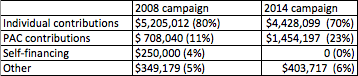
With 5 years as a U.S. Senator now behind him, the sources of Merkley’s donations are shifting. A smaller share is coming from individual contributors and twice as much from political action committees (PACs). Also, more unions are stepping up as big contributors, his big donors have less of an Oregon focus and Merkley isn’t having to dig into his own pocket.

merkleySenate

According to the Center for Responsive Politics, contributions to Merkley’s campaign committee for his 2008 campaign and for his 2014 campaign as of Dec. 31, 2013 break down as follows:

Screen Shot 2014-03-26 at 10.18.34 PM

For his 2008 Senate race, Merkley’s largest 10 contributors (individuals and PACs) to his campaign committee were:

JStreetPAC $78,180
Council for a Livable World $55,889
State of Oregon employees $35,050
Oregon Health & Science University $33,964
Moveon.org $26,731
Stoel, Rives et al $23,323
League of Conservation Voters $21,500
Intel Corporation $17,920
Newmark Knight Frank $17,300
Intl. Brotherhood of Electrical Workers $17,200

The largest contributor to his 2008 campaign, Washington, D.C-based JStreetPAC, makes contributions to candidates who support a two-state solution for Israel and Palestine and robust American military aid to Israel. “I am and will continue to be a staunch supporter of the special relationship between the U.S. and Israel,” Merkley said during his 2008 campaign.“I will always seek to ensure its strength and foster its growth.”

The second largest contributor to his 2008 campaign, Council for a Livable World, is a Washington, D.C.-based non-profit advocacy organization dedicated to reducing the danger of nuclear weapons. Merkley subsequently voted in 2010 for a new Strategic Arms Reduction Treaty (START) with Russia and in February 2014, Merkley and Senator Edward J. Markey (D-Mass.) introduced legislation that would cut $100 billion over the next decade from the U.S. nuclear weapons budget.

The bill, S. 2070, would shut down all U.S. missile defense activities, reduce from 12 to eight the number of SSBN(X) ballistic-missile submarines that are set to replace the retiring Ohio-class fleet and limit to eight the number of Ohio-class submarines that can currently be fielded. The bill has been referred to the Senate Committee on Armed Services where its languishing.

The largest 10 contributors (individuals and PACs) to Merkley’s campaign committee for his 2014 race as of the end of 2013 are significantly different, with much less of an Oregon focus:

Votesane PAC $31,250
Thornton & Naumes $25,000
Intel Corporation $22,050
Honeywell Intl. $20,000
Operating Engineers Union $20,000
Intl. Association of Firefighters $18,500
Blue Cross/Blue Shield $17,100
League of Conservation Voters $15,314
American Crystal Sugar $15,000
Communications Workers of America $15,000

Votesane PAC, a non-partisan channel for political donations, has funneled $1.6 million to candidates in the 2014 election cycle, with almost all of it going to Democrats.

The only union showing up in Merkley’s list of top 10 contributors for his 2008 race was the International Brotherhood of Electrical Workers at $17,200. Three unions show up as his biggest contributors for the 2014 race so far with a total of $53,500.

Also making their debut as major Merkley contributors are individuals from Thornton & Naumes, a Boston, Mass. law firm with class action expertise that has represented people claiming they were victims of asbestos and toxic exposure, defective products, financial fraud, and personal injury accidents.. Law firms and lawyers have been the top contributors to Merkley’s 2014 campaign as of Dec. 31, 2013, donating a total of $296,363.

This only reveals, of course, donations up the end of 2013. Expect a lot of shifts as the campaign progresses.

Merkley has already spent $3,045,241, or almost half, of the funds he’s raised since 2008. Recently, the largest single amount has gone to Mandate Media,a Portland-based internet strategy,services,and advertising firm specializing in progressive political candidates and advocacy organizations. Mandate is also associated with BlueOregon, a widely distributed progressive e-newsletter.

The top 5 recipients of the campaign’s recent expenditures were:

Mandate Media $200,485
CHS Mailing $141,305
Kauffman Group $125,163
Linemark Printing $ 71,639
Benenson Strategy Group $ 47,000

It’s important to recognize that much of the money now being spent on campaigns is so-called independent expenditures, spending by groups and individuals who claim they are not coordinating their activities with a candidate’s campaign committee.

In Merkley’s 2008 race, for example, according to FindTheBest, the following outside groups spent about $675,000 in support of his candidacy:

Committee Amount

Service Employees International
Union Committee on Political Education
(SEIU Cope) $430,238
League of Conservation Voters Inc. $145,317
Democratic Senatorial Committee $ 47,746
League of Conservation Voters
Action Fund $ 40,862
Moveon.org Political Action $ 7,026

It’s likely that similarly large amounts of independent expenditures will occur in the 2014 race.

Data sources: The Center for Responsive Politics (http://www.opensecrets.org), a non-profit, non-partisan research group based in Washington, D.C.; FindTheBest (www.findthebest.com; http://bit.ly/1nYKKSA),a network of for-profit websites connected to help consumers and businesses make informed decisions.

merkleySenate