It was 1943. By all appearances, Rudolph Höss, his wife, Hedwig, and their five children – Klaus, Heidetraud, Brigitte, Hans-Jürgen and Annegret – had an idyllic life in the Polish countryside. They lived in an exquisite villa with a tranquil garden, a greenhouse and a small swimming pool.
The children played in the yard, Rudolph and Hedwig went about their daily lives and Hedwig adorned herself with lipstick and jewelry.

(Scene from The Zone of Interest)
But something was amiss.
Hedwig’s clothing and jewels were taken from a Jewish woman on her way to the gas chambers. Beyond the concrete wall at the property’s edge, topped with barbed wire, was a sprawling complex of gas chambers and crematoria known as the Auschwitz-Birkenau concentration camp, the largest extermination camp run by the Nazis in Poland during WWII. Rudolph Höss, a German SS officer, was the camp commandant. An estimated 960,000 Jews were killed there.

led to gas chamber #3 at Auschwitz, where two thousand people
at a time could be murdered.
Source: The World Holocaust Remembrance Center
“Human beings did this to other human beings and it’s very convenient for us to try and distance ourselves from them because we think we can never behave this way, but I think we should be less certain than that,” said Jonathan Glazer, the director of a 2024 movie, “The Zone of Interest” that depicted the mundane daily activities of the family at their home during the war.
In the movie, when her husband is transferred to a new post in Germany, Hedwig is enraged. She demands that the family stay at Auschwitz, claiming, “This is the life we’ve always dreamed of.”
It all brings to mind Hannah Arendt’s talk about “the banality of evil”, which she cited when writing about one of Höss’ compatriots, Adolf Eichmann, in her 1963 book Eichmann in Jerusalem: A Report on the Banality of Evil.
“Never again,” proclaimed the weary idealists, the peace-seekers, the hopeful.
So much for that.
Moises Sotelo, 54, of Newberg, OR was on his way to work at about 5:30 a.m. on June 12 when U.S. Immigration and Customs Enforcement (ICE) officers swooped in and took him into custody. According to an ICE detention database, Sotelo was transferred to ICE’s Northwest Detention Center in Tacoma, Washington.

“ICE Seattle arrested Moises Sotelo-Casas, 54, who is a citizen of Mexico, as a part of routine federal law enforcement activity that identifies, detains and removes criminal aliens to their country of origin,” ICE Public Affairs Officer David Yost said in a statement. “Sotelo has a criminal conviction for DUI in Newberg, OR, and he will remain in custody pending removal.”
Sotelo’s family sought community support through a GoFundMe account with a $175,000 goal to “Help the Sotelo Family with Expenses After ICE Detainment”. The account had raised $142,751 from 2,100 donations as of June 30.
There was a time when Moises Sotel0’s plight would have generated little public concern and certainly fewer helping hands. .
In 2022, the public perception of an invasion of migrants across the southern border of the United States bore some relation to reality.
U.S. immigration authorities carried out 2.38 million migrant encounters (a term encompassing apprehensions and expulsions) at the southwest border during Joseph Biden’s presidency in FY 2022, according to the Migration Policy Institute. For the first time, not only were there more Venezuelans, Cubans, and Nicaraguans encountered than migrants from El Salvador, Guatemala, and Honduras, but there were significant attempted crossings by Brazilians, Ecuadorians, Haitians, Ukrainians, Indians and Turks. Monthly encounters peaked at over 370,000 people in December 2023, nearly 12,000 a day. This isn’t count migrants who crossed the border and escaped detection. (For a better understanding of the brutal migration process, see Footnote 2)
The crescendo of arrivals overwhelmed processing capacities, federal infrastructure, and border communities. As the chaos at the border increased, the public became more hostile to the migrants. Donald Trump exploited that hostility in winning re-election to the presidency in November 2024.
His administration has since initiated vigorous, combative mass deportation efforts that resemble military-style attacks at homes, businesses and public spaces. Masked and heavily armed ICE agents wearing tactical gear and carrying high-powered rifles have been descending on areas in unmarked black SUVs and armored vehicles. Immigrants showing up at U.S. Immigration and Customs Enforcement offices for routine check-ins are being arrested. “What should be routine appointments are becoming detention traps,” Katrina Kilgren, an immigration attorney and pro tem instructor at the Knight Law Center in Eugene, OR told the Register-Guard newspaper.
Increasingly, ICE has been targeting work sites, such as farms, meat production plants and restaurants, and migrant worker gathering places, such as Home Depot, in immigration sweeps.
In April, Acting ICE Director Todd Lyons told attendees of the 2025 Border Security Expo in Arizona he wanted the agency to become as efficient at deporting immigrants as e-commerce giant Amazon is at delivering packages. “We need to get better at treating this like a business,” Lyons said, describing his ideal deportation process as “like [Amazon] Prime, but with human beings.”
In one deportation case reported by the Portland Mercury, Jorge (a pseudonym being used to protect his identity) received a text message on his cell phone in Spanish from ICE in early June.Jorge had immigrated to the US from Nicaragua in late 2021 as an asylum seeker. He has an active asylum case, a work permit, a job, and a young family. The message told him to report to the nearest ICE facility within 12 hours to check in and sign paperwork, or face deportation. After consulting a lawyer, he followed the instructions, only to be detained by ICE agents and sent to a federal detention center in Tacoma, Washington.
ICE was holding about 56,397 people in detention facilities across the country as of June 15, 2025 likely setting a record high, according to TRAC Immigration. Despite the government’s stated goal of pursuing criminals, 40,433 out of 56,397—or 71.7%—held in ICE detention had no criminal record, TRAC Immigration claims. Adams County Detention Center in Natchez, Mississippi held the largest number of ICE detainees so far in FY 2025, averaging 2,166 per day as of June 2025.
The vast majority of ICE detention centers are privately operated and for profit, with companies such as GEO Group and CoreCivic dominant in the space. Tom Homan, Trump’s border adviser, has called for boosting ICE’s detention capacity to at least 100,000 people. In furtherance of that goal, the U.S. Department of Homeland Security posted a request in April asking contractors to submit bids for new detention facilities, transportation, security personnel, medical services and administrative support.
Florida is now turning a remote abandoned mosquito-infested 39-square-mile airport next to Everglades National Park in Florida into the newest migrant prison featuring mostly tents and trailers in sweltering heat and nicknamed “Alligator Alcatraz”. Florida Governor Ron DeSantis has said the facility will be temporary and have “zero environmental impacts.”
“It’s like a theatricalization of cruelty,” Maria Asuncion Bilbao, Florida campaign coordinator at the immigration advocacy group American Friends Service Committee, told The Associated Press.

detention center on July 1, 2025.
The National Immigrant Justice Center claims that people in the private detention centers detention experience inhumane conditions and rights abuses that include medical neglect, preventable deaths, punitive use of solitary confinement, lack of due process, obstructed access to legal counsel, and discriminatory and racist treatment.
The Trump administration has also sent immigrants to detention facilities outside the United States, including to Cuba’s Guantánamo Bay in Cuba and Centro de Confinamiento del Terrorismo ( CECOT) in El Salvador, where brutal conditions predominate.
The Trump administration is also trying to deport a group of migrants convicted of violent crimes from countries including Cuba, Mexico and Vietnam to South Sudan, a country embroiled in fighting between various political and ethnic groups. In a Travel Advisory, the U.S. Department of State advises: “Violent crime, such as carjackings, shootings, ambushes, assaults, robberies, and kidnappings are common throughout South Sudan, including Juba. Foreign nationals have been the victims of rape, sexual assault, armed robberies, and other violent crimes.”
In June, the U.S. Supreme Court granted the Trump administration’s request to allow it to deport migrants to places other than their country of origin, often to countries plagued by violence. The Trump administration wanted the power to do so as part of its effort to discourage illegal migration by threatening to deport migrants a third country with no recourse.
Legal analyst Steve Vladeck told CNN, “…today’s ruling allows the government to remove those individuals and others to any country that will take them—without providing any additional process beyond an initial removal hearing, and without regard to the treatment they may face in those countries.”
To add insult to injury, Semafor reported on July 1 that the Trump administration is thinking about trying to void naturalized immigrants citizenship — potentially starting with New York City mayoral primary winner Zohran Mamdani. Asked about Tennessee Rep. Andy Ogles’ proposal to strip Mamdani, who was born in Uganda but became a citizen in 2018, of his legal status, White House press secretary Karoline Leavitt said it’s “something to be investigated.” Semafor reported that GOP leaders are increasingly comfortable with revoking foreign nationals’ visas over their political beliefs or actions, and that may soon extend to citizens.

NPR reported on June 30 that the Justice Department is aggressively prioritizing efforts to strip some Americans of their U.S. citizenship, a practice heavily used during there McCarthy era of the late 1940s and early 1950s. “Department leadership is directing its attorneys to prioritize denaturalization in cases involving naturalized citizens who commit certain crimes — and giving U.S. attorneys wider discretion on when to pursue this tactic, according to a June 11 memo published online,” NPR said. Approximately 25 million immigrants are naturalized citizens.
Hans von Spakovsky, with the conservative Heritage Foundation, told NPR he supports the DOJ’s denaturalization efforts. “I do not understand how anyone could possibly be opposed to the Justice Department taking such action to protect the nation from obvious predators, criminals, and terrorists,” he said.
But Trump’s draconian efforts to halt border crossings and deport already settled migrants are now driving a new sympathy for migrants and resistance to ICE’s aggressive deportation efforts.
Even popular podcaster Joe Rogan is raising doubts about Trump’s deportation chaos. “Bro, these ICE raids are fucking nuts, man,” Rogan said in June. ” I don’t think if they, the Trump administration, if they’re running and they said, we’re gonna go to Home Depot and we’re gonna arrest all the people at Home Depot, we’re gonna go to construction sites, and we’re gonna just, like, tackle people at construction sites. I don’t think anybody would have signed up for that. They said, we’re gonna get rid of the criminals and the gang members first, right? And now we’re, we’re seeing, like, Home Depots get raided. Like, that’s crazy.”
Local government officials are raising concerns, too. A group of elected officials in one of Oregon’s most racially diverse counties pushed back Monday against the Trump administration’s immigration crackdown. (See footnote 3)
“ICE has no place in our neighborhoods,” Cornelius City Councilor Angeles Godinez told OPB in June. “When fear enters our community, trust leaves,” she said. “Without trust, our schools, our cities and even our local economies suffer.”
“To the immigrant community across Oregon, I am one of you, I see you. I know what you’re going through and I stand with you in unwavering solidarity,” said Tigard City Councilor Yi-Kang Hu.
And then there’s the massive cost of Trump’s immigration program, a veritable cornucopia of cash.[1] “If the bill passes, it could make ICE the nation’s largest jailer, Wirth more funding for detention than the entire federal Bureau of Prisons,” according to immigration expert Aaron Reichlin-Melnick.
With the federal deficit already high, and projected to increase to destructive levels under the Republicans’ “big, beautiful bill”, America is going to pay a heavy price for Trump’s deportation fiasco. With the immigration blowout, the Senate-passed a reconciliation bill that would add over $4 trillion to the national debt through Fiscal Year (FY) 2034, $1 trillion more than the House-passed One Big Beautiful Bill Act (OBBBA).
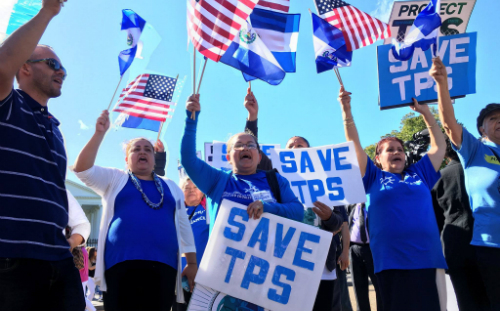
Protests against immigration arrests are multiplying as people rail against government overreach and a majority of Americans now say actions by the U.S. Immigration and Customs Enforcement have “gone too far,” according to a new PBS News/NPR/Marist poll..
But it’s not enough.
As The Leadership Conference on Civil and Human Rights said earlier this year, the Trump administration’s widespread and persistent cruelty, indiscriminate immigration enforcement tactics, wrongful questioning and detention of American citizens, unjust profiling, and abuse of common decency “signals a troubling shift toward a more punitive and dehumanizing approach to immigration enforcement.”
” History has shown us time and time again,” the Leadership Conference said, ” that when communities come together, our collective resistance has the power to rewrite the narrative and create change. While it may feel like we are in the midst of a dark chapter, together, we can write the next one — a chapter where compassion and justice prevail over cruelty and inhumanity. In the end, that’s what defines us — not just as a nation, but as human beings.”
We cannot be the Höss family. We cannot be innocent bystanders. Evil must not triumph. We must resist.
________________________________________
[1]Immigration-related items in the Senate bill. Source: The New York Times.
Immigration detention capacity: Expand capacity to detain immigrants taken into custody | $45 bil. |
| Border wall: Fund border barrier system construction and related activities | $45 bil. |
| U.S. Immigration and Customs Enforcement: Funding for hiring, training, transportation, facilities and legal resources to carry out immigration enforcement and removals | $31 bil. |
| State and local grants: Funding for border security, immigration enforcement and major event security. The Senate parliamentarian determined that this provision does not comply with the chamber’s rules, and it may be removed or modified. | $13 bil. |
| Homeland Security Department funding: For border security and immigration enforcement | $12 bil. |
| U.S. Customs and Border Protection: Funding to expand workforce and purchase new vehicles and technology | $12 bil. |
| Border surveillance technology | $6.2 bil. |
| Department of Justice grants: For state and local immigration and law enforcement | $3.5 bil. |
| Department of Justice funding: For immigration and other law enforcement | $3.3 bil. |
| Fund vetting for sponsors of unaccompanied alien children: Through the Office of Refugee Resettlement | $0.3 bil. |
2. For a better understanding of what is driving migrants to the United States and who is guiding them through Mexico to the US border, read Soldiers and Kings: Survival and Hope in the World of Human Smuggling by Jason De León. In 2015, he began a long-term ethnographic project focused on understanding the daily lives of Honduran smugglers who profit from transporting migrants across the length of Mexico. This 2024 National Book Award-winning story examines the complicated relationship among transnational gangs, the human smuggling industry, and migrant desires for safety and well-being.
3 .An immigration scholar, Austin Kocher, has written a Journalist Resource guide analyzing U.S. Immigration and Customs Enforcement arrest data, based on datasets published by the Data Deportation Project. His observations are revealing as to the Trump administration’s motives:
“The Trump administration is now demanding that ICE make 3,000 arrests per day. That is to say, ICE did not come close to meeting the quota set in January until June—and even then; only for a few days at a time. To be clear: this is a lot of arrests. I’m not downplaying that. But it’s also clear that the Trump administration’s daily arrest quotas are detached from the reality of what ICE can do—and even more so now that the new quota is 3,000 per day.
This prompts a further question: if these quotas are demonstrably unattainable, why have them? In my view, the answer is simple: the unattainability of the quotas is the point.
An essential component of Donald Trump’s longstanding approach to politics is to invent crises, or exploit existing crises, in ways that ensure they are unsolvable. No amount of funding for immigration enforcement will ever be enough to achieve his mass deportation goals. No amount of power concentrated in the office of the President will ever be sufficient to exercise totalizing control over immigration. The goal is not to solve a real problem, but to manufacture an ever-expanding crisis that justifies ever-expanding unregulated power.”



















 ThinkingOregon