The Donald Trump Presidential Library. Enough!

“ ’Look on my works, ye Mighty, and despair!’ / Nothing beside remains. Round the decay / Of that colossal wreck, boundless and bare, / The lone and level sands stretch far away.

Percy Bysshe Shelley

UPDATE: 10/14/2025: A Florida court has put on hold the transfer of land held by a Miami college for President Trump’s presidential library, ruling that the college failed to provide reasonable public notice for its board vote to donate the land. The injunction Tuesday temporarily froze the transfer of 2.63 acres to commemorate Trump’s time in the White House. The Miami Dade College land is now a parking lot estimated to be worth more than $67 million, according to county appraisers.

UPDATE: 9/24/2025: NBC News reported today that Trump’s presidential library will be housed in Florida on land currently owned by Miami-Dade College, adjacent to the Freedom Tower and located on the city’s downtown waterfront.

Donald Trump, a man with the reading habits of an illiterate and the attention span of a hummingbird, wants to build a presidential library when he leaves office.

He also wants to fly away in a Boeing 747-8 jumbo jet gifted to the United States by Qatar. When he leaves office he plans to take it with him to his yet-to-be-built presidential library. A submissive Republican-led Congress may let him get away with this normalization of corruption.

The future Trump Presidential Library?
An AI vision.

Trump is already trying to fill an account to build his library.

In December 2024, ABC News agreed to pay $15 million toward the library to settle a defamation lawsuit over anchor George Stephanopoulos’ inaccurate on-air assertion that the president-elect had been found civilly liable for raping writer E. Jean Carroll. Under the settlement agreement, the payment is described as a “charitable contribution.”

In January 2025, Meta Platforms agreed to settle a lawsuit for $25 million after suspending Trump’s Facebook accounts following the  January 6 attack other U.S. Capitol, with $22 million of that going toward the presidential library.

After his last term in office, a top fundraiser on Trump’s campaign said the president had told supporters he wanted to raise $2 billion for his library. Back then, however, there was considerable skepticism about Trump’s political future or the likelihood of him being able to raise enough money for a library. “I thought to myself, what is this alternative fantasy life you’re living?” one prominent fundraiser said. “I have no clue where they think they’ll get this money raised. Anyone who gives to him will be radioactive.”

How times have changed.

The location of a potential Trump Presidential Library is yet to be determined.  The Washington Post reported at the end of Trump’s first term that sources close to Trump said he planned to build a library and museum in Florida. In March 2025, it was reported that members of Trump’s team were looking at possible sites at  Florida Atlantic University  (FAU) in Palm Beach County, where Trump’s Mar-a-Lago is located and Florida International University (FIU) near the Trump National Doral Miami golf resort.

Trump’s inaugural committee has also said any money left over from its $250 million haul will go the presidential library, as will millions being paid by individuals to dine and meet with Trump at special events at Mar-a-Lago.

The Donald J. Trump Presidential Library Fund Inc. was incorporated in Florida on December 20, 2024, shortly after the ABC News settlement, and a library website already exists.

As with the The Barack Obama Presidential Center,  the website makes clear that The National Archives will administer the records of the Trump administration (textual, electronic, audiovisual, and artifacts) which will remain at National Archives facilities in the National Capital Region. In other words, there will be no actual presidential library at the Donald J. Trump Presidential Library .

Still to be determined is what Trump’s library will look like, what will be in it or how much it will cost. Obama is still struggling to raise money to compete construction of his presidential center, 3050 days after the end of his presidency. The project has also been beset by controversy, including questions over high “executive compensation” paid to people running the project. The center’s projected cost has also nearly doubled from its original estimate and is now projected at close to $1 billion.  

President Trump, never one to miss an opportunity for an insulting comment, has called the Obama Center “a disaster” and blamed “woke” construction workers” for problems at the site. “I mean look, President Obama — and if he wanted help, I’d give him help because I build on time and on budget,” Trump exclaimed at a White House meeting with  new Canadian Prime Minister Mark Carney meeting in early May. 2025. Trump has apparently forgotten the six bankruptcies from his over-leveraged hotel and casino businesses in Atlantic City and New York and the destruction of his shuttered 39-story hotel and casino in Atlantic City, N.J. in 30 seconds with controlled explosions in Feb. 2021 .

Given Trump’s ability to generate controversy out of thin air, expect the path toward a Trump Presidential Library to be similarly erratic, filled with drama and leaving disillusioned supporters in its wake.

Of course all this controversy over a jet-themed presidential library would be moot if the practice of building such ego-satisfying monuments that aren’t even real research libraries any more ended once and for all.

As a matter of fact, presidential libraries filled with reading material are a thing of the past anyway.

The Barack Obama Presidential Center under construction, Oct. 2024

The Barack Obama Presidential Center on a 20-acres site in Chicago, if it’s ever finished, isn’t going to have a presidential library. Artifacts and records from Obama’s two terms in the White House are being digitalized and organized by the National Archives and Records Administration (NARA) and will be stored in existing NARA facilities. The only library planned for the site is a new branch of the Chicago Public Library in a massive a 235-foot-tall fortresslike museum tower.

Obama has appealed to a roster of contributors to build his monument, with some heavy hitters donating $25 million or more. If Trump goes ahead with his library plans, he will likely have to copy Obama and initiate a massive fundraising effort to supplement the funds he has already squeezed out of lawsuits.

Is that really what the country needs, more Trump lawsuits to generate cash, an onslaught of solicitations to potential donors large and small, under-the-table deals with donors while Trump is still in office, more inevitable controversy and, in the end, just another monument to the ephemeral nature of political power?

It’s time to end this scattering of presidential shrines across the American landscape, to put a stop to more money-sucking temples to former presidents. With the digitization of records, there will be no need for a vast collection of paper records reminiscent of the warehouse in Raiders of the Lost Ark.

Sorry, Donald.

Risky business: Corporate messaging and abortion.

Remember when people used to buy products because they were well made, priced right and met their needs?

Corporate meddling in politically contentious issues to signal virtue of one kind or another has put an end to that.

Businesses have been trying to position themselves as good corporate citizens for years in order to bring about a more favorable operating environment, but earlier efforts focused on neutral moves like raising public awareness of such things as charitable contributions, employee volunteerism and hiring veterans.

Recently, however, companies have been more willing to take public stands on truly controversial issues in order to raise their public profile… and sell more products.  And it just happens to be that federal and state lawmakers are simultaneously using abortion politics to rile their voters ahead of the 2020 election.

An example of this new outspokenness is the response to restrictive abortion legislation recently enacted in several states, including Missouri, Georgia, Mississippi, Kentucky, Alabama, and Ohio.

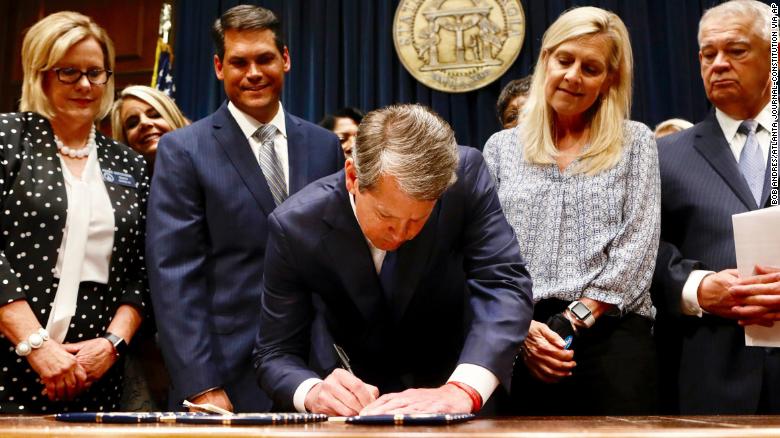
On May 7, 2019, Georgia Governor Brian Kemp signed a law that would ban abortion as soon as physicians can detect a heartbeat, which can be as soon as six weeks (before some women are aware they’re pregnant).

brianKempabortion

Georgia Governor Brian Kemp signing abortion law.

“Georgia is a state that values life,” Kemp said at the bill signing. “We protect the innocent, we champion the vulnerable, we stand up and speak for those that are unable to speak for themselves.”

On May 15, Alabama’s governor, Kay Ivey, signed a law defining a fetus as a legal person “for homicide purposes” and making performing an abortion in the state a felony.

Netflix, Disney and WarnerMedia responded that they might stop producing television shows and movies in Georgia, and multiple actors threatened that they wouldn’t work in Georgia if the state’s law takes effect.

“I think many people who work for us will not want to work there, and we will have to heed their wishes in that regard,” said Disney CEO Bob Iger. “… we will work with the ACLU and others to fight it in court,” said Netflix chief content officer Ted Sarandos.

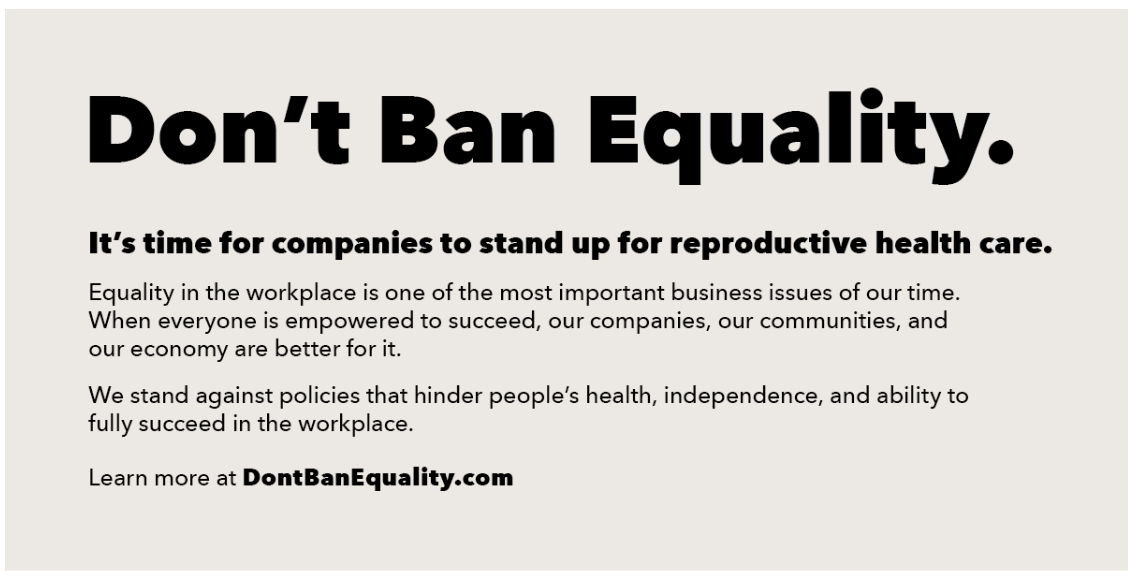
Earlier this month, leaders of more than 180 businesses, including Maria Pope, President and CEO of Portland General Electric, signed a letter that ran as an ad in The New York Times opposing the restrictive abortion laws enacted recently in multiple states.

mariapopePGE

Maria Pope, President and CEO of PGE, signed the “Don’t Ban Equality” letter.

“It’s time for companies to stand up for reproductive health care,” the Don’t Ban Equality letter said. Restricting abortion is “bad for business.”

dontbanequality


A problem with corporate virtue signaling like this as a marketing strategy is that it assumes the company has other people’s best interests at heart, that it’s not driven by profit seeking. There’s a risk that even altruistic millennials passionate about social causes will see through that, increasing cynicism, not brand loyalty.

Another issue with corporations trying to sell themselves as social justice warriors is that, as Tara Isabella Burton wrote in Vox, companies are pushing the spending of money “as a ritualistic as well as transactional act.” That can backfire. Purchases based on product quality are more likely to be sustained than those based on ever-changing corporate advocacy.

Public policy positions taken by corporate leaders on social issues may also not reflect the views of many employees or consumers, despite the presumptions of executives that others must be in alignment.

On abortion, for example, polling shows that Americans are actually fairly evenly split between those who identify as pro-life and those who identify as pro-choice. A majority of Americans, including many Democrats, support abortion restrictions in the second and third trimesters. In short, corporate honchos are mistaken if they believe most Americans are unrestricted abortion supporters.

As columnist David Byler wrote in the Washington Post, “… neither Republican nor Democratic voters unanimously want the total victory that activists on both sides are agitating for. Republicans are generally pro-life and Democrats are mostly pro-choice, but there’s real dissent among the rank-and-file voters in both camps. Our constantly shifting status quo may be unnerving to the most engaged pro-choice and pro-life advocates. But whatever they might say, the average U.S. voter wants a negotiated compromise in the abortion wars.”

Corporate evangelizing on all sorts of social issues can run afoul of public and employee attitudes, particularly with toxic social media serving as a megaphone for unhinged mobs of ever-smaller tribes determined to play a role in a debate.

Ideology-driven public positioning can also alienate employees and potential hires who are not in sync with a company’s cultural alignment or simply value open thinking.

”Internally, if leaders can create safe avenues for employees with different values and beliefs to voice their ideas (about CSR practices, products, or other business-related issues), this may lead to greater innovation, not to mention goodwill among those who value ideological tolerance as an over-arching feature of their workplace,” several U.S. business professors wrote in United States Politics and Policy.

Then there’s the fact that organizations and individuals who praise corporate intervention on sensitive public issues are generally much less enthused when the intervention has a conservative bent.

A striking example of this is the left’s outrage over comments made in July 2012 by Dan Cathy, Chick-fil-A’s CEO, to the Baptist Press. Cathy said he was “guilty as charged” in his support of what he described as traditional marriage. “We know that it might not be popular with everyone, but thank the Lord, we live in a country where we can share our values and operate on biblical principles,” Cathy said.

To say the least, all hell broke loose, with liberals and LGBTQ activists condemning Cathy and endorsing Chick-fil-A boycotts.

Controversy resurfaced with a March 2019 report by the progressive organization Think Progress that the chain’s foundation donated $1.8 million in 2017 to groups Think Progress said have anti-LGBTQ agendas.

Then there’s the shifting attitudes in the corporate world, which make executives unreliable moral leaders. “Americans ought to be cautious before making corporations their moral compass or primary vehicle for reform,” Adam Winkler, a professor of law at UCLA, wrote recently in The New Republic. “The policy positions taken by U.S. companies on social issues today lean in the direction of inclusion. But tomorrow might be different, if the country—or a business’s particular consumer base—turns in a different direction.

If all this keeps up, you may soon be nostalgic for the days when companies tried to sell their products with simple “plop, plop, fizz, fizz” jingles.