Buried in Political Fundraising Texts? Grin and Bear It.

Like the bubonic plague, a pestilence of political fundraising messages has descended on me. 

“WOW, we’re blown away!” said a frenetic message I recently received from the Democratic Congressional Campaign Committee (DCCC). “Since Kamala Harris announced Governor Tim Walz as her running mate, Top Democrats have UNLOCKED a 400% match through MIDNIGHT Tonight!!!…So please: Will you rush a 4X-MATCHED $3 to the DCCC…”

The Republicans are after me, too.

“Patriot – please don’t ignore this message; we’re grasping at straws here…,” said a recent text message from the National Republican Senatorial Committee (NRSC). “The Democrats are already out-raising and out-spending our America First candidates… Can we count on you to give $10 to ensure Senate Republicans can fight back against Joe Biden and his extremist Democrats in the Senate?”

And in a text message reminiscent of Mission Impossible, where instructions to a secret agent self-destruct after playing, I got a text from Donald Trump Jr. pleading for money and adding, “Please handle this message with care & delete after reading.”

I’m registered as “unaffilated” with a party, but still get most of the online entreaties from Republican-affiliated groups. That may be because, according to research conducted by YouMail, Republicans are outpacing Democrats in political text messaging in 2024 by a ratio of at least 2 to 1. 

“Lara Trump viewed your profile yesterday and nominated you for LIVING LEGEND STATUS,” said one message from the Republican National Committee. “This is the highest honor the co-chair can bestow, and she selected YOU.”

Kellyanne Conway, who served as Senior Counselor to President Trump during his term, has pleaded with me to complete a National Security Survey and, by the way, “Will you contribute your most generous gift to support our campaign to take back the Senate and elect a Republican majority?”

Why, you might ask, are the Democratic and Republican parties so damn aggressive in their fundraising? After all, the Biden—now Harris—campaign committee raised $284.1 million and Trump’s campaign committee raised $217.2 million in total between January 2023 and June 30, 2024, the most recent date for which Federal Election Commission filings are available.

Initial numbers from July suggest, however, that the money race has tightened. The Harris campaign reported it raised $310 million last month and had $377 million in cash on hand, while the Trump campaign reported raising just $138 million in July, but still had $327 million in cash on hand.

And both parties expect to spend a lot more.

A report from AdImpact predicted that the 2024 cycle will be the most expensive presidential campaign ever, with total spending expected to reach $10.69 billion, 19% more than spending in the 2019-2020 presidential cycle.

Since text messaging is the primary tool for fundraising, expect a lot more of it. 

And don’t expect to stop the deluge by replying “STOP”. That’s a useless effort that tells the sender your phone number is both active and responsive. Blocking the sender’s phone number won’t do much either, because all it does is stop messages from that specific blocked number.

So hang in there. It will end on Nov. 5. 

One more thing:

A common feature of political fundraising texts is an attempt to lure you in with a promise your donation will be matched (equaled or multiplied) by an unknown source. It’s likely a ruse. Don’t believe it.

According to OpenSecrets, a nonpartisan, independent nonprofit that tracks money in U.S. politics, “…legal experts say it is hard to see how donation matching could happen given campaign contribution limits. And there are no accountability mechanisms to determine whether campaigns actually follow through with their promises.”

“I think these promised matches are largely a marketing ploy from direct mail fundraising,” Michael Kang, a law professor at Northwestern whose expertise includes campaign finance, told OpenSecrets. “They stir up contrived urgency.”

Liberal Media Jump on the Kamala Harris Bandwagon

Gag me with a spoon.

Talk about shifting on a dime.

President Biden withdraws from the 2024 race, Vice President Kamala Harris picks up the mantle and the liberal media jump on board.

Even Biden’s withdrawal statement is being cast mostly as a brave, selfless, patriotic effort, like a “don’t speak ill of the dead” obituary, rather than an admission that the Democratic Party’s leaders and wealthy donors had abandoned him. 

It wasn’t long ago that the press delighted in portraying Harris as a largely ineffectual, slightly dim and somewhat daffy politician with a habit of speaking in a kind of garbled incoherent word salad and a failed policy effort as Biden’s border czar.  

Last week, New York Times columnist David Brooks cautioned that “…as of 18 months ago, she would not have made an effective president or even a good candidate. She ran a disastrous presidential campaign and has been a mediocre vice president, even measured by the low standards of the office. She could always repeat the normal Democratic positions but had no distinctive view for where the country needed to go.”

Now, with Biden out, the media is transforming Harris from a somewhat awkward and cringy figure in the Democratic Party to a “cool” pop culture personality with a sterling reputation in a matter of days, commented CNN commentator Van Jones. 

New York Magazine went over the top in its latest issue with this cover:

The New York Times has even attempted to turn the tide on Harris’ sometimes derided laughter, saying “The Trump campaign sees Harris’s laugh as a vulnerability to exploit. But far from a liability, it is one of her most effective weapons.”

In a flash, Harris has gone from an unaccomplished player in foreign affairs to a widely admired wonderkind. A New York Times story on her foreign policy chops was even headlined, “A Global Reputation For a Steely Resolve And Deft Diplomacy.”

“…the consensus among foreign officials and diplomats is that Ms. Harris has a firm grip on international affairs,” the Times enthused in a July 27 article quoting Chancellor Olaf Scholz of Germany: “She is a competent and experienced politician who knows exactly what she is doing and has a very clear idea of her country’s role, of developments in the world, and of the challenges we face.”

When Biden tweeted his exit, the Democratic Party and its acolytes “…declared a triumph of democracy and the end of popular “disillusionment,” observed author and reporter Matt Taibbi. “Attention shifted to the real candidate, Kamala Harris, who was not only MLK, Gandhi and Captain America, but a woman of color with a Jewish husband…” 

Party stalwarts are jumping on board with superlatives, too. “I’ve known Kamala Harris a long time,” wrote Hillary Clinton. “This brilliant prosecutor will make the case against convicted felon Donald Trump.”

On July 28, Lydia Polgreen, an opinion columnist with the New York Times, wrote that “…Harris had been significantly underrated, that the chatter about her flaws for the past four years maybe didn’t tell her full story and that she had some unique talents and traits that made her a stronger candidate than her record might suggest.”

Rather than hold Harris’ missteps against her, Polgreen turned them into positives. 

“I see a woman who struggled to compete for power against her peers, buried under an array of vague and unstated expectations about whether she gave the right answers, had the right ideas, was smart or specific enough,” Polgreen wrote. “Like any woman of ambition, I deeply relate to these experiences. As strange as it might seem, I have come to think these experiences could make her the ideal candidate in a surreal campaign against a man who is so certain of himself, who admits to no mistakes, who has no humility and who, for many of us, is utterly unrelatable.”

Jenny Holland, who writes “Saving Culture (from itself)” on substack, says “The establishment blob is so desperate to avoid a Trump presidency that they are willing to support a woman who is so flippant and unserious that she would embrace a youth culture trend of “brat”, which means being “just that girl who is a little messy and maybe says dumb things sometimes, who feels herself but then also maybe has a breakdown but parties through it.” 

Still, Harris may want to tread lightly before embracing her newfound adulation as a given. The press can be your friend, but it can also turn on you. 

Identity Politics is Alive And Well at The New York Times

I’m a member of Tau Kappa Epsilon fraternity, one of the largest men’s collegiate fraternities in North America.  If I ran for office, would you assume all 12,000 voting-age collegiate members of my fraternity and all the living TKE alumni would support me?  

Ronald Reagan was a member of Tau Kappa Epsilon fraternity, too. When he ran for president, did the news media assume the votes of all his TKE fraternity brothers were a sure thing?

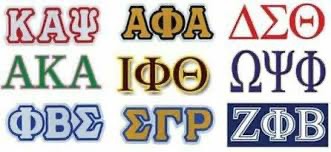
The New York Times seems to think that members of all the Black Greek-letter sororities and fraternities at US colleges are a ready-made bloc of Kamala Harris supporters in her quest for the presidency because she’s been a member of the Black sorority Alpha Kappa Alpha since her undergraduate days at Howard University. 

“As Vice President Kamala Harris’s presidential campaign rushes to shore up its base, its efforts will be bolstered by a ready-made coalition: the more than two million members of Black Greek-letter organizations who have quickly united to mobilize Black voters nationwide,” the Times reported today.  

“A united Black Greek front has the potential to offer even more significant political advantage, as their voter engagement programs reach millions every four years,” the Times added. 

Maya King, the Times reporter who wrote the story, says in her bio, “As a native Southerner, I have been most fascinated by the ways the region has changed politically, culturally and demographically over the last few presidential election cycles — and how those changes are connected.”

But King barely acknowledged those changes in her article. The cheerleading article barely mentioned that there have been signs of deteriorating Black support for the Democratic ticket and growing Black consideration of Donald Trump. 

In November 2023, the Times reported that Black voters were  more disconnected from the Democratic Party than they have been in decades, frustrated with what many saw as inaction on their political priorities and unhappy with President Biden, a candidate they helped lift to the White House. Polls by the Times and Siena College found that 22 percent of Black voters in six of the most important battleground states said they would support former President Trump in the 2024 election, and 71 percent would back President Biden.

Erosion of Black support for the Democratic Party has also been found by the Pew Research Center. The Center reports that although the majority of Black voters across education levels are Democrats, there has been a decrease in affiliation with the Democratic Party in recent years. While 93% of Black voters with college degrees identified with or leaned toward the Democratic Party in 2012, that number decreased to 79% in 2023.

Biden’s withdrawal from the 2024 presidential contest and Harris’  ascension may well change some Black voters’ preferences, but it’s not likely to be a universal shift. Harris, for example, is a progressive Democrat, but only 28 percent of black Democrats consider themselves liberal, according to the Pew Research Center, while 70 percent identify as moderate or conservative.

On June 25, the Times reported on data  captured by a new Harvard study that shows Black voters  have slightly shifted toward Trump since 2020. “One possible explanation is that some Black voters’ economic gains have allowed them to focus more on noneconomic issues — such as abortion and L.G.B.T.Q. rights — on which they are more conservative than typical Democrats,” the Times said.

The fact is, Black candidates can’t rely on group solidarity. “It’s certainly true that black voters support black Democratic candidates at higher rates, … but analysis of past elections and campaigns shows that black voters have never prioritized simple descriptive representation over other factors, like party affiliation, campaign viability, candidate electability, preexisting relationships with the black community and a sense of authenticity,” according to the New York City-based Brennan Center for Justice. 

For the New York Times to publish a story assuming Black solidarity for a Black presidential candidate who’s a member of a Black sorority is irresponsible journalism.

As James Bennett, who was the editorial page editor at The New York Times from May 2016 until his forced resignation in June 2020 over a controversial op-ed, has said, “The reality is that the Times is becoming the publication through which America’s progressive elite talks to itself about an America that does not really exist.”

Trump/Vance Threaten The Competence of the Federal Civil Service

Donald Trump has made it clear he wants to overhaul the federal civil service and erode merit system principles. Sen. J.D. Vance, R-Ohio, Trump’s pick for vice president, has said that if Trump wins re-election, he should “…fire every single mid-level bureaucrat” and “replace them with our people.”

At campaign events, Trump has promised to “obliterate the deep state,” what he believes is a network of non-elected government employees working under cover to bypass elected officials and further their own contrary agenda.

I’m sure it sounds straightforward, simple and appealing to Trump’s ideological followers who think career civil servants would work to stymie Trump’s conservative policies if he’s re-elected.

But firing all the federal government’s mid-level bureaucrats and replacing them with political appointees would be a disaster for America.

I know that because I’m a former mid-level federal bureaucrat. I know that much of the work in multiple government agencies by U.S. civil servants is highly specialized, complex, and essential for an efficient government that serves the people. 

Under the U.S. General Service (GS) pay scale, the GS-1 through GS-7 range generally marks entry-level positions, mid-level positions are in the GS-8 to GS-12 range and top-level positions (senior managers, high-level technical specialists, or physicians) are in the GS-13 to GS-15 range.

I served in that mid-level band. As a Foreign Affairs Officer with the National Marine Fisheries Service during part of my professional career, I worked with the Department of State on international fisheries negotiations, principally with Russia, Canada and Asian nations. In preparing for that job, I earned a bachelor’s degree in International Relations, a master’s degree in Political Science and a master’s degree in Marine Affairs. I had also written a proposal for the United Nations Conference on the Law of the Sea and worked for an international marine conservation non-profit in Canada.

Many others on my team had similar backgrounds. During my time in government I worked with a wide range of exceptional people with broad experience and academic backgrounds doing specialized work that advanced American interests. 

“Almost all Western democracies have a professional civil service that does not answer to whatever political party happens to be in power, but is immune from those sorts of partisan wranglings,” says Kenneth Baer, who served as a senior Office of Management and Budget (OMB) official. “They bring… a technical expertise, a sense of long history and perspective to the work that the government needs to do.”

Gutting the civil service and replacing experienced workers with political hacks, as Trump and Vance advocate, would be irresponsible.

Don’t let it happen.

President Biden: Stay or Go?

Option 1: Everybody just throw up their hands in dismay and let the fur fly.

Option 2: Adopt a “Stand by your man” attitude. Treat the current controversy as much ado about nothing, just “one bad night”. It wouldn’t be the first time the party ignored obvious personal failures by prominent members. Regardless of the current sturm and drang over Biden’s well-being and mental stability, just hang in there and hope the furor will dissipate, relying on the American public’s inability to focus on anything for more than a few days (or minutes). Count on spineless, wishy-washy electeds, such as Rep. Jerry Nadler (D-NY), to back off their calls for Biden to step aside. Ignore the fact that Biden, even if he hangs on, may not be well enough to lead for another four years even if he wins. 

Option 3: Keep up the practiced deception, despite the evidence. The Wall Street Journal reported today that aides, in order to protect the president from scrutiny (and keep their jobs and influence), kept a tight rein on his travel plans, news conferences, public appearances and meetings with donors. Ignore the fact that hordes of aides and elected Democrats have deceived the public and that most voters think Joe is just too damn old. Oliver Wiseman wrote today in The Free Press, “As Biden geared up for a second run, it was clear that any young, ambitious Democrat who dared to challenge him would be all but disowned by their party… In poll after poll, Democratic voters told the party they wanted someone other than Biden at the top of the ticket. But the party apparatus ignored them. Now look where we are.”

Option 4:  Convince Biden to step down before the convention, making Kamala Harris President. Anoint Harris as the nominee at the party’s convention, in the midst of riotous pro-Palestinian demonstrations  (Shades of the riots at the 1968 Democratic convention in Chicago, which lead to Hubert Humphrey’s loss to Richard Nixon in the general election) On June 27, the day of President Biden’s debate, Harris’ approval rating was 39.4 percent, while her disapproval rating was 49.4 percent.. ignore the fact that her approval numbers have actually fallen since the first presidential debate sparked calls for Biden to quit the race. According to FiveThirtyEight’s average, on June 27, the day of the debate, Harris’ approval rating was 39.4 percent, while her disapproval rating was 49.4  percent. On July 5, Harris’ approval rating stood at 37.1 percent and her disapproval rating was 51.2 percent, not a hopeful sign if she runs against Trump, whose approval numbers have actually been rising.

Option 5: Convince Biden to withdraw as the party’s nominee at the Democratic Convention and initiate an open convention, releasing the pledged delegates he has accumulated to date (3,894 of 3,937 committed so far). All those delegates could then vote for whomever they chose. That might, of course, run the risk of alienating minority voters who would resent the party automatically not elevating Kamala Harris (she wouldn’t even be assured of keeping the No. 2 job),  setting off chaos on the convention floor and leaving the party’s eventual nominee just weeks to make his/her case to voters before the Nov. 5 election.  

Option 6: Back to Option 1.

Executives Warming to Trump Are Making a Mistake

In the 1930s, fashion entrepreneur Hugo Boss saw opportunity in Hitler’s rise. A German businessman and an early member of the Nazi Party, his clothing company used forced labor in German-occupied territories and prisoner-of-war camps to manufacture uniforms for the SS and the Wehrmacht.

The willingness of business interests to align themselves with dubious political leaders has a long history.

Some of America’s top business executives are carrying on the tradition today with their apparent willingness to reconnect with Donald Trump.

At a June 13 Business Roundtable meeting in Washington, D.C., about 80 CEOs met with Trump, including Apple’s Tim Cook, JP Morgan’s Jamie Dimon, Citigroup’s Jane Fraser, Bank of America’s Brian Moynihan and  Xerox CEO Steven Bandrowczak. 

The executives told the Wall Street Journal their willingness to listen to Trump stems from frustration with President Biden, a growing sense that Trump could win the presidency again and a desire to shape the Republican’s agenda before the election. 

This warming to Trump comes despite his legacy of inflammatory and divisive rhetoric, his role in the chaos of Jan. 6 and his relentless effort to undermine the 2020 election and overturn the legitimate results. This is also a man who  admired the Tiananmen Square massacre in China and told Xi Jinping that he had no problem with Xi putting ethnic/religious minorities into detention camps. 

Larry Diamond, an expert on democratic governance at the Hoover Institution, told CNN that Trump, clearly a damaged man, “has massive responsibility for creating the normative atmosphere in which extremism, hatred, racial bigotry and violent imagery have prospered and metastasized.”

“Looking back at it now, the most surprising thing about the Donald Trump presidency is that we survived it at all: the lies, the chaos, the ignorance, ugliness, recklessness and lawlessness,” Bill Press, a senior political contributor on CNN, wrote in The Hill. Press noted not only “how bad the Trump presidency was, but how dangerous, operating without any limits, a repeat Trump performance would be.”

Too many American business leaders seem ready to ignore that ominous warning. They are doing so at great risk to themselves and America.

Mail-In-Voting Is On The Ballot in Oregon

In 2020, Donald Trump filed several lawsuits in an effort to stop vote-counting or force recounts after his campaign said post-Election Day increases in vote totals for President Joe Biden — many of which came from mail ballots, that were counted following the in-person votes — were evidence of fraud. 

None of the lawsuits succeeded. 

But Trump has continued to denigrate mail-in voting and promulgate theories that the 2020 election was contaminated by voter fraud, and his true believers are falling in behind him. (A humorous aside is that many Republican groups are also spending millions of dollars this year promoting voting by mail to spur turnout, particularly in competitive states)

Even though elections researchers have demonstrated that making it easier to vote by mail generates higher voter turnout for both parties, and incidences of fraud are rare, in December Trump called for an end to mail-in voting entirely. Following a “cutting off one’s nose to spite one’s face” strategy, he claimed in March that “any time the mail is involved, you’re going to have cheating”.  

Some election experts expect Trump to prematurely claim victory on the basis of early in-person votes in 2024 and to litigate the election going forward.

Now we have all three Republicans running to be Oregon Secretary of State, which oversees the state’s elections, hyping claims of voter fraud and affirming their desire to end Oregon’s long tradition of running elections by mail.

The three Republicans in the primary race are Beaverton real estate broker Brent Barker, state Sen. and rancher Dennis Linthicum and Salem business analyst Tim McCloud.

Brent Barker’s campaign website spells out his support for:

  • Statewide In-Person Voting
  • Limiting mail-in ballots to Military and Absentee Voters
  • Resetting all voter registration rolls to zero and requiring everybody to re-register
  • Hand counting tally results for all elections with observers

Linthicum, on his campaign website, pledges to:

  • Restore election integrity and promote diligent custodial ownership of election records
  • Advocate for in-person local precinct voting with ID
  • Safeguard the elections for the integrity of every Oregonian’s vote

Tim McCloud has not set up a website with campaign pledges. He was, however, a plaintiff in a lawsuit intended to end mail voting and electronic voting tabulation in Oregon.

A federal judge tossed the lawsuit, saying “generalized grievances” about the state’s elections aren’t enough to give a group of unsuccessful Republican candidates and other election deniers standing to sue.

McCloud has also commented on election issues in general. In responses to a questionnaire from KATU News, he said, “I will heavily fortify our election system against attacks, and implement fail-safe systems to prevent any disruption of our election system by bad actors. Additionally, I will advance all efforts for more access to Oregon’s public elections records, including more transparent processing of ballots, and conducting routine and thorough voter roll audits statewide.”

Whatever the merits, or failures, of mail-in voting, one thing remains true. As political analyst Larry J. Sabato, has said, “Every election is determined by the people who show up.”

Don’t Bet on Truth Social Saving You, Mr. Trump

Coincidentally, and perhaps fatefully, the ticker symbol of the newly listed Truth Social company on NASDAQ is DJT, (Donald Trump’s initials), the same ticker symbol used by Trump Hotels and Casino Resorts, which filed for Chapter 11 bankruptcy protection from creditors in federal bankruptcy court in New Jersey in 2004.

Political and financial media are speculating that investor approval of a plan to take public Truth Social, Donald Trump’s social media company, will rescue him from the potentially catastrophic burdens of his multiple court cases.  My view – don’t count on it. 

On Friday, March 22, shareholders of Digital World Acquisition Corp. (DWAC) approved a deal to merge with Trump’s media business, Trump Media & Technology Group. The primary arm of Trump Media & Technology Group is the social networking site Truth Social. The stock, with a ticker symbol of DJT, will begin trading on the trading on Nasdaq next week. 

With DJT expected to start trading with a valuation of about $5 billion, Trump’s 60% stake will be worth about $3 billion at the outset. An amazing potential windfall for Trump.

But here’s the rub.

DWAC is a shell company, what’s known as a “special purpose acquisition company” or SPAC, which will be replaced by Trump Media & Technology Group. And SPACs have had a notoriously checkered history in the market.

During 2020-2021, SPAC’s were “an unmitigated mess for investors,” according to Michael Cembalest, chairman of market and investment strategy for J.P. Morgan Asset Management.

SPACs that went public in 2020 had the worst performance, with a median loss to investors of more than 80 percent, according to Institutional Investor. Of the 431 SPACs that were able to complete a merger during 2020-2021, 90 percent had negative net returns. 

Companies brought public via SPACs also generated worse business results than their IPO counterparts, likely because they needed fast revenue growth to achieve sound profitability and didn’t get it.

The result? The De-SPAC Index, which measures the performance of companies taken public through a SPAC merger, fell 45% in 2021.

In 2022, most post-merger SPACs continued to perform poorly, with the De-SPAC Index falling almost 75%. The following year, 2023, was no more rewarding for SPAC investors, with at least 21 firms that went public by merging with special purpose acquisition companies going bankrupt. 

Likely discouraging the SPAC trend further are regulatory changes approved ty the Securities and Exchange Commission (SEC) in January 2024. 

All this means Donald Trump’s DJT will likely be an outlier in the market this year and the hype surrounding it may well burst in failure for investors, including Donald Trump. It’s best to remember, after all, that Trump Media & Technology Group booked just $3.3 million in revenue for the first nine months of 2023, according to a regulatory filing, and lost $49 million during that period. . 

Worse, Truth Social had only 494,000 monthly active US users in February 2024, and its user total has actually been shrinking, plunging 51% year over year in February,  according to Similarweb stats provided to CNN.

Then there’s the fact that Trump’ has been tied to other businesses that have gone bankrupt . “A number of companies that were associated with President Trump have filed for bankruptcy. There can be no assurances that TMTG will not also become bankrupt,” Trump Media said in its SEC filing.

Truth Social is also inextricably tied to Donald Trump himself, a 77-year-old man with an uncertain future.

The history of another hyped SPAC, EV company Lordstown Motors Corp., may be instructive.

Lordstown reverse merged with a SPAC, DiamondPeak Holdings, in October 2020 with an estimated equity value of $1.6 billion. The stock hit a peak of $31.40 a share on Sept. 21, 2020. 

Things went downhill from there. 

On June 27, 2023, Lordstown filed for Chapter 11 bankruptcy. In September 2023, Lordstown agreed to sell its assets to Delaware-based LAS Capital, whose majority equity holder was Lordstown founder and ex-CEO Steve Burns, for $10 million.

The SPAC merger agreement prohibits Trump Media’s shareholders from selling their shares for six months after the deal is done. DWAC shares closed at a high of $97.54 in March and closed at $36.94 on Friday, March 22, 2024. DJT will likely be erratic as well. And there are no sure things on Wall Street.

In other words, Donald Trump’s 60% stake in the new company could well be worth less than $3 billion six months from now…a lot less.

Maybe even zero.

An added complication, though, is that DJT’s board could grant Trump a waiver that would allow him to sell shares before the six months are up. The likelihood of a waiver being granted is enhanced by the fact that the board includes one of Trump’s sons, three former members of his administration and former GOP Rep. Devin Nunes.

Don’t count on them being too concerned about the impact of a maj0r sale on other investors.

Messages of Doom Aren’t Reaching Trumpers

A friend recently praised the The Atlantic’s January/February 2024 edition for turning over an entire issue to 24 writers offering dystopian warnings about a second Trump presidency. 

“In his first term, Trump’s corruption and brutality were mitigated by his ignorance and laziness, “ wrote David Frum. “In a second, Trump would arrive with a much better understanding of the system’s vulnerabilities, more willing enablers in tow, and a much more focused agenda of retaliation against his adversaries and impunity for himself.”

“Trump’s bullying of military leaders, journalists, and judges was never merely the ranting of an attention seeker, and that behavior—backed by the credible threat of violence from radicalized supporters—will likely become even more central to his governing style,” wrote Juliette Kayyem.

That should have a real impact on public discourse about Trump, my friend said.

Not likely.

The Atlantic, The New York Times, The Washington Post, The New Yorker, Vanity Fair, The Washington Monthly and multiple other elite liberal/progressive/left-leaning publications are preaching to the choir in covering politics and so much more of the cultural landscape. Far too often, their attention is on things the vast majority of Americans are simply not focusing on. 

As former New York Times editor James Bennet wrote in The Economist, “The reality is that the Times is becoming the publication through which America’s progressive elite talks to itself about an America that does not really exist.”

The New York Times illusions are reflected in its coverage of the HBO show “Succession”, described by one critic as “an amoral look at the stupidity of capitalism”. The paper droned on about the show interminably after its debut in June 2018. 

“…time has hardly dulled the beige sheen of “Succession”, New York Times reporter Alexis Soloski effused in the paper’s Dec. 3, 2024 edition. “In January it will likely dominate the Emmy Awards — all of the main cast received nominations and Armstrong earned two, for writing and as an executive producer — and no other show has come to replace it in the cultural consciousness.”

But the fact is Succession was a niche show, not even on the radar of most Americans. Succession’s May 2023 finale drew 2.9 million viewers, a series high. Even counting delayed viewing, “Succession” averaged just 8.7 million viewers per episode in its fourth and final season.

That’s with a total U.S. population of 341 million, with just about every household having a television or computer screen for streaming.

That’s how it is with the New York Times. Even though it now has about 10 million subscribers, and still claims it runs “All the News That’s Fit to Print”, it’s not really talking to America. 

According to the paper’s readership demographics, 91% of its readers identify as Democrats, only 7% of the readership doesn’t have a higher education degree and most of its readers are white and well-off. 

In other words, most people who read the New York Times and other liberal-leaning publications do so because they already share the political sensibilities of these publications.

And frankly, there’s not much incentive for pundits to go off the beaten track. As Osita Nwaney put it in a Columbia Journalism Review article about political writing, “…What’s worth writing about and how? The morsels of rage and misery we offer might not have much political effect, but they do feed an online writing economy that rewards speed, quantity, and deference to algorithms designed for the profit of three or four tech companies—an economy that offers few incentives to generate writing that lingers in the mind longer than half a day or half an hour…The whole system is one of the bleakest forms of entertainment imaginable.”

Similar limiting factors are present with most “elite” news outlets in the United States. 

Even television news and opinion shows reach a narrow audience. The days when Walter Cronkite dominated the scene,  reaching an estimated 27-29 million viewers per night, when the nation’s population was just over 200 million, are long gone. 

ABC World News Tonight with David Muir finished the week of November 27 at No. 1 in the evening news ratings race with an average of just 8.45 million viewers. That same week, NBC Nightly News with Lester Holt averaged 7.075 million viewers and The CBS Evening News with Norah O’Donnell averaged 5.05 million total viewers. In other words, the combined viewership of all three top evening network news shows totaled 20.56 million, about one third fewer viewers than Cronkite alone reeled in more than 40 years ago when America’s population was much smaller.

The proliferation of liberal political comment on social media  and in reams of political punditry also likely has less of an impact on the broad public than is often assumed. 

This is likely one big reason why all the hand-wringing about Trump in progressive publications and network news shows, isn’t denting Trump’s support. He’s still crushing his GOP presidential primary opponents and surpassing President Biden in the polls, even in a poll pitting Trump against Biden, Kennedy, West and Stein. 

Put simply, Trump’s supporters just aren’t listening. 

My Two Cents on Donald Trump’s Affair with Stormy Daniels

OK, let’s talk about some really serious stuff.

Did Donald Trump have an affair with Stormy Daniels, as so many in the media have reported?

There are two questions here. Did Trump have an affair and was it with Stormy Daniels? As a former newspaper reporter, I’ve been intrigued as the media have been all over the map on these questions.

I’m reminded of when The Oregonian newspaper, in its initial reporting on the Neil Goldschmidt scandal, ran a story with the headline “Goldschmidt confesses ’70s affair with girl, 14”  in 2004? 

An affair? To say the least, a lot of people took heated exception to that portrayal of what happened. 

“Despite what you’ve read in the papers or seen on TV, former Portland mayor and eventual Oregon Gov. Neil Goldschmidt did not have an affair with a 14-year-old girl,” wrote the Seattle Post-Intelligencer.   “Yes, he took the girl into the basement rec room of her parents’ home repeatedly for sex. Yes, he came over to her house — conveniently situated in his own neighborhood — when he knew her parents would be away. And it was pretty easy for him to know that since her mother worked at city hall. 

And, yes, over a period of three years, this powerful man and family friend who would become Oregon’s premier politician also sexually abused his children’s baby sitter at a downtown hotel and even in the office of the mayor. But, no, this was definitely not an “affair. As Portland Tribune columnist Phil Stanford rightly wrote this week, “Slice it any way you want … it still comes out…statutory rape.”

Trump didn’t have an affair with pornographic film actress Stormy Daniels either. An affair is a romantic and emotionally intense relationship with someone other than your spouse or partner.

Trump had sex with Daniels. Once. Saying they had an affair is journalistic malpractice.

As the Washington Post reported in a widely watched 2018  interview on CBS’s “60 Minutes” , Daniels described how she first met Trump at a celebrity golf tournament in Lake Tahoe in 2006 when she was 27 and he was 60. Trump invited her to have dinner at his hotel suite.  Believing that Trump could snag her a role on his television show, Daniels said she had sex with Trump that night. They met again the following year at the Beverly Hills Hotel in Los Angeles. Trump, she recalled, spent the meeting watching “Shark Week” on television. They did not have sex, and Daniels said they never met again.

In other words, Trump did not have an affair with Stormy Daniels. They had intercourse, coitus, fornication, copulation, carnal knowledge……sex.

For that matter, Trump didn’t have sex with Stormy Daniels either.

Stormy Daniels doesn’t exist. That’s just the stage name of Stephanie Gregory Clifford, born on March 17, 1979 in Baton Rouge, Louisiana. The porn star told In Touch magazine she had “textbook generic” sex with Trump, after which Trump said, ‘I’m gonna call you, I’m gonna call you. I have to see you again. You’re amazing. We have to get you on The Apprentice.’”

It’s not clear to me why most of the media have persisted in referring to the woman involved in this contretemps as Stormy Daniels. I know that many porn stars use a stage name in order to retain anonymity, but there is no good reason why the media should promote awareness of her porn star stage name and there’s certainly no reason for the media to allow the woman in this case to hide behind a stage name to protect her privacy

Privacy, after all, is clearly the last thing she wants.