The Manafort mess: I’m shocked, shocked!

casablanca-17

“I’m shocked, shocked to find that gambling is going on in here!,” said Captain Renault in Casablanca, as a croupier handed him a pile of money.

I feel the same way about comments from political figures in the U.S., including Hillary Clinton, who have expressed astonishment and dismay over allegations that Trump’s campaign chairman, Paul Manafort, provided campaign assistance to Ukraine’s former president, Viktor Yanukovych. Yanukovych was forced to flee from Ukraine to Russia in 2014 after violent several months of political crisis and violent protests.

I’m equally unsurprised by attempts to tar Manafort as a villain because he has lobbied in the U.S. for Mobutu Sese Seko of Zaire and Ferdinand Marcos of the Philippines

Hillary Clinton’s campaign leapt at the chance to draw blood. “Donald Trump has a responsibility to disclose campaign chair Paul Manafort’s and all other campaign employees’ and advisers’ ties to Russian or pro-Kremlin entities, including whether any of Trump’s employees or advisers are currently representing and or being paid by them,” said Clinton’s campaign manager Robby Mook.

Good grief. Everybody’s in such high dudgeon.

But wait a minute.

We’re not all rubes, as so many politicians and media outlets assume. We know that Washington, D.C. is packed with public relations professionals and lobbyists who work for foreign governments and special interests, many of them with reputations for corruption and human rights abuses.

Take John Podesta, the Chairman of Hillary Clinton’s presidential campaign.

In 1988, he and his brother, Tony, founded Podesta Associates, Inc., a Washington, D.C., government relations and public affairs lobbying firm. The firm later changed its name to the Podesta Group, Inc.

According to the Sunlight Foundation, which works to make our government and politics more accountable and transparent, the Podesta Group has been a registered agent, or lobbyist, for a number of foreign governments, including the Government of the Arab Republic of Egypt, the Embassy of the Republic of Azerbaijan, the National Security Council of Georgia, the Republic of Kosova, the Government of Albania and the Kingdom of Thailand.

In 2013, for example, the Podesta Group reported being paid $840,196.21 by the Embassy of the Republic of Azerbaijan.

The previous year, the corruption watchdog Transparency International awarded the crown of “Corrupt Person of the Year” to Azerbaijani President Ilham Aliyev. “Despite its massive oil resources, … Azerbaijan is plagued by endemic corruption that prevents ordinary Azerbaijanis from sharing in their country’s natural wealth and is a significant barrier to Azerbaijan’s development,” the organization said.

That same year, public protests against human rights abuses led to brutal crackdowns, arrests, and undemocratic trials.

2013 was another awkward time for the Government of Azerbaijan when election authorities released vote results re-electing Aliyev – a full day before voting had even started. The announcement followed intimidation of activists and journalists and free speech restrictions.

Freedom House, a promoter of global human rights, lambasted the country’s government. “Azerbaijan is ruled by an authoritarian regime characterized by intolerance for dissent and disregard for civil liberties and political rights,” the organization said in 2013.

The federal  Foreign Agents Registration Act (FARA) requires persons acting as agents of foreign principals in a political or quasi-political capacity to make periodic public disclosure of their relationship with the foreign principal, as well as activities, receipts and disbursements in support of those activities. There are about  2,000 foreign agents registered under the Act representing more than 100 countries.

Late last year, the Center for Public Integrity released a study, “The hired guns who advocate for the world’s worst human rights abusers” – a research report that highlighted the PR firms that make the most money representing clients that violate human rights.

The study said FARA records revealed that “that the 50 countries with the worst human rights violation records have spent $168 million on American lobbyists and public relations specialists since 2010.”

The study said the leader of the pack was Omnicom-owned Ketchum PR, which made $37 million representing human-rights violators, followed by Qorvis Communications/MSL Group at $20.6 Million dollars.

In 2013, Ketchum was behind a Vladimir Putin-led PR push tied to Syria. When the New York Times ran a highly visible op-ed about Syria submitted by Russian President Putin in Sept. 2013, Ketchum arranged it (and likely wrote it).

“From the outset, Russia has advocated peaceful dialogue enabling Syrians to develop a compromise plan for their own future,” Putin said. “We are not protecting the Syrian government, but international law.” The op-ed went on to say, “Millions around the world increasingly see America not as a model of democracy but as relying solely on brute force…”

According to ProPublica and Ketchum reports, Russia paid $1.3 million for Ketchum’s professional services for the period ended in May 2013.

In 2014, the New York Times reported how Angus Roxburgh, a former Ketchum consultant and journalist for the BBC and The Economist, recounted his experiences working with Ketchum. “The Russian officials…were initially convinced they could pay for better coverage, or intimidate journalists into it,” Roxburgh told the Times. “They were eventually persuaded to take reporters to dinner instead.”

According to the Times, Roxburgh told The Daily Beast that Ketchum’s aim “means helping them (Russia) disguise all the issues that make it unattractive: human rights, invasions of neighboring countries, etc.”

Last year, Saudi Arabia, under fire for human rights abuses, hired a cornucopia of U.S. PR/lobbying firms to tell its story in a favorable way and influence legislation.

In March, the Saudi Royal Embassy retained DLA Piper and Pillsbury Winthrop Shaw Pittman. That same month, it also hired Targeted Victory, which uses expansive data to put together digital campaigns for political clients, and Zignal Labs, which uses big data analytics, media monitoring and business intelligence to provide insights that drive public outreach efforts. In September 2015, the Saudi government expanded its efforts further by signing contracts with PR leviathan Edelman and the Podesta Group.

Just a few things to remember when attack dogs and establishment politicians, including Hillary Clinton, feign surprise and horror at amoral U.S. PR and lobbying firms doing business with foreign governments and foreign leaders with bad reputations.

Don’t be shocked.


Addendum

On 8/25/16, PoliticoPlaybook reported that the FBI and DOJ are looking into the Podesta Group’s work in Ukraine:

K STREET WATCH  The FBI and DOJ’s probes into the Podesta Group’s work for a non-profit tied to the former Ukrainian government are sending shockwaves downtown, where the investigation into the firm’s work for the European Centre for a Modern Ukraine has led to widespread nervousness. Reps from multiple firms who lobby for foreign entities think this might be a tipping point, and the feds might take a much broader look at other firms and clients. “It’s right in the purview of the DOJ – they don’t need a referral,” said one lobbyist.


Let them eat cake: the White House Correspondents Association dinner

Ninety-three murders of journalists have been documented in Mexico since 2000, according to Article 19, an international organization devoted to freedom of the press.

Want some names? In the first three months of 2016, there were 69 attacks against the press in Mexico, including the murders of three journalists: Marco Hernández Bautista, Anabel Flores Salazar and Moisés Dagdug Lutzow.

Anabel-Flores-Sala_2684761a

Mexican reporter Anabel Flores Salazar, a 32-year-old mother of two, was discovered on the side of the road half-naked with her arms tied behind her back and a plastic bag over her head. She worked as a crime reporter for the newspaper El Sol de Orizaba in the eastern state of Veracruz


But the journalists, politicians and celebrities didn’t let any of that get in the way of the revelry, schmoozing and self-congratulatory behavior at the White House Correspondents Association dinner on April 30.

Like at the Academy Awards, toned and tanned women in designer outfits posed for the cameras on the red carpet as they arrived. There were actresses Kerry Washington, Vivica A. Fox and Carrie Fisher (with her dog, Gary), models Karlie Kloss, Kendall Jenner and Daniela Lopez, even the entire cast of The View.

kendalljenner

Media and public policy expert Kendall Jenner at the White House Correspondents Association dinner, April 30, 2016. Source: perezhilton.com


All the talk after the splashy dinner, more like Anna Wintour’s annual Met Gala than a media event, was about comedian Larry Wilmore’s controversial remarks. None of the talk was about how the event affirmed the close, almost cloying, relationships between the politicians and the political press who cover the White House.

If you want an explanation for the precipitous across-the-board bipartisan decline in the public’s respect for the press, you have it in the White House Correspondents Association dinner.

When I handled public relations for a major corporation, a standard warning to employees likely to come into contact with the media was, “Remember. A reporter is not your friend.” That didn’t mean the media were your enemy, just that no matter how amiable they might be, their objective is to search out the news, to inform the public debate, not to serve as a marketing arm of the company.

The media in Washington, D.C. seem to have forgotten that.

The White House Correspondents Association dinner that began on May 7, 1921 as a somewhat stuffy black-tie event for 50 guests (yes, all men) has expanded to a 2620 guest dinner and a bacchanalia of parties stretching out over days.

A turning point in the dinner’s perception came in 2012 when respected NBC newsman Tom Brokaw said on “Meet the Press” that it was “time to rethink” the celebrity-focused occasion since it, in his words, “separates the press from the people that they’re supposed to serve, symbolically.”

“What kind of image do we present to the rest of the country?” Brokaw asked. “ Are we doing their business, or are we just a group of narcissists who are mostly interested in elevating our own profiles?”

If you wonder where Donald Trump came from, and even to some degree Bernie Sanders, this is it. The whole self-congratulatory White House Correspondents Association affair is a celebration by politicians and the press of their specialness, a reminder of why so many Americans feel abandoned and ignored by the elite decision-makers who live in their bubble of mutual admiration.

“…now it’s not just one night of clubby backslapping, carousing and drinking between the press and the powerful, it’s four full days of signature cocktails and inside jokes that just underscore how out of step the Washington elite is with the rest of the country,” wrote Politico before this year’s dinner. “It’s not us (journalists) versus them (government officials); it’s us (Washington) versus them (the rest of America).”

America First: of course.

When Donald Trump laid out his foreign policy agenda on Wednesday, April 27, many of the critical commentators latched on to his statement, “America first will be the major and overriding theme of my administration.”

Donald Trump

Republican presidential candidate Donald Trump gives a foreign policy speech at the Mayflower Hotel in Washington, Wednesday, April 27, 2016. ePhoto/Evan Vucci

“Trump’s New Slogan Has Old Baggage From Nazi Era” was the headline of a Bloomberg column. “America first” and the idea it represented — American neutrality towards the Nazis — has been largely banished from respectable discourse, the column said, in an attempt to discredit Trump.

Critics suggested that Trump was advocating a discredited policy that had been soundly rejected by Americans before WWII. It’s not that simple.

The fact is that until Japan’s attack on Pearl Harbor, Americans were genuinely divided between interventionism and isolationism. Millions of patriotic Americans believed that it was not in the nation’s interest to get involved again in European turmoil. Some polls showed that in June 1940, American opinion was split two-to-one in favor of staying out of the war, even if it meant Britain losing.

Started on September 4, 1940, the America First Committee, which favored nonintervention in Europe’s war, had 450 chapters across the country at its peak.

America First’s most outspoken leader was Charles Lindbergh, famous for having been the first to fly solo across the Atlantic in 1927.

lindberghamericafirst.banner.AP

Lindbergh speaks at an America First Committee rally in Oct. 1941

After the attack on Pearl Harbor, however, Lindbergh became active in the war effort.

As for America First, it was dissolved on December 10, 1941, three days after the Japanese attack on Pearl Harbor.

I’m not a big fan of Trump, but attempts to discredit him by his reference to America First are off-base. The hard-headed philosophy of putting America first in foreign policy decisions is not obsolete and Trump’s foreign police prescription is not isolationist.

“No country has ever prospered that failed to put its own interests first. Our friends and enemies put their interests above ours, and we must start doing the same,” Trump said on Wednesday.

Former Secretary of State Condoleezza Rice said the same thing, though in a different way.  “In a democracy as pluralistic as ours, the absence of an articulated ‘national interest’ either produces a fertile ground for those wishing to withdraw from the world or creates a vacuum to be filled by parochial groups and transitory pressures,”she said.

Ensuring a nation’s survival is a critical obligation of a leader in foreign policy. You will not be a successful leader of America if you recoil from the urgency of protecting the national interest, of making America first.


Obama and the media: a breakdown on both sides

President Obama takes the cake in complaining about the failure of the media to hold politicians accountable.

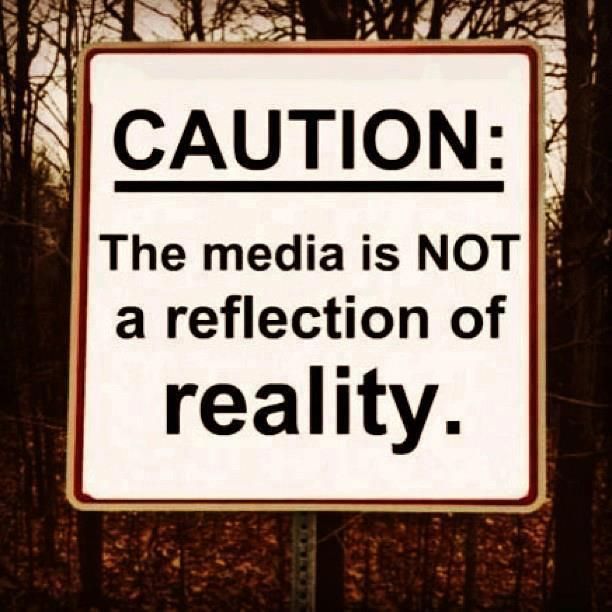
mediareality

After all, his administration has done all it can to stonewall and deceive the media.

On Monday, he made extensive remarks at a Washington, D.C. event for the Toner Prize for Excellence in Political Reporting about the responsibilities of journalists. His comments, given his record of trying to thwart the media, were remarkable.

“Real people depend on you to uncover the truth,” he declared. “We should be held accountable…What we’re seeing right now does corrode our democracy and our society. When our elected officials and political campaigns become entirely untethered to reason and facts and analysis, when it doesn’t matter what is true and what’s not, that makes it all but impossible for us to make decisions on behalf of future generations.”

“The electorate… would be better served if billions of dollars in free media came with serious accountability, especially when the politicians issue unworkable plans or make promises that they can’t keep,” Obama said. “And there are reporters here who know they can’t keep them… When people put their faith in someone who can’t possibly deliver on his or her promises, that only breeds more cynicism. ”

Though he may well have intended his remarks to be a dig at media coverage of Donald Trump, Obama was a very strange messenger given his misstatements and resistance to media oversight.

After all, it was Obama who made the infamous comment about his Affordable Care Act: “If you like the plan you have, you can keep it.  If you like the doctor you have, you can keep your doctor, too.  The only change you’ll see are falling costs as our reforms take hold.”

And it’s under the Obama administration that the government has set a dismal record of failing to provide information in response to Freedom of Information Act (FOIA) requests, many from journalists. People who have asked for records under the law received censored files or nothing in 77 percent of requests, a record, according to an Associated Press investigation.

In some FOIA cases, usually after news organizations filed expensive federal lawsuits, the Obama administration found tens of thousands of pages after it previously said it couldn’t find any, the AP said. The website Gawker, for example, sued the State Department in 2015 when it said it couldn’t find any emails an aide to Hillary Clinton and former deputy assistant secretary of state, had sent to reporters. It was only after the lawsuit was filed that the State Department found 90,000 documents about correspondence between the aide and reporters.

Since Obama became president, his administration has pursued an aggressive war against whistleblowers and leakers to the media, with more prosecutions under the 1917 Espionage Act than under all previous presidents combined.

And to top it all off, Obama proudly proclaimed in his Toner Prize remarks, “…something I’m really proud of is the fact that, if you go back and see what I said in 2007 and you see what I did, they match up,” a comment that, for some unexplainable reason, was met with applause by the fawning media in attendance.

Were they not aware of all the broken promises documented on the Pulitzer Prize winning Politifact.

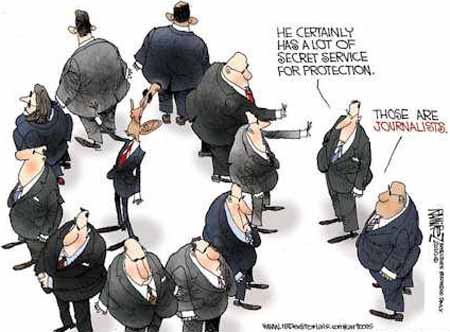
Maybe not. Maybe the mainstream media have been too busy serving as cheerleaders or protectors of the administration.

obama-protected-by-the-media


Even the Washington Post story about his remarks at the Toner event , written by a reporter who covers the White House, was little more than a 510 word press release relaying Obama’s speech verbatim, devoid of any context.

Maybe they were busy writing impactful stories about the Kardashians, or a man dressed as a shark in Katy Perry’s Super Bowl half-time performance, or a 1000 word story about a campaign worker manhandling a Breitbart reporter at a Donald Trump event.


The Donald, Melania, Ted and Heidi show

It’s all theater, folks.

An anti-Trump Political Action Committee that has raised only about $20,000 runs an ad on social media targeted at Mormon voters in Utah….and all hell breaks loose.

Ahh, the power of social media and the political value of feigned indignation.

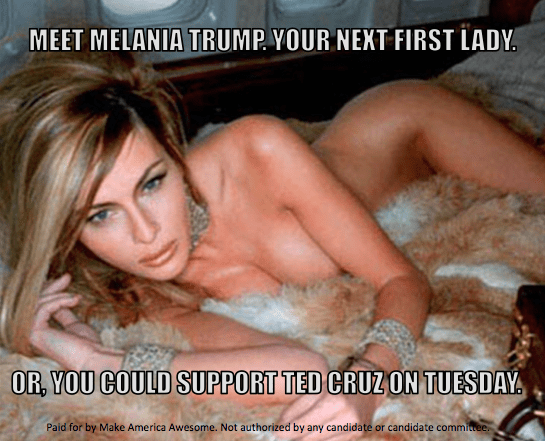
melaniatrumpad

The ad (above) featured Donald Trump’s wife, Melania, posing in the nude for GQ Magazine in 2000. It was posted by the Make America Awesome PAC, founded in 2015 by Liz Mair, a Republican-leaning political strategist. Its contributions have come from a small group, including Donald Gayhardt CEO of payday lender Tiger Financial Management/Speedy Cash, Virginia Postrel, a Libertarian political and cultural writer, and Donald Sherwood, a former Republican Congressman representing Pennsylvania’s 10th congressional district.

What made it all fascinating is how Trump and Cruz took advantage of the situation by publicly exchanging schoolyard taunts.

Knowing how to maximize attention, Trump Tweeted:

Lyin’ Ted Cruz just used a picture of Melania from a G.Q. shoot in his ad. Be careful, Lyin’ Ted, or I will spill the beans on your wife!”

and

“Wow @SenTedCruz, that is some low level ad you did using a picture of Melania in a G.Q. shoot. Be careful or I will spill the beans on your wife.”

(One theory is that Trump was referring to a 2005 incident when a depressed Heidi Cruz was observed sitting next to an expressway with her head in her hands. But admit it, ladies. You’d want to sit on a curb and cry if you were married to Ted, too, wouldn’t you?)

Cruz responded with this Tweet:

“Pic of your wife not from us. Donald, if you try to attack Heidi, you’re more of a coward than I thought. #classless

Then Trump Tweeted:

“Lyin’ Ted Cruz denied that he had anything to do with the G.Q. model photo post of Melania. That’s why we call him Lyin’ Ted!”

Not to be left out, Liz Mair followed up with a Tweet of her own:

“Hi Donald, I know you’re really upset about that ad, but it was Make America Awesome’s, not Ted Cruz’s.”

And then late Wednesday night, Trump kept the dispute alive and visible with another incendiary Tweet and photo:

trumpheidimelaniatweet

My goodness. How crass can you be?

The fact is, however, the initial ad would have quickly sunk into oblivion if Trump and Cruz had not exploited it to their perceived advantage.

Pundits have been fulminating about this controversy, focusing on the coarseness of the Mair ad and the candidates’ trigger-finger responses. The major media attacked Mair’s ad for “slut-shaming” Melania Trump and called out Donald Trump for throwing a Trumpertantrum.

But the pundits have completely missed the point.

Its all theater, folks, and we’re all suckers for being drawn into the attention-grabbing drama that either candidate could have stopped at any time. The candidates are the actors preparing themselves for the greatest acting job in the world.

As Ronald Reagan said, “For years, I’ve heard the question: “How could an actor be president?” I’ve sometimes wondered how you could be president and not be an actor.”


Hillary and The Donald: Self-inflicted wounds

With Super Tuesday voting and other primaries and caucuses behind us, Donald Trump and Hillary Clinton are the clear leaders in the Republican and Democratic races for their party’s presidential nominations.

But they are both damaged candidates and the parties have only themselves to blame for their success.

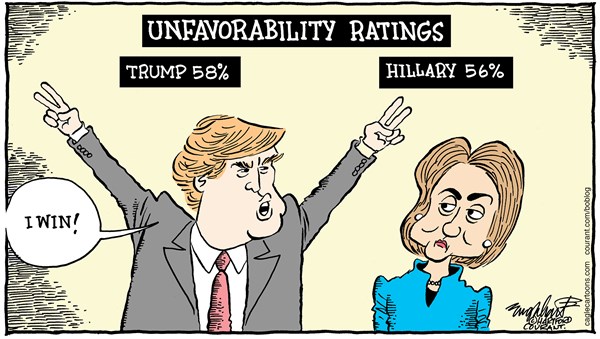
166747_600-2

Democrats have known for years that Hillary would be a seriously flawed candidate.

 “She has always been awkward and uninspiring on the stump,” a senior Democratic consultant once told the Washington Post. “Hillary has Bill’s baggage and now her own as secretary of state — without Bill’s personality, eloquence or warmth.”

 While her damaging e-mail scandal may be relatively new, Hillary has been associated with decades of personal and political contretemps, leading to a clear case of Clinton fatigue among the populace.

Equally troubling to the Democratic Party should be Hillary’s trust gap.

In a July 2015 Quinnipiac University national poll, 57 percent of respondents said Clinton is not honest and trustworthy, one of the worst scores among all the top candidates at the time. And her scores have gotten worse. In a subsequent Quinnipiac poll, 61 percent of respondents said Clinton is not honest and trustworthy.

In an August 2015 Quinnipiac University poll, “liar” was the first word that came to mind more than others in an open-ended question when voters were asked what they think of Clinton, followed by “dishonest” and “untrustworthy”. (“Arrogant” was the first word that came to mind for Trump, but that doesn’t seem quite as toxic)

In January 2016, a poll produced for ABC by Langer Research Associates put Hillary 12 points behind Bernie Sanders, 48-36 percent, in being seen as more honest and trustworthy, a deterioration from 6 points behind in Dec. 2015 and equal to Sanders in October 2015.

But Hillary’s problems as a candidate go even deeper.

“Voters see her as an extraordinarily cynical, power-hungry insider,” James Poulos said in The Week on Feb. 2. “She is out for herself, not out for Americans. Voters know it.”

This ties in with a long-held and widespread perception that Hillary and her family are just plain greedy, what with them hauling off $190,000 worth of china, flatware, rugs, televisions, sofas and other gifts when they moved out of the White House, taking money from all sorts of unsavory people and foreign countries for their Foundation, and charging exorbitant amounts for speeches.

David Axelrod, a political consultant who helped steer Obama to the presidency, noted in his book, “Believer”, that Hillary has two other main weaknesses: she’s a polarizing rather than a “healing figure,” and she has a hard time selling herself as the “candidate of the future” given her checkered past and long political resume.

And then, as Josh Kraushaar wrote in The Atlantic before Jeb Bush dropped out, “…pundits and donors alike are vastly overrating the prospects of two brand-name candidates for 2016 — Hillary Clinton and Jeb Bush — and undervaluing the reality that the current political environment is as toxic as it’s ever been for lifelong politicians.”

Then there’s Trump

That, of course, takes us to Donald Trump, the Republican Party’s “Nightmare on Park Avenue.”

Isolated in their cocoons, party officials (and the political press) assumed an establishment candidate would emerge the victor. They denied to themselves and others for months that Trump would be a viable candidate for the Republican nomination.

Nobody was more smug in this assumption then Jeb!

He started early, rebuilding political connections, building a professional staff and laying the groundwork for a “shock and awe” fundraising blitz. But he faltered early and never regained his balance. He watched helplessly as his fund-raising advantage become a disadvantage, defining him as the establishment favorite when the Republican base was looking for a change agent.

Political leaders also overestimated voters’ desire for solid, traditional, steady candidates and too quickly dismissed Trump as a long-term threat. “Reality TV will gather a lot of interest and a lot of people enjoyed the celebrity of that, but for the last 14 years, I’ve had to live in the real world and deal with real world issues and come up with real world solutions,” former Texas Gov. Rick Perry said in mid-2015. “And that’s what the people I think of this country want out of the next president of the United States.”

Meanwhile, confident that Trump’s bombast, misstatements and insults would doom him, Republican Party leaders watched incredulously as he rolled over establishment candidates.

“Until recently, the narrative of stories like this has been predictable,” Matt Taibbi wrote in Rolling Stone. “If a candidate said something nuts, or seemingly not true, an army of humorless journalists quickly dug up all the facts, and the candidate ultimately was either vindicated, apologized, or suffered terrible agonies… That dynamic has broken down this election season. Politicians are quickly learning that they can say just about anything and get away with it.”

As Karen Tumulty wrote in the Washington Post, “Will Trump eventually cross a line — or do the lines no longer exist?”

The make-up and size of the Republican candidate field also has worked to Trump’s advantage.

There’s no love lost, for example, between most members of Congress and Ted Cruz. And with so many Republican candidates (17 at one point), voter preferences were atomized for too long and even now none of the remaining candidates are willing to drop out, preventing the emergence of a single challenger to Trump.

So here we are, facing the possibility of a Clinton-Trump election.

Just goes to show that Clarence Darrow was right. “When I was a boy I was told that anybody could become President; I’m beginning to believe it,” he said.


Disillusionment and despair: the Trump turmoil

Donald Trump isn’t a candidate.

Donald-Trump-Caricature

He’s a stand-in for the alienation and disillusionment so many Americans feel as both the Republican and Democratic parties have failed us.

How could it be otherwise when so much seems so wrong and fakery, misdirection, and outright lies by both parties have been so pervasive?

Consider:

  • The past several decades have seen the most sustained rise in inequality in the United States since the 19th century after more than 40 years of narrowing inequality following the Great Depression. By some estimates, income and wealth inequality are near their highest levels in the past hundred years.
  • The 2009 $830 billion stimulus package, with a claimed focus on shovel-ready projects, was supposed to fix things after the Great Recession. The legacy instead – a slow growth economy. The first 23 quarters of the recovery, which officially began in June of 2009, had an annual rate of growth of just 2.1 percent.
  • The distribution of wealth in the United States is even more unequal than that of income. The wealthiest 5 percent of American households held 54 percent of all wealth reported in 1989, rose to 61 percent in 2010 and reached 63 percent in 2013.
  • 71 percent of Americans say life has gotten worse for middle-class Americans over the past 10 years.
  • Today’s fifty-somethings may be part of the first generation in American history to experience a lifetime of downward mobility, in which at every stage of adult life, they have had less income and less net wealth than did people who were their age ten years before.
  • There is now less economic mobility in the United States than in Canada or much of Europe. A child born in the bottom one-fifth of incomes in the United States has only a 4 percent chance of rising to the top one-fifth.
  • Young Americans (ages 18-34) are earning less (adjusted for inflation) than their peers in 1980 ; the college graduating class this year left with an average student debt of $35,051.
  • In 1986, President Reagan signed legislation that was supposed to fix the illegal immigration issue once and for all. Three million applied for legal status and about 2.7 million received it. Today, about 11.7 million immigrants are living in the United States illegally. So much for the fix.
  • Despite all the “mission accomplished” and “victory is at hand” assurances, America has been at war in the Middle East for the past 15 years, with little to show for it, billions of dollars down a rathole, thousands of American soldiers dead and wounded, and continuing chaos in Afghanistan, Iraq, Libya and Yemen.
  • Despite the billions the government has spent on poverty-related programs, half of children age three and younger live in poverty.
  • The White House wants to “press the reset button” on one of Washington’s biggest challenges: its increasingly troublesome relationship with Russia,” Vice President Biden, 2/7/2009; “We’re going to hit the reset button and start fresh (with Russia),” Secretary of State Hillary Clinton, 3/6/2009
  • “If you like the plan you have, you can keep it.  If you like the doctor you have, you can keep your doctor, too.” President Obama, 6/6/2009.
  • “I ended the war in Iraq, as I promised. We are transitioning out of Afghanistan. We have gone after the terrorists who actually attacked us 9/11 and decimated al Qaeda.” President Obama, 9/14/2012
  • Despite assurances from some politicians that all’s well, the Medicare program has $28.1 trillion in unfunded liabilities over the next 75 years. Together with Social Security’s $13.3 trillion shortfall, the government has accumulated entitlement spending commitments that far exceed our capacity to pay for them.
  • In the 2012 election cycle, a tiny elite of the U.S. population, just 0.40 %, made a political contribution of more than $200, providing 63.5% of all individual contributions to federal candidates, PACs and Parties, according to the Center for Responsive Politics.
  • Fewer than four hundred families are responsible for almost half the money raised in the 2016 presidential campaign to date, a concentration of political donors that is unprecedented in the modern era.

As H.L. Mencken said, “Under democracy one party always devotes its chief energies to trying to prove that the other party is unfit to rule — and both commonly succeed, and are right.”