Portland City Council Voters: Do You Know What You Did?

All you Portland voters. Remember how you voted 58.1% to 41.9% on Measure 26-228 to switch to a ranked choice voting (RCV) system for the Portland City Council?

“In the end, we saw monumental wins that will change the landscape of our local democracy and advance opportunity for communities of color,” enthused the Coalition of Communities of Color after the vote.

“Portlanders made history by demanding a government that is effective, accountable and representative,” said Debra Porta, co-chair of the Charter Commission, which initially recommended voters consider the sweeping changes .

“The passage of Measure 26-228 is an historic step towards a democracy that truly gives all Portlanders a seat at the decision making table and a government that meets their basic needs,” said Sol Mora of the group Portland United for Change, which advocated for the measure. “This victory was powered by the people for the people.”

Well, supporters got what they wanted. But while Measure 26-228 required mote than 50% yes votes in Portland to pass, the 12 new city councilors elected under the the quirky new system didn’t need 50% to win in the 4 new districts.

This is how the RCV reform proposal described the system: 

 “If no candidate receives a majority of the vote in the initial round, subsequent rounds are counted in which (i) candidates retain the number of votes counted for them in the first and any subsequent rounds that already occurred; and (ii) the candidates having the fewest votes are successively eliminated in rounds and their votes are counted as votes for the candidates who are ranked next on the ballots that had been counted for the eliminated candidates. The process of eliminating candidates and transferring their votes to the next-ranked candidate on ballots repeats until a candidate has a majority of the vote.”

The Councilors of each district were elected using a proportional method of RCV known as “single transferable vote” (STV). In this system, voters rank the candidates and if a candidate gets more votes than needed to be elected the extra, or surplus, votes get transferred to the voter’s next choices. The charter reform proposal was so convoluted it took almost 300 words to explain how it would work (See below for complete text).

Under this system, a candidate running for a seat in a multimember district could win a position on the Council with as little as 25% of the vote, or maybe even less.

And that’s exactly what happened.

Eleven of the twelve Councilors were elected with 25% of the vote in their district. One newly-elected Councilor, Jamie Dunphy in East Portland’s District 1, was even elected with just 22.8% of the vote.

District 1’s three final winners were Candace Avalos, Loretta Smith and Dunphy. In the 1st round, Avalos was the first choice of just 19.4% of the vote, Smith was the first choice of 13.1% and Dunphy was the first choice of 11.9%.

One consequence of all this is that the newly elected Councilors may be able to remain in office by consistently satisfying just that small segment of eligible voters and ignoring those who are disenchanted with their performance because it would require 75% of voters to vote against the entrenched councilor to remove him or her.

As Tim Nesbit, a former chief of staff to former Democratic Governor Ted Kulongoski and a critic of the ballot measure before its passage, wrote in the Portland Tribune, “This will be a ‘welcome to the Hotel California’ for candidates who seek office in the first council election to follow. It will be easy to check in to the council, but much harder to be forced to leave.”

Charter reform’s explanation of how “single transferable vote” (STV) would work: 

“Councilors of each district are elected using a proportional method of ranked choice voting known as single transferable vote. This method provides for the candidates to be elected on the basis of a threshold. The threshold is determined by the number of seats to be filled plus one, so that the threshold is the lowest number of votes a candidate must receive to win a seat such that no more candidates can win election than there are seats to be filled. In the initial round, the number of first rankings received by each candidate is the candidate’s vote count. Candidates whose vote counts are at least the threshold are declared elected. Votes that counted for elected candidates in excess of the threshold are called surplus. If fewer candidates are elected in the initial round than there are seats to be filled, the surplus percentage of all votes for the candidates who received a surplus are transferred to the next-highest ranked candidates in proportion to the total numbers of next-highest rankings they received on the ballots that counted for the elected candidate. If, after all surpluses have been counted in a round, no additional candidates have a vote count that is at least the threshold, the candidates with the lowest vote counts are successively eliminated in rounds and their votes are counted as votes for the candidates who are ranked next highest on the ballots that had been counted for the eliminated candidates, until another candidate has a vote count that is at least the threshold or until the number of candidates remaining equals the number of seats that have not yet been filled. The process of transferring surpluses of elected candidates and eliminating candidates continues until all positions are elected.”

Portland’s Next Mayor? Who Cares?

Portland’s Next Mayor?

In all the turmoil and media attention focused on Portland’s new ranked choice voting election in November, much of the focus has been on the contest for mayor.[1]

Why?

The next mayor is going to be a eunuch. No, I don’t mean a castrated man. I mean the word metaphorically, in the sense an ineffectual or powerless person.

It’s the new 12-person City Council that will have the power to enact laws. The new mayor won’t even sit on the City Council or vote on council items (except to break a tie).  The mayor, and the new city administrator, who will be appointed by the mayor with council approval, will be in charge of carrying out City Council actions and crafting the city budget.

The mayor will also be tasked with appointing a city administrator, city attorney, and police chief, but that will also be only with the City Council’s approval. And to top it all off, the mayor won’t have veto power over council decisions. 

The mayor will serve more as a $175,463-a-year figurehead than a legislator, Tate White, a member of the city’s government transition team, told OPB earlier this year. “They’re going to be partnering with other jurisdictions, they’ll be standing at press conferences, they’re going to be the people meeting with representatives from sister cities when they come and visit, it will be far more ceremonial,” she said.

But don’t count on the new 12-person City Council, with three representatives per four new geographical districts and only one staff person for each City Council member, to be all that cooperative, efficient or effective. It might be more functional than New York City’s 51-member City Council, but likely not much. After all, a City Council member can be elected with as little as 25% + 1 votes, so their constituencies will be pretty damn small.[2] One consequence could be a Councilor able to remain in office by consistently satisfying just that smaller segment of eligible voters.

Jeff Jacoby, an award-winning columnist for the Boston Globe, calls the ranked choice voting process “democracy on the Rube Goldberg model”, where  ideas that supposedly simplify people’s lives wreak havoc instead.


[1] Mayoral candidates include three current members of Portland City Council: Rene Gonzalez, Mingus Mapps and Carmen Rubio. Others running are: Saadiq Ali, early childhood educator Shei’Meka As-Salaam, inventor James Atkinson IV, REAP youth advocate Durrell Kinsey Bey, financial advisor Nancy Congdon, Yao Jun He, advocate for the unhoused and community activist Michael O’Callaghan, artist and performer Liv Osthus, city hall veteran and green energy advocate Marshall Runkel, owner and president of TITAN Freight Systems Keith Wilson and maintenance supervisor Dustin Witherspoon. 

[2] Charter reform’s explanation of how “single transferable vote” (STV) will work: 

“Councilors of each district are elected using a proportional method of ranked choice voting known as single transferable vote. This method provides for the candidates to be elected on the basis of a threshold. The threshold is determined by the number of seats to be filled plus one, so that the threshold is the lowest number of votes a candidate must receive to win a seat such that no more candidates can win election than there are seats to be filled. In the initial round, the number of first rankings received by each candidate is the candidate’s vote count. Candidates whose vote counts are at least the threshold are declared elected. Votes that counted for elected candidates in excess of the threshold are called surplus. If fewer candidates are elected in the initial round than there are seats to be filled, the surplus percentage of all votes for the candidates who received a surplus are transferred to the next-highest ranked candidates in proportion to the total numbers of next-highest rankings they received on the ballots that counted for the elected candidate. If, after all surpluses have been counted in a round, no additional candidates have a vote count that is at least the threshold, the candidates with the lowest vote counts are successively eliminated in rounds and their votes are counted as votes for the candidates who are ranked next highest on the ballots that had been counted for the eliminated candidates, until another candidate has a vote count that is at least the threshold or until the number of candidates remaining equals the number of seats that have not yet been filled. The process of transferring surpluses of elected candidates and eliminating candidates continues until all positions are elected.”

Mail-In-Voting Is On The Ballot in Oregon

In 2020, Donald Trump filed several lawsuits in an effort to stop vote-counting or force recounts after his campaign said post-Election Day increases in vote totals for President Joe Biden — many of which came from mail ballots, that were counted following the in-person votes — were evidence of fraud. 

None of the lawsuits succeeded. 

But Trump has continued to denigrate mail-in voting and promulgate theories that the 2020 election was contaminated by voter fraud, and his true believers are falling in behind him. (A humorous aside is that many Republican groups are also spending millions of dollars this year promoting voting by mail to spur turnout, particularly in competitive states)

Even though elections researchers have demonstrated that making it easier to vote by mail generates higher voter turnout for both parties, and incidences of fraud are rare, in December Trump called for an end to mail-in voting entirely. Following a “cutting off one’s nose to spite one’s face” strategy, he claimed in March that “any time the mail is involved, you’re going to have cheating”.  

Some election experts expect Trump to prematurely claim victory on the basis of early in-person votes in 2024 and to litigate the election going forward.

Now we have all three Republicans running to be Oregon Secretary of State, which oversees the state’s elections, hyping claims of voter fraud and affirming their desire to end Oregon’s long tradition of running elections by mail.

The three Republicans in the primary race are Beaverton real estate broker Brent Barker, state Sen. and rancher Dennis Linthicum and Salem business analyst Tim McCloud.

Brent Barker’s campaign website spells out his support for:

  • Statewide In-Person Voting
  • Limiting mail-in ballots to Military and Absentee Voters
  • Resetting all voter registration rolls to zero and requiring everybody to re-register
  • Hand counting tally results for all elections with observers

Linthicum, on his campaign website, pledges to:

  • Restore election integrity and promote diligent custodial ownership of election records
  • Advocate for in-person local precinct voting with ID
  • Safeguard the elections for the integrity of every Oregonian’s vote

Tim McCloud has not set up a website with campaign pledges. He was, however, a plaintiff in a lawsuit intended to end mail voting and electronic voting tabulation in Oregon.

A federal judge tossed the lawsuit, saying “generalized grievances” about the state’s elections aren’t enough to give a group of unsuccessful Republican candidates and other election deniers standing to sue.

McCloud has also commented on election issues in general. In responses to a questionnaire from KATU News, he said, “I will heavily fortify our election system against attacks, and implement fail-safe systems to prevent any disruption of our election system by bad actors. Additionally, I will advance all efforts for more access to Oregon’s public elections records, including more transparent processing of ballots, and conducting routine and thorough voter roll audits statewide.”

Whatever the merits, or failures, of mail-in voting, one thing remains true. As political analyst Larry J. Sabato, has said, “Every election is determined by the people who show up.”

Merkley’s money: what a difference a term makes

HandsOut

Things are different now.

When Democrat Jeff Merkley first ran for the U.S. Senate in 2008, he raised a total of $6,512,231.

Now that he’s a Senator, he’s already reported raising $6,286,013 for his reelection and the 2014 race, in theory, hasn’t even begun. The Republicans haven’t even chosen who will run against him.

That means Merkley’s total haul is likely to go much higher as individuals, special interests and Democratic Party funds ramp up their donations to keep him in office.

The two parties are in a no-holds-barred struggle for control of the Senate, where pollsters and analysts think the Republicans have a shot at taking control with a good showing in the November 2014 elections. Merkley isn’t often mentioned as being in a high-risk race, but then former Senator Gordon Smith wasn’t thought to be vulnerable early on either.

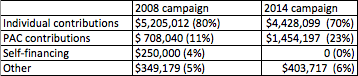
With 5 years as a U.S. Senator now behind him, the sources of Merkley’s donations are shifting. A smaller share is coming from individual contributors and twice as much from political action committees (PACs). Also, more unions are stepping up as big contributors, his big donors have less of an Oregon focus and Merkley isn’t having to dig into his own pocket.

merkleySenate

According to the Center for Responsive Politics, contributions to Merkley’s campaign committee for his 2008 campaign and for his 2014 campaign as of Dec. 31, 2013 break down as follows:

Screen Shot 2014-03-26 at 10.18.34 PM

For his 2008 Senate race, Merkley’s largest 10 contributors (individuals and PACs) to his campaign committee were:

JStreetPAC $78,180
Council for a Livable World $55,889
State of Oregon employees $35,050
Oregon Health & Science University $33,964
Moveon.org $26,731
Stoel, Rives et al $23,323
League of Conservation Voters $21,500
Intel Corporation $17,920
Newmark Knight Frank $17,300
Intl. Brotherhood of Electrical Workers $17,200

The largest contributor to his 2008 campaign, Washington, D.C-based JStreetPAC, makes contributions to candidates who support a two-state solution for Israel and Palestine and robust American military aid to Israel. “I am and will continue to be a staunch supporter of the special relationship between the U.S. and Israel,” Merkley said during his 2008 campaign.“I will always seek to ensure its strength and foster its growth.”

The second largest contributor to his 2008 campaign, Council for a Livable World, is a Washington, D.C.-based non-profit advocacy organization dedicated to reducing the danger of nuclear weapons. Merkley subsequently voted in 2010 for a new Strategic Arms Reduction Treaty (START) with Russia and in February 2014, Merkley and Senator Edward J. Markey (D-Mass.) introduced legislation that would cut $100 billion over the next decade from the U.S. nuclear weapons budget.

The bill, S. 2070, would shut down all U.S. missile defense activities, reduce from 12 to eight the number of SSBN(X) ballistic-missile submarines that are set to replace the retiring Ohio-class fleet and limit to eight the number of Ohio-class submarines that can currently be fielded. The bill has been referred to the Senate Committee on Armed Services where its languishing.

The largest 10 contributors (individuals and PACs) to Merkley’s campaign committee for his 2014 race as of the end of 2013 are significantly different, with much less of an Oregon focus:

Votesane PAC $31,250
Thornton & Naumes $25,000
Intel Corporation $22,050
Honeywell Intl. $20,000
Operating Engineers Union $20,000
Intl. Association of Firefighters $18,500
Blue Cross/Blue Shield $17,100
League of Conservation Voters $15,314
American Crystal Sugar $15,000
Communications Workers of America $15,000

Votesane PAC, a non-partisan channel for political donations, has funneled $1.6 million to candidates in the 2014 election cycle, with almost all of it going to Democrats.

The only union showing up in Merkley’s list of top 10 contributors for his 2008 race was the International Brotherhood of Electrical Workers at $17,200. Three unions show up as his biggest contributors for the 2014 race so far with a total of $53,500.

Also making their debut as major Merkley contributors are individuals from Thornton & Naumes, a Boston, Mass. law firm with class action expertise that has represented people claiming they were victims of asbestos and toxic exposure, defective products, financial fraud, and personal injury accidents.. Law firms and lawyers have been the top contributors to Merkley’s 2014 campaign as of Dec. 31, 2013, donating a total of $296,363.

This only reveals, of course, donations up the end of 2013. Expect a lot of shifts as the campaign progresses.

Merkley has already spent $3,045,241, or almost half, of the funds he’s raised since 2008. Recently, the largest single amount has gone to Mandate Media,a Portland-based internet strategy,services,and advertising firm specializing in progressive political candidates and advocacy organizations. Mandate is also associated with BlueOregon, a widely distributed progressive e-newsletter.

The top 5 recipients of the campaign’s recent expenditures were:

Mandate Media $200,485
CHS Mailing $141,305
Kauffman Group $125,163
Linemark Printing $ 71,639
Benenson Strategy Group $ 47,000

It’s important to recognize that much of the money now being spent on campaigns is so-called independent expenditures, spending by groups and individuals who claim they are not coordinating their activities with a candidate’s campaign committee.

In Merkley’s 2008 race, for example, according to FindTheBest, the following outside groups spent about $675,000 in support of his candidacy:

Committee Amount

Service Employees International
Union Committee on Political Education
(SEIU Cope) $430,238
League of Conservation Voters Inc. $145,317
Democratic Senatorial Committee $ 47,746
League of Conservation Voters
Action Fund $ 40,862
Moveon.org Political Action $ 7,026

It’s likely that similarly large amounts of independent expenditures will occur in the 2014 race.

Data sources: The Center for Responsive Politics (http://www.opensecrets.org), a non-profit, non-partisan research group based in Washington, D.C.; FindTheBest (www.findthebest.com; http://bit.ly/1nYKKSA),a network of for-profit websites connected to help consumers and businesses make informed decisions.

merkleySenate