The union campaign at Burgerville: a quixotic quest

burgervillestrike

Local news is replete with stories about the failure of contract negotiations between Burgerville and the Burgerville Workers Union ands the threat of a worker strike, but most are failing to point out a critical fact — only 111 Burgerville employees at a total of five of the company’s 47 locations have even voted to form a union.

Furthermore, of the 142 employees who were working in those five locations during their respective votes, only 94 of them were still employed at Burgerville as of mid-2019 and the lead organizers of the unionizing effort at three of the five restaurants no longer worked at the company

It’s also likely that most of  the employees now threatening an “imminent” strike will not be at Burgerville long-term because the fast-food industry is grappling with record employee turnover.

According to MIT Technology Review, the turnover rate in the fast-food industry is 150%. In other words, the typical fast food restaurant is seeing its entire workforce, plus half of its new hires, replaced in 12 months.

Burgerville is doing better, perhaps because of its expansive benefits, including health insurance, vacation pay and financial wellness training. Still, the annual turnover rate across all its restaurants in 2018 was 83% (up from 71% in 2017), according to the company.

The union has reportedly asked for a $5 hourly increase for all unionized workers; Burgerville has offered a $1 an hour increase for all workers, which would put them 6 months ahead of a state-mandated minimum-wage increase.

The union says Burgerville’s proposed pay raise is “miserly.” Is it?

According to Glassdoor, a website where current and former employees anonymously review companies and anonymously submit and view salaries, average base pay for hourly crew members is currently $12.  When factoring in bonuses and additional compensation, a crew member at Burgerville can expect to make an average annual salary of $25,298.

For comparison, the typical McDonald’s crew member makes $9 per hour, according to Glassdoor. When factoring in bonuses and additional compensation, a crew member at McDonald’s can expect to make an average annual salary of $19,242.

The typical Wendy’s Crew Member makes $9 per hour., Glassdoor says.  When factoring in bonuses and additional compensation, a Crew Member at Wendy’s can expect to make an average annual salary of $18,738.

In other words, the average hourly pay of Burgerville crew members is already higher than at key competitors.

Could Burgerville afford to pay its employees more? It’s a private company owned by The Holland Inc., so it doesn’t make its financials public. The economy is strong, however, and the fast-food, or quick service restaurant (QSR), industry in the United States, has been doing well, particularly in 2018 and 2019. Workers have reason to believe Burgerville has benefited.

I understand workers’ desire to share in America’s prosperity, but any increase in wages crunches the bottom line and in a highly competitive marketplace only some of additional labor costs can be passed on to price sensitive consumers. The preferred solution for many fast-food businesses is reducing, not increasing, labor costs, largely by leveraging technology to employ fewer people.

Then, of course, there’s the question of whether the union’s demand for “a living wage” at Burgerville is even realistic.

According to a Living Wage Calculator developed by MIT, A living wage is the hourly rate that an individual in a household must earn to support his or herself and their family. The assumption is that the sole provider is working full-time (2080 hours per year).

The Calculator says a living wage for two adults, with one working, and one child in Multnomah County is $26.06 an hour or $54,205 a year. It is delusional to think Burgerville will pay that much to an easily replaceable crew member with limited skills and an expected short tenure.

The fact is, rather than pushing for unattainable wages at Burgerville, current crew members would be better off enhancing their job skills and/or education to qualify for higher paying employment elsewhere.
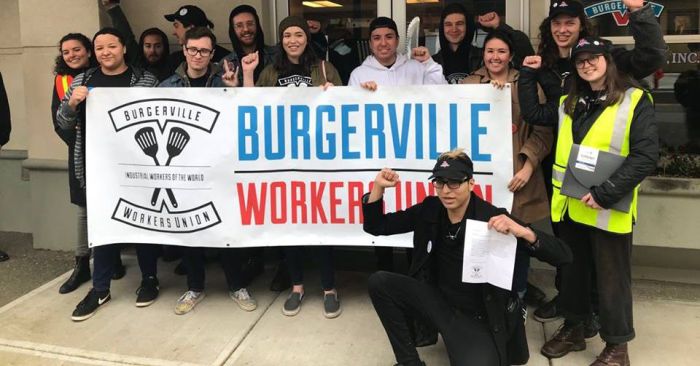
Unionizing Burgerville: workers of the world unite…then quit.

Time passes. Things change.

That’s certainly been the case at Burgerville, where workers at the company’s restaurant at 3504 SE 92nd Ave. in Portland voted 18-4 in April 2018 to form a union.

burgervilleworkersunion

Over the next 12 months, employees at four more Burgerville sites followed suit:

May 13, 2018: 19119 SE McLoughlin Blvd. site – 17 yes, 5 no

Dec. 11, 2018: 1122 SE Hawthorne Blvd. site –  13 yes; 9 no

April 3, 2019: 8218 NE Glisan St. site – 15 yes, 9 no

April 4-5, 2019: 1135 NE Martin Luther King Jr Blvd. site – 14 yes, 7 no

Adding it all up, 111 Burgerville employees at a total of five locations have voted on whether to form a union.

Burgerville says it hasn’t kept track of which specific employees participated in the union votes, so it can’t quantify how many of the 111 voters are still employed by the company. It has determined, however, that of the 142 employees who were working in the five unionized locations during their respective votes, only 94 of them, or 66%, are still employed at Burgerville.

Furthermore, the lead organizers of the unionizing effort at three of the five restaurants no longer work at Burgerville. Two resigned their positions less than one month following their locations’ votes and a third organizer just resigned.

The fast-food industry is currently grappling with record employee turnover. According to MIT Technology Review, the turnover rate in the fast-food industry is 150%. In other words, the typical fast food restaurant is seeing its entire workforce, plus half of its new hires, replaced in 12 months.

Burgerville is doing better, perhaps because of its expansive benefits, including health insurance, vacation pay and financial wellness training. Still, the annual turnover rate across its 42 restaurants in 2018 was 83% (up from 71% in 2017), according to the company.

What all this means is:

  • Three of the five union organizers are no longer working at Burgerville.
  • A significant share of all the Burgerville employees who voted in the five union elections since April 2018 are likely not still working at the company.
  • It is highly likely that few of the 142 employees who were working at the five unionized locations during their respective votes will still be employed at Burgerville 12 months from now.
  • Few of the employees at the five Burgerville locations 12 months from now will have participated in the original votes to unionize.

Why, then, should the employees at the five locations one year from now be forced to be members of a union?

Unfortunately, future employees at the five Burgerville  restaurants probably won’t be given an opportunity to vote on whether to be represented by a union and, if so, which one.

One option to address this situation could be automatic representation elections whenever employee turnover by a bargaining unit over time exceeds a certain percentage. A bill introduced in Congress in 2017 (H.R. 2763 – Employee Rights Act) proposed 50 percent be the trigger.

Another possible solution, suggested by both Samuel Estreicher, a Professor of Law at New York University School of Law, and Michael Oswalt, an Associate Professor of Law at the Northern Illinois University College of Law, is regularly scheduled union representation elections the same way we regularly schedule political elections.

Estreicher, who called his proposal “easy in, easy out,” suggested that every two or three years the employees in a unit, after an initial minimal required showing of interest, would have an opportunity to vote in a secret ballot whether they wish to continue the union’s representation, select another organization, or have no union representation at all.

Oswalt argued that regularly scheduled union representation elections would be better than the simple continuation of the status quo.

“…workplace culture would slowly shift, creating an atmosphere where workers would feel internal pressure to, at the very least, think about the ramifications of selecting or not selecting a bargaining agent,” Oswalt wrote.

That would  be a good thing for Burgerville workers.