Should I stay or should I go: Bernie’s conundrum.

sanderspic

Hillary Clinton and her allies want Bernie Sanders to withdraw from the race. For additional pressure, the liberal media, including Talking Points Memo,the Washington Post, Daily Kos and the NY Times are piling on in unison. With increasing vehemence, they all argue Sanders should quit because he can’t win the Democratic nomination.

“…Sanders’ campaign is now taking a scorched-earth approach toward its opponents—even if that means helping Donald Trump win the White House,” wrote David Nir in today’s Daily Kos.

Sanders’ continued presence in the race increases divisiveness in the party, his critics assert, makes it harder for Hillary to focus on Trump and forces Hillary to keep spending millions to secure her nomination that would be better spent in the general election.

On March 17, the New York Times reported that the previous week President Obama had privately told a group of Democratic donors that Sanders was close to when his campaign against Clinton would end and that the Democratic Party must soon come together to back her.

According to the Times, people at the donor event “took his comments as a signal to Mr. Sanders that perpetuating his campaign, which is now an uphill climb, could only help the Republicans recapture the White House.”

So let’s look at what Hillary did in her own 2007-2008 contest with Obama.

The objective of each of the candidates in the primaries and caucuses was to secure the support of 2,117 delegates, a majority, to the August 2008 Democratic National Convention.

At the end of 2007, Clinton led in the national polls with 42% of likely voters, over Obama at 23% and John Edwards at 16%.

On Jan. 3, Obama unexpectedly won the Iowa caucuses with 38% of the vote, over Edwards, 30%, and Clinton, 29%. That gave Obama 28 pledged delegates, Clinton 14 and Edwards 3.

At the conclusion of the next three primaries (New Hampshire, Nevada, South Carolina) on Jan. 26, the pledged delegate vote count was Obama 88, Clinton 46 and Edwards 3. This was after Obama won by a more than two-to-one margin over Clinton in South Carolina, taking 55% of the vote to Clinton’s 27% and Edwards’s 18%. After his shellacking, John Edwards suspended his candidacy on January 30, 2008.

With the Super Tuesday primaries looming, Senator Ted Kennedy endorsed Obama, a high profile endorsement that buoyed Obama’s hopes. On Tuesday, Feb. 5, with 23 states and territories and 1,681 delegates up for grabs, Obama captured 847 delegates and Clinton 834. That put Obama at 1036 pledged delegates and Clinton at 1056.

Earlier in 2008 it had been expected that the nominee would be known after Super Tuesday, but Obama and Clinton were essentially tied in pledged delegates.

During Feb. 9-19, Obama swept 11 state contests and expanded his pledged delegate lead by 120. By the end of February, Obama had 1,192 pledged delegates, Clinton 1,035. But Clinton led among super-delegates, 240 to 19.

In the March primaries and caucuses, both candidates hung in there, with Obama winning 210 pledged delegates and Clinton 205, putting Obama slightly ahead with a total of 1,562½ pledged delegates and Clinton with 1,421½.

 On March 29, Obama’s lead prompted Sen. Pat Leahy, D-Vermont, to call for Clinton to drop out of the race. “I think that her criticism (of Obama) is hurting him more than anything John McCain has said,” Leahy said. “I think that’s unfortunate.”

 As the contest continued into April, a consensus began to grow that Clinton didn’t have much of a chance to overcome Obama’s lead in pledged delegates. Coincident with that growing feeling, some Democrats began to argue that Clinton staying in the race was damaging Obama’s likelihood of success in the general election.

Clinton did go on to win in Pennsylvania, but Obama won in North Carolina and the two almost tied in Indiana on May 6. At that point, Obama led Clinton by 164 pledged delegates and there were only 217 pledged delegates left to be decided, leading to more calls for Clinton to drop out of the race.

Even comedians got in the act. “Hillary Clinton says she isn’t dropping out because there are still six states that haven’t had their Democratic primary,” said Conan O’Brien. “That’s right. Barack Obama’s favored in the states of Oregon, Montana and South Dakota, and Hillary is favored in the state of denial.”

Clinton’s fortunes deteriorated further on May 10 when Obama’s super-delegate total passed Clinton’s, making it even more likely that Clinton’s run was doomed.

But Hillary Clinton persevered.

It wasn’t until June 3 when Obama’s delegates from South Dakota and Montana primaries, plus his announcement of more super-delegates, put Obama over the majority needed for the Democratic nomination.

Still, it took until June 5 for the Clinton campaign to post a letter to supporters on its website saying Hillary would endorse Obama on June 7.

From my perspective, that pretty well sums it up. Bernie, ignore the calls to drop out coming from Hillary and her bought and paid for acolytes. Keep a-pluggin’ away.


                                       If the hills are high before

                                       And the paths are hard to climb,

                                       Keep a–pluggin’ away.

                                       And remember that successes

                                       Come to him who bides his time,—

                                        Keep a–pluggin’ away.

“Keep a-plugging away”, Lyrics of Lowly Life, Paul Laurence Dunbar

dunbar


Why is Val Hoyle smiling?

moneyinpolitics

Like Hillary Clinton, Rep. Val Hoyle, D-Eugene, who’s running for Secretary of State,  wants to get the obscene amounts of money out of politics…..later.


That way, she can rake in bundles of money now while running for Oregon Secretary of State as a champion of fundraising reform.

hoyle-mobile

Val Hoyle (D-Eugene)

In the past, Hoyle has said she supports enacting a constitutional amendment to limit campaign contributions, so long as the limits aren’t “unreasonably low”.

She has also blamed Democratic losses outside Oregon on “fear and cynicism” among voters fostered by large political contributions “from a small handful of special interests”.

So much for worrying about special interests.

According to state records, Hoyle has raised $587,000 to date, putting her at the top of the fundraising pile among the Secretary of State candidates.

Val Hoyle (D)……………………..$592,728

Brad Avakian (D)…………………$387,482

Dennis Richardson (R)………….$297,413

Richard Devlin (D)……………. ..$172,315

Sid Leiken (R)……………………..$ 45,104

Hoyle’s biggest contributor is Michael Bloomberg, a New York businessman who supports aggressive gun control measures. On April 29, he gave Hoyle $250,000 in appreciation for her support of legislation that passed in the last session expanding background checks to almost all private firearm transfers.

“Mike is supporting Val Hoyle because her leadership in passing Oregon’s background check bill is truly notable,” Howard Wolfson, a spokesman for Bloomberg, told Willamette Week in an email. “No one in the country has worked harder —or more successfully—to take on the NRA than she has.”

Hoyle has also received $105,000 in contributions from Emily’s List, a Washington, D.C.-based political action committee that supports female candidates.

Without those two large contributions, both from out-of-state, Hoyle would have raised just $237,728, which would have put her behind both Brad Avakian and Dennis Richardson in fundraising totals.


P.S.: The other candidates aren’t exactly pure in their fundraising either, although they’re collecting nothing comparable to Hoyle from individual donors.

Brad Avakian’s larger contributions

  • $40,000 from United Food and Commercial Workers Local 555
  • $30,000 from Oregon School Employees Association – Voice of Involved Classified Employees (2307)
  • $10,000 from Pacific NW Regional Council of Carpenters, SSF
  • $10,000 from Oregon League of Conservation Voters PAC (2352)
  • $7,500 from Peter Goldman, a Seattle attorney
  • $6,000 from Naral Pro-Choice Oregon PAC (172)
  • $2,500 from Mt. & M Gaming, operator of The Last Frontier Casino in La Center, WA


Dennis Richardson’s larger contributions 

  • $25,000 from Sherman and Wanda Olsrud of Medford, OR
  • $15,000 from Larry Keith of Salem, OR
  • $15,000 from James Young of Lebanon, OR
  • $15,000 from Freres Timber, Inc. of Lyons, OR
  • $10,000 from Stephen M Greenleaf of Medford, OR
  • $10,000 from Richard E Uihlein of Lake Forest, IL
  • $10,000 from Murphy Co. of Eugene, OR
  • $5,000 from Zidelle Collin s of Shady Grove, OR
  • $5,000 from David A deVilleneuve of Central Point, OR

Clinton’s winning… and losing

Like the houseguest who overstayed her welcome, Hillary Clinton is losing admirers the longer she’s on the stage.

hillarycartoon

She won a decisive victory in New York’s Democratic primary yesterday. You’d think the victory was evidence of her steady climb in popular approval, a sign of voters’ deep and growing affection for her.

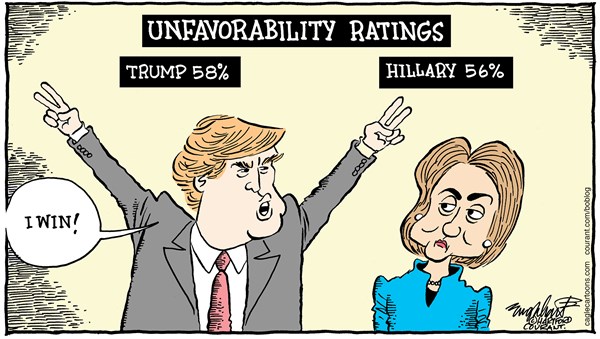
But the closer she comes to victory, the more people dislike her.

In January 2013, just prior to her official resignation as Secretary of State on Feb. 1,  just 25 percent of voters from both parties held a negative view of Hillary.

By March 2016, a Wall Street Journal/NBC survey revealed that among voters in both parties, 51 percent held a negative view of Hillary and 38 percent held a positive view.

This month, things were considerably worse. An April 10-14 poll showed that among voters in both parties, 56 percent held a negative view of Mrs. Clinton and 32 percent held a positive view. The way things are going, nobody will really like her by November.

Her only saving grace, if you can call it that, is that no candidate on the Democratic or Republican side is seen favorably by more than 50 percent of registered voters.

—-

By the way, Hillary’s New York victory yesterday was less impressive than her performance in 2008. That year, when she won the primary against Barack Obama, she carried all but one of New York’s 62 counties.

This time, she lost all but 13 of New York’s counties to Bernie Sanders, an astonishing shift. What saved Hillary in the popular vote was that her wins were concentrated in populous urban areas, including Buffalo, Syracuse and New York City.

primarymapNY

Memo to Verizon strikers: you’re doomed

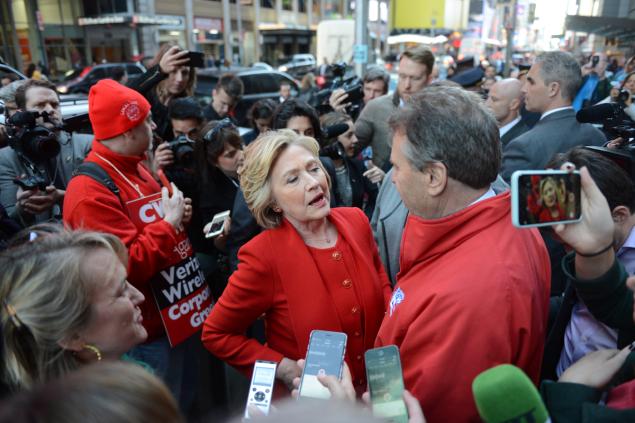
Hillary Clinton and Bernie Sanders are mining for union votes, so their pandering to the 39,000 Verizon strikers is par for the course.

Both greeted strikers yesterday at Verizon offices in Brooklyn and Manhattan. “This is just another major corporation trying to destroy the lives of working Americans,” Sanders said  in Brooklyn. “And today you’re standing up not just for justice for Verizon workers. You’re standing up for millions of Americans who don’t have a union.”

sandersverizon2

Bernie Sanders addressing striking Verizon workers IN Brooklyn. “Thank you for your courage in standing up against corporate greed,” he told them.


hillaryverizon2

Hillary Clinton speaks to union leader, Denis Tranor, while she visits striking Verizon workers in Manhattan.

The full-throated proclamations of support from Clinton and Sanders don’t, however, change the fact that the jobs of most of the strikers are doomed.

That’s because, as was the case with a 2011 Verizon strike, many of the strikers service the company’s shrinking landline, or wireline, phone business, or the company’s FIOS network, where Verizon is trying to reduce its role. They don’t service Verizon’s Wireless network, which provides most of Verizon’s profits.

The striking workers are complaining about not sharing in Verizon’s profits, but ignoring the fact that they are not the ones generating the profits. Why in heaven’s name would Verizon want to go out of its way to accommodate the strikers when the customer base they serve is collapsing?

All the public back and forth accusations being covered in the media, which love conflict, obscure the simple fact that the business is changing and nothing the strikers or the politicians grasping for votes say will change that.


The truth be told: Bill Clinton and Black Lives Matter

The real truth-teller in Hillary’s political campaign isn’t the candidate. It’s her husband.

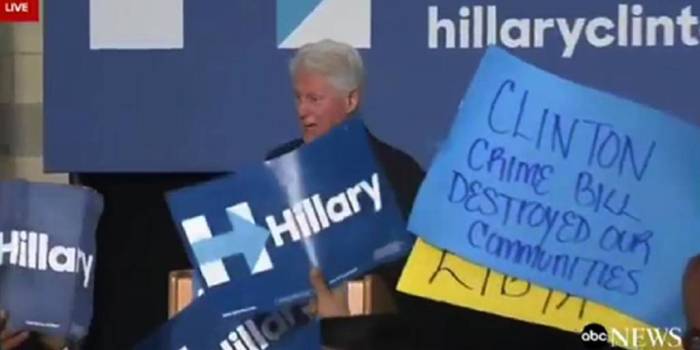
Yesterday, Bill Clinton got into quite a set-to with Black Lives Matter protesters in Philadelphia. What set it off was the chants of protesters repeatedly interrupting his remarks to protest his 1994 crime bill on the claim it was anti-black.

billclintonphilly

The protesters also held up signs saying things such “Clinton’s crime bill destroyed our communities” and “Black youth are not super-predators,” referring to a remark Hillary made in a 1996 address at New Hampshire’s Keene State College in support of the 1994 Violent Crime Control Act. “We can talk about why they ended up that way, but first we have to bring them to heel,” she said then.

Earlier this year, Hillary backtracked in an effort to pacify Black Lives Matter and other critics. “Looking back, I shouldn’t have used those words, and I wouldn’t use them today,” Hillary Clinton told the Washington Post.

Bill Clinton’s lengthy and spirited response to the Philadelphia protesters was more clearly a full-throated defense of his own administration’s record than an endorsement of his wife, but much of it was right on.

Sounding like a conservative at times, Clinton defended strict law enforcement as something that was necessary to protect black families from marauding black gangs and drug dealers committing black-on-black violence in inner cities.

“Let’s just tell the whole story,” Bill Clinton said, asserting that his crime bill was flawed because of Republican objections, but it was still a critical, necessary bill. “I talked to a lot of African American groups. They thought black lives mattered. They said ‘take this bill, because our kids are being shot in the street by gangs. We have 13-year-old kids planning their own funerals.”

“And because of that bill and the background check law, we had a 46 year low in the deaths of people by gun violence, and who do you think those lives were,” Clinton said. “Whose lives were saved that mattered?”

When the protesters continued interrupting him, Clinton got even more animated and defended Hillary’s use of the term “super predators” in 1996. “I don’t know how you would characterize the gang leaders who got 13-year-old kids hopped up on crack and sent them out into the street to murder other African American children,” he shouted. “You are defending the people who kill the lives you say matter. Tell the truth.”

“When somebody won’t hush and listen to you, that ain’t democracy,” Clinton said. “They’re afraid of the truth. Don’t you be afraid of the truth.”

You got it, Bill.

It’ll be too damn bad if Trump gets walloped

The glee was palpable. This past weekend, E.J. Dionne Jr., a liberal columnist at the Washington Post, exuberantly declared that Donald Trump’s candidacy is set to implode.

But such elation may be misplaced if Trump’s defeat allows the status quo politicians, power brokers and so-called thought leaders to claim victory and dismiss the concerns of many of his frustrated and embittered supporters.

PoliticsAsUsual

Trump’s supporters reflect a lot of discontent that’s boiling up in this country. If it’s just dismissed as the complaints of a fringe and we return to politics as usual, that would be a tragedy.

It would mean ignoring millions of Americans like Sam W., a longtime friend from back East.

Sam called me the other day to shoot the breeze. We started talking about cycling tours and our children, but it wasn’t long before the conversation turned to politics.

And off he went, hardly pausing for a breath.

Sam’s a professional, has a graduate degree and is drawn to Donald Trump, partly because of his disgust with politics as usual. In an exasperated tone, he said he felt that the pundits, the media and political leaders in both parties are demonizing him and others like him as poorly educated, ill-informed, racist bumpkins who need to get with the program.

“It’s really discouraging,” Sam said, “to be labeled a nutcase and a low-knowledge voter because I think the leaders of both parties have utterly failed us in confronting America’s problems.”

His litany of frustrations was a long one.

When he argues that massive illegal immigration and sanctuary cities undermine the rule of law, sanctimonious liberals call him a bigot, he said.

When he lambastes Obama’s and Hillary Clinton’s disastrous lead-from-behind foreign policy, the collapse of one Middle East country after another, Russia’s takeover of Crimea and ascendency in Syria and other international messes, he said he’s dismissed or ignored.

Sam also endorses the argument that some international defense agreements need to be reexamined. “Too many countries are only able to afford their cushy social welfare programs because the U.S. picks up the tab for their security,” Sam said. “That’s crap. When our own budget is strained, isn’t it legitimate to consider more sharing of the burden?”

When he expresses his frustration with the latest PC controversy, such as  the complaints by Emory University students that somebody writing “Trump 2016” in chalk on a campus sidewalk makes them feel unsafe and in pain, he’s accused of being a narrow-minded old fogie.

Sam is also disheartened with the failure of both parties to honestly tackle the ever-expanding national debt. When George W. Bush left office in January 2009, the national debt was $10 trillion. Now in the eighth year of Obama’s presidency, it is over $19 trillion.

But neither party is talking seriously about the critical need to reduce federal spending and avoid a debt crisis. Democrats never seem to give a damn, Sam said, but the Republicans aren’t much better because they say they care, but the truth is they still vote for budget busting bills.

Sam also doesn’t think either party has really shown much real concern for the poor. The Democrats just want to expand the welfare state and generate thank-you votes, he said, and the Republicans seem insensitive to the legitimate concerns of struggling Americans.

For that matter, the establishment elite of both parties doesn’t seem to understand the legitimate worries of the middle class either, Sam said. A lot of Americans are really scared and struggling just to stay in place, he said, but politicians seem more focused on catering to big banks, corporations and the wealthy.

And think about what we may end up with if Trump is pushed out, Sam said. “On the Republican side we could be faced with Ted Cruz, a right-wing bible-thumping moralist who is a pariah in his own party. On the other side, Hillary Clinton is an uninspiring and widely distrusted candidate whose entire family stinks of greed and appears oblivious to common standards of conduct.”

“An awful lot of Americans are just completely disillusioned with U.S. politics as usual,” Sam said.

 “Whether they are the academic, media, and entertainment elites of the Left or the political and business elites of the Right, America’s self-appointed best and brightest uniformly view the passions unleashed by Trump as the modern-day equivalent of a medieval peasants’ revolt. And, like their medieval forebears, they mean to crush it,” the National Review said earlier this year.

If they succeed, and then ignore the concerns of Sam and millions of Americans like him, the prognosis for stability and progress is not good.

Obama and the media: a breakdown on both sides

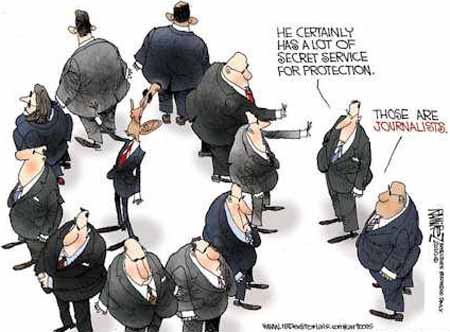
President Obama takes the cake in complaining about the failure of the media to hold politicians accountable.

mediareality

After all, his administration has done all it can to stonewall and deceive the media.

On Monday, he made extensive remarks at a Washington, D.C. event for the Toner Prize for Excellence in Political Reporting about the responsibilities of journalists. His comments, given his record of trying to thwart the media, were remarkable.

“Real people depend on you to uncover the truth,” he declared. “We should be held accountable…What we’re seeing right now does corrode our democracy and our society. When our elected officials and political campaigns become entirely untethered to reason and facts and analysis, when it doesn’t matter what is true and what’s not, that makes it all but impossible for us to make decisions on behalf of future generations.”

“The electorate… would be better served if billions of dollars in free media came with serious accountability, especially when the politicians issue unworkable plans or make promises that they can’t keep,” Obama said. “And there are reporters here who know they can’t keep them… When people put their faith in someone who can’t possibly deliver on his or her promises, that only breeds more cynicism. ”

Though he may well have intended his remarks to be a dig at media coverage of Donald Trump, Obama was a very strange messenger given his misstatements and resistance to media oversight.

After all, it was Obama who made the infamous comment about his Affordable Care Act: “If you like the plan you have, you can keep it.  If you like the doctor you have, you can keep your doctor, too.  The only change you’ll see are falling costs as our reforms take hold.”

And it’s under the Obama administration that the government has set a dismal record of failing to provide information in response to Freedom of Information Act (FOIA) requests, many from journalists. People who have asked for records under the law received censored files or nothing in 77 percent of requests, a record, according to an Associated Press investigation.

In some FOIA cases, usually after news organizations filed expensive federal lawsuits, the Obama administration found tens of thousands of pages after it previously said it couldn’t find any, the AP said. The website Gawker, for example, sued the State Department in 2015 when it said it couldn’t find any emails an aide to Hillary Clinton and former deputy assistant secretary of state, had sent to reporters. It was only after the lawsuit was filed that the State Department found 90,000 documents about correspondence between the aide and reporters.

Since Obama became president, his administration has pursued an aggressive war against whistleblowers and leakers to the media, with more prosecutions under the 1917 Espionage Act than under all previous presidents combined.

And to top it all off, Obama proudly proclaimed in his Toner Prize remarks, “…something I’m really proud of is the fact that, if you go back and see what I said in 2007 and you see what I did, they match up,” a comment that, for some unexplainable reason, was met with applause by the fawning media in attendance.

Were they not aware of all the broken promises documented on the Pulitzer Prize winning Politifact.

Maybe not. Maybe the mainstream media have been too busy serving as cheerleaders or protectors of the administration.

obama-protected-by-the-media


Even the Washington Post story about his remarks at the Toner event , written by a reporter who covers the White House, was little more than a 510 word press release relaying Obama’s speech verbatim, devoid of any context.

Maybe they were busy writing impactful stories about the Kardashians, or a man dressed as a shark in Katy Perry’s Super Bowl half-time performance, or a 1000 word story about a campaign worker manhandling a Breitbart reporter at a Donald Trump event.


J’accuse …! Hillary’s misdirected Flint indictments

For Hillary, it’s simple enough. Blame the whole Flint water fiasco on Republican Governor Rick Snyder and environmental racism.

clintonflint1

Hillary’s not interested in dealing with facts or educating the public. Her goal is to harness public anger to her political advantage.

But in doing so, Hillary’s been fundamentally dishonest.

Consider:

  • In the spring of 2014, it wasn’t the governor, but Flint’s Emergency Manager, who decided to switch the city’s water supply from the Detroit water system’s Lake Huron water to the Flint River.
  • Although the Detroit water supply contained a low-cost corrosion inhibitor preventing lead from household pipes from contaminating the water, no inhibitor was added to the Flint River water. This sin of omission was committed by some water management worker(s), not the Emergency Manager or Gov. Snyder.
  • It was in response to a request from Lee Anne Walters, a Flint mother who had determined her child had lead poisoning, that the initial testing took place. Walters appealed to a Virginia Tech University team led by Prof. Marc Edwards to sample and test the water at her home.
  • The team found lead levels that on average contained over 2,000 parts per billion (ppb) of lead—more than 130 times the EPA’s maximum allowable limit of 15 ppb.
  • The Virginia Tech team gave the results, which showed high lead levels, to a Region 5 EPA employee, Miguel Del Toral.
  • Del Toral identified potential problems with Flint’s drinking water. In June 2015, he sent upstairs an internal memo summarizing the looming lead contamination problem, noting that Flint residents were not being protected by federal law.
  • Region 5 of the EPA, in the face of this potentially devastating water quality news, took no action and did not notify Flint residents. EPA Region 5 Administrator Susan Hedman told The Detroit News she sought a legal opinion on whether the EPA could force action, but it wasn’t completed until November.
  • But meanwhile, at the request of some Flint residents, the Va. Tech team did a more comprehensive analysis of water samples in the city and found sky-high level of lead contamination.
  • Still, as late as July 2015, after Miguel Del Toral’s memo was leaked by the American Civil Liberties Union, it was Brad Wurfel, a spokesman for Michigan’s Department of Environmental Quality, not Gov. Snyder, who brushed off the memo and assured Flint residents all was safe. “…anyone who is concerned about lead in the drinking water in Flint can relax,” Wurfel said. “It does not look like there is any broad problem with the water supply freeing up lead as it goes to homes.”
  • Rick Snyder declared a state of emergency for Flint and Genesee County in January 2016 as a result of the contaminated drinking water crisis.

“It just makes me so angry that we as a society have spent the money and passed laws that say we want clean water,” Virginia Tech’s Prof. Edwards said in a Feb. 29, 2016 CNN interview. “We have civil servants out there who are supposed to be protecting us and the laws are not being followed. None of us are safe in this country until we get an Environmental Protection Agency, state primacy agencies and water utilities committed to following existing laws.”

So how about telling the truth for a change, Hillary.


Hillary and The Donald: Self-inflicted wounds

With Super Tuesday voting and other primaries and caucuses behind us, Donald Trump and Hillary Clinton are the clear leaders in the Republican and Democratic races for their party’s presidential nominations.

But they are both damaged candidates and the parties have only themselves to blame for their success.

166747_600-2

Democrats have known for years that Hillary would be a seriously flawed candidate.

 “She has always been awkward and uninspiring on the stump,” a senior Democratic consultant once told the Washington Post. “Hillary has Bill’s baggage and now her own as secretary of state — without Bill’s personality, eloquence or warmth.”

 While her damaging e-mail scandal may be relatively new, Hillary has been associated with decades of personal and political contretemps, leading to a clear case of Clinton fatigue among the populace.

Equally troubling to the Democratic Party should be Hillary’s trust gap.

In a July 2015 Quinnipiac University national poll, 57 percent of respondents said Clinton is not honest and trustworthy, one of the worst scores among all the top candidates at the time. And her scores have gotten worse. In a subsequent Quinnipiac poll, 61 percent of respondents said Clinton is not honest and trustworthy.

In an August 2015 Quinnipiac University poll, “liar” was the first word that came to mind more than others in an open-ended question when voters were asked what they think of Clinton, followed by “dishonest” and “untrustworthy”. (“Arrogant” was the first word that came to mind for Trump, but that doesn’t seem quite as toxic)

In January 2016, a poll produced for ABC by Langer Research Associates put Hillary 12 points behind Bernie Sanders, 48-36 percent, in being seen as more honest and trustworthy, a deterioration from 6 points behind in Dec. 2015 and equal to Sanders in October 2015.

But Hillary’s problems as a candidate go even deeper.

“Voters see her as an extraordinarily cynical, power-hungry insider,” James Poulos said in The Week on Feb. 2. “She is out for herself, not out for Americans. Voters know it.”

This ties in with a long-held and widespread perception that Hillary and her family are just plain greedy, what with them hauling off $190,000 worth of china, flatware, rugs, televisions, sofas and other gifts when they moved out of the White House, taking money from all sorts of unsavory people and foreign countries for their Foundation, and charging exorbitant amounts for speeches.

David Axelrod, a political consultant who helped steer Obama to the presidency, noted in his book, “Believer”, that Hillary has two other main weaknesses: she’s a polarizing rather than a “healing figure,” and she has a hard time selling herself as the “candidate of the future” given her checkered past and long political resume.

And then, as Josh Kraushaar wrote in The Atlantic before Jeb Bush dropped out, “…pundits and donors alike are vastly overrating the prospects of two brand-name candidates for 2016 — Hillary Clinton and Jeb Bush — and undervaluing the reality that the current political environment is as toxic as it’s ever been for lifelong politicians.”

Then there’s Trump

That, of course, takes us to Donald Trump, the Republican Party’s “Nightmare on Park Avenue.”

Isolated in their cocoons, party officials (and the political press) assumed an establishment candidate would emerge the victor. They denied to themselves and others for months that Trump would be a viable candidate for the Republican nomination.

Nobody was more smug in this assumption then Jeb!

He started early, rebuilding political connections, building a professional staff and laying the groundwork for a “shock and awe” fundraising blitz. But he faltered early and never regained his balance. He watched helplessly as his fund-raising advantage become a disadvantage, defining him as the establishment favorite when the Republican base was looking for a change agent.

Political leaders also overestimated voters’ desire for solid, traditional, steady candidates and too quickly dismissed Trump as a long-term threat. “Reality TV will gather a lot of interest and a lot of people enjoyed the celebrity of that, but for the last 14 years, I’ve had to live in the real world and deal with real world issues and come up with real world solutions,” former Texas Gov. Rick Perry said in mid-2015. “And that’s what the people I think of this country want out of the next president of the United States.”

Meanwhile, confident that Trump’s bombast, misstatements and insults would doom him, Republican Party leaders watched incredulously as he rolled over establishment candidates.

“Until recently, the narrative of stories like this has been predictable,” Matt Taibbi wrote in Rolling Stone. “If a candidate said something nuts, or seemingly not true, an army of humorless journalists quickly dug up all the facts, and the candidate ultimately was either vindicated, apologized, or suffered terrible agonies… That dynamic has broken down this election season. Politicians are quickly learning that they can say just about anything and get away with it.”

As Karen Tumulty wrote in the Washington Post, “Will Trump eventually cross a line — or do the lines no longer exist?”

The make-up and size of the Republican candidate field also has worked to Trump’s advantage.

There’s no love lost, for example, between most members of Congress and Ted Cruz. And with so many Republican candidates (17 at one point), voter preferences were atomized for too long and even now none of the remaining candidates are willing to drop out, preventing the emergence of a single challenger to Trump.

So here we are, facing the possibility of a Clinton-Trump election.

Just goes to show that Clarence Darrow was right. “When I was a boy I was told that anybody could become President; I’m beginning to believe it,” he said.


Wall St: embedded like a tick in politics

For all the talk about Hillary Clinton’s ties to Wall Street, she’s hardly the only presidential candidate Wall Street is investing in.

No matter who wins the Democratic and Republican nominations and the November election, the securities and investment industry will be embedded like a tick in Washington.

occupy-wall-street-political-cartoon-lobbyistsThe industry is one of the top interest groups supporting members of the 113th Congress so far during the 2015-2016 election cycle, with $157,708,874 in contributions that have been spread on both sides of the aisle like honey.

For example, the campaign committee and leadership PAC of Sen. Chuck Schumer (D-NY) have taken in $2,244,256 while the campaign committee and leadership PAC of Sen. Rob Portman (R-OH) have collected $1,342,094.

In 2015, the securities and investment industry contributed $102 million to all the candidates and their super PACs, according to the Center for Responsive Politics. In fact, the industry led all industries tracked by the Center in terms of contributions.

This continues a pattern begun in the 2012 election cycle when the securities and investment industry became the single largest source of political contributions. In that cycle, the industry was responsible for $283 million in contributions, most of it coming from individuals who work in the industries, rather than corporate PACs, according to the Center.

Considering just the current candidates, the industry was the top donor to Clinton ($17.2 million) and Rubio ($9.9 million) in 2015 when their campaign committees and super PACs are combined. In addition, the industry’s contributions represented a significant share of total contributions to Cruz ($12.2 million).

The industry was no slouch in supporting some of the candidates who have dropped out either. Ron Paul took in $4.3 million and Fiorina $2.8 million from the industry, though the industry poured the most money down the drain with Bush, contributing $34 million to his campaign.

So don’t count on popular angst about Wall Street’s role translating into diminished influence for Wall Street after the 2016 presidential election.

Just sayin’.