Trump’s Immigrant Solution: Manzanar Redux?

During World War II, President Roosevelt authorized the military to forcibly relocate people of Japanese ancestry from the West Coast to inland camps. 
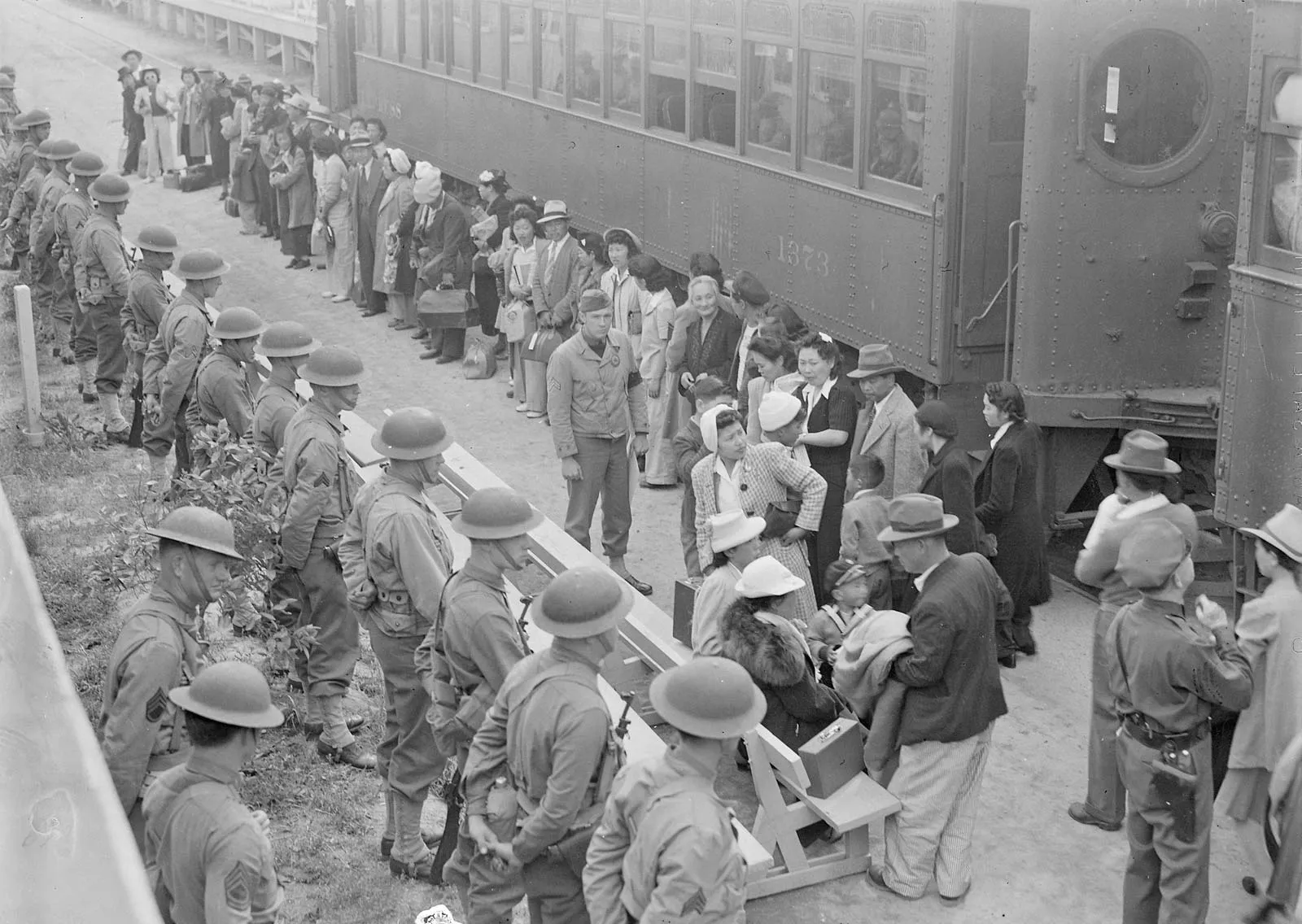
Manzanar War Relocation Center near Lone Pine, Calif.; it operated from March 1942 to Nov. 1945. Some 10,000 people were confined there during this time. Resistance to the incarceration at Manzanar soon led to a prison uprising that the Army put down by shooting 11 prisoners, killing two.

In April 1942, officials posted Civil Exclusion Orders No. 25 and No. 26 on telephone poles and store windows throughout Multnomah County. A few weeks later, Civilian Exclusion Order No. 49 was posted in Hood River. The orders gave Japanese-Americans only a few days to put their affairs in order before they had to report for evacuation.

On May 5, 1942, Japanese-Americans in Military Area No. 1 reported to the Portland  Assembly Center, leaving their pets, possessions, and lives behind. The center—built on the site of the Pacific International Livestock Exposition—was surrounded by barbed wire, watchtowers, and military guards armed with machine guns. The center had a peak population of 3,676.

Those living in Military Area No 2, including the Japanese Americans in Hood River, were sent by train to the Pinedale Assembly Center in California’s San Joaquin Valley, a temporary location until later transfer to permanent internment camps. 

Now President-elect Trump and his coterie of illegal immigration hardliners want to use the military again and put arrested immigrants in the country illegally in camps run by the Homeland Security Department. 

Will he follow through with his threats?  Count on it.

“Trump 1.0 was a test for the system, but it was also a trial for an inexperienced leader who had the inclination of a wrecking ball but often lacked the capacity or the cadres to follow through,” Susan B. Glasser wrote in the Nov. 21 New Yorker.  “Trump 2.0 is about an all-out attack on that system by a leader who fears neither Congress nor the courts nor the voters whom he will never have to face again.”

During the Republican primary campaign, The New York Times reported that  Trump’s top immigration policy adviser, Stephen Miller, said military funds would be used to build “vast holding facilities that would function as staging )enters” for immigrants as their cases progressed and they waited to be flown to other countries.

 Earlier this month, Tom Fitton, who runs a conservative group, Judicial Watch, wrote that Trump’s administration would “declare a national emergency and will use military assets” to address illegal immigration “through a mass deportation program.”  Trump responded on his social media platform, Truth Social, reposting Mr. Fitton’s post with the comment, “TRUE!!!”

On Monday, Trump confirmed that he planned to declare a national emergency to carry out his promise to use the military in his mass deportations. 

Trump has also threatened to use the Alien Enemies Act of 1798 – which allows presidents to deport citizens of an “enemy nation” without the typical proceedings – as part of his mass deportation plans. 

Thomas Homan, a contributor to the Heritage Foundation’s controversial Project 25 and Trump’s proposed Border Czar, told Fox Business Network, “They’ll be used to do non-enforcement duties such as transportation, whether it’s on ground or air, infrastructure, building, intelligence.” Horman has also said transportation and supply assets from the Department of Defense, including military planes, could be used.  

Stephen Miller, Trump’s incoming deputy chief of staff for policy, has also floated the idea of “deputising” the National Guard  to carry out large-scale raids and detentions. The military could also be dispatched to the southern border with “an impedance and denial mission,” Miller has said. 

“You reassert the fundamental constitutional principle that you don’t have the right to enter into our sovereign territory, to even request an asylum claim,” Miller said  at the Conservative Political Action Conference  (CPAC) earlier this year. “The military has the right to establish a fortress position on the border to say no one can cross here at all.”

No matter how Trump plans to use the military, the move is likely to bring an avalanche of legal challenges.

Aaron Reichlin-Melnick, a senior fellow at the American Immigration Council, said on Monday that under US law, presidents may declare a national emergency and exert emergency powers only in specific situations. “And ‘use the military for deportations’ isn’t one of those specific things,” Reichlin-Melnick wrote on social media.

Anthony D. Romero, executive director of the American Civil Liberties Union, issued the following statement: on Nov. 18:

“We are crystal clear that the next Trump administration will do everything in its power to make mass deportation raids a reality. As we ready litigation and create firewalls for freedom across blue states, we must also sound the alarm that what’s on the horizon will change the very nature of American life for tens of millions of Americans.”

In 1983, the bipartisan Commission on Wartime Relocation and Internment of Civilians reported that the internment program was a “grave injustice” driven by “race prejudice, war hysteria and a failure of political leadership.” In 1988, President Ronald Reagan signed the Civil Liberties Act, which offered a formal apology to surviving victims.

It’s hard to believe all this current Trump-inspired turmoil is what the 76,744,608 people who voted for Trump this time around wanted.

Correcting history: no more good guys (or girls)

In the face of student protests, Princeton University has decided that while it will retain Woodrow Wilson’s name on the Woodrow Wilson School of Public and International Affairs, it will be transparent about Wilson’s “failings and shortcomings”. A special Woodrow Wilson legacy committee of the Princeton Board of Trustees called for the University “to acknowledge that Wilson held and acted on racist views”.

Some students, under the banner of a Black Justice League, had demanded that Princeton remove Wilson’s name from the school because of his clear racism during his academic and political careers.

So now that we’re on the path of publicly highlighting not just the achievements, but also the warts-and-all failings, of Americans in the context of current thinking, I offer the following new text to accompany all monuments, displays, etc. intended to honor some prominent people.

Thomas Woodrow Wilson

woodrowWilson

Wilson (1856-1924) served honorably as President of Princeton University and as the 28th President of the United States (1913-1921) After WWI, he tried to build an enduring peace through creation of the League of Nations. He was also a leader of the Progressive Movement. In 1918 he endorsed the 19th Amendment whose ratification provided all women the right to vote by its ratification in 1920.

P.S. Arguing that segregation lessened “friction” between the races, Wilson permitted it throughout the government during his presidency. Though Wilson had initially been friendly to the Russian Revolution, his attitude changed once labor strikes, race riots, and anarchist attacks broke out across the United States in 1919. In response, Wilson’s attorney general deported left-wing activists, raided political groups, and arrested thousands. In the words of one historian, Wilson’s “legacy of repression lasted for decades”; his administration’s violation of civil liberties served as a precedent for McCarthyism in the 1950s.

In short, Wilson was a sleazeball.

Charles Augustus Lindbergh

charles-lindbergh-E

Lindbergh (1902-1974), an American aviator, made the first solo nonstop flight across the Atlantic Ocean on May 20-21, 1927.

P.S. Because of his initial opposition to U.S. entry into WWII, some accused him of being a fascist sympathizer. Also, after his and his wife’s death, it was learned that Lindbergh had maintained three secret families in Europe that included seven out-of-wedlock children borne by three different mothers. So much for the greatness of The Lone Eagle. What a sleazeball.

Franklin Delano Roosevelt

Franklin_Delano_Roosevelt-H

Roosevelt, who assumed the Presidency at the depth of the Great Depression as 32nd President (1933-1945), guided America through one of its greatest domestic crises and helped lead the Allies to victory over Germany and Japan in WWII.

P.S. Roosevelt cheated on his wife, Eleanor, all over the place, most notably with Lucy Mercer (later Rutherfurd), endorsed the internment of thousands of Japanese, Italian and German aliens and U.S. citizens in American internment camps during WWII, tried to “pack” the U.S. Supreme Court to impose his will, and failed to protect millions of Jews from being slaughtered by Hitler’s armies. In short, he was a cheating, power-hungry, civil rights ignoring sleazeball.

Martin Luther King Jr.

martinlutherKing

Dr. Martin Luther King is widely regarded as America’s pre-eminent advocate of nonviolence and one of the greatest nonviolent leaders in world history.

During the years of his leadership of the modern American Civil Rights Movement, African Americans achieved major, genuine progress toward racial equality in America. Dr. King’s “I Have a Dream” speechNobel Peace Prize lecture and “Letter from a Birmingham Jail” are among the most revered orations and writings in the English language.

P.S. King’s critics accused him of an overblown need for adulation and a complex personal life that included a myriad of affairs during his marriage to Loretta Scott King. Dr. Ralph Abernathy, a close associate of King, said in his 1989 autobiography And the Walls Came Tumbling Down that King had a “weakness for women.”Clayborne Carson—who was engaged by King’s widow, Coretta Scott King, to compile a collection of her husband’s writings—said extensive portions of the dissertation King prepared for his Ph.D. in theology from Boston University, “A Comparison of the Conception of God in the Thinking of Paul Tillich and Henry Nelson Wieman,” was plagiarized. In summary, King was actually a sleazeball.

Suzie Baldwin

SuzieQ

Baldwin, a senior at Princeton University, comes from Lexington, Kentucky and graduated from Eastview Prep School as an AP Scholar with distinction. She was captain of the debate team and earned several awards in regional competitions. She also participated in the National Honor Society and student government. At Princeton, she is pursuing a major in Political Science with a minor in Religion. She is a member of the Varsity Equestrian Team and volunteers at the Eastside Homeless Shelter. After graduation, Baldwin intends to travel in Europe, enter Harvard Law School and then work for the ACLU.

P.S. Baldwin, born in 1996, was raised an only child on a massive estate with a thoroughbred horse farm in Kentucky where she was a spoiled brat. She frequently threw temper tantrums, both in public and at home, hated to hear the word “no”, refused to clean up and put her toys away, expected to be listened to at all times, and frequently interrupted adult conversations. In high school, Baldwin exuded an air of condescension and was widely disliked by teachers for her unwillingness to listen to opposing points of view. At Princeton, she’s a royal pain-in-the-ass in class, where she constantly insists that “the revolution is coming”.  Baldwin is, in essence, a sleazeball.

John Q. Smith

johnQpublic

Smith, born Feb. 4, 1960, has, to all appearances, lived a fairly ordinary and honorable life. Raised in Hillsboro, OR, during his early summers he sold lemonade in front of his home and sent the proceeds to a local homeless shelter. In high school he played quarterback on the football team and participated in the robotics program. He graduated from the University of Oregon with a degree in accounting, after which he went to work for Precision Castparts in Portland. He is married to the former Jamie Lynn Wilkinson and has two children.

P.S. Smith presents a public picture of himself as a normal, stand-up guy.However, as a child he had a habit of shoplifting items at major retailers, in college he bought liquor for underage fraternity brothers and he hid a brief cheat sheet in his shoe when taking his CPA exam. He repeatedly overvalued his old clothes contributions to Goodwill on his tax returns and fudged on his resume.In addition, at an accounting convention in New Orleans in his 30s, he smoked some marijuana and engaged a prostitute (though he thought, at first, that she was just an attractive woman at the hotel bar). In short, beneath his thin veneer of respectability, Smith is a sleazeball.