Gov. Kotek: Don’t Sign The Bill Paying Strikers

Bill to grant striking workers unemployment pay fails final vote in Oregon  Senate - OPB

Sometimes it’s nice to be first.

Oregon is justly proud, for example, that in 1971 it was the first state to pass a bottle bill to address the growing problem of litter from beverage containers and to encourage recycling.  

Other times being first is an abomination. 

That will be the case if Oregon Gov. Kotek signs SB 916, which would award up to ten weeks of unemployment insurance benefits to workers who go on strike.

The Oregon Employment Department (OED) anticipates that the bill would result in an additional $2.1 million of benefit payments in the 2025-27 biennium. Critics of the bill say this doesn’t take into account the likelihood of longer and more frequent strikes if workers can count on some income while striking.

The whole concept of strikes is an assumption that the loss of income for workers and the loss of production by employers will motivate an eventual settlement. SB 916 would change that whole dynamic, putting employers at a disadvantage. Equally egregious, because the Unemployment Insurance Trust Fund is funded through a payroll tax that is paid by employers, Oregon employers would be paying workers not to work.

What makes their strong support for this bill particularly egregious is that it is aimed at benefiting an extremely small portion of the labor force, but a sector that overwhelmingly favors the Democrats in campaign contributions. 

In 2024, just 15.9% of wage and salary workers in Oregon were union members, according to the Bureau of Labor Statistics. Dig deeper and you find that the union membership rate for public sector workers in Oregon, about 51%, is considerably higher. That is consistent across the country, where unionization is about five times higher nationwide in the public sector compared with the private sector.

Supporters of SB 916 often try to bolster their cause by alluding to the fact that New York and New Jersey already allow unemployment benefits to be paid to strikers, but they neglect to mention that both states bar public employees, such as teachers, from striking.

No wonder the bill has drawn across-the-board opposition from businesses and public entities, including already stretched local governments and school districts.

Earlier in the process, two Senate Democrats, Jeff Golden, D-Ashland and Janeen Sollman, D-Hillsboro, showed praiseworthy wisdom in voting against the bill. “Counties, cities and schools are scrambling to just maintain current services,” Sollman said. “Now is not the time to be adding more uncertainty and more expenses.”

Both senators subsequently changed their minds and voted for a scaled back bill, but Sollman’s statement is still valid.  As Senate Minority Leader Daniel Bonham, R-The Dalles, said, “This is bad policy. It’s going to be harmful to our students. It’s going to be harmful to the state.”

Despite the financial strains facing Oregon, and even the likely diversion of kicker money to address forest fires, Gov. Tina Kotek, a Democrat with strong ties to labor, has said she plans to sign the bill.

“I know the argument has been that this will be highly detrimental to our school districts,” Kotek said in a June 9 media availability. “I don’t particularly believe that is an accurate assessment of that bill and at the end of the day I support the right of folks to strike and I believe the way the bill is drafted we will actually see shorter strikes.”

Don’t count on it. 

Pay Striking Workers Unemployment Benefits? No Way!

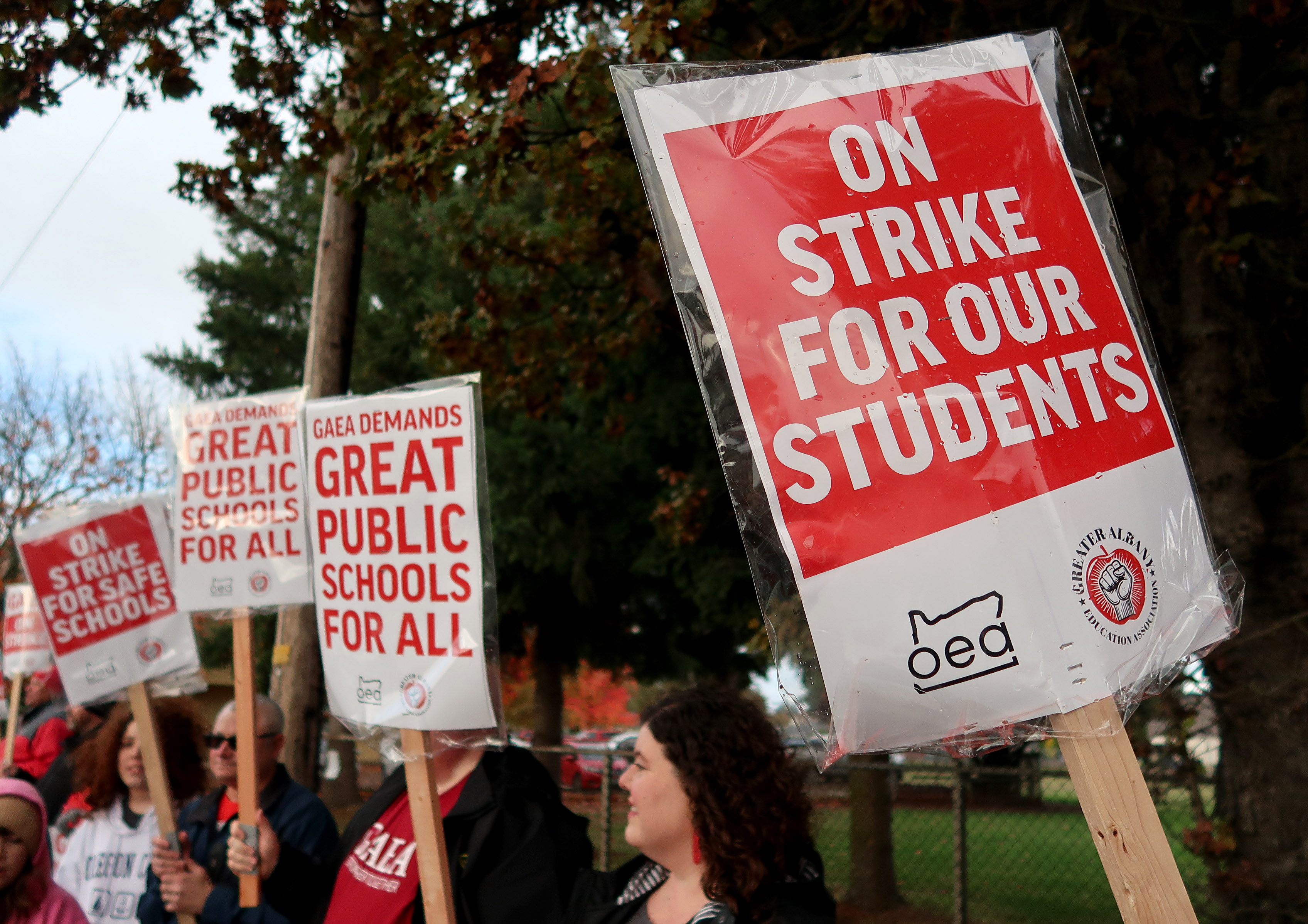
People gathered together for strike

We don’t have enough money for this, we don’t have enough money for that, Oregon legislators moan. And then the Oregon Senate votes for SB 916, a bill to pay striking workers unemployment benefits.

The Oregon Employment Department projects the bill could add $11.2 million in payments to striking workers. The Legislative Revenue Office predicts it could cost $5.6 million in the next two biennia, based on striking activities between 2015 and 2024.

SB 916 would make Oregon the only State in the country to grant unemployment benefits to striking public and private sector workers. Oregonians can be proud of some of the state’s groundbreaking legislation, but this is not one to be praised. 

 Russell Lum, a Political Organizer with the Oregon Nurses Association, said in written testimony to the Senate Committee on Labor and Business, “SB 916 … can bring about fair contracts faster”, but that is unlikely. 

I bet it will cost a lot more as public and private worker unions extend their strikes, safe in the knowledge they will get compensation during their strike.  As Terry Hopkins, the President & CEO of the Grants Pass & Josephine County Chamber of Commerce, said in written testimony to the Senate Committee on Labor and Business, ”By providing UI benefits during strikes, SB 916 could inadvertently incentivize prolonged labor disputes, as the financial pressure to reach a resolution is alleviated for striking workers. This potential for extended disputes not only disrupts the operations of the directly involved businesses but also has ripple effects throughout the supply chain, impacting small businesses that are indirectly connected.”

What makes Democrats’ strong support for this bill particularly egregious is that it is aimed at benefiting unions, an extremely small portion of the labor force, but a sector that overwhelmingly favors the Democrats in campaign contributions.

In 2024, just 15.9% of wage and salary workers in Oregon were union members, according to the Bureau of Labor Statistics. Dig deeper and you find that the union membership rate for public sector workers in Oregon, about 51%, is considerably higher. That is consistent across the country, where unionization is about five times higher nationwide in the public sector compared with the private sector.

The bill has now gone to the Oregon House, where Democrats hold a 36-24 majority. Two Democrats in the Senate showed great wisdom in voting against the bill, Jeff Golden, D-Ashland and Janeen Sollman, D-Hillsboro. “Counties, cities and schools are scrambling to just maintain current services,” Sollman said. “Now is not the time to be adding more uncertainty and more expenses.”

Amen.

Oregon Democrats are going to get your kicker, one way or another

State Senator Jeff Golden wrote an Opinion column in The Oregonian recently calling for diversion of the next kicker, recently forecasted to be $1.8 billion, to a dedicated Wildfire Programs Fund, which the state treasurer would invest.

It’s just one more way for a hungry Democrat-run government to raid your pocketbook. 

The idea came out of a workgroup of 36 stakeholders chosen by Gov. Tina Kotek to deliberate over alternative funding sources for dealing with wildfires. 

The key options identified were:

  • Kicker Funds: One-time use to “jump-start” wildfire funding.
  • Bottle Bill Adjustment: increase the bottle deposit to include a non-refundable portion for wildfire funding.
  • Insurance retaliatory tax – Dedicate a portion of existing retaliatory taxes paid by out-of-state insurers to the State.
  • Ending Balance: Dedicate 0.5% of previous biennium’s appropriations (if there is an ending balance) to the Wildfire Fund. 
  • One time transfer from the Rainy Day Fund (RDF) – directed to wildfire.
  • Lottery Funds – Constitutionally dedicate a portion of lottery funds for wildfire.
  • Landowner assessment rates and existing structure – will be part of the solution. 

The proposal to create a Wildfire Programs Fund “stands out from the others,” Golden wrote.

“Funding for our programs would come not from the $1.8 billion principal—that would be preserved – but rather from the investment interest it earns.,” Golden wrote. “Assuming 5% annual return (a reasonable guess judging by the Treasury’s investment history), the fund would annually generate $90 million – $180 million each biennium – for wildfire programs. While that’s not enough to cover all our needs, it sure looks good relative to the $87 million budgeted in the current two-year cycle.”

The Legislature has fooled around with the kicker before. In 1991 and 1993, budget problems relating to Ballot Measure 5 of 1990 prompted lawmakers to suspend the kicker, withholding $246 million from taxpayers. Then, in 2007, lawmakers succeeded in diverting funds from the corporate kicker to a surplus account called the rainy day fund.

Public resistance to diversion of the kicker has historically been strong. As one current Reddit post says, “The Oregon State government is run as efficiently as an HOA. The kicker policy at least mandates them to return surpluses rather than letting this group of clowns spend it on whatever is fashionable and keeps them in office.”

There’s also long been suspicion that free-spending Democrats will take undue advantage of any relaxation in kicker policy.“This past session, I was approached multiple times by Democrats who wanted to use the kicker for some purpose, and their requests were well over $10 billion,” Senate Minority Leader Tim Knopp, R-Bend, told OPB in 2023. “The reason I haven’t done any of that is, once you open the door, you’re going to spend it all.”

That’s still true. 

Think Eco-Extremism Is Dead? Not In Oregon.

Oregon Democratic State Senator Jeff Golden of Ashland is confused.

Golden is the chief sponsor of a bill, SB 681, that would prohibit the State Treasurer from renewing investments in or making new investments in a private market fund if the managers of the fund have stated an intention to invest in fossil fuels. Joining him as regular sponsors of the bill are seven other Democrats: Senators Lew Frederick, Khanh Pham, Kathleen Taylor; House members Zach Hudson, Lisa Fragala, Mark Gamba, Travis Nelson.

The bill simply makes no sense. 

In relying on environmental criteria, investing is driven by a political agenda, not the best interests of investors.

In addition, the State Treasurer invests in securities that trade in secondary markets. As the Hewlett Foundation’s Kelly Born and Stanford Law professor emeritus Paul Brest have argued, it is virtually impossible for a socially motivated investor to increase the beneficial outputs of a publicly traded corporation by purchasing, or not purchasing, its stock.

Golden’s bill also undermines logic right off the bat when it justifies itself by citing everything but the kitchen sink as justification for the restrictive policy: 

“Whereas in Oregon, more intense forest fires threaten rural communities and disrupt outdoor recreational opportunities and the tourism industry; smoke from these fires threatens our workforce, our elders and our children; severe droughts constrain our important agricultural and nursery industries and imperil our salmon runs; and businesses are forced to spend millions to mitigate the most pressing climate effects rather than investing in future innovation and opportunities.”

Good grief. 

Then, while it prohibits fossil fuel investments on the one hand; on the other hand it cites the requirement that the State Treasurer is required to manage investment portfolios “so as to maximize investment returns and minimize the risk of loss.” You can’t do both at the same time. 

It also ignores the responsibility of the State Treasurer not to do anything that abrogates the treasurer’s fiduciary responsibilities to make available funds “as productive as possible” and “to diversify the investments of the investment funds”.

The Democrats’ bill is just leftist activism parading as socially responsible investing.

Stop it in its tracks.