Gov. Kotek: Don’t Sign The Bill Paying Strikers

Bill to grant striking workers unemployment pay fails final vote in Oregon  Senate - OPB

Sometimes it’s nice to be first.

Oregon is justly proud, for example, that in 1971 it was the first state to pass a bottle bill to address the growing problem of litter from beverage containers and to encourage recycling.  

Other times being first is an abomination. 

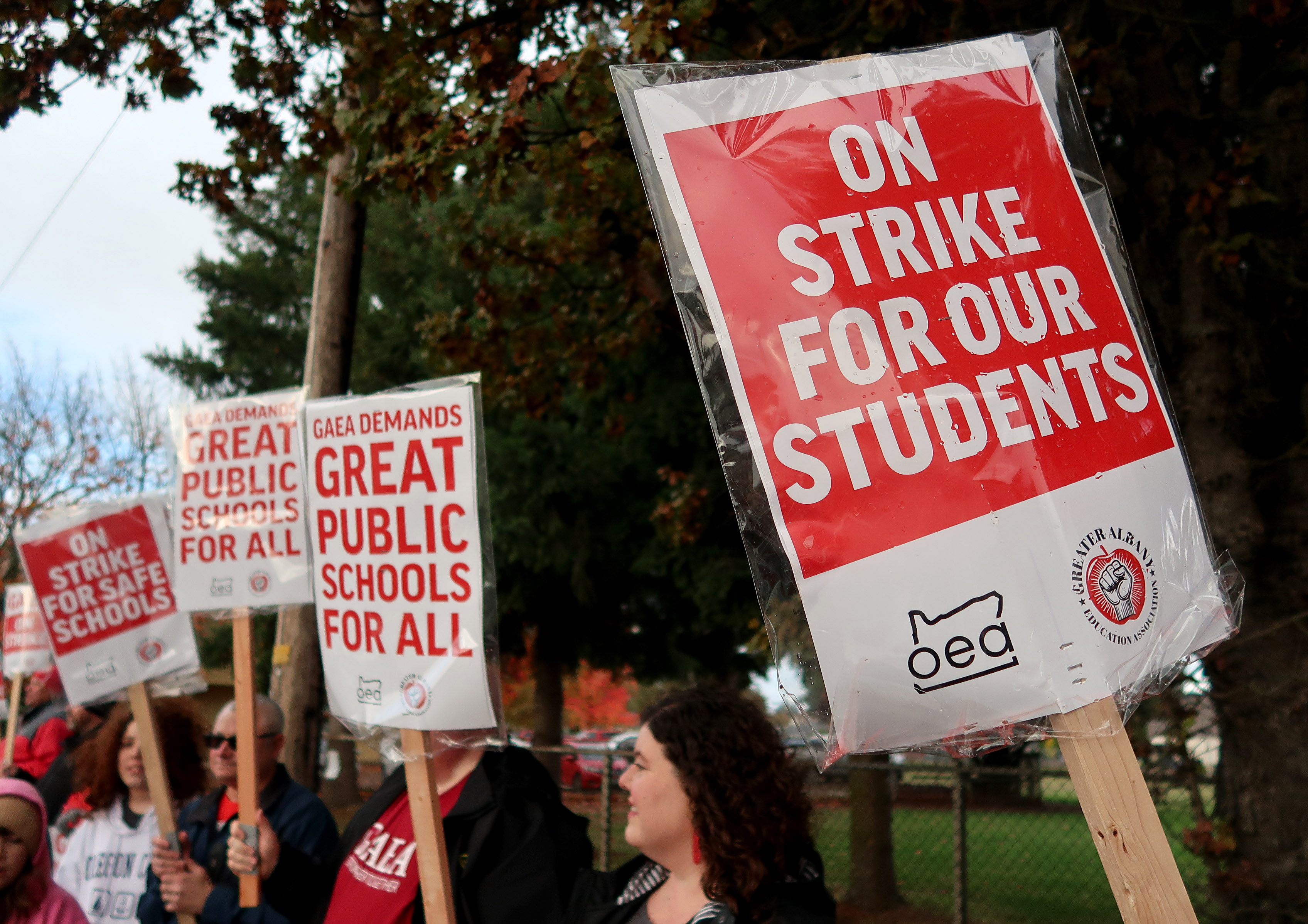
That will be the case if Oregon Gov. Kotek signs SB 916, which would award up to ten weeks of unemployment insurance benefits to workers who go on strike.

The Oregon Employment Department (OED) anticipates that the bill would result in an additional $2.1 million of benefit payments in the 2025-27 biennium. Critics of the bill say this doesn’t take into account the likelihood of longer and more frequent strikes if workers can count on some income while striking.

The whole concept of strikes is an assumption that the loss of income for workers and the loss of production by employers will motivate an eventual settlement. SB 916 would change that whole dynamic, putting employers at a disadvantage. Equally egregious, because the Unemployment Insurance Trust Fund is funded through a payroll tax that is paid by employers, Oregon employers would be paying workers not to work.

What makes their strong support for this bill particularly egregious is that it is aimed at benefiting an extremely small portion of the labor force, but a sector that overwhelmingly favors the Democrats in campaign contributions. 

In 2024, just 15.9% of wage and salary workers in Oregon were union members, according to the Bureau of Labor Statistics. Dig deeper and you find that the union membership rate for public sector workers in Oregon, about 51%, is considerably higher. That is consistent across the country, where unionization is about five times higher nationwide in the public sector compared with the private sector.

Supporters of SB 916 often try to bolster their cause by alluding to the fact that New York and New Jersey already allow unemployment benefits to be paid to strikers, but they neglect to mention that both states bar public employees, such as teachers, from striking.

No wonder the bill has drawn across-the-board opposition from businesses and public entities, including already stretched local governments and school districts.

Earlier in the process, two Senate Democrats, Jeff Golden, D-Ashland and Janeen Sollman, D-Hillsboro, showed praiseworthy wisdom in voting against the bill. “Counties, cities and schools are scrambling to just maintain current services,” Sollman said. “Now is not the time to be adding more uncertainty and more expenses.”

Both senators subsequently changed their minds and voted for a scaled back bill, but Sollman’s statement is still valid.  As Senate Minority Leader Daniel Bonham, R-The Dalles, said, “This is bad policy. It’s going to be harmful to our students. It’s going to be harmful to the state.”

Despite the financial strains facing Oregon, and even the likely diversion of kicker money to address forest fires, Gov. Tina Kotek, a Democrat with strong ties to labor, has said she plans to sign the bill.

“I know the argument has been that this will be highly detrimental to our school districts,” Kotek said in a June 9 media availability. “I don’t particularly believe that is an accurate assessment of that bill and at the end of the day I support the right of folks to strike and I believe the way the bill is drafted we will actually see shorter strikes.”

Don’t count on it. 

Oregon Democrats are going to get your kicker, one way or another

State Senator Jeff Golden wrote an Opinion column in The Oregonian recently calling for diversion of the next kicker, recently forecasted to be $1.8 billion, to a dedicated Wildfire Programs Fund, which the state treasurer would invest.

It’s just one more way for a hungry Democrat-run government to raid your pocketbook. 

The idea came out of a workgroup of 36 stakeholders chosen by Gov. Tina Kotek to deliberate over alternative funding sources for dealing with wildfires. 

The key options identified were:

  • Kicker Funds: One-time use to “jump-start” wildfire funding.
  • Bottle Bill Adjustment: increase the bottle deposit to include a non-refundable portion for wildfire funding.
  • Insurance retaliatory tax – Dedicate a portion of existing retaliatory taxes paid by out-of-state insurers to the State.
  • Ending Balance: Dedicate 0.5% of previous biennium’s appropriations (if there is an ending balance) to the Wildfire Fund. 
  • One time transfer from the Rainy Day Fund (RDF) – directed to wildfire.
  • Lottery Funds – Constitutionally dedicate a portion of lottery funds for wildfire.
  • Landowner assessment rates and existing structure – will be part of the solution. 

The proposal to create a Wildfire Programs Fund “stands out from the others,” Golden wrote.

“Funding for our programs would come not from the $1.8 billion principal—that would be preserved – but rather from the investment interest it earns.,” Golden wrote. “Assuming 5% annual return (a reasonable guess judging by the Treasury’s investment history), the fund would annually generate $90 million – $180 million each biennium – for wildfire programs. While that’s not enough to cover all our needs, it sure looks good relative to the $87 million budgeted in the current two-year cycle.”

The Legislature has fooled around with the kicker before. In 1991 and 1993, budget problems relating to Ballot Measure 5 of 1990 prompted lawmakers to suspend the kicker, withholding $246 million from taxpayers. Then, in 2007, lawmakers succeeded in diverting funds from the corporate kicker to a surplus account called the rainy day fund.

Public resistance to diversion of the kicker has historically been strong. As one current Reddit post says, “The Oregon State government is run as efficiently as an HOA. The kicker policy at least mandates them to return surpluses rather than letting this group of clowns spend it on whatever is fashionable and keeps them in office.”

There’s also long been suspicion that free-spending Democrats will take undue advantage of any relaxation in kicker policy.“This past session, I was approached multiple times by Democrats who wanted to use the kicker for some purpose, and their requests were well over $10 billion,” Senate Minority Leader Tim Knopp, R-Bend, told OPB in 2023. “The reason I haven’t done any of that is, once you open the door, you’re going to spend it all.”

That’s still true. 

Reshaping Oregon’s Kicker: If You Can’t Win the Game, Change the Rules

Like a casino that changes the Blackjack odds by shifting from one hand-held deck to multiple decks critics of Oregon’s kicker law are preparing for a stealth raid on your wallet.

State economist, Carl Riccadonna, hired in August by Gov. Tina Kotek, “has taken it upon himself to get the forecast more in line with reality” KGW reported in November. In other words, to try to minimize (or eliminate) it.

 “I think that the truing up of the calculation under the new chief economist is really going to be helpful to provide stability when we are trying to do budgeting every two years, ” Kotek said in November. 

The Oregon Legislature passed the “Two percent kicker” law in 1979.  It requires the state to refund surplus revenues to taxpayers when actual General Fund revenues exceed the forecast amount by more than two percent. The personal income tax kicker money comes from all state General Fund revenue sources, except for corporate tax revenues. Personal income tax is the largest contributor. In 2000, voters acting on a legislative referral put a large portion of the 2% surplus kicker statute into the state constitution (Article IX, Section 14).

In October 2023, the Oregon Office of Economic Analysis (OEA) confirmed a $5.61 billion revenue surplus in the 2021-2023 biennium, triggering a tax surplus credit, or kicker, for the 2023 tax year. The surplus—the largest in state history[1]—was returned to taxpayers through a credit on their 2023 state personal income tax returns filed in 2024. 

Democrats, never at a loss for ideas on how to spend more government money, in league with unions and liberal special interest groups, are eager to see the kicker refunds throttled.

Because the kicker is in the Oregon Constitution, a ballot measure would need to be referred to the people to get them to surrender their Kicker refund, but don’t put it past the Democrat-dominated legislature to get creative to facilitate higher government spending.

“Oregon’s inaccurate revenue forecasting costs billions needed for critical public services,” said a memo Service Employees International Union Local 503, Oregon’s largest public-sector union, sent recently to Gov. Kotek.

SEIU research director, Daniel Morris, has complained that poor economic forecasting has resulted in too much money going out the door as kicker refunds.  “Over the last five forecasts it’s been embarrassingly bad,” he told OPB. “There are real consequences for the families of Oregon.”

Joe Baessler, interim executive director of  American Federation of State, County and Municipal Employees Council 75, has lambasted the kicker as well. “They’re deciding to under-inflate our revenue,” said Baessler. “It forces budgeting that is not in line with how much revenue is coming into the state and rolls back the amount of money we have for services that Oregonians want.”

The Oregon Center for Public Policy regularly rails against the kicker too. “Oregon’s kicker is a policy that worsens income inequality, racial inequality and geographic inequality,” says the Center. 

With a new state economist committed to forecast reform, Democrats holding a supermajority in the Oregon House and Senate, Tina Kotek serving as governor, and special interest groups salivating over a bigger state budget, the generous kickers of the past are in jeopardy. Count on it. 


[1] Personal Income Kicker History

Two Percent Kicker, Biennia 1979-81 to 2021-23
BienniumTax YearSurplus/Shortfall ($ millions)PercentMean ($)
1979-811981-$141None
1981-831983-$115None
1983-851985$897.70%$80
1985-871987$22116.60%$190
1987-891989$1759.80%$130
1989-911991$186Suspended
1991-931993$60None
1993-951994/5$1636.27%$110
1995-971996/7$43214.37%$290
1997-991998/9$1674.57%$100
1999-012000/1$2546.02%$160
2001-032002/3-$1,249None
2003-052004/5-$401None
2005-072006/7$1,07118.60%$610
2007-092008-$1,113None
2009-112010-$1,050None
2011-132012$124None
2013-152014$4025.60%$210
2015-172016$4645.60%$250
2017-192018$1,68817.17%$910
2019-212020$1,89817.34%$990
2021-232022$5,61944.28%

After adjournment, the deluge

stormcoming

I guess it wasn’t enough for Democrats to allow people in the country illegally to get Oregon driver’s licenses, ignoring voters who soundly rejected the practice in 2014. Oregon’s Democrat-controlled 2019 Legislature also voted to bury Oregonians in a deluge of tax increases.

“Only time will tell whether there will be political consequences for Oregon Democrats who enacted this tax hike, Patrick Gleason, Vice President of State Affairs at Americans for Tax Reform, wrote in Forbes. “What is certain is that Oregon lawmakers are making their state a less attractive place to do business, create jobs, invest, and raise a family, and they are doing so at a time when other states are implementing reforms to make their tax and regulatory climates more welcoming.”

 At the top of the 2019 Legislature’s tax list is the gross receipts tax on sales inside the state’s borders that exceed $1 million, whether or not the business makes a profit. The tax, equivalent to a sales tax, is expected to raise $2 billion per biennium. The legislative revenue office says the tax will hit about 40,000 businesses. This less than three years after almost 60% of Oregon voters rejected Measure 97, a ballot measure that would have imposed a state gross receipts tax. 

Adding insult to injury, the Democrats passed SB 116 setting a particularly inconvenient election date if a tax repeal petition now seeking signatures qualifies for the ballot. Rather than having the vote take place during the general election in 2020, when there’s likely to be high interest and participation, the bill provides for a special election on January 21, 2020.

I guess they figured picking Christmas or New Year’s Day for the vote would be too obvious an attempt at manipulation.

Paid Family Leave legislation (HB 2005-B) is going to cost you, too. A 1% payroll tax will fund a paid family leave insurance program (FAMLI) to be administered by the Oregon Employment Department.  The tax will come on top of the business sales tax.

A Revenue Impact statement projected that employers will pay $542.3 million and employees $1,029.6 in 2021-2023. In 2023-2025, employers will pay $ 775.0 million and employees $1,471.5 million.

Then there’s the maneuvering with the kicker.  The collective “kicker” tax rebate Oregonians will likely receive when they file in 2020 is going to be $108 million smaller, thanks to HB 2975, a bill Gov. Kate Brown signed into law in April.

 And don’t forget SB 861, which provides for paying the postage for election ballots. It will cost taxpayers an estimated $1.7 million per election. Gov. Brown pushed for the law, figuring it would increase voter turnout. In a rather bizarre statement, given the widespread availability of stamps, Brown testified that low-income and younger residents don’t always have access to postage stamps.

There’s also HB 2449-B, a 50-cent increase in the emergency communications tax on our phones, which will bring the total to $1.25 per month.

Oregon’s minimum wage law is increasing employer costs, too.

According to the Office of Economic Analysis Department of Administrative Services, the law will result in a slowdown in job growth. “While the impact is small when compared to the size of the Oregon economy, it does result in approximately 40,000 fewer jobs in 2025 than would have been the case absent the legislation,” the office has reported.  “Our office is not predicting outright job losses due to the higher minimum wage; however, we are expecting future growth to be slower as a result.”

And next year, Oregon voters will get a chance to vote on an increase in yet another Oregon tax, this one on tobacco. If approved, the cigarette tax would increase by $2 a pack and E-cigarettes and cigars would be taxed at 65% of their wholesale price.

Whew, what a torrent!

As the humorist Gerald Barzan observed, “Taxation with representation ain’t so hot either.”


Keep The Kicker

KICKERMaldonado-Fiesta-Krebial-e1371927310255

Oregonians learned earlier today that they may be up for another kicker.  And the progressive Oregon Center for Public Policy is already bitching about “lost revenue.”

“Should it come to pass, this unanticipated, automatic tax cut would cost the state about $400 million at a time when Oregon schools and essential services are at risk from budget cuts and suffer from long-term underfunding,” the Center said in an e-mail blast.

“Lost revenue?” “Cost the state?” Give me a break.

It’s not the state’s money. It’s yours. But progressives keep finding reasons to take it away.

In 2015, when an improving economy triggered a “kicker” rebate of about $400 million, State Rep. Tobias Read, D-Beaverton, sponsored a bill that would have diverted half of that $400 million to education and half to the state’s general reserve. Fortunately, Read’s bill didn’t get a committee hearing.

According to The Oregonian, Sen. Alan DeBoer, R-Ashland, plans to introduce a bill to redirect the kicker to K-12 education. If it passes, voters will make the final decision.

Oregonians already made it perfectly clear what they think of this idea. In 2016, Oregon taxpayers were given an opportunity to donate their kicker rebate to the state’s Common School Fund when they filled out their tax forms. Hardly any did. At one point, records showed fewer than one-half of one percent of taxpayers were choosing to do so. Hardly a magnanimous endorsement of the idea.

The state got itself into a real mess with its constant spending increases and ever-expanding pension obligations. Don’t let that be an excuse for ending the kicker.