Layoffs: Are Pamplin’s Former Oregon Outlets Next?

When Mississippi-based Carpenter Media Group announced its acquisition of Oregon’s Pamplin Media Group earlier this month, Todd Carpenter, the company’s chairman was effusive in his commitment to the continuation of quality journalism at Pamplin’s multiple Oregon new sites.[1]

“We are pleased to join this exceptional team of journalists, marketing and newspaper people in Oregon,” Carpenter said. “We share their high standards and business values, understand the importance of delivering high-quality journalism and marketing services to these communities and will work hard to support them in their efforts.”

That commitment may not hold long based on recent Carpenter actions at its Washington news properties.

According to the Seattle Times, Carpenter has just disclosed that it will lay off 62 people at Sound Publishing newspapers in Washington state, including more than half the unionized newsroom employees at the Daily Herald of Everett, WA.,  that it acquired in January. Sound Publishing operates 43 papers in Washington. 

Sound Publishing papers were already thinly staffed, the Seattle Times said, with some employing just a single reporter, so cuts may be into the bone. “To me that doesn’t look like preserving local journalism,” said Kaitlin Gillespie, executive officer of the Pacific Northwest Newspaper Guild, “but what do I know?”

On June 21, the Columbia Journalism Review reported that the Herald published a story describing the owners as having “gutted” the newsroom—but the story then disappeared from the Web, apparently at Carpenter’s request. After editors threatened to walk out, the story was republished with some modifications.

Next up on the acquisition block could be the EO Media Group, that is known to be looking for a buyer. The EO Media Group, formerly known as the East Oregonian Publishing Company, is a newspaper publishing company based in Oregon that publishes 17 newspapers in Oregon and southwest Washington.

The loss of local news across the country has had far reaching implications. “As everyone knows, the internet knocked the industry off its foundations, ” James Bennet,  former editorial page editor at The New York Times, wrote in The Economist in December 2023. “Local newspapers were the proving ground between college campuses and national newsrooms. As they disintegrated, the national news media lost a source of seasoned reporters and many Americans lost a journalism whose truth they could verify with their own eyes.”

Just since 2005, the country has lost one-third of its newspapers and two-thirds of its newspaper journalists. So far in 2023, an average of 2.5 newspapers have closed each week according to a State of Local News Report by Tim Franklin, Senior Associate Dean and John M. Mutz Chair in Local News and Director of the Medill Local News Initiative at Northwestern University.  Most were weekly publications, in areas with few or no other sources for news.

“The underlying infrastructure for producing local news has been weakened by two decades of losses of newsrooms and reporting jobs,” noted an October 2022 report from the Agora Journalism Center at the University of Oregon’s School of Journalism and Communication. “And news organizations today…often sense they are swimming against the tide of economic, technological, political, and cultural changes that threaten the long-term viability of local news production.”


[1] Pamplin news sites include: The Portland Tribune, Lake Oswego Review, West Linn Tidings, Wilsonville Spokesman, The News-Times (Forest Grove and Hillsboro), The Times (Tigard and Tualatin), Beaverton Valley Times, The Outlook (Gresham), Sandy Post, Estacada News, Columbia County Spotlight (Scappoose and St. Helens), The Herald-Pioneer (Canby and Molalla), Woodburn Independent, Newberg Graphic, Madras Pioneer, Central Oregonian (Prineville), Milwaukie Review, Oregon City News, Sherwood Gazette, Southwest Community Connection (Portland), The Bee (Portland), Business Tribune and Your Oregon News.

Could Sale of the Pamplin Media Group Threaten Local News?

The word is Pamplin Media Group, publisher of the Portland Tribune and 23 other local community papers in Oregon, is being shopped around for sale. 

Simultaneously, the Group is closing its Gresham Outlook printing facility and laying off its approximately 20 employees, an indicator of financial stress.

A Portland Tribune story noted earlier this year that the Pamplin Media Group “…has weathered numerous upheavals in the journalism business, three recessions that reduced advertising revenues and the COVID-19 pandemic that reduced revenues even more than the previous recessions.”

With all the bruising changes affecting the local newspaper industry, sale of the group may well lead to another upheaval. 

In early 2023, when Mark Garber handed off the position of president of the Pamplin Media Group to become president emeritus, he commented that when he’d started his newspaper career as a reporter in 1979, “We used manual typewriters and handed our copy to an editor, who marked it up, literally cut and pasted it, and then sent it to a human typesetter.”

The changes in the local newspaper business since those days have been massive, butchering a once robust news ecosystem in the United States.

The loss of local news has had far reaching implications. “As everyone knows, the internet knocked the industry off its foundations, ” James Bennet,  former editorial page editor at The New York Times, wrote in The Economist in mid-December. “Local newspapers were the proving ground between college campuses and national newsrooms. As they disintegrated, the national news media lost a source of seasoned reporters and many Americans lost a journalism whose truth they could verify with their own eyes.”

Just since 2005, the country has lost one-third of its newspapers and two-thirds of its newspaper journalists. So far in 2023, an average of 2.5 newspapers have closed each week according to a State of Local News Report by Tim Franklin, Senior Associate Dean and John M. Mutz Chair in Local News and Director of the Medill Local News Initiative at Northwestern University.  Most were weekly publications, in areas with few or no other sources for news.

“The underlying infrastructure for producing local news has been weakened by two decades of losses of newsrooms and reporting jobs,” noted an October 2022 report from the Agora Journalism Center at the University of Oregon’s School of Journalism and Communication. “And news organizations today…often sense they are swimming against the tide of economic, technological, political, and cultural changes that threaten the long-term viability of local news production.”

In Oregon’s current troubling time, when misinformation is on the rise, the civic damage from a decline in trusted, quality local newspaper coverage can be particularly severe. Even more so when local papers rip more of their content from national news outlets or run stories to satisfy distant corporate owners. “Communities that lack robust local news also tend to experience lower rates of civic engagement, higher rates of polarization and corruption, and a diminished sense of community connection,” the report said.

The recent acquisition of many legendary local newspapers by hedge funds and private equity groups shows what could await the Pamplin Media Group. 

The Register-Guard in Eugene was locally owned until 2018 when it was sold to GateHouse Media Inc.  In 2019, GateHouse Media’s parent company, New Media Investment Group, acquired Gannett, the parent company of USA Today and more than 100 other dailies, creating the largest newspaper company in the country, with the combined company adopting the Gannett name. 

Management of the new company was left to Fortress Investment Group, a private equity firm in New York City. Fortress, which controlled New Media Investment Group, the parent of GateHouse, was owned by SoftBank, a Japanese conglomerate. 

There were about 21,255 employees at Gatehouse and Gannett at the time of the merger; Gatehouse had 10,617, Gannett 10,638. Gannett has since dramatically cut costs, reducing its headcount to 11,200 at the start of 2023.

Over the years, the Register-Guard has suffered right along with Gannett. At the time of its sale to Gatehouse in 2018 the Register-Guard had over 40 employees. Its website currently lists just 3 News reporters, 3 Sports reporters and 1 Multimedia Photo Journalist. Hardly enough for robust local coverage.

The Alden Global Capital hedge fund is another company eviscerating local newspapers. Alden, which owns about 200 publications, including the Chicago Tribune, is the second-largest newspaper publisher in the country, behind Gannett. Alden is perhaps best known for acquiring and then gutting the Denver Post.

In July 2023, Los Angeles billionaire Dr. Patrick Soon-Shiong sold The San Diego Union-Tribune to an affiliate of the MediaNews Group, which is owned by Alden, for an undisclosed amount. The Voice of San Diego called Alden “the most terrifying owner in American journalism” and said the sale put the Union-Tribune “back in the American newspaper doom loop.” 

Word of cutbacks was swift. The same day as the sale announcement, the MediaNews Group sent an email to the paper’s employees saying cutbacks would be needed to “offset the slowdown in revenues as economic headwinds continue to impact the media industry” and informing staff that the new owner would be offering buyouts. If enough employees didn’t take buyouts, the company said it would lay off additional employees. 

As of the end of October 2023, employees estimated that somewhere between 60 and 80 people were left from the 108-person newsroom under Soon-Shiong.

The Voice of San Diego said the sale of the Union-Tribune to Alden put it “back in the American newspaper doom loop.” Let’s hope the sale of Pamplin Media Group doesn’t put its community newspapers in the same place.

It’s not just print newspapers that are dying; their readers are, too.

Cemeteries in Huntersville, NC | Gethsemane Cemetery & Memorial Gardens

Not that long ago, printed newspapers dominated the news landscape and seemed to have a promising future.

In 1940, daily circulation of print newspapers in the U.S. was 41.1 million, according to the Pew Research Center. It was a rare home that didn’t start the day with a newspaper at the breakfast table. At my home in Wallingford, CT, we had two papers delivered daily in the 1940s. In the morning, we got the Meriden Record; In the afternoon we got the New Haven Register. Established about 1812, the Register was one of the oldest continuously published newspapers in the United States.

In the mid-1980’s, weekday print newspaper circulation in the U.S. reached a peak of 63.3 million.  Americans avidly followed stories about events such as the assassination of Indian Prime Minister Indira Gandhi, the introduction of Apple’s original Macintosh personal computer (accompanied by a still heralded Orwellian-themed “1984” TV ad), the agreement between China and the United Kingdom to transfer power in Hong Kong from the UK to China in 1997 and Villanova’s stirring 66-64 upset victory over Georgetown in the NCAA championship. 

Onward and upward, thought media leaders. 

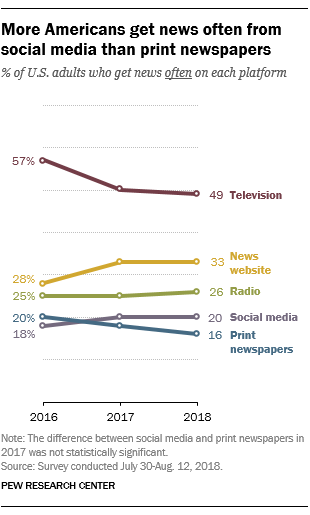
Print newspapers hung in there until the early 2000s. Then the bottom began to fall out. By 2012, daily print circulation was down to 43.4 million. By 2020, Pew Research estimated that print circulation had fallen to just under 24.3 million. What happened? The internet and age.

Print newspaper readers have always tended to be older, more affluent, and more educated. Publishers and advertisers used to like that. The problem is that as those older readers have aged and died, they have not been backfilled by subsequent generations. Instead, younger readers have been gravitating to digital communications channels.

And the shift has accelerated across print platforms where readers have been aging fast.

In a 2012 Pew Research Survey, just 23% of respondents said they read a printed newspaper the previous day. The highest readership, 48% was among those 65 and older. The lowest was those 18-24, at 6%, and 25-29, at 10%.

Pew – where people got news yesterday


The percentages saying they read a printed newspaper yesterday have continued to steadily decline.

A newer May 2021 survey revealed that most consumers never use newspapers as a source of news, and only 25 percent of adults aged 65 or above (those who engage with newspapers the most) reported reading newspapers every day. Meanwhile, even older folks are warming up to online news. Those over 50 are also warming up to the web. In 2016, 32% of the news readers in the 50+ age group expressed a preference for the web. This increased to 43% in a 2019 survey. Newspapers have become even less popular as a news source than radio, and are also among the least used daily news sources among adults aged 18 – 24.

If this young cohort keeps its print avoidance as it ages, print newspapers will eventually lose almost their entire audience.

The biggest threat is probably to local papers with smaller circulation. Papers with a significant number of print subscribers, such as the still profitable Wall Street Journal and The New York Times, are in a better position.

About five years ago, the Journal’s Editor-in-chief, Gerard Baker, was asked by a writer for the Nieman Lab whether he saw a day when there would be no print edition at all.

I don’t really foresee the day when there’s no print edition,” Baker said. ” I mean, who knows — we live in a rapidly changing world. Who can really say anything with conviction about what will be 10, 15, 20 years hence? But as things stand, we have a million print subscribers who really value the print edition of the paper. They really want it. They’re prepared to pay a significant amount of money for what they pay for a print newspaper. There continues to be strong demand for the print product, and we will continue to need to meet that demand. I don’t foresee any other changes in the foreseeable future.”

Notwithstanding this rosy prediction, in Sept. 2017 the paper announced it would stop publishing its European and Asian editions. Falling overseas sales and plunging print advertising revenue in recent years drove the decision, according to the Journal. In Oct. 2020, it took another step away from print, cutting print editions of its fashion and luxury lifestyle insert WSJ. Magazine from a dozen to eight.

Those are the drip drip signs of changing attitudes at the Journal about the viability of print.

Meanwhile, most of the paper’s subscription growth is on the digital side. In 2017, of the paper’s 2.1 million subscribers, 1.08 million were digital. Daily print readership now stands at about 734 thousand copies, while digital subscribers total about 2.7 million.

It’s a similar story at The New York Times. In 2017, the paper had 540,000 daily print and 2.2 million digital subscribers. Daily print readership now stands at about 795,000 copies, while digital subscribers total about 5.7 million.

A friend of mine told me he used to subscribe to the daily print version of the Columbus (Ohio) Dispatch, even after he moved away from Columbus, until he realized he was spending $1000 a year for the subscription. A 12-month digital subscription today is just $119.88.

In all three cases, it costs a lot less to be a digital subscriber, so you have to really love print to go that way. Fewer and fewer people do.

An added note: Covid-19 isn’t helping either. Covid-19’s devastation has hit the elderly the hardest. Of the more then 800,000 Americans who have died from Covid-19, 75% have been 65 or older, according to the Centers for Disease Control and Prevention. That’s the newspaper audience.