
An increasing number of Oregonians and their elected representatives appear to believe that affordable medical care is a right.
But fewer Oregonians seem to worry about paying for it.
Take Medicaid.
Like “The Eggplant That Ate Chicago,” Medicaid is gnawing away at Oregon’s budget.
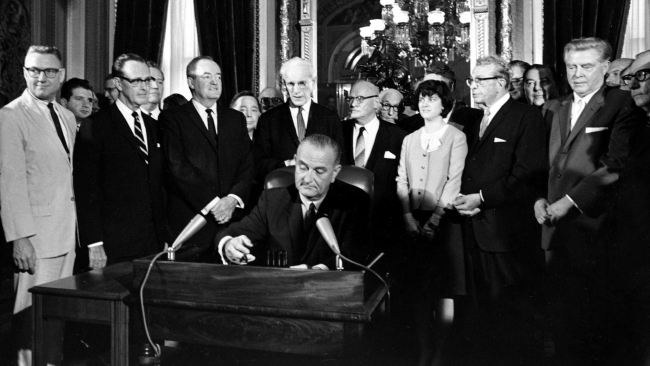
Medicaid was created as a Federal-State funded program by President Lyndon B. Johnson in 1965 as part of his “Great Society” initiative. It was originally intended to be a fairly limited government program to subsidize health care for the poor.
But like so many initially modest government programs, Medicaid has metastasized into what one commentator has called “a budget-gobbling fiscal disaster.” Medicaid is now the third largest domestic program in the federal budget after Medicare and Social Security and, as Pew Charitable Trusts noted in a recent report, Medicaid is now most states’ biggest expense after K-12 education.
Spiraling enrollment is the major reason for the cost jumps.
In the beginning, federal and state Medicaid money allowed states to provide medical care only for single parents and children on welfare. Over time the universe of people eligible for benefits grew to include two-parent families, children with speech and development impediments, people who could be cared for at home rather than in an institution, children up to age 5, 8 and then 18, individuals with mental retardation, pregnant women and so on.
Just since 2000, the number of enrollees nationally has more than doubled, going from 34.5 million to 73.5 million. And because Medicaid is an entitlement program, states have to provide required benefits to eligible enrollees, with the state paying part of the cost. In other words, as more people join the program, it costs more.
Medicaid went into effect on July 1, 1966. Just a few million people enrolled the first year and about $850 million of public money was spent on the program, partly because only 28 states implemented it immediately.
Oregon introduced Medicaid in July 1967. By the end of that year, 37 other states had also implemented their Medicaid programs. In 1982, Arizona became the last state in the nation to implement a Medicaid program.
That same year, the first hints of federal cost concerns surfaced when Congress passed legislation limiting Medicaid eligibility to the “medically needy” whose income was at most 133 1/3 percent of the AFDC income eligibility level in a state. But the program’s explosive growth continued.
By 1973, national enrollment had reached 17 million and total Medicaid spending $9.4 billion. By 2013, Medicaid enrollment was 52.3 million and spending totaled $460 billion. In 2016, Medicaid enrollment reached 72.2 million and Medicaid spending totaled $553.5 billion.
The Centers for Medicare and Medicaid Services’ Office of the Actuary projects national enrollment will reach 77.5 million in 2024.
According to the National Association of State Budget Officers, the run-up in Medicaid costs meant that Medicaid spending accounted for 28.2 percent of total state spending in fiscal 2015, the single largest component of total state expenditures, and 19.7 percent of general fund expenditures. The Association projected that in fiscal 2016, Medicaid spending will come out at 29 percent of total state spending and 20.3 percent of general fund expenditures.
Oregon’s Medicaid spending has also seen explosive budget-busting growth, posing fiscal challenges for the entire government.
The Patient Protection and Affordable Care Act (ACA) called for states to expand Medicaid to low income adults and provides federal funds to cover 100 percent of the costs of the newly eligible people from 2014 through 2016. The federal matching rate was then set to decrease over the next four years to 90 percent in 2020.
When Oregon made the well-intended but ill-conceived commitment to expanding Medicaid under Obamacare, a report commissioned by the state estimated that the Medicaid expansion would cost the state $217 million in the 2017-2019 biennium, the first full two-year budget cycle in which the state would begin shouldering some of the costs. The Oregon Health Authority later revised that to $369 million, about 70 percent more.
In June of this year, the Legislature sent to Gov. Kate Brown a plan to raise $550 million in health care taxes to fund Oregon’s Medicaid program in the 2017-2019 biennium.
The Legislature even went so far as to extend Medicaid to children brought to the United States illegally. Coverage will begin in January 2018, with total enrollment of about 15,000 anticipated.
The Oregon Health Authority has calculated that the fiscal impact of this expansion will be about $36 million during the 2017-19 biennium. Under federal law, illegal immigrants can only receive Medicaid for emergency conditions, including pregnancy-related costs. To get around that, Oregon will pay 100 percent of Medicaid costs for illegal immigrants.
Some people breathed a sigh of relief at the enactment of the Medicaid package, but the solution is temporary and elected officials know it. Escalating costs are only going to get worse, partly because of the scheduled decrease in the percentage of the bill to be covered by the federal government.
Newly eligible Medicaid beneficiaries were fully financed by the federal government for 2014 through 2016, but the federal share will decline until the federal government funds just 90 percent of the costs and the states pick up 10 percent starting in 2020.
That’s going to have a bad enough impact on the state budget, but what happens after that could be even worse. Oregon’s expansion of Medicaid eligibility was considered a no-brainer by supporters because of the 90 percent commitment, but government can be fickle. From a fiscal perspective, it is unrealistic to expect the federal government to continue to pay 90 percent.
Congress could change the state/federal shares at its discretion, a possibility John Kasich, Ohio’s Republican governor, raised on July 19. “…states cannot expect the federal government to continue paying 90 percent of Medicaid expansion costs given our nation’s historic debt; they must accept a gradual return to traditional cost-sharing levels,” Kasich wrote in a New York Times opinion piece.
The federal government has historically provided states with Medicaid funding on a sliding scale based on their per capita income, with more affluent states getting a 50 percent match and poorer states getting up to 83 percent.
If efforts to constrain burdensome Medicaid costs are made again, you can be sure they will be met with overwrought cries of despair. There will also be new accusations like the claim by Sen. Elizabeth Warren (D-MA) that the House GOP’s plan to repeal and replace parts of the Affordable Care Act “…will devastate Americans’ healthcare. Families will go bankrupt. People will die.”
But not tackling the escalating costs of Medicaid will be medical malpractice.
So hold on to your hats, folks. This isn’t over.




 ThinkingOregon