The Pronoun Police Are Patrolling Oregon Schools

The Human Rights Campaign once tweeted that we should all “Begin conversations with “Hi, my pronouns are _____. What are yours?” 

Not so fast, critics have responded.

“Coercing people into publicly stating their pronouns in the name of “inclusion” is a Trojan horse that empowers gender ideology and expands its reach,” said Colin Wright, a fellow at the Manhattan Institute. “It is the thin end of the gender activists’ wedge designed to normalize their worldview. The effort to resist gender ideology is reality’s last stand. We simply can’t ignore fundamental realities of our biology and expect positive outcomes for society. “

The battle is on.

Much of the conflict has arisen in academic settings, including K-12 schools and colleges.

Students at Scripps College in Claremont, CA. have been advised that they can choose which of numerous different pronouns they want professors to use in addressing them.

Pronoun options were:
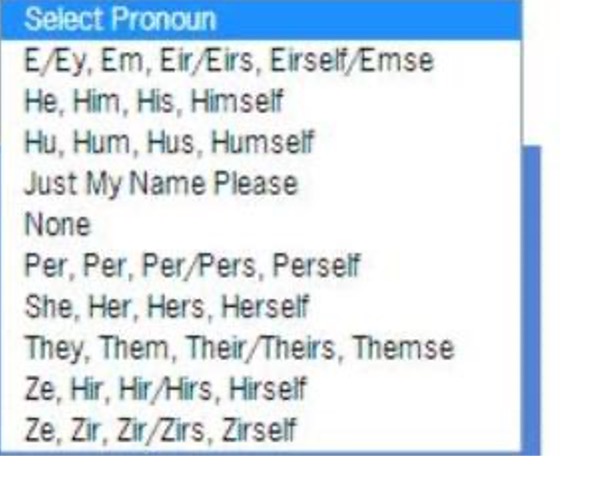
One student said the options were necessary protection from “institutionalized violence.”

Not to be left behind, the State of Oregon has embraced the same pronoun policies, turning appropriate pronoun usage into compelled speech.

In October 2021, Colt Gill, then Director of the Oregon Department of Education, used his Education Update email message to urge Oregonians to “Celebrate International Pronoun Day with ODE.”

“When we collectively share our names and pronouns, we can share the burden of fighting against injustice,” he wrote. “Pronoun sharing within the workplace and throughout school communities is an important opportunity to build trust and connection with transgender, non-binary, two-spirit colleagues, students, friends, and community members.”

Gill told educators:

  • If you are comfortable, share your pronouns when you’re introducing yourself at the start of a meeting: “I’m (Name) and I use she and they pronouns” 
  • Change your Zoom name to include your pronouns, every time: Name, (she/they), ODE 
  • Include pronouns in your ODE email signature 

In January 2023, ODOE issued Supporting Gender Expansive Students: Guidance for Schools. Included in the guidance is the following:

  • Gender expansive students may choose to change the name assigned to them at birth to an asserted name that affirms their gender identity. Gender expansive students may also ask to be referred to by the pronouns that affirm their gender identity.
  • Even if a student does not update their records, they should be referred to by their asserted name and pronouns Intentional or unintentional continuous misgendering of a student by refusing to use their asserted name and pronouns can potentially create a hostile environment. 
  • Schools should engage in student-led support planning for name and pronoun changes. Once the school and student have decided on a supportive action plan, the school should immediately take action to implement the plan.”

The guidance cautioned about disclosing the decisions students make. “To the extent possible, schools should refrain from revealing information about a student’s gender identity, even to parents, caregivers, or other school administrators, without permission from the student.”

When a local news outlet asked ODOE about the policy providing leeway to keep parents in the dark on official school transitions, ODE said this was for a “safety concern.”

On Oct. 19, 2023, the State Board of Education lent its weight to the pronouns dispute, adopting new health K-12 education standards that include:“Demonstrate ways to treat all people with dignity and respect, including people of all genders, gender expressions and gender identities” starting in the 4th grade. 

The new standards will come into full effect in Oregon public schools by the 2025-26 school year. 

Educators and other Oregonians who are less than enthusiastic about the progressive pronoun push may hope the campaign will abate, but it looks like the beatings will continue until morale improves and educators with the courage to challenge the received wisdom of the education establishment will be at risk.

An ever-growing list of pronouns have now become expressions of one’s self-proclaimed identity, a claim that proponents insist everyone must affirm—or else.

Some critics argue that all this is just capitulating to a politically correct, Orwellian effort to validate social progressive doctrines.

Others argue that the controversy is just a way for ideologues to browbeat people, to claim authority over how people speak and to allow language commissars to monitor incorrect speech in schools, workplaces and life.

 Compelling expansive pronoun usage is a dramatic curtailment of freedom of speech, critics assert. As Graham Hillard, managing editor at the James G. Martin Center for Academic Renewal, put it, “When Big Brother arrives in the 21st century, he will appear not on posters but in grammar handbooks, HR manuals, and social media”

In the meantime, how should you navigate the rocky shoals of the pronoun wars without being chastised, harassed, berated and charged with insensitivity?

‘Tis a puzzlement.

Reducing the home mortgage interest deduction: enough with the crocodile tears


homemortgageinterest

A Christie’s International Real Estate warning.

The tax bill just passed by the Senate would let new homeowners continue to claim a deduction for the interest they pay on mortgage debt of up to $1 million. Under the House bill, existing homeowners could continue writing off interest paid on mortgage debt up to $1 million, but new mortgages would be subject to a $500,000 cap.

The House provision would be calamitous, tragic, disastrous, critics argue.

Reducing or eliminating the mortgage interest deduction “will hurt millions of hard-working American families and marginalize homeownership,” said Granger McDonald, Chairman of the National Association of Realtors.

Slicing the home mortgage interest deduction could lead to a housing recession, said Jerry Howard, CEO of the National Association of Home Builders.

Let’s get real here.

The change proposed by the House wouldn’t really mean much to many taxpayers. You have to itemize deductions to claim the deduction on your tax return now. Only about one-third of taxpayers now itemize and only three-quarters of those claim a mortgage interest deduction, according to the Urban-Brookings Tax Policy Center.

But that would change because the tax bill would almost double the standard deduction, from $12,700 to $24,000 for married couples and from $6,350 to $12,000 for single filers. With this change, fewer taxpayers would benefit from the mortgage interest deduction. The Tax Policy Center figures the share of households claiming the home mortgage interest deduction would drop to 4 percent. That’s right. Just 4 percent.

That drop would also reflect the fact that, despite a lot of high cost homes in the Portland Metro Area, it’s pretty easy to buy a home for less than $500,000 in most of the rest of Oregon and the nation.

For example, the median home value is $251,100 in Tillamook, $336,600 in Corvallis and $162,300 in Pendleton.

According to the Mortgage Bankers Association, Americans who applied for a mortgage to buy a home in January 2017 were looking for a loan sized at an average of $309,200. The median home value in the United States is only $203,400, according to Zillow.


State Home Values

NAME MEDIAN Zillow Home Value Index
California $469,300
New York $267,100
Florida $192,600
Illinois $163,100
Texas $159,000
Pennsylvania $155,000


Georgia $149,300
Michigan $126,100
Ohio $122,400

Only 5.4% of all loans originated in 2017 have been for more than $500,000, according to ATTOM Data Solutions. That’s just 325,000 loans, most of which went to the wealthy.

Want to know the median list price by city, state, zip code, and neighborhood? Zillow’s Home Value tool provides that data.

The three states with the highest percentage of home mortgage loans over $500,000 in 2017 have been Washington, D.C. (35.1%), Hawaii (15%) and California (11.5%), followed by Delaware, Massachusetts and Washington state at about 9%.

They’re the ones who would see their ox gored under the House bill, and it’s the members of Congress from these states in the forefront of wanting to preserve the $1 million level.

In Democrat-dominated California, the pain would be noticeable. In the San Jose metropolitan area, 75% of new mortgage loans as of early November 2017 were for more than $500,000 and the median home price was more than $1 million, according to an analysis by CoreLogic Inc. In the San Francisco metro area, 60% of new loans were for more than $500,000.

“I think that harming the ability for Americans to own their home is like attacking motherhood and apple pie,” Rep. Judy Chu (D-Monterey Park), who represents an area that includes Pasadena and much of the San Gabriel Valley, told the Los Angeles Times.

So what the Senate is doing is defending a tax break that mostly benefits a small number of affluent homeowners and distorts the housing market?

The distortion occurs because the tax reduction increases the price of housing. Well-off buyers are willing to pay more because they anticipate deducting their mortgage interest, effectively lowering their monthly house payments.

”… there’s good evidence that cutting back the mortgage-interest deduction would lower prices in high-cost areas, where newcomers find it difficult to move nowadays,” asserts Howard Husock, vice president for research and publications at the Manhattan Institute.

So enough with the weeping and wailing. Reducing the home mortgage interest deduction would be a good thing.

The Democratic debate: Soak the rich. Yeah! that’s the ticket!

Remember how Jon Lovitz, as Tommy Flanagan, the pathological liar on Saturday Night Live, would build a narrative that was a series of lies and say, “Yeah! That’s the ticket!”?

The Democratic debate was like that.

Want something for nothing? When I’m president, you’ll get it: Tuition-free public colleges and universities; free mandatory parental leave, without burdening small businesses; $15 minimum wage with no increase in productivity; enhanced Social Security benefits; Tax cuts for middle-class families; Refinancing of federal college debt at a low interest rate; Government subsidies of Obamacare for people in the United States illegally; move America to 100% renewable energy with federal subsidies.

The Democrats offered up a grab bag of free stuff. How would they pay for it all? Hillary summed up the Democratic Party’s answer. “ I know we can afford it, because we’re going to make the wealthy pay for it,” she proclaimed.

JonLovitzSNL

Yeah! That’s the ticket!

Reminds me of Margaret Thatcher’s observation, “The problem with socialism is that you eventually run out of other people’s money.”

The national debt stands at $18.2 trillion, up from $10.6 trillion when President Obama took office, and it is continuing to increase an average of
 $1.88 billion a day. The debt goes up when the government doesn’t get enough revenue in a given fiscal year to pay its bills. Annual federal deficits have been shrinking lately, but that pattern isn’t expected to last as the budget takes hits in the coming years.

And then, of course, the country already faces problems with covering the huge costs of entitlements such as Social Security and Medicare.

Unless we want to embrace ever-higher deficits, money would need to be found to pay for the cornucopia of benefits the Democrats promise.

Hillary Clinton said not to worry, we’ll get it from higher taxes on the wealthy. “Right now, the wealthy pay too little and the middle class pays too much,” she said in the debate.

Echoing Clinton, Lincoln Chafee chimed in that the rich are doing fine, “so there’s still a lot more money to be had from this top echelon.”

The problem is that the top-earning 1 percent of Americans (earning about $400,000 +), a pretty fluid club of individuals on a year-to-year basis, already pay almost 50 percent of federal income taxes and the top 25 percent pay about 87 percent, making the United States extraordinarily dependent on small slices of the population.

The Congressional Budget Office has calculated that high-income earners receive only pennies in federal benefits for every dollar they pay in federal taxes. In contrast, those in the middle 20 percent of earners received $2.23 in benefits for each dollar they paid and the lowest 20 percent receive close to $20 in federal benefits for every dollar they pay in federal taxes. In other words, the high-income earners are already subsidizing middle-income and low-income Americans.

“Despite the data, accusations that the rich are not paying their fair share continue,” The Manhattan Institute has reported. “This rhetoric is based more on perception than reality, or on a mistaken belief that the government needs more funds to become further entrenched in Americans’ lives. While this rhetoric may work as a populist rallying cry, the data show that a central tenet of the political left’s platform is simply incorrect.”