Trump Pursuing a New Tactic to Build His Presidential Library: Lawsuits.

Meta Platforms has agreed to pay about $25 million to settle a lawsuit Trump brought against the company after the social-media platform suspended his accounts following the attacks on the U.S. Capitol that year.

$22 million of the payment will go toward a fund for Trump’s presidential library,. Meta won’t admit wrongdoing under an agreement Trump signed in the Oval Office on Jan. 29.

This follows a Dec. 14 announcement that ABC News would pay $15 million to settle a defamation lawsuit brought by Trump is discouraging. Even more discouraging, however, is word that under the terms of the settlement ABC News will donate the $15 million to Trump’s future presidential foundation and museum.

And now The New York Times reports many executives at CBS’s parent company, Paramount, believe that settling an absurd $10 billion lawsuit against CBS filed before the Nov. 2024 election would increase the odds that the Trump administration does not block or delay their planned multibillion-dollar merger with Skydance. Trump accused CBS of deceptively editing a “60 Minutes” interview with Vice President Kamala Harris. 

“A settlement would be an extraordinary concession by a major U.S. media company to a sitting president, especially in a case in which there is no evidence that the network got facts wrong or damaged the plaintiff’s reputation,” the Times reported on Jan. 30. 

“We once held the office of president, as well as its occupant, in high regard,” Anthony Clark wrote in The Last Campaign: How Presidents Rewrite History, Run for Posterity, and Enshrine Their Legacies. “As we have lowered our opinions of both, presidential libraries, consequently, have grown larger and more powerful—and, not incidentally, less truthful.” As Clark wrote in Salon, presidential centers tend to be “proud, defensive, and a little self-absorbed” and eventually become theme parks with declining numbers of visitors.

The Donald J. Trump Presidential Library Fund Inc. was incorporated in Florida on Dec. 20, six days after it was revealed that ABC News had agreed to donate the $15 million to Trump’s future presidential foundation and museum.

The Wall Street Journal’s Annie Linskey and Rebecca Ballhaus reported “Serious talks about the suit, which had seen little activity since the fall of 2023, began after Meta Chief Executive Mark Zuckerberg flew to Trump’s Mar-a-Lago club in Florida to dine with him in November, according to the people familiar with the discussions. The dinner was one of several efforts by Zuckerberg and Meta to soften the relationship with Trump and the incoming administration. Meta also donated $1 million to Trump’s inaugural fund. Last year, Trump warned that Zuckerberg could go to prison if he tried to rig the election against him. Toward the end of the November dinner, Trump raised the matter of the lawsuit, the people said. The president signaled that the litigation had to be resolved before Zuckerberg could be ‘brought into the tent,’ one of the people said.”

Knowing Donald Trump’s tendency toward grandiosity, he will likely want a supercalifragilisticexpialidocious billion dollar Presidential Monument. The Washington Post reported back in January 2021 that a top Trump fundraiser said the president had told supporters he wanted to raise $2 billion for his presidential library and museum and thought he could collect it in small-dollar donations from his grass-roots supporters. A satirical website was subsequently created showing the contents of a potential Donald J. Trump Presidential Library, with images of “The Wall of Criminality” and the “Alt Right Auditorium”. 

The way we’re headed, presidential centers will surpass Egypt’s pyramids as monuments to the egos of leaders. But as I’ve observed in previous posts, if Donald Trump goes forward with his museum plans, his  former, current and future advisors may have reason to be concerned. Many of the Egyptian pyramids entombed not only the deceased, but also the deceased’s servants.

Source: Putnam Museum

The New York Times fails to make its case in its latest Trump probe.

I’m no Trump fan, but Sunday’s New York Times article, The Swamp That Trump Built, which major media figures will likely call a “bombshell,” is filled with innuendo but little proof that spending at Trump properties actually buys influence.

The story does document that Trump’s private properties, particularly Mar-a-Lago in Florida, have become favor-seeking cesspools, with individuals, organizations and companies directing business there.  The story also makes it crystal clear that the influence-seeking spending has been lucrative for Trump properties. 

Mar-a-Lago

The story also documents that an awful lot of individuals, groups and companies that patronized a Trump property had business before the administration. 

But The Times went further. It asserted that the favor-seekers got what they wanted for their money, advancing their interests.  

“An investigation by The Times found over 200 companies , special interest groups and foreign governments that patronzed Mr. Trump’s propertieswhile reaping benefits from him and his administration,” The Times reported. “Just 60 customers with interests at stake before the Trump administration brought his family business nearly $12 million during the first two years of his presidency, The Times found. Almost all saw their interests advanced, in some fashion, by Mr. Trump or his government.”

The problem is that in many cases The Times presented no hard evidence that spending by the favor-seekers at Trump properties was directly connected to favorable government decisions. Simply saying that many big spenders at Trump’s properties “saw their interests advanced, in some fashion, by Mr. Trump or his government” is not proof of malfeasance. If that is proof of corruption, all the members of Congress should be in jail.

The story is littered with references to businesses and organizations holding events at Trump properties, implying that they were buying special favors.

The Times reported, for example, that Morgan Stanley paid at least $156,882 to hold a conference at Trump International Hotel in Washington, D.C. in 2017, Deloitte spent at least $347,529 for a conference there in June 2017 and the Food Marketing Institute paid $1.2 million to hold conferences at Trump National Doral Miami in 2018 and 2019. But all three told The Times the events had been booked long in advance. So much for buying influence with the President.

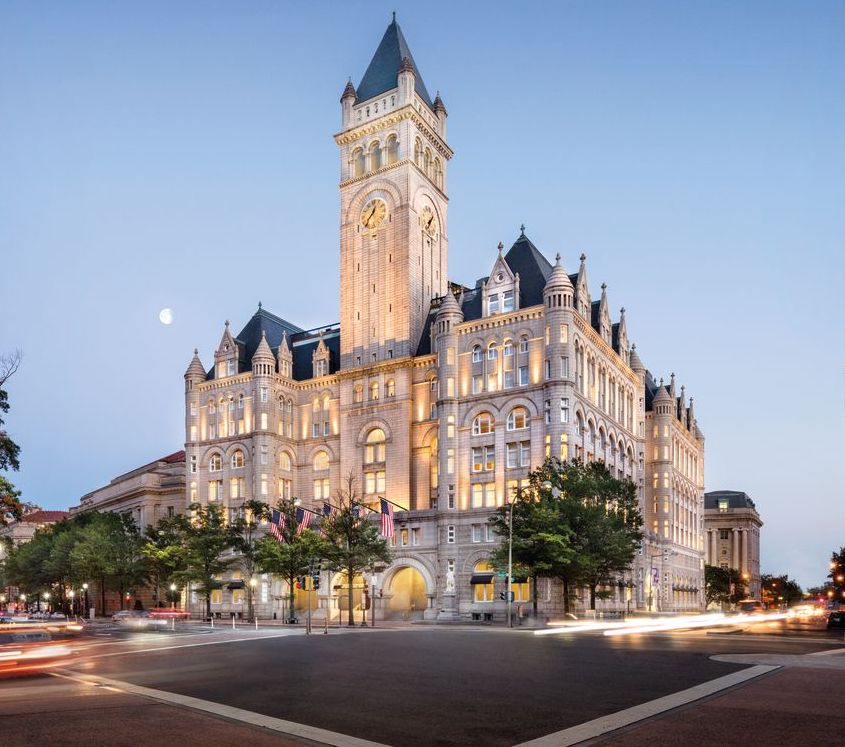
Trump International Hotel Washington, D.C.,

In another case, the Times wrote about a time when a White House meeting of restaurant executives to discuss the pandemic included Tilman Fertitta, a billionaire who had once operated a café in a Trump casino. Fertitta complained that bad publicity had forced him to return millions of dollars in federal aid intended to help strapped small businesses. He asked that the administration create a second fund for the larger private restaurateur. But Treasury Secretary Steven Mnuchin was noncommittal, the Times wrote, and the fund never materialized. I guess that connection didn’t pay off.

Then there’s David Storch, who the Times story suggests was involved in some influence peddling that began at Mar-a-Lago.

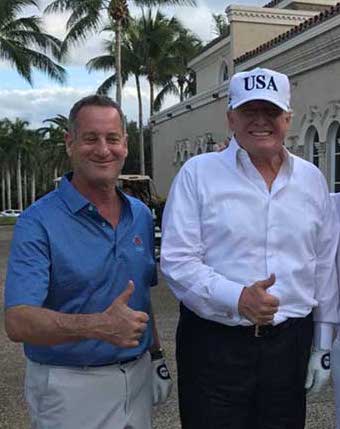
Shortly after Trump’s election, a Mar-a-Lago member invited Storch, an Illinois aviation executive, to a round of golf at the nearby Trump International Golf Club in West Palm Beach. They ran into Trump in the golf club’s dining room and the three ended up playing together. (The Times gratuitously noted that Trump International abuts the Palm Beach County jail)

According to The Times, “In the closing months of the Obama administration, Mr. Storch’s company, AAR Corp., had wrested from a rival a $10 billion contract to service State Department aircraft. The contract was to be the linchpin of AAR’s move into expanded government work. But as Mr. Trump took office, the competitor, DynCorp, was fighting the award in federal court.

DynCorp had a potentially powerful ally in the new president. It was owned by Cerberus Capital Management, whose billionaire co-founder Stephen A. Feinberg had donated generously to Mr. Trump’s election effort. Mr. Feinberg was in talks to take a senior administration role, while DynCorp would soon begin lobbying the administration to rescind AAR’s contract. On Inauguration Day, Mr. Storch took to the new president’s favorite social media platform and tweeted a picture of their (golf) game.”

David Storch (L) with Donald Trump at the Trump International Golf Club

That’s it. That’s all the story said. Did Storch raise the contract issue with Trump during the golf game? Did the golf game lead directly to further contacts between Trump and Storch or his representatives? Did the contact between Storch and Trump play a role in the federal court decision? What was the court’s decision? The Times story didn’t say. 

The Times story also noted  that The FLC Group, a Vietnamese conglomerate with a commercial airline subsidiary, hosted a conference at Trump’s Washington hotel in June 2018, promoting investment opportunities in Vietnam.The story then connected that event to the Federal Aviation Administration certifying eight months later that Vietnamese airlines could fly to the United States. Quite a leap.

Individuals and businesses seeking favors from the U.S. government have been spreading their money around since the American Revolution.

There’ve been cash payments to a Secretary of the Interior for control of federal oil reserves in Wyoming  and bribes in plain envelopes to a vice president in the White House, hidden campaign contributions, donations to non-profits endorsed by a member of Congress, even purchases of advertising on a puny little Texas radio station owned by a president’s wife. 

The Times story shows that the spending by favor-seekers is continuing during the Trump administration, this time in the form of paying for memberships and events at Trump properties, with active encouragement by Trump.

What the over 10,000 word story doesn’t do, however, is provide evidence of a quid pro quo, establish a clear link between all that spending and subsequent favorable government action. In other words, in its zeal to trash Trump it failed to prove its point.