Gilda Radner and the Republicans’ One Big Beautiful Bill

Gilda Radner

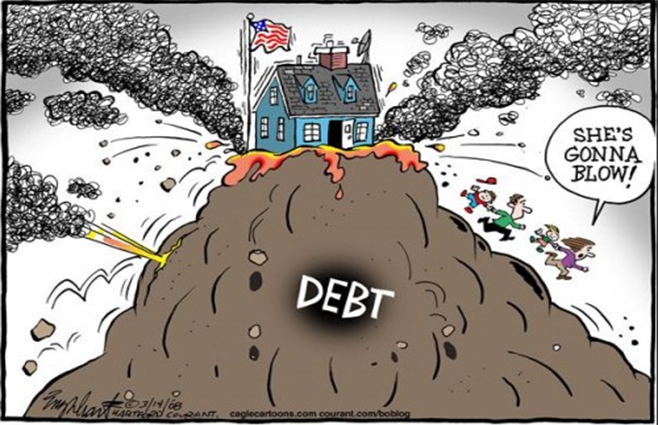
The Senate has passed its version of the Fiscal Year (FY) 2025 reconciliation bill – the One Big Beautiful Bill Act (OBBBA). The Committee for a Responsible Federal Budget estimates the deficit impact , with interest, over the next 10 years will be $4.1 trillion. It would add $5.5 trillion to the nation’s debt if made permanent.

The Committee says the bill is littered with special interest giveaways and new tax and spending entitlements, relies on numerous budget gimmicks, makes the tax code more complicated and less fair and explodes interest costs to nearly $2 trillion per year – including by adding to the debt and pushing up interest rates throughout the economy.

“The Senate took a bill that already borrowed way too much, and took it from bad to worse,” the Committee said. “The Senate expanded the House’s tax breaks, watered down its offsets, introduced new special interest giveaways, and added another trillion dollars onto the price tag.”  

Donald Trump and the Republican Party say the Committee and the Democrats who agree with it are wrong. The White House says the measure will actually cut the deficit by $1.4 trillion. 

According to Factcheck.org, the Senate bill includes $4.5 trillion in tax cuts,  extending lower rates passed in 2017 and adding new tax cuts. But Senate Republicans have taken steps to remove consideration of the 2017 tax cuts in determining the bill’s impact on the deficit. Republican Sen. Bill Hagerty, who was presiding over the Senate in April, ruled that Sen. Lindsey Graham, the Senate Budget Committee chair, had the sole authority to decide whether extending the 2017 tax cuts officially adds to the deficit.

Graham and like-minded Senate Republicans have said that because the tax cuts have been in effect and are “current policy,” they are not new and do not add to future deficits.

The U.S. government announces its annual deficit and national debt each year, and often more frequently, such as monthly. The U.S. Treasury Department provides detailed information on the figures.

The national debt is the total amount of money the U.S. government owes from past and present borrowing, while the deficit is the difference between the government’s spending and revenue in a single year.

The TreasuryDirect website publishes data on the national debt, and the U.S. Treasury Fiscal Data website provides information on both the deficit and the debt. Additionally, the Congressional Budget Office (CBO) releases monthly budget reviews that include the deficit or surplus for that month. 

My question – If the Republicans are right, how are they going to explain the increase in the deficit and national debt that likely will be announced down the road if The One Big Beautiful Bill Act eventually gets Trump’s signature? Hmmm. Tis a conundrum.

Maybe they will just mimic Gilda Radner’s character, Emily Litella, on Saturday Night Live.  When her misguided rants were challenged she just said, “Never mind”? 

Donald J. Trump’s Dec.16, 2024 Press Conference: Falsehoods, Distortion, Fakery and Deceit

“Nuttiness may be subjective, but truthfulness is not”

Bill Scher, Politics Editor, Washington Monthly

On Dec. 16, Donald J. Trump held his first press conference since his Nov. 5, 2024 election. Wishing to be of service to those of you who were too busy or not inclined to tune in, I reviewed the entire deluge of Trump’s rambling thoughts:

  • We had no wars when I left office and now the whole world is blowing up.

Truth: When Trump left office in early 2021, US troops were still deployed in combat missions in Afghanistan and Iraq. About  200,000  US troops were deployed overseas, including 6,000 – 7,000 American troops spread across Africa, with the largest numbers concentrated in the Sahel and the Horn of Africa,  about 50,000 troops at roughly two dozen bases across Japan and about 2,000 Marines in  northern Australia 

  • “Lot of people don’t realize, but we did 571 miles of wall (on the Mexican border).  I built much more than I said I was going to build.”

Truth: Early in his 2016 election campaign, Trump pledged to build a wall along the entire 2000-mile length of the border with Mexico. He later clarified he’d build a wall covering half of that distance. In his State of the Union address in February 2020, he pledged to build “substantially more than 500 miles” by January 2021.

Various types of fencing totaling 654 miles, running through California, Arizona, New Mexico and Texas, were already in place before Trump became president in 2017.  At the end of Trump’s first term, the Trump administration said it completed more than 400 miles of border wall, but only 80 miles of new wall barriers were actually built where there were none before. The vast majority of the construction replaced existing structures at the border that had been built by previous US administrations.

  • “We’re also going to create clean coal. Clean coal is something that has really taken over. …we’re going to be doing a lot of clean coal for the people of West Virginia and others, Wyoming.”

Truth: The idea of “clean coal” is generally considered not viable, as current technology cannot fully mitigate the environmental impacts of burning coal, making it essentially a marketing term with little practical application; while some technologies can reduce emissions, the process remains too expensive and energy-intensive to be considered truly “clean” on a large scale, with many experts stating that “clean coal” is a myth

  • “So we’re looking to save maybe $2 trillion and it’ll have no impact. Actually. It’ll make life better, but it’ll have no impact on people.  We will never cut social security or things like that. It’s just waste, fraud and abuse.” 

Fact: This would certainly run counter to Trump’s actions in his first term, during which he added $8 trillion to the national debt,  despite having promised to run budget surpluses.  The federal government is now burning through $6.8 trillion annually and the Committee for a Responsible Federal Budget says Trump’s proposed policies would add an estimated $7.7 trillion to debt over the next decade. Cutting $2 trillion in one year would be impossible, as well, given that Trump has already said he’s not going to touch Social Security or Medicare., the two largest government programs, and interest payments, which account for 13% of federal spending, can’t be cut either (Unless the government plans to default on the national debt). Discretionary spending accounts for only about 25% of total expenditures, but that includes defense, which Congress has no inclination to cut.

  • We’ll immediately restore the sovereign borders of the United States and stop illegal immigration.”

Truth: Over the past 30 years, the Border Patrol’s budget has grown more than sevenfold, the number of agents stationed along the southwest border has quadrupled, the border wall has been strengthened and lengthened, and increasing amounts of technology have been used to deter illegal migrants, but they have kept coming, more and more of them from countries other than Mexico. Also complicating the situation, a substantial number of the illegal immigrant population in the United States came legally on work visas and stayed after they expired.  The government has been terrible at finding and deporting these people. 

  • “We had no problems, we had no inflation. We had no inflation. We had at less than 1%. A perfect number.”

Truth: The Consumer Price Index rose 7.8% during Trump’s first term. The CPI rose an average of 1.9% each year of the Trump presidency according to the Bureau of Labor Statistics. That was about the same as the average under Obama (1.8%) and below the average of 2.4% during George W. Bush’s years.

  • Trump responding to a question, “Do you believe there’s a connection between vaccines and autism? Do you believe there’s a link?” Trump: We’re looking to find out. …There’s something wrong. And we’re going to find out about it.”

Truth: Many studies have looked at whether there is a relationship between vaccines and Autism Spectrum Disorder (ASD.), but to date, the studies continue to show that vaccines are not associated with ASD, according to the federal Centers for Disease control and Prevention. 

Two studies, referred to as the Wakefield Studies, have frequently been cited by those claiming that the MMR vaccine causes autism. Both studies are considered critically flawed. In the first study, published in 1998, Wakefield’s hypothesis was that the measles, mumps and rubella (MMR) vaccine  caused a series of events that include the development of autism. The study was subsequently retracted; in scientific terms, this means that the paper is not part of the scientific record because it was found to be based on scientific misconduct. In this case, the studies were deemed fraudulent and data misrepresented. The second study, published in 2002, which examined the relationship between measles virus and autism, was also critically flawed. Meanwhile, several studies have been performed that disprove the notion that MMR causes autism.

  •  Trump responding to a question – “Do you think schools should mandate vaccines?” Trump – “I don’t like mandates. I’m not a big mandate person.”

Truth: Mandating vaccinations of schoolchildren saves lives. Schools and broader communities rely on high immunization rates to keep vaccine-preventable diseases from spreading. When more children are immunized, the risk for everybody declines, particularly for people with weakened immune systems and chronic medical conditions like lung, heart, liver, kidney disease or diabetes. The more parents who decline to vaccinate their children, the greater the risk that infection will spread in the community.

  • “Europe doesn’t use pesticides, and yet they have a better mortality rate than we do.”

Truth: Pesticides are still widely used in Europe, with the agricultural sector relying on significant volumes of chemical pesticides to maintain crop yields, although the EU has regulations in place to limit their use and is actively working to reduce pesticide reliance because widespread pesticide use is major source of pollution, according to the European Environment Agency.

  • ” They’re still counting the vote in California.

Truth: California did take longer to count votes in the recent federal elections than other states, but the California Secretary of State had certified the 2024 election results prior to Trump’s news conference.  

  • “We got the biggest tax cuts in history.”

Truth: Trump’s tax cut s in the Tax Cuts and Jobs Act of 2017 was not the largest in history, either in percentage of gross domestic product or in inflation-adjusted dollars.  When the Congressional Budget Office reviewed tax cuts enacted between 1981 and 2023, it found that two other tax cut bills were bigger – former President Ronald Reagan’s 1981 package and legislation signed by former President Barack Obama that extended earlier tax cuts enacted during former President George W. Bush’s administration. Reagan’s 1981 tax cut was the largest in U.S. history, reducing revenues by $19 trillion over a decade. 

  • The US took in hundreds of billions of dollars in tariffs “from China” during Trump’s first term and “no other president took in 10 cents, not 10 cents.”  before he was president.

Truth: First, according to the Peterson Institute for International Economics the revenue from tariffs on Chinese imports come from the importers, not China. Importing businesses pay the tariffs and then have to decide whether to bear some of the costs or pass any portion of the cost on to consumers through higher prices.

Second, according to the Institute, Americans have been paying tariffs on imports from China for decades., going as far back as the late 19th and early 20th centuries and more recently during the Clinton, Bush, and Obama administrations. 

And we’re going to have four more years of this.

Admoniti estis.

The Covid Rescue Act is just a start. Next up: exploding debt.

Before President Biden signed the 630 page $1.9 trillion American Rescue Plan Act of 2021, Democrats focused most of their public messaging on the $1400 checks that would be going out to everybody and their brother (and sister). Who doesn’t like free money, the Democrats figured. After President Biden signed the bill, Democrats shifted some of their messaging to highlighting an expansion of the child tax credit (CTC).

Before the new law, the CTC allowed qualifying families to reduce their income tax bills by up to $2,000 for each child through age 16. The new law increases the credit to $3,000 a child and makes parents of 17-year-olds eligible to for the 2021 tax year. The credit rises to $3,600 for children under the age of 6 as of the end of 2021.

For a qualifying family with one child, the previous credit would have cut a $5,000 tax bill to $3,000. Under the new law, the credit will cut the tax bill to $2,000, and to $1,400 if the child is under age 6. The benefit amount will gradually diminish for single filers earning more than $75,000 per year, or married couples making more than $150,000 a year.

Though framed as an expansion of the current tax credit, it is essentially a guaranteed income for families with children, because it will provide most parents a monthly check of up to $300 per child. That’s because unlike the current program, where the money is distributed annually as a tax reduction or check, the new program will send out monthly checks to provide a more stable cash flow.

Kiplinger illustrated the program by assuming a family of five with three children ages 12, 7 and 5. Assuming the family qualifies for the higher child credit and doesn’t opt out of the advance payments, they could get $800 per month from the IRS from July through December 2021, for a total of $4,800. They would then claim the additional $4,800 in child tax credits when they file their 2021 return next year.

But neither the Democrats nor the media are talking about how much the benefit will cost. You have to be a very aggressive, persistent searcher to find a number. 

According to the Joint Committee on Taxation, the CTC expansion in President Biden’s rescue bill will cost a whopping $110 billion just in 2021. 

But that probably won’t be the final cost because Democrats want to make the new CTC program permanent. Left-leaning groups are already lobbying for permanency. 

“Substantially increasing the CTC on a permanent basis would help secure economic stability for working families, reduce inequality, and sustainably boost economic growth,” says one such organization, the Center for American Progress. “It would be one of the most effective investments we can make as a society.”

Democrats have already introduced bills in the House and Senate to make the CTC changes permanent. 

The Committee for a Responsible Federal Budget figures the ultimate price tag of the $1.9 trillion American Rescue Plan Act could be twice as high if some of the policies in the bill are extended beyond their presumed expiration dates, substantially increasing deficits and debt.

As Jared Bernstein, a top economic advisor to Biden told the Wall Street Journal last month, “When you’re worried about fiscal sustainability, the things that hurt you are not the temporary measures,” Mr. Bernstein said in an interview late last month. “It’s the things that are permanent [and] that aren’t paid for.”

On March 22, 2021, the New York Times reported that President Biden’s advisers were expected to present a proposal to him recommending a series of bills that would propose a $3 trillion economic package. This would be in addition to extension of the so-called temporary tax cuts meant to cut poverty that are already on the books, which could cost an additional billions of dollars. 

Since neither the Democrats nor Republicans seem much concerned about exploding deficits and debt, it’s doubtful that policies in the American Rescue Plan Act that lawmakers decide to make permanent or the cost of the $3 trillion package will be fully offset with tax increases or spending restraint.

“In addition to trying to make permanent some of the temporary provisions in the package, Democrats hope to spend trillions of dollars to upgrade infrastructure, reduce the emissions that drive climate change, reduce the cost of college and child care, expand health coverage and guarantee paid leave and higher wages for workers,” The New York Times reported.

Hang on. It’s going to be a rough, and expensive, ride. 

The Democratic debate: Soak the rich. Yeah! that’s the ticket!

Remember how Jon Lovitz, as Tommy Flanagan, the pathological liar on Saturday Night Live, would build a narrative that was a series of lies and say, “Yeah! That’s the ticket!”?

The Democratic debate was like that.

Want something for nothing? When I’m president, you’ll get it: Tuition-free public colleges and universities; free mandatory parental leave, without burdening small businesses; $15 minimum wage with no increase in productivity; enhanced Social Security benefits; Tax cuts for middle-class families; Refinancing of federal college debt at a low interest rate; Government subsidies of Obamacare for people in the United States illegally; move America to 100% renewable energy with federal subsidies.

The Democrats offered up a grab bag of free stuff. How would they pay for it all? Hillary summed up the Democratic Party’s answer. “ I know we can afford it, because we’re going to make the wealthy pay for it,” she proclaimed.

JonLovitzSNL

Yeah! That’s the ticket!

Reminds me of Margaret Thatcher’s observation, “The problem with socialism is that you eventually run out of other people’s money.”

The national debt stands at $18.2 trillion, up from $10.6 trillion when President Obama took office, and it is continuing to increase an average of
 $1.88 billion a day. The debt goes up when the government doesn’t get enough revenue in a given fiscal year to pay its bills. Annual federal deficits have been shrinking lately, but that pattern isn’t expected to last as the budget takes hits in the coming years.

And then, of course, the country already faces problems with covering the huge costs of entitlements such as Social Security and Medicare.

Unless we want to embrace ever-higher deficits, money would need to be found to pay for the cornucopia of benefits the Democrats promise.

Hillary Clinton said not to worry, we’ll get it from higher taxes on the wealthy. “Right now, the wealthy pay too little and the middle class pays too much,” she said in the debate.

Echoing Clinton, Lincoln Chafee chimed in that the rich are doing fine, “so there’s still a lot more money to be had from this top echelon.”

The problem is that the top-earning 1 percent of Americans (earning about $400,000 +), a pretty fluid club of individuals on a year-to-year basis, already pay almost 50 percent of federal income taxes and the top 25 percent pay about 87 percent, making the United States extraordinarily dependent on small slices of the population.

The Congressional Budget Office has calculated that high-income earners receive only pennies in federal benefits for every dollar they pay in federal taxes. In contrast, those in the middle 20 percent of earners received $2.23 in benefits for each dollar they paid and the lowest 20 percent receive close to $20 in federal benefits for every dollar they pay in federal taxes. In other words, the high-income earners are already subsidizing middle-income and low-income Americans.

“Despite the data, accusations that the rich are not paying their fair share continue,” The Manhattan Institute has reported. “This rhetoric is based more on perception than reality, or on a mistaken belief that the government needs more funds to become further entrenched in Americans’ lives. While this rhetoric may work as a populist rallying cry, the data show that a central tenet of the political left’s platform is simply incorrect.”

Monica Wehby: down for the count

Originally positioned by the Republicans as a smart female political newcomer and seen as a credible challenger to Senator Jeff Merkley (D-OR), Monica Wehby has become a damaged candidate with diminishing changes of success.

“I’m not a politician,” she said in announcing her candidacy in January 2014. So, far, that’s pretty clear. A pediatric neurosurgeon at Randall Children’s Hospital, she has been tripped up almost from day one.

wehby

It’s not as though Merkley should be a particularly strong opponent. Winning the first time by just 49% to 46%, he’s a pretty colorless Senator with one of the most liberal voting records and without any significant legislative accomplishments.

With today being the first day of the federal fiscal year, Merkley can also be fairly targeted as a Senator who has done nothing to effectively deal with the burgeoning national debt, now at $17.5 billion and counting, that is going to burden all our children.

Merkley is also running at a time when the country overall is in a pretty sour mood, with 67 percent of registered voters saying the nation is on the wrong track (NBC/Wall Street Journal) and 57 percent of registered voters nationwide saying it’s time to give a new person a chance in Congress (NBC/Wall Street Journal).

But if the polls are right, that doesn’t seem to matter to enough Oregonians to make Merkley vulnerable.

Instead, Wehby has been left defending herself against such things as charges arising out of opposition research that she harassed a boyfriend and her ex-husband. As Joe Pounder, a veteran GOP researcher, told Politico, “There’s the growing intensity of a media cycle fueled by the salacious and voyeuristic.”

Likely opposition research that generated reports on the website Buzzfeed in September that multiple portions of position documents on Wehby’s website had been plagiarized also has slowed any Wehby momentum.

Despite Wehby’s efforts to position herself as a new choice, and the significant support she’s been getting from independent spending, it’s pretty clear at this point that she hasn’t broken out to capture the hearts, minds and votes of enough Oregonians to win.

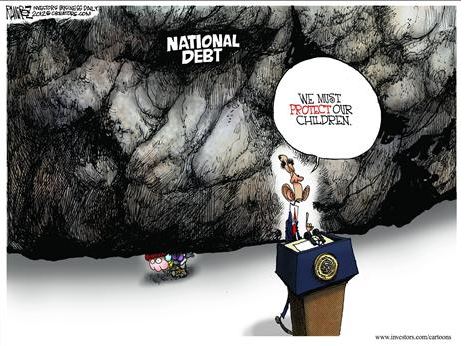
The real war is on our children

Democrats are again pulling out from their rhetorical basement accusations that Republicans are waging a “war on women”. Meanwhile, they’re ignoring another war that’s real, the “war on our children” that government spending addicts are prosecuting.

Our children are going to pay a heavy price for the fiscal insanity that has already led to national debt in excess of $17 billion.

Obama-National-DebtThe increase in our national debt over the past 25 years. years has been mind-boggling. In 1990, it was $3.2 billion, in 2000 $5.7 billion. By 2010 it was $13.6 billion. Now it has leaped to $17.5 billion.

But Democrats, in the spirit of “see no evil”, want to keep the issue under wraps and focus on other things. During a February 2014 House Financial Services Committee hearing, Rep. Maxine Waters (D-CA) and Rep. Keith Ellison (D-MN) even complained about two real-time running national debt clock displays in the hearing room. Ellison said it was just intended to send an ideological message.

Obama says his FY2015 budget proposal is an “opportunity agenda”. Yes, an opportunity for $564 billion more debt, an opportunity to increase total national debt to nearly $25 trillion over the next 10 years and an opportunity to pander to Americans who want it all without paying for it.

As Alabama Sen. Jeff Sessions, the top Republican on the Senate Budget Committee, said, Obama’s budget is a declaration that “deficits don’t matter, debt doesn’t matter, and that reality itself doesn’t matter.”

Some Democrats are arguing that annual deficits are dropping, so we can all back off worrying about the problem.

But the most recent Congressional Budget Office (CBO) budget forecast projects that after a few years of lower deficits they’ll climb again for an indefinite period. In addition, the national debt will increase annually by much more than the amount of the deficit because a considerable amount of federal borrowing is not counted in the budget.

As a result, the CBO projects $7.9 trillion will be added to the nation’s cumulative public debt over the next decade.

That’s because revenue will keep up with economic growth, but spending will grow even more. “Spending is boosted by the aging of the population, the expansion of federal subsidies for health insurance, rising health care costs per beneficiary, and mounting interest costs on federal debt,” the CBO said.

According to the CBO, interest payments will soon become the third largest item in the federal budget, after Social Security and Medicare. Right now, interest on the debt costs $233 billion. CBO projects that interest costs will reach $880 billion by 2024. As interest costs grow, they could crowd out investment in other priorities, including education, research and development, and other programs that could help our economy grow.

Large and growing federal debt that restrains economic growth will give policymakers less flexibility to respond to unexpected challenges, and eventually increase the risk of a fiscal crisis.

A Peter G. Peterson Foundation survey released on March 25, 2014 concluded that 67 percent of people say their concern about the national debt has increased over the past few years and 79 percent say that addressing the national debt should be among the President and Congress’ top 3 priorities.

And yet, Democrats continue to resist deficit-lowering efforts.

Deficit reduction surged as a policy priority during Obama’s first term: Between 2009 and 2013,  the share citing the deficit as a top priority rose 19 points, according to a January 2014 report from the Pew Research Center for the People & the Press. In the most recent 2014 survey, majorities of Republicans (80%) and independents (66%) continued to say reducing the budget deficit should be a top priority for the president and Congress, but just 49% of Democrats viewed it as a top priority, the lowest percentage since Obama took office. Going back 20 years, the gap between Republicans and Democrats on the issue has never been as large as it is today, Pew said.

Not exactly a hopeful sign for the emergence of bipartisan cooperation on the issue.