Resident Tuition at PSU for Native Americans Across The Country: Academic Guilt Run Amok

On April 21, 2022, Portland State University (PSU) announced approval of a 3.6% increase to in-state undergraduate tuition for the 2022-23 academic year. Even this increase will be a cut from current service levels because of projected inflation., noted Vice President of Finance & Administration, Kevin Reynolds. 

Resident undergraduate tuition for the 2022-23 academic year will be $9,000 for students enrolled in 15 credits a quarter for three quarters, according to PSU.

Non-resident undergraduate tuition for the 2022-23 academic year will be $27,900 for students enrolled in 15 credits a quarter for three quarters.

“Tuition is a necessity,” said PSU President Stephen Percy, moaning about limited state support being behind tuition increases. “The state covers less than 35% of our education costs. We strive to be affordable, but we also must meet our obligation to deliver an outstanding experience to our students — in the classroom and outside it. That requires resources and the resource need increases each year.”

So what does PSU do next in the face of the grim realities of its fiscal challenges?

On July 21, it announced that, starting this upcoming fall, students who are members of the country’s nearly 600 federally recognized tribes across the country will receive in-state tuition. 

“Portland State offers this benefit to tribal members as part of our ongoing effort to provide a welcoming environment for Indigenous students in downtown Portland,” Chuck Knepfle, PSU’s vice president of enrollment management, said in a statement. “This offer of in-state tuition is a small way to honor the legacy of Indigenous nations from across the country.”

PSU told Oregon Public Broadcasting (OPB) it is not aware of any other schools  in the United States that have also made the move to offer discounts to Native American students on a national scale. There’s probably a reason for that.

This is nothing more than academic guilt run amok!

Tribal members who are Oregon residents already have access to resident tuition andthe Oregon Tribal Student Grant program that  will provide grants that can be used for tuition and other college-related expenses at colleges and universities by members of Oregon’s nine federally-recognized tribes.

Expanding resident tuition benefits to out-of-state tribal members means foregone revenue for increased services. And despite the tendency of left-leaning idealists to see government benefits as free, Oregonians will have to cover the cost of this new non-resident benefit. 

It’s just more wrong-headed feel-good performative activism, at the expense of Oregon taxpayers.
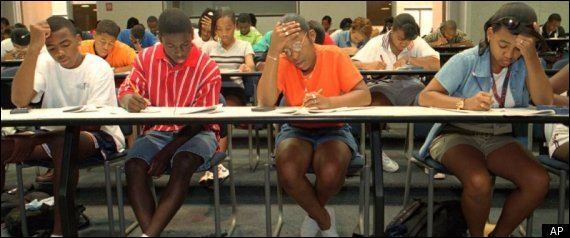
Danger ahead: the dismal performance of some minorities on the SAT

The College Board recently reported the results for SAT test-takers in the class of 2015…and the news isn’t good.

african-american-teenagers-taking-the-sat

On average, high school graduates in the class of 2015 had lower scores in all three subject areas (critical reading, math and writing) than in 2014 and overall the lowest performance since the 2,400-point scale was developed about a decade ago.

The mainstream media covered this pretty well, but most ignored or said little about a more disturbing aspect of the report: the results for Native American, African American and Hispanic students were appalling.

Just 41.9% of SAT takers in the class of 2015 (712,000 students) met the SAT College and Career Readiness Benchmark. That means they have a 65% probability of obtaining a first-year GPA of B- or higher at a four-year college. It indicates a student’s readiness to enter college or career-training programs and to succeed in credit-bearing, entry-level college courses.

But look at the percent of U.S. test-takers who met the benchmark broken down by race/ethnicity:

  • Asian: 61.3%
  • White: 52.8%
  • Native American: 32.7%
  • Hispanic: 22.7%
  • African American: 16.1%

The numbers for native Americans, Hispanics and African-Americans in Oregon who met the College and Career Readiness Benchmark were pretty dismal, too: 

  • Native American: 31%
  • Hispanic: 22.6%
  • African American: 24.9%

Some argue that the averages for minority students are low because the number of them taking the test is expanding: 32.5% were underrepresented minority students in the class of 2015, compared to 31.3% in the class of 2014 and 29.0% in the class of 2011.

Others argue that this is avoiding the real issue, that too many minority students are not getting a good education. “Without access to challenging courses and assessments that measure their progress, students will not be able to get the most out of their opportunities to prepare for college and careers.” The College Board said in its report.

The College Board noted that there continue to be striking differences in academic preparation between white and Asian students and African Americans, Native Americans and Hispanics that affect college readiness. White and Asian students taking the SAT, for example, are more likely to have taken AP and Honors courses. They are also more likely to have completed a full “core curriculum,” which includes four or more years of English, three or more years of mathematics, three or more years of natural science, and three or more years of social science and history.

“Nowhere is there more of a need to expand access to more rigorous coursework than among low-income and minority students,” said Cyndie Schmeiser, Chief of Assessment at the College Board.

The U.S. Census projects that racial and ethnic minorities will represent more than half of all children in the United States by 2023, and that the U.S. population will be 54 percent minority by 2050. As noted by the Association of American Colleges & Universities, “Youth from these communities need full preparation for and access to higher education. It would be both immoral and impractical to ignore the disparities facing these young people, as a brighter future for them means a brighter future for all.”