Like a Bad Penny, Former Portland Businessman Andrew Wiederhorn is Back in the News

Andrew Wiederhorn

Like a bad penny, Andrew Wiederhorn just keeps coming back. 

Wiederhorn, once a high-flying business star in Portland, ended up in federal prison for 14 months after being convicted of paying an illegal gratuity to a co-conspirator and filing a false tax return. 

After prison, Wiederhorn moved to Southern California and became the CEO of a publicly traded company, FAT Brands, Inc, that runs the hamburger chain Fatburger.

In May 2024, he re-emerged in the news when the federal government accused him of taking millions of dollars in bogus loans from companies he controlled — loans which were later forgiven. Over 11 years, the government said, Wiederhorn took bogus loans totaling $47 million for his personal benefit. That income, the government said, should have been reported to the IRS. The government argued he should have paid taxes on the money because it was income. 

Now he may have found a savior. The New York Times reported on Sunday, March 30, that on Friday, March 28, Adam Schleifer, a federal prosecutor working on Weiderhorn’s case, was sitting at his computer in Los Angeles when he received an email from a White House official, Saurabh Sharma, saying that he had been terminated. No reason was cited. 

“Given that the case has drawn headlines recently and that Mr. Wiederhorn has donated to political action committees supporting Mr. Trump, his colleagues suspected that may have played a role in his dismissal,” the New York Times reported. 

UPDATE – New York Times, July 29, 2025

The Justice Department moved Tuesday to end two high-profile criminal cases in Los Angeles whose handling by the Trump administration had been criticized by veteran prosecutors as alarming.

The moves by the leader of U.S. Attorney’s Office for the Central District of California, Bill Essayli, came on the same day the administration said it would use a legally untested maneuver to ensure that Mr. Essayli remains in charge of the office beyond his interim appointment, which was set to expire Wednesday.

Mr. Essayli filed court papers asking a judge to dismiss pending criminal charges against Andrew Wiederhorn, the founder of Fatburger, who was fighting accusations of wire fraud and other crimes related to the company. While it is ultimately a judge’s decision whether to dismiss charges, a prosecutor’s request to do so makes it nearly impossible for the case to proceed to trial.

The move to end the Wiederhorn case comes months after White House officials fired the prosecutor in charge of it, Adam Schleifer, whom the right-wing influencer and close Trump ally Laura Loomer had publicly attacked on social media.

Mr. Schleifer’s dismissal unnerved Justice Department veterans, who could not recall any similar instance in which a White House staff member directly dismissed a lower-level career prosecutor. Along with Mr. Schleifer, the White House used the same method to fire a career prosecutor in Memphis.

Liberal Media Jump on the Kamala Harris Bandwagon

Gag me with a spoon.

Talk about shifting on a dime.

President Biden withdraws from the 2024 race, Vice President Kamala Harris picks up the mantle and the liberal media jump on board.

Even Biden’s withdrawal statement is being cast mostly as a brave, selfless, patriotic effort, like a “don’t speak ill of the dead” obituary, rather than an admission that the Democratic Party’s leaders and wealthy donors had abandoned him. 

It wasn’t long ago that the press delighted in portraying Harris as a largely ineffectual, slightly dim and somewhat daffy politician with a habit of speaking in a kind of garbled incoherent word salad and a failed policy effort as Biden’s border czar.  

Last week, New York Times columnist David Brooks cautioned that “…as of 18 months ago, she would not have made an effective president or even a good candidate. She ran a disastrous presidential campaign and has been a mediocre vice president, even measured by the low standards of the office. She could always repeat the normal Democratic positions but had no distinctive view for where the country needed to go.”

Now, with Biden out, the media is transforming Harris from a somewhat awkward and cringy figure in the Democratic Party to a “cool” pop culture personality with a sterling reputation in a matter of days, commented CNN commentator Van Jones. 

New York Magazine went over the top in its latest issue with this cover:

The New York Times has even attempted to turn the tide on Harris’ sometimes derided laughter, saying “The Trump campaign sees Harris’s laugh as a vulnerability to exploit. But far from a liability, it is one of her most effective weapons.”

In a flash, Harris has gone from an unaccomplished player in foreign affairs to a widely admired wonderkind. A New York Times story on her foreign policy chops was even headlined, “A Global Reputation For a Steely Resolve And Deft Diplomacy.”

“…the consensus among foreign officials and diplomats is that Ms. Harris has a firm grip on international affairs,” the Times enthused in a July 27 article quoting Chancellor Olaf Scholz of Germany: “She is a competent and experienced politician who knows exactly what she is doing and has a very clear idea of her country’s role, of developments in the world, and of the challenges we face.”

When Biden tweeted his exit, the Democratic Party and its acolytes “…declared a triumph of democracy and the end of popular “disillusionment,” observed author and reporter Matt Taibbi. “Attention shifted to the real candidate, Kamala Harris, who was not only MLK, Gandhi and Captain America, but a woman of color with a Jewish husband…” 

Party stalwarts are jumping on board with superlatives, too. “I’ve known Kamala Harris a long time,” wrote Hillary Clinton. “This brilliant prosecutor will make the case against convicted felon Donald Trump.”

On July 28, Lydia Polgreen, an opinion columnist with the New York Times, wrote that “…Harris had been significantly underrated, that the chatter about her flaws for the past four years maybe didn’t tell her full story and that she had some unique talents and traits that made her a stronger candidate than her record might suggest.”

Rather than hold Harris’ missteps against her, Polgreen turned them into positives. 

“I see a woman who struggled to compete for power against her peers, buried under an array of vague and unstated expectations about whether she gave the right answers, had the right ideas, was smart or specific enough,” Polgreen wrote. “Like any woman of ambition, I deeply relate to these experiences. As strange as it might seem, I have come to think these experiences could make her the ideal candidate in a surreal campaign against a man who is so certain of himself, who admits to no mistakes, who has no humility and who, for many of us, is utterly unrelatable.”

Jenny Holland, who writes “Saving Culture (from itself)” on substack, says “The establishment blob is so desperate to avoid a Trump presidency that they are willing to support a woman who is so flippant and unserious that she would embrace a youth culture trend of “brat”, which means being “just that girl who is a little messy and maybe says dumb things sometimes, who feels herself but then also maybe has a breakdown but parties through it.” 

Still, Harris may want to tread lightly before embracing her newfound adulation as a given. The press can be your friend, but it can also turn on you. 

Identity Politics is Alive And Well at The New York Times

I’m a member of Tau Kappa Epsilon fraternity, one of the largest men’s collegiate fraternities in North America.  If I ran for office, would you assume all 12,000 voting-age collegiate members of my fraternity and all the living TKE alumni would support me?  

Ronald Reagan was a member of Tau Kappa Epsilon fraternity, too. When he ran for president, did the news media assume the votes of all his TKE fraternity brothers were a sure thing?

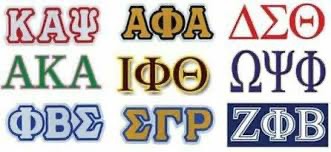
The New York Times seems to think that members of all the Black Greek-letter sororities and fraternities at US colleges are a ready-made bloc of Kamala Harris supporters in her quest for the presidency because she’s been a member of the Black sorority Alpha Kappa Alpha since her undergraduate days at Howard University. 

“As Vice President Kamala Harris’s presidential campaign rushes to shore up its base, its efforts will be bolstered by a ready-made coalition: the more than two million members of Black Greek-letter organizations who have quickly united to mobilize Black voters nationwide,” the Times reported today.  

“A united Black Greek front has the potential to offer even more significant political advantage, as their voter engagement programs reach millions every four years,” the Times added. 

Maya King, the Times reporter who wrote the story, says in her bio, “As a native Southerner, I have been most fascinated by the ways the region has changed politically, culturally and demographically over the last few presidential election cycles — and how those changes are connected.”

But King barely acknowledged those changes in her article. The cheerleading article barely mentioned that there have been signs of deteriorating Black support for the Democratic ticket and growing Black consideration of Donald Trump. 

In November 2023, the Times reported that Black voters were  more disconnected from the Democratic Party than they have been in decades, frustrated with what many saw as inaction on their political priorities and unhappy with President Biden, a candidate they helped lift to the White House. Polls by the Times and Siena College found that 22 percent of Black voters in six of the most important battleground states said they would support former President Trump in the 2024 election, and 71 percent would back President Biden.

Erosion of Black support for the Democratic Party has also been found by the Pew Research Center. The Center reports that although the majority of Black voters across education levels are Democrats, there has been a decrease in affiliation with the Democratic Party in recent years. While 93% of Black voters with college degrees identified with or leaned toward the Democratic Party in 2012, that number decreased to 79% in 2023.

Biden’s withdrawal from the 2024 presidential contest and Harris’  ascension may well change some Black voters’ preferences, but it’s not likely to be a universal shift. Harris, for example, is a progressive Democrat, but only 28 percent of black Democrats consider themselves liberal, according to the Pew Research Center, while 70 percent identify as moderate or conservative.

On June 25, the Times reported on data  captured by a new Harvard study that shows Black voters  have slightly shifted toward Trump since 2020. “One possible explanation is that some Black voters’ economic gains have allowed them to focus more on noneconomic issues — such as abortion and L.G.B.T.Q. rights — on which they are more conservative than typical Democrats,” the Times said.

The fact is, Black candidates can’t rely on group solidarity. “It’s certainly true that black voters support black Democratic candidates at higher rates, … but analysis of past elections and campaigns shows that black voters have never prioritized simple descriptive representation over other factors, like party affiliation, campaign viability, candidate electability, preexisting relationships with the black community and a sense of authenticity,” according to the New York City-based Brennan Center for Justice. 

For the New York Times to publish a story assuming Black solidarity for a Black presidential candidate who’s a member of a Black sorority is irresponsible journalism.

As James Bennett, who was the editorial page editor at The New York Times from May 2016 until his forced resignation in June 2020 over a controversial op-ed, has said, “The reality is that the Times is becoming the publication through which America’s progressive elite talks to itself about an America that does not really exist.”

The Horror of Sexual Violence on Oct 7. Believe It.

“You haven’t talked about this until now. Why?

I decided to talk about it only after I heard that people are trying to say that it didn’t happen….I needed to talk for women. I need to talk because I won’t forgive myself if I will still see people that are saying  those things didn’t happen when I know that they did.”  

Testimony of an Israeli victim of sexual violence on Oct 7, Screams Before Silence

A claque of 59 academics who describe themselves as “professors of journalism and scholars of news media” from across the country are in high dudgeon about a Dec. 28, 2023 New York Times story describing a “pattern of rape, mutilation and sexual violence by Hamas” during its Oct. 7, 2023 attack on Israel.

Asserting there are compelling reports questioning the integrity of the story, the professors said in a letter to the paper, “We recommend that The New York Times immediately commission a group of journalism experts to conduct a thorough and full independent review of the reporting, editing and publishing processes for this story and release a report of the findings.”

Leaving aside that of all the things to complain about regarding coverage of the Israel-Hamas conflict, a group of academics are focusing on a sexual assault story, it will be regrettable if the professors’ complaint is used to try to undermine widespread and convincing allegations of sexual violence committed by Hamas on Oct. 7.

Don’t let it.

Rami Davidian, who rescued some people from Nova, told Haaretz, an Israeli newspaper, he saw women’s bodies tied to trees in the area of the party. “There were trees on which there was one body, and there were cases in which a number of bodies were tied to the same tree,” he related. “There was a case of a couple who were in an embrace, naked, and tied to a tree. Both of them had been shot in the chest.” Davidian said he had seen more than five bodies that had been mutilated “in intimate places… their organs were cut off, damaged. There was blood from the groin… There were also shots to breasts.”

The aftermath of the Nova massacre

In  Screams Before Silence, a new documentary film from Sheryl Sandberg, former COO of Meta, Sandberg interviewed multiple eyewitnesses, released hostages, first responders, medical and forensic experts, and survivors of the Hamas massacres..

“I’ll never forget what I saw there for so long as I live,” a witness to the massacre’s results said in the film ” I saw girls tied up with their hands behind them to every tree here…Someone murdered them, raped them, and abused them here on these trees. Their legs were spread. Everyone who sees them knows they were abused. Someone stripped them. Someone raped them. They inserted all kinds of things into their intimate organs, like wooden boards, iron rods. Over 30 girls were murdered and raped here. I had to close their legs and cover their bodies so no one else would see what I saw.”

“Every one of us, women and men, must speak up for these women and say, “We will bear your story. We will bear witness for you…what happened to you will be told.”   said Shari Mendes, an Israeli Defense Force (IDF) reservist. 

Whatever the reliability of the New York Times article, the professors need to acknowledge the truth of the larger story of sexual assault by Hamas.

Never forget that..

Confronting Chaos: Today’s New York Times

NY Times Book Review interview with Brontez Purnell, 02/25/2024:

NY Times – “What’s the last book that made you cry?”

Purnell – “The newspaper is the only thing I read that makes me cry.”

Excerpts from the Sunday New York Times, Feb. 25, 2024

Predators Leer as Moms Put Girls on Instagram, NY Times
  • Seeking social media stardom for their underage daughters, mothers post images of them on Instagram. The accounts draw men sexually attracted to children, and they sometimes pay to see more.  Interacting with the men opens the door to abuse. Some flatter, bully and blackmail girls and their parents to get racier and racier images. The Times monitored separate exchanges on Telegram, the messaging app, where men openly fantasize about sexually abusing the children they follow on Instagram and extol the platform for making the images so readily available.

          “It’s like a candy store 😍😍😍,” one of them wrote. 

  • A record number of people across the country are experiencing homelessness. The federal government’s annual tally last year revealed the highest numbers of unsheltered people since the count began in 2007.
  • …the principal challenge has come at home, where additional U.S. military assistance to Ukraine has been stymied by Donald Trump-aligned House Republicans who question the importance of Ukraine for American security and in some cases even the centrality of the North Atlantic Treaty Organization alliance itself.
  • “You feel totally helpless, totally abandoned by authorities and society in general. You feel like nothing,” said Araceli Gatica, a 32-year-old who left San Luis Acatlán, a mountain village in Guerrero (Mexico). A local gang threatened to kill her after she refused to keep paying $200 a month in extortion. She arrived recently with her three children in Ciudad Juárez, across the border from El Paso, Texas, hoping to seek asylum in the U.S.
  • Bombs that struck houses, markets and bus stations across Sudan, often killing dozens of civilians at once. Ethnic rampages, accompanied by rape and looting, that killed thousands in the western region of Darfur. And a video clip, verified by United Nations officials, that shows Sudanese soldiers parading through the streets of a major city, triumphantly brandishing the decapitated heads of students who were killed on the basis of their ethnicity.
  • Ms. Haley’s loss in South Carolina follows a string of early defeats. She argued in her speech that the nation needed new leadership in the midst of “a world on fire.” “It seems like our country is falling apart,” she said, adding that she was worried “to my core” for its future. “America will come apart if we make the wrong choices. “
  • Prominent epidemiologists have estimated that an escalation of the war in Gaza could cause up to 85,000 Palestinian deaths over the next six months from injuries, disease and lack of medical care, in addition to the nearly 30,000 that local authorities have already reported since early October.
  • And yet, even if parts of society came to terms with natural bodies, the same cannot be said for the natural process of women aging. Wrinkles are the new enemy, and it seems Gen Z — and their younger sisters — are terrified of them. Gen Z-ers are being introduced to the idea of starting treatments early as “preventative” treatment. They are growing up in a culture of social media that promotes the endless pursuit of maintaining youth — and at home, some of them are watching their mothers reject aging with every injectable and serum they can find. But considering the speed at which social media is pushing ever more unattainable beauty standards onto children, it’s time for us to consider our moral obligation to minimizing damage for the next generation.
  • … increasingly in recent months, scrolling the (Tik Tok) feed has come to resemble fumbling in the junk drawer: navigating a collection of abandoned desires, who-put-that-here fluff and things that take up awkward space…(T)he malaise that has begun to suffuse TikTok feels systemic, market-driven and also potentially existential, suggesting the end of a flourishing era and the precipice of a wasteland period.

Lawyers of Distinction: The Fraud That Won’t Die

What does it take to crush a cockroach?

After multiple exposures as a fraud, Lawyers of Distinction, a Florida-based business, continues to grow its membership and confidently promote itself in national publications such as The New York Times.

It’s latest promotion? A prominent ad in the Sunday, August 6, 2023 edition of The New York Times, reproduced here so you can read the names of the newest members  who apparently want to embellish their credentials by deceiving the public.

Nine of the members saluted in the ad are from Oregon. Lawyers of Distinction claims to have a total of 34 members from the state. “Reach Out for Representation You Can Trust,” says Kali Yost, one of the Oregon members, on her website, which features the Lawyers of Distinction 2023 logo. 

Impressed? Don’t be. 

About all that’s required to be named a “Lawyer of Distinction” is to apply yourself or be nominated, fill out some online forms and pay a fee. 

According to the Orlando, FL-based organization’s website, a Charter Membership, for $475 a year, comes with a “Customized 14″ x 11″ genuine rosewood plaque”. A Featured Membership, for $575 a year, brings the plaque and inclusion in a membership roster published in USA Today, The New York Times, The American Lawyer and the National Law Journal.

Then there’s the Distinguished Membership, for $775 per year (described on the organization’s website as “Most Popular”), which brings the rosewood plaque, the membership roster ads and an 11″ tall translucent personalized crystal statue.

Lawyers of Distinction,  incorporated in 2014, is like diploma mills, outfits that claim to be higher education institutions, but only provide illegitimate academic degrees and diplomas for a fee.

The Lawyers of Distinction website describes the application review process as follows:

“Lawyers of Distinction Members have been selected based upon a review and vetting process by our Selection Committee utilizing U.S. Provisional Patent # 62/743,254. The platform generates a numerical score of 1 to 5 for each of the 12 enumerated factors which are meant to recognize the applicant’s achievements and peer recognition. Members are then subiect to a final review for ethical violations within the past ten years before confirmation of Membership. Nomination does not guarantee membership and attorneys may not pay a fee to be nominated. Attorneys may nominate their peers whom they feel warrant consideration. The determination of whether an attorney qualifies for Membership is based upon the aforementioned proprietary analysis discussed above. Membership is not meant to infer any endorsement of Lawyers of Distinction by any of the 50 United States Bar Associations or The District of Columbia Bar Association. Any references to “excellent,” “excellence,” or “distinguished” are meant to refer to the Lawyers of Distinction organization only and not to any named member individually.”

Phew! Sounds complex and rigorous. 

Don’t believe it.

 It’s just pay-for-play. It’s selling badges.  It’s paying for meaningless accolades. Apply, pay the annual membership fee and you’re in.

According to the Florida Division of Corporations, “Lawyers of Distinction Inc.” is a private for-profit company with a principal address of 4700 Millenia Boulevard, Suite 175, Orlando, FL 32839. 

Robert B. Baker, at the same address, is listed as the President in the company’s 2023 Annual Report. 

Robert Baker

But don’t go to the office address expecting to be ushered into a space with a clean, modern aesthetic that communicates success. The address is only a virtual office. The site offers a “Platinum Plan” for $69 a month and a “Platinum Plan with live receptionist” for $194 a month.

Robert “Robbie” Brian Baker, a member of the Florida Bar (Bar #992460), is also the founder and owner of Baker Legal Team at 2255 Glades Rd., Ste 330-W, Boca Raton, FL 33431. According to the Baker Legal Team website, he has a degree from Boston University School of Law in 1989 and a B.A. from Ithaca College.  He began his career, the website says, as a prosecutor working as an Assistant District Attorney in Kings County, New York. 

As an aside, the firm’s website has the chutzpah to highlight that it’s a member of Lawyers of Distinction. 

Lawyers of Distinction’s website says it currently has over 5000 members. If 5000 lawyers sign up for the Distinguished category at $775 this year, the organization will rake in $3.9 million. Quite a haul.

Lawyers of Distinction used to try to quell doubts about its legitimacy by including on its website a  section headed, “Is Lawyers of Distinction A Scam? With Over 5000 Members, See What Lawyers Have To Say.” All the section contained was a few member comments and ratings, such as, “Andre L. Pennington – June 20, 2022, I love the opportunities that this honor provides. I highly recommend!” Now the link just takes you to a page that says, “Lawyers of Distinction currently has over 5000 members in the United States. The best way to hear about someone’s actual experience with a company is to receive information from an actual user, not a 3rd party.” 

It’s likely that few attorneys have been duped by Lawyers of Distinction, lured into believing they’ve been selected for a rare honor based on their legal work. They must figure that impressing potential clients is worth the mendacity and deception.

But the widespread use of Lawyers of Distinction by attorneys really just represents the decay of honest professional representation. If the American Bar Association  and state bar associations really cared about lawyers’ clients they would be cracking down on such misleading marketing ploys. If the publications that run the outfit’s ads, such as The New York Times, gave a whit about truth in advertising, they’d decline to run its ads, too.

And if an attorney ballyhoos their selection as a Lawyer of Distinction to you, beware. They already have one strike against them and are living in a world of unearned praise.

11/13/2024 UPDATE: Oregon State Bar Refuses To Prohibit Deceit and Misrepresentation By Its Members

Justice Clarence Thomas and the Horatio Alger Association: What The New York Times Didn’t Tell You

On July 9, 2023, The New York Times ran a 4,314-word story about Supreme Court Judge Clarence Thomas’s connections with an exclusive club, the Horatio Alger Association of Distinguished Americans Inc.. 

“His friendships forged through Horatio Alger have brought him proximity to a lifestyle of unimaginable material privilege,” the reporters wrote, leading into multiple examples of benefits he received from a broad cohort of wealthy and powerful friends and insinuations that Thomas had been compromised.

Citing the Association’s website, the story said the non-profit group, portrayed as a group of wealthy and influential believers in meritocratic success, has awarded more than $245 million in college scholarships to roughly 35,000 students since its founding in 1947. The Association has been tax-exempt since Oct. 1952.

What the reporters didn’t do was look deeper at the Association. It has quite a dubious history.

In 1988, while a business reporter at The Oregonian newspaper, I researched and wrote a story about the Association, which had inducted two prominent Oregonians. The story (which won plaudits from the Columbia Journalism Review) noted that from 1985 through 1987 — the latest period for which tax records were available at the time — the Association raised $2.1 million. During those three years, The organization spent $1.7 million. Just $315,000 of that went to scholarships.

Rather than funding scholarships, most of the association’s outlays went to executive salaries, office expenses, books devoted largely to laudatory stories of the members’ lives, annual banquets at places such as New York’s Waldorf Astoria Hotel and the Westin Galleria Hotel in Houston and contracts with a New York public relations firm.

The amount of salary and benefits going to the association’s executive director alone, which increased from $98,126 in 1985 to $120,154 in 1987, exceeded or almost equaled the amount of scholarships awarded in each of the past three years. Those scholarships totaled $100,000 in both 1985 and 1986 and $115,000 in 1987.

In 1987 the Association spent more on printing and publications than on scholarships. Its principal annual publication was a hard-cover book titled “Only in America Opportunity Still Knocks.” The book devoted 132 of its 192 pages to a membership list and biographies featuring informal snapshots of the members and outlines of their paths to success.

A review of the Association’s recent federal tax filings reveals it still engages in questionable financial behavior.

The IRS requires that tax-exempt organizations, nonexempt charitable trusts, and section 527 political organizations file an annual Form 990 to provide the IRS with the information required by 26 U.S. Code § 6033. In its recent filings it stated its purpose as: “(1) To provide scholarship assistance to help promising high school students (who fit the Horatio Alger profile) attend college, and (2) to spread the message that America’s free enterprise system provides the greatest opportunities in the world for personal achievement and success.”

The Alexandria, VA-based Association’s recent Form 990s (2020, 2021) reveal it has grown substantially since I wrote about it in 1988, reporting total revenue of $27,092,429 in 2020 and $20,322,852 in 2021. But its scholarship distributions still fall far short of its annual revenue.

In 2020, its scholarship grants totaled $11,223,951, just 41% of its revenue. In 2021, grants totaled $12,287,913, 60% of its revenue, which was at least better than in 2010, when its revenue totaled $19,682,336 and its grants to individuals totaled just $4,721,307.

Where has all the rest of its revenue gone?

In 2021, a whopping $2,446,876 went to salaries, other compensation and employee benefits, including $1,348,080 to Executive Director Terrence J. Giroux. Another $318,936 went to a Philadelphia, PA public relations firm, Brian Communications. A total of $552,717 was spent on “event management”, slightly less than the $1,062,380 spent on event management and production in 2020. (The Association’s Form 990s say some of that money went to Linder & Associates, but that is a property management company in Los Angeles, California. The money probably went, instead, to Linder Global Events, an event management agency based in Washington, D.C.)

The Red Bank Film Factory of Red Bank, NJ was paid $471,271 and Destin Productions LLC of Limassol, Cyprus took in $330,000 for a television marketing campaign in 2021

Another $8,527,523 went to “Other Expenses”, including legal, accounting, advertising, office expenses, travel, conferences, conventions and meetings. 

According to the Association’s 2021 Form 990, $2,739,296 went just to “Member support and meetings, including the annual board of directors meeting, annual awards week in Washington, D.C. and specialized forums.”

In other words, given the amount of its revenue, the Association falls far short of expectations in its scholarship handouts, while spending extravagant sums on compensation and other functions, such as public relations and fancy dinners for its mostly wealthy members. 

Media coverage of the Association, while frequently citing its distinguished members, such as author Maya Angelou, former Intel CEO Craig Barrett, Michael Bloomberg and NBC News anchor Tom Brokaw, also has failed to mention that its ranks include some questionable characters, such as:

  • Roger Ailes, who resigned as chairman and CEO of Fox News after being accused of sexual harassment by several female Fox employees, including on-air hosts
  • Elizabeth Holmes, former CEO of Theranos. Holmes was convicted in 2022 on four counts of wire fraud for swindling doctors and patients to use her company’s blood-testing services while knowing that Theranos was incapable of producing accurate results, according to the indictment. She was also accused of defrauding investors of more than $700 million with the fabricated claims.
  • Joe Allbritton, a Washington, D.C. power-broker who turned a blind eye to evidence that Riggs Bank, of which he was  chairman and chief executive officer, was “handling the proceeds of foreign corruption and paid paid a $16 million criminal fine over charges the bank had failed to report suspicious transactions with foreign account holders.” The judge who imposed the fine described the bank as “a greedy corporate henchman of dictators and their corrupt regimes.”

America loves stories about someone picking themselves up by their bootstraps, as in Horatio Alger’s books about  impoverished boys and their rise from humble backgrounds to lives of success, although, truth be told, you can’t really do that. Truth be told, the Horatio Alger Association of Distinguished Americans Inc. isn’t all it’s stacked up to be either.


Fess Up, New York Times. You Didn’t Break the George Santos Story

Read almost any story about the fraud perpetrated by a lying George Santos before his election to the House of Representatives from New York’s 3rd congressional district and you will see the blockbuster news attributed to the New York Times (NYT).

Certainly, the NYT made no effort to disabuse readers of that presumption. 

In its Dec. 19, 2022 blockbuster story exposing Santos’ lies, “Who Is Rep.-Elect George Santos? His Résumé May Be Largely Fiction”, the paper attributed its discoveries to “…a New York Times review of public documents and court filings from the United States and Brazil, as well as various attempts to verify claims that Mr. Santos, 34, made on the campaign trail,…”

In a print introduction to a Jan. 5, 2023 podcast on the story, the NYT repeated this claim. “George Santos, the Republican representative-elect from New York, ran for office and won his seat in part on an inspiring personal story. But when Times reporters started looking into his background, they made some astonishing revelations: Almost all of Mr. Santos’s story was fake.”

But it wasn’t the NYT that broke the fraudster’s story. 

It was the North Shore Leader, a local Long Island weekly newspaper with a circulation of about 20,000. And the North Shore leader exposed Santos well before the November election.

The leader has now raised the issue in a story titled “The Leader Told You So: US Rep-Elect George Santos is a Fraud – and Wanted Criminal”.

“In a story first broken by the North Shore Leader over four months ago, the national media has suddenly discovered that US Congressman-elect George Santos (R-Queens / Nassau) – dubbed “George Scam-tos” by many local political observers – is a deepfake liar who has falsified his background, assets, and contacts,” the story says.

Either the NYT failed to give credit where credit was due or the mighty publication utterly failed to check reporting done by a tiny local paper less than a 1-hour drive from the NYT Building on W. 41st St. in Midtown Manhattan.

By the way:

Neither the North Shore Leader nor the NYT newspapers have reported on another interesting journalistic matter tied to Santos. The NYT did report that Santos once told associates he was (in the NYT’s words) “a journalist at a famous news organization in Brazil,” but didn’t go deeper. According to ta Jan. 10, 2022 report by the Columbia Journalism Review (CJR), Gregory Morey-Parker, who briefly lived with Santos in New York eight or so years ago, told CJR’s Jon Allsop that Santos claimed to have been working at the time for Globo, the Brazilian media behemoth, as a reporter covering human-interest stories out of the US.

According to Morey-Parker, Santos also claimed to be an executive at Globo. When Allsop put this to Ali Kamel, the director-general of journalism at Globo, he described it as “a crazy story” and “a lie, pure and simple.” (Santos’s office did not return a request from Allsop for comment)

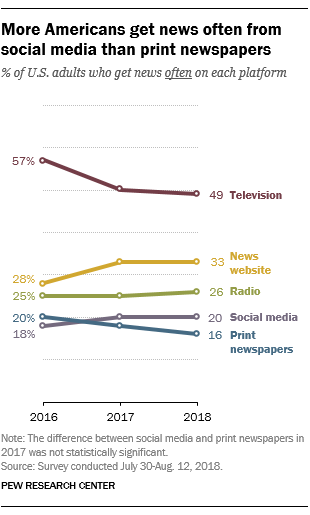
It’s not just print newspapers that are dying; their readers are, too.

Cemeteries in Huntersville, NC | Gethsemane Cemetery & Memorial Gardens

Not that long ago, printed newspapers dominated the news landscape and seemed to have a promising future.

In 1940, daily circulation of print newspapers in the U.S. was 41.1 million, according to the Pew Research Center. It was a rare home that didn’t start the day with a newspaper at the breakfast table. At my home in Wallingford, CT, we had two papers delivered daily in the 1940s. In the morning, we got the Meriden Record; In the afternoon we got the New Haven Register. Established about 1812, the Register was one of the oldest continuously published newspapers in the United States.

In the mid-1980’s, weekday print newspaper circulation in the U.S. reached a peak of 63.3 million.  Americans avidly followed stories about events such as the assassination of Indian Prime Minister Indira Gandhi, the introduction of Apple’s original Macintosh personal computer (accompanied by a still heralded Orwellian-themed “1984” TV ad), the agreement between China and the United Kingdom to transfer power in Hong Kong from the UK to China in 1997 and Villanova’s stirring 66-64 upset victory over Georgetown in the NCAA championship. 

Onward and upward, thought media leaders. 

Print newspapers hung in there until the early 2000s. Then the bottom began to fall out. By 2012, daily print circulation was down to 43.4 million. By 2020, Pew Research estimated that print circulation had fallen to just under 24.3 million. What happened? The internet and age.

Print newspaper readers have always tended to be older, more affluent, and more educated. Publishers and advertisers used to like that. The problem is that as those older readers have aged and died, they have not been backfilled by subsequent generations. Instead, younger readers have been gravitating to digital communications channels.

And the shift has accelerated across print platforms where readers have been aging fast.

In a 2012 Pew Research Survey, just 23% of respondents said they read a printed newspaper the previous day. The highest readership, 48% was among those 65 and older. The lowest was those 18-24, at 6%, and 25-29, at 10%.

Pew – where people got news yesterday


The percentages saying they read a printed newspaper yesterday have continued to steadily decline.

A newer May 2021 survey revealed that most consumers never use newspapers as a source of news, and only 25 percent of adults aged 65 or above (those who engage with newspapers the most) reported reading newspapers every day. Meanwhile, even older folks are warming up to online news. Those over 50 are also warming up to the web. In 2016, 32% of the news readers in the 50+ age group expressed a preference for the web. This increased to 43% in a 2019 survey. Newspapers have become even less popular as a news source than radio, and are also among the least used daily news sources among adults aged 18 – 24.

If this young cohort keeps its print avoidance as it ages, print newspapers will eventually lose almost their entire audience.

The biggest threat is probably to local papers with smaller circulation. Papers with a significant number of print subscribers, such as the still profitable Wall Street Journal and The New York Times, are in a better position.

About five years ago, the Journal’s Editor-in-chief, Gerard Baker, was asked by a writer for the Nieman Lab whether he saw a day when there would be no print edition at all.

I don’t really foresee the day when there’s no print edition,” Baker said. ” I mean, who knows — we live in a rapidly changing world. Who can really say anything with conviction about what will be 10, 15, 20 years hence? But as things stand, we have a million print subscribers who really value the print edition of the paper. They really want it. They’re prepared to pay a significant amount of money for what they pay for a print newspaper. There continues to be strong demand for the print product, and we will continue to need to meet that demand. I don’t foresee any other changes in the foreseeable future.”

Notwithstanding this rosy prediction, in Sept. 2017 the paper announced it would stop publishing its European and Asian editions. Falling overseas sales and plunging print advertising revenue in recent years drove the decision, according to the Journal. In Oct. 2020, it took another step away from print, cutting print editions of its fashion and luxury lifestyle insert WSJ. Magazine from a dozen to eight.

Those are the drip drip signs of changing attitudes at the Journal about the viability of print.

Meanwhile, most of the paper’s subscription growth is on the digital side. In 2017, of the paper’s 2.1 million subscribers, 1.08 million were digital. Daily print readership now stands at about 734 thousand copies, while digital subscribers total about 2.7 million.

It’s a similar story at The New York Times. In 2017, the paper had 540,000 daily print and 2.2 million digital subscribers. Daily print readership now stands at about 795,000 copies, while digital subscribers total about 5.7 million.

A friend of mine told me he used to subscribe to the daily print version of the Columbus (Ohio) Dispatch, even after he moved away from Columbus, until he realized he was spending $1000 a year for the subscription. A 12-month digital subscription today is just $119.88.

In all three cases, it costs a lot less to be a digital subscriber, so you have to really love print to go that way. Fewer and fewer people do.

An added note: Covid-19 isn’t helping either. Covid-19’s devastation has hit the elderly the hardest. Of the more then 800,000 Americans who have died from Covid-19, 75% have been 65 or older, according to the Centers for Disease Control and Prevention. That’s the newspaper audience.

The New York Times fails to make its case in its latest Trump probe.

I’m no Trump fan, but Sunday’s New York Times article, The Swamp That Trump Built, which major media figures will likely call a “bombshell,” is filled with innuendo but little proof that spending at Trump properties actually buys influence.

The story does document that Trump’s private properties, particularly Mar-a-Lago in Florida, have become favor-seeking cesspools, with individuals, organizations and companies directing business there.  The story also makes it crystal clear that the influence-seeking spending has been lucrative for Trump properties. 

Mar-a-Lago

The story also documents that an awful lot of individuals, groups and companies that patronized a Trump property had business before the administration. 

But The Times went further. It asserted that the favor-seekers got what they wanted for their money, advancing their interests.  

“An investigation by The Times found over 200 companies , special interest groups and foreign governments that patronzed Mr. Trump’s propertieswhile reaping benefits from him and his administration,” The Times reported. “Just 60 customers with interests at stake before the Trump administration brought his family business nearly $12 million during the first two years of his presidency, The Times found. Almost all saw their interests advanced, in some fashion, by Mr. Trump or his government.”

The problem is that in many cases The Times presented no hard evidence that spending by the favor-seekers at Trump properties was directly connected to favorable government decisions. Simply saying that many big spenders at Trump’s properties “saw their interests advanced, in some fashion, by Mr. Trump or his government” is not proof of malfeasance. If that is proof of corruption, all the members of Congress should be in jail.

The story is littered with references to businesses and organizations holding events at Trump properties, implying that they were buying special favors.

The Times reported, for example, that Morgan Stanley paid at least $156,882 to hold a conference at Trump International Hotel in Washington, D.C. in 2017, Deloitte spent at least $347,529 for a conference there in June 2017 and the Food Marketing Institute paid $1.2 million to hold conferences at Trump National Doral Miami in 2018 and 2019. But all three told The Times the events had been booked long in advance. So much for buying influence with the President.

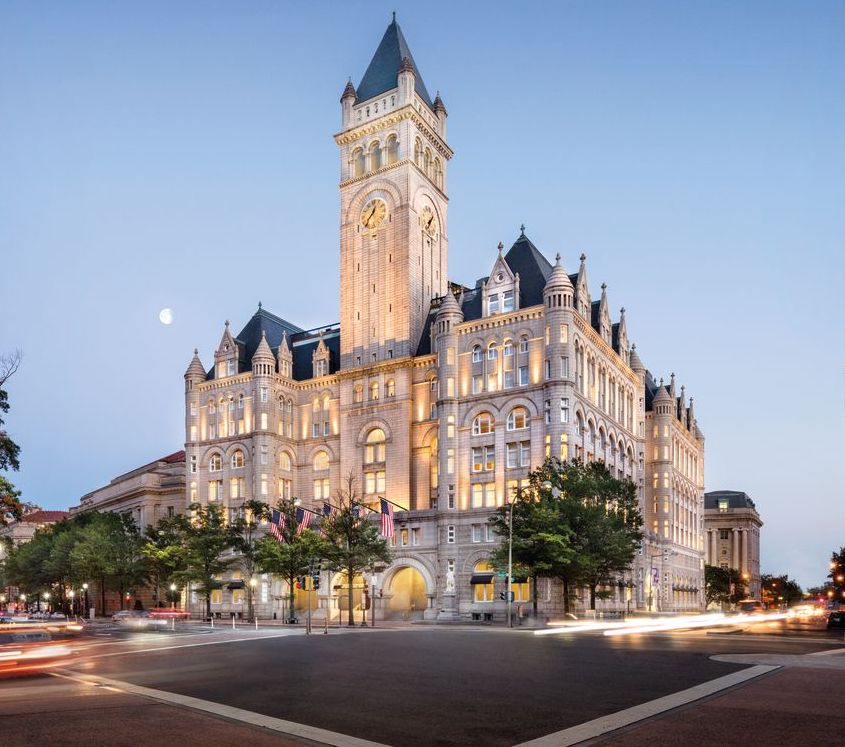
Trump International Hotel Washington, D.C.,

In another case, the Times wrote about a time when a White House meeting of restaurant executives to discuss the pandemic included Tilman Fertitta, a billionaire who had once operated a café in a Trump casino. Fertitta complained that bad publicity had forced him to return millions of dollars in federal aid intended to help strapped small businesses. He asked that the administration create a second fund for the larger private restaurateur. But Treasury Secretary Steven Mnuchin was noncommittal, the Times wrote, and the fund never materialized. I guess that connection didn’t pay off.

Then there’s David Storch, who the Times story suggests was involved in some influence peddling that began at Mar-a-Lago.

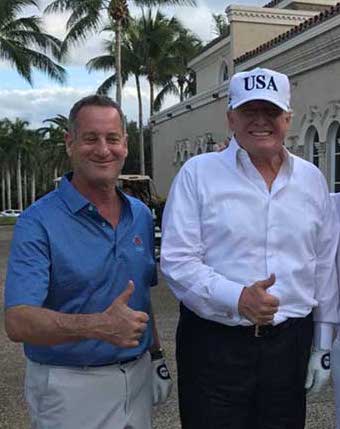
Shortly after Trump’s election, a Mar-a-Lago member invited Storch, an Illinois aviation executive, to a round of golf at the nearby Trump International Golf Club in West Palm Beach. They ran into Trump in the golf club’s dining room and the three ended up playing together. (The Times gratuitously noted that Trump International abuts the Palm Beach County jail)

According to The Times, “In the closing months of the Obama administration, Mr. Storch’s company, AAR Corp., had wrested from a rival a $10 billion contract to service State Department aircraft. The contract was to be the linchpin of AAR’s move into expanded government work. But as Mr. Trump took office, the competitor, DynCorp, was fighting the award in federal court.

DynCorp had a potentially powerful ally in the new president. It was owned by Cerberus Capital Management, whose billionaire co-founder Stephen A. Feinberg had donated generously to Mr. Trump’s election effort. Mr. Feinberg was in talks to take a senior administration role, while DynCorp would soon begin lobbying the administration to rescind AAR’s contract. On Inauguration Day, Mr. Storch took to the new president’s favorite social media platform and tweeted a picture of their (golf) game.”

David Storch (L) with Donald Trump at the Trump International Golf Club

That’s it. That’s all the story said. Did Storch raise the contract issue with Trump during the golf game? Did the golf game lead directly to further contacts between Trump and Storch or his representatives? Did the contact between Storch and Trump play a role in the federal court decision? What was the court’s decision? The Times story didn’t say. 

The Times story also noted  that The FLC Group, a Vietnamese conglomerate with a commercial airline subsidiary, hosted a conference at Trump’s Washington hotel in June 2018, promoting investment opportunities in Vietnam.The story then connected that event to the Federal Aviation Administration certifying eight months later that Vietnamese airlines could fly to the United States. Quite a leap.

Individuals and businesses seeking favors from the U.S. government have been spreading their money around since the American Revolution.

There’ve been cash payments to a Secretary of the Interior for control of federal oil reserves in Wyoming  and bribes in plain envelopes to a vice president in the White House, hidden campaign contributions, donations to non-profits endorsed by a member of Congress, even purchases of advertising on a puny little Texas radio station owned by a president’s wife. 

The Times story shows that the spending by favor-seekers is continuing during the Trump administration, this time in the form of paying for memberships and events at Trump properties, with active encouragement by Trump.

What the over 10,000 word story doesn’t do, however, is provide evidence of a quid pro quo, establish a clear link between all that spending and subsequent favorable government action. In other words, in its zeal to trash Trump it failed to prove its point.