Malfeasance: Oregon State Bar Association Drops the Ball

So much for the Oregon State Bar Association looking after the interests of lawyers’ clients.

On Oct. 9, 2023, I filed a complaint with the Association asserting that a number of Oregon lawyers are misrepresenting their credentials, that they are acting in an unethical manner by asserting to past, current and potential clients that their selection as “Lawyers of Distinction” by a Florida-based business is evidence of their legal skills and achievements.

On Feb. 17, 2024, I filed a second, more detailed complaint and followed up with an email asking whether the association intended to respond.

On May 20, 2024, Linn Davis, Assistant General Counsel and CAO Attorney, finally responded at length saying he found no reason to pursue any charges of professional misconduct by Oregon lawyers.

 “You expressed concerns that Oregon lawyers are improperly using membership in “Lawyers of Distinction” to advertise their services,” he wrote in an email. “ “Lawyers of Distinction” appears to be a marketing firm that uses some criteria to determine what lawyers are eligible for promotion. Listings on the “Lawyers of Distinction” site include a statement regarding the criteria for promotion and a link to apply for consideration. I lack any sufficient basis for believing the statements there to be false regarding the organization or the significance of membership. I also lack evidence that any particular lawyer in Oregon has utilized this marketing tool in a misleading manner. I conclude that there is no sufficient basis to warrant a referral of your concerns to Disciplinary Counsel. Because I find no sufficient evidence of professional misconduct, I will take no further action on this matter.”

I beg your pardon!

You can’t find any information that challenges the legitimacy of Lawyers of Distinction? Give me a break.

The Lawyers of Distinction website says “…Members have been selected based upon a review and vetting process by our Selection Committee utilizing U.S. Provisional Patent # 62/743,254. The platform qenerates a numerical score of 1 to 5 for each of the 12 enumerated factors which are meant to recognize the applicant’s achievements and peer recognition. Members are then subject to a final review for ethical violations within the past ten years before confirmation of Membership. Nomination does not guarantee membership and attorneys may not pay a fee to be nominated. Attorneys may nominate their peers whom they feel warrant consideration. The determination of whether an attorney qualifies for Membership is based upon the aforementioned proprietary analysis discussed above.”

Phew! Sounds complex and rigorous. 

Don’t believe it.

 Essentially, it’s just pay-for-play. Apply, pay the annual membership fee and you’re in. It’s like a diploma mill, an outfit that claims to be a higher education institution, but only provides illegitimate academic degrees and diplomas for a fee.

Want evidence?

Some lawyers at the Davis Law Group in Seattle nominated Lucy, the office’s 5-pound teacup poodle, and paid the membership fee. Lucy didn’t go to law school, but she passed her state ‘bark exam, the law firm said, had been recognized by the legal community as a ‘top dog’ and was a member of the King County Bark Association.

Lucy, a Lawyer of Distinction

Lucy, recipient of a Juris Dogtor, was accepted. Lawyers of Distinction sent Lucy a plaque naming her one of the top 10 percent of attorneys in the country and congratulated her on Twitter. Suffice it to say, Lucy was thrilled. 

As for Davis’ assertion that he lacked evidence that any particular lawyer in Oregon has utilized this marketing tool in a misleading manner, is he blind? Does he not know how to search websites?  All he needed to do was check out the Lawyers of Distinction’s website and the websites of Oregon lawyers who are members.

For example:  Casey Baxter, the founder of Baxter Law, LLC in Bend, lists “Lawyers of Distinction Award” under HONORS & AWARDS on his website; Portland DUI lawyer Andy Green and Tammi Caress, the Principal Owner of Caress Law, PC in Portland, feature the Lawyers of Distinction logo on their websites.

The Oregon Rules of Professional Conduct (as amended effective January 1, 2024) for Oregon attorneys is explicit about how attorneys must communicate about themselves:

Rule 7.1 A lawyer shall not make a false or misleading communication about the lawyer or the lawyer’s services. A communication is false or misleading if it contains a material representation of fact or law, or omits a fact necessary to make a statement considered as a whole not materially misleading. 

Rule 8.4 It is professional misconduct for a lawyer to…engage in conduct involving dishonesty, fraud, deceit or misrepresentation that reflects adversely on the lawyer’s fitness to practice law. 

An Oregon attorney claiming he or she is a exceptional because of membership in “Lawyers of Distinction” is clearly making “a false or misleading communication” and engaging in “professional misconduct” involving “dishonesty” “deceit” and “misrepresentation”.

According to the Florida Division of Corporations, “Lawyers of Distinction Inc.” is a private for-profit company with a principal address of 4700 Millenia Boulevard, Suite 175, Orlando, FL 32839.

Robert B. Baker, at the same address, is listed as the Owner in the company’s 2023 Annual Report. 

But don’t go to the office address expecting to be ushered into a space with a clean, modern aesthetic that communicates success. The address is only a virtual office. The site offers a “Platinum Plan” for $69 a month and a “Platinum Plan with live receptionist” for $194 a month. 

Robert “Robbie” Brian Baker, a member of the Florida Bar (Bar #992460), is also the founder and owner of Baker Legal Team at 2255 Glades Rd., Ste 330-W, Boca Raton, FL 33431. According to the Baker Legal Team website, he has a degree from Boston University School of Law in 1989 and a B.A. from Ithaca College.  He began his career, the website says, as a prosecutor working as an Assistant District Attorney in Kings County, New York. 

As an aside, the firm’s website has the chutzpah to highlight that it’s a member of Lawyers of Distinction. 

If the Oregon State Bar Association and its 15,000 members are honestly committed to accountability, excellence, fairness, and leadership in the legal profession, as it claims, they should insist that Oregon attorneys halt falsely advertising themselves as Lawyers of Distinction or holders of other unearned accolades. 

It’s common sense. Responsible lawyers and their association should maintain the integrity of the legal profession. To do otherwise diminishes the law. 

11/13/2024 UPDATE: Oregon State Bar Refuses To Prohibit Deceit and Misrepresentation By Its Members

Don’t Count On Allegations of Campaign Financing Foul Play In McLeod-Skinner’s Race Stirring Things Up

Jamie McLeod-Skinner

I’m a political junkie. Have been forever. When I was a kid, i went with my father to drop off Eisenhower/Nixon campaign material at homes in our neighborhood, in the 8th grade a local paper printed my first letter to the editor on a national policy dispute, and my career included serving on the staff of a committee of the House of Representatives. Even now, Lord knows how many political news sites I monitor.

But I’m a peculiar outlier. Face it, most folks could care less about politics most of the time. They ignore day-to-day political drama. A recent Gallup poll found that only 32% of Americans pay close attention to politics.  I think it’s less.

I bring this up because some may think the current dust-up over campaign contributions in the Jamie McLeod-Skinner/Janelle Bynum Democratic primary race in Oregon’s 5th District is going to influence a lot of voters. 

I doubt it.

The Democratic establishment, including the Democratic Congressional Campaign Committee and Gov. Tina Kotek (D) are backing Bynum. But now a new super PAC, Health Equity Now, has reserved about $352,000 in advertising with spots supporting McLeod-Skinner, according to the media tracking firm AdImpact. The ads began running in the Portland market on Wednesday. 

The PAC didn’t register with the Federal Election Commission (FEC) until May 3, allowing it to avoid filing information on its donors before the election occurs next Tuesday, May 21.

News media have jumped on the story. OPB said the whole affair is “raising questions about whether Republicans are trying to tilt the scales in the contest.” The Oregon Capital Chronicle Outside reported the outside money money “…spurred accusations from Democrats that Republicans are meddling to ensure incumbent GOP Rep. Lori Chavez-DeRemer faces a weaker opponent in November. “

ABC News reported a Bynum spokesperson said the ad buys “certainly looks like there are ties to Republicans.” 

“Let us be crystal clear, Jamie McLeod-Skinner is House Republicans’ dream opponent because they know they can beat her — making this shady GOP election meddling in a Democratic primary all the more alarming,” said Blakely Wall, a spokesperson for the Bynum campaign.

So why do I think this tempest won’t much matter?

Sure, there are incessant polls on political opinions, but that doesn’t mean people are constantly paying attention to politics in general or political shenanigans in particular. 

“We often talk about high-information voters versus low-information voters,” Larry Sabato, the director of the University of Virginia’s Center for Politics, told Columbia Journalism Review. ” What we leave out is the no-information voter. They’re the ones on social media or watching these crank news shows from the far right.… They actually know less than they would if they didn’t watch news at all. I’m very pessimistic.”

Most Americans think the country is in deeply polarized times, but sixty-five per cent of respondents to a Pew survey last year said that they were “exhausted”, not absorbed,  when thinking about politics. It’s probably worse now.

Even if some of our population have some interest in public policy, it’s hard to find it. A recent New Yorker article referred to when the late Neil Postman, an education scholar at New York University, wrote of the distinction between George Orwell and Alduous Huxley’s visions of the future. “Orwell feared that the truth would be concealed from us, Postman wrote. “Huxley feared the truth would be drowned in a sea of irrelevance.”

In the Internet/AI age, meaningful political information is “drowned in a sea of irrelevance.” And what does get through is more likely to be disinformation or to stir cynicism. A recent University of Michigan study shows that people regularly on social media were exposed to more political attacks and came away more cynical and distrustful of politic. Instead of becoming more involved, that can make them frustrated, disgruntled and disengaged. 

Then there’s the diminishing availability of real political news. Newspapers, once the main source of such news for everybody from business leaders to rural smalltown farmers, are a dying breed. And many of the ones that survive are on a resources diet. The Oregonian, once a powerful force with statewide coverage, is a shell of its former self. 

And if you are reading this, you are a tiny, and shrinking, part of politically engaged Oregonians.

So don’t be surprised if the hullabaloo about McLeod-Skinner’s fundraising causes barely a ripple in the general public’s views on the campaign. That’s just the way things go.

Is Portland’s Ranked Choice Voter Education Project Stumbling?

In its early years, the electric vehicle start-up Fisker tried to stimulate public interest by showing off a concept sports car, the EMotion, going down a desert road in a flashy 2017 marketing video. The problem, revealed by the Wall Street Journal,  – the car in the video didn’t have a motor or battery. It was propelled by people hiding inside who were pushing it forward with their feet through a hole in the floor.

To say the least, it was a deceptive start of a good idea, a worthy concept that stumbled in its execution. 

Portland’s voter education project on the city’s new ranked choice voting system to be utilized in the November 2024 election seems to be like that.

Request for Proposals on a voter education contract “…from qualified proposers with demonstrated experience in voter and community education and outreach” went out on April 7, 2023 asking that proposals be submitted by May 3, 2023. The intent was to post an intent to award the contract to a specific bidder on June 9, 2023.

The first slip-up occurred when a winning bidder wasn’t chosen until July 2023.

The winner of the $675,000 contract was United Way of the Columbia-Willamette in collaboration with Democracy Rising, Portland United for Change (a fiscally sponsored project of the United Way) and Brink Communications of Portland. United Way of the Columbia-Willamette was the sole legal entity awarded the contract and has oversight over it.

Portland United for Change was tasked with leading the day-to-day management of contract activities and to support subcontractor grant recipients working to implement the education and outreach effort for harder-to-reach voters. Samantha Gladu, Coalition Director at Portland United for Change, was expected to manage the overall project.

Democracy Rising was expected to apply its expertise in voter education efforts in five states on ranked choice voting.

Brink, which described itself as “…a queer woman-owned, BIPOC and LGBTQIA2S+-led marketing and communications agency united around justice, equity and solidarity”, was expected to provide four members of a six-person Project Team working on the voter education effort. 

A second slipup occurred two months later, however, when Brink, a 12-year-old 43-employee firm, unexpectedly ceased operations. “The disruptions of the pandemic, the recent economic downturn and upheavals in the marketing industry have been very difficult for our small business,” the company said in a LinkedIn post. 

Rather than switch to another bidder, the city left it to United Way to find a replacement firm for Brink. It took until January 2024 for United Way to accomplish that by selecting Hearts & Minds Communications LLC of Portland, a company founded in 2021 which describes itself as “…a growing collective of communicators, designers and strategists united by our approach to center racial justice in our work”.

Hearts & Minds has not responded to inquiries seeking information on who on its staff would replace the Brink employees serving on the Project Team, details on their roles and qualifications and specifics on their projected hourly rates.  

Then another problem. 

Two months later, on March 13, 2024, Samantha Gladu, Coalition Director at Portland United for Change, abruptly left the organization and transitioned to another employer. She had been expected to be the day-to-day contact with the city, helping to coordinate all the meetings and directing the appropriate people to meetings regarding various elements of the project. 

As of May 16, 2024, United Way had still not replaced Gladu and it’s not clear who’s running the show. “I think we can all agree that this is a very competitive market for employees, and we are not at all surprised that Samantha was poached away from her role at United Way. United Way is recruiting for this position,” said Shoshanah OppenheimCharter Transition Project Manager with the city.

All this turmoil occurred while the original timeline for the entire project had  envisioned that two key phases of the project would be underway.

First, Nov. 2023 – Feb. 2024 was supposed be spent identifying and engaging local voter education partners, building out infrastructure and collateral for different campaign focuses and working with election officials on ranked choice voting implementation.

Then, during Feb. 2024 – June 2024, the project team was expected to focus on outreach to coalition partners to extend capacity, the recruitment and training of organizational and volunteer leaders on voter education, and engagement of stakeholders and media to facilitate their understanding of the new election system.

The winning bidder was expected to use this time to offer sub-grants to “…local non-profit and community-based organizations who can assist in disseminating this vital information through trusted mediums to members of populations who traditionally lacked access to inclusive voter education and are most likely to benefit from focused, supplemental outreach.”

United Way’s original bid said the voter education effort aimed “to be operating on all cylinders” in June. The way things are going, it’s doubtful that will be the case. 

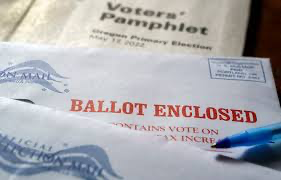
Mail-In-Voting Is On The Ballot in Oregon

In 2020, Donald Trump filed several lawsuits in an effort to stop vote-counting or force recounts after his campaign said post-Election Day increases in vote totals for President Joe Biden — many of which came from mail ballots, that were counted following the in-person votes — were evidence of fraud. 

None of the lawsuits succeeded. 

But Trump has continued to denigrate mail-in voting and promulgate theories that the 2020 election was contaminated by voter fraud, and his true believers are falling in behind him. (A humorous aside is that many Republican groups are also spending millions of dollars this year promoting voting by mail to spur turnout, particularly in competitive states)

Even though elections researchers have demonstrated that making it easier to vote by mail generates higher voter turnout for both parties, and incidences of fraud are rare, in December Trump called for an end to mail-in voting entirely. Following a “cutting off one’s nose to spite one’s face” strategy, he claimed in March that “any time the mail is involved, you’re going to have cheating”.  

Some election experts expect Trump to prematurely claim victory on the basis of early in-person votes in 2024 and to litigate the election going forward.

Now we have all three Republicans running to be Oregon Secretary of State, which oversees the state’s elections, hyping claims of voter fraud and affirming their desire to end Oregon’s long tradition of running elections by mail.

The three Republicans in the primary race are Beaverton real estate broker Brent Barker, state Sen. and rancher Dennis Linthicum and Salem business analyst Tim McCloud.

Brent Barker’s campaign website spells out his support for:

  • Statewide In-Person Voting
  • Limiting mail-in ballots to Military and Absentee Voters
  • Resetting all voter registration rolls to zero and requiring everybody to re-register
  • Hand counting tally results for all elections with observers

Linthicum, on his campaign website, pledges to:

  • Restore election integrity and promote diligent custodial ownership of election records
  • Advocate for in-person local precinct voting with ID
  • Safeguard the elections for the integrity of every Oregonian’s vote

Tim McCloud has not set up a website with campaign pledges. He was, however, a plaintiff in a lawsuit intended to end mail voting and electronic voting tabulation in Oregon.

A federal judge tossed the lawsuit, saying “generalized grievances” about the state’s elections aren’t enough to give a group of unsuccessful Republican candidates and other election deniers standing to sue.

McCloud has also commented on election issues in general. In responses to a questionnaire from KATU News, he said, “I will heavily fortify our election system against attacks, and implement fail-safe systems to prevent any disruption of our election system by bad actors. Additionally, I will advance all efforts for more access to Oregon’s public elections records, including more transparent processing of ballots, and conducting routine and thorough voter roll audits statewide.”

Whatever the merits, or failures, of mail-in voting, one thing remains true. As political analyst Larry J. Sabato, has said, “Every election is determined by the people who show up.”

America’s Elites Showcase TikTok, National Interests Be Damned.

Supporting Tik Tok is chic. 

At least that’s the message I get from the decision by Vogue’s Anna Wintour to choose Shou Chow, TikTok’s chief executive, as an Honorary Chair of this year’s over-the-top Met Gala in New York City tonight. 

TikTok declined to reveal to The New York Times its financial contribution to the Met Gala, but sponsors in previous years are known to have each kicked in roughly $5 million (TikTok and China are probably delighting in how cheaply the glitterati can be bought off).

The New York Times even took note of Chow’s high profile at the Met Gala with an article in Sunday’s paper, “TikTok’s Boss Takes On a Flashy Gig”.

All the official co-chairs of the splashy event – Zendaya, Jennifer Lopez, Bad Bunny and Chris Hemsworth – are likely on board, too, caring less about matters of substance than celebrity visibility.

All this at the same time as Washington, D.C. is focused on TikTok’s corrosive influence in the United States, its massive collection of potentially sensitive user information and its ownership by the Chinese company ByteDance. Those concerns have prompted the U.S. government to pass legislation banning the social media platform unless it is sold to a government-approved buyer.

China has criticized the congressional action, saying it undermines US claims of support for free speech, an ironic assertion since speech is tightly controlled in China, where the government maintains a vise-like grip on media, the internet, and personal expression and any dissent can result in arrest, torture and imprisonment. Moreover, American platforms such as Facebook, YouTube and X (formerly Twitter) have been banned in China for years.

(TikTok filed a federal lawsuit on May 7, 2024 challenging the constitutionality of the new law. The lawsuit accuses the government of trampling on TikTok’s First Amendment rights—as well as the free-speech rights of Americans—under the banner of national security)

Still, the style elite seem perfectly happy to help TikTok elevate its presence and influence, national interests be damned.

It may be because in their jaded eyes they see moral equivalence between the United States and authoritarian countries such as China, even though the evidence is clear that, as Douglas Murray, a British political commentator, wrote in The Free Press, “We have enormous moral authority, and…there is an oceanic gulf separating the many failures and shortcomings of the United States and the intentional and wanton taking of human life that is all too common in more authoritarian climes.”

It brings to mind Donald Trump’s admiration of authoritarian leaders. In a 2023 interview with Tucker Carlson on Fox, Carlson asked, “How smart is [Xi]? Could you tell?” “Top of the line,” Trump replied. “President Xi is a brilliant man. If you went all over Hollywood to look for somebody to play the role of President Xi, you couldn’t find [them], there’s nobody like that: the look, the brain, the whole thing.”

You may think that elites elevating questionable or authoritarian figures shouldn’t be of any concern. But people who enable dark forces, and even cheer them on, are ignoring the threat that China poses to democracy and rule of law around the world. 

China’s abdication of its responsibilities under the 1985 Sino-British Joint Declaration, where China promised to preserve the judicial system, legislative and executive autonomy, and all the key freedoms to which Hong Kong people had become accustomed, is hard evidence of China’s intentions.

The fact is that dismissal of China’s threat is naive. China is seeking to displace the United States and restore China to its rightful place. Lionizing people like Shou Chow ignores that reality. 

College Protests and the Law of Unintended Consequences

An intervention in a complex system always creates unanticipated and often undesirable outcomes.

Rabbi Danya Ruttenberg understands unintended consequences. “[W]e all know that sometimes people mean well but cause harm nonetheless—out of ignorance, out of carelessness, out of deeply ingrained ways of thinking they haven’t examined, out of an emotional reaction that got the better of their lofty intentions, or … well, the list goes on,” she says.

There’s a message here for today’s rabid pro-Palestine student protesters convinced that their actions will bring about change.

If they are trying to emulate the protests against the Vietnam war in 1960s, the bloodiest and most dramatic of which occurred at the 1968 Democratic Convention in Chicago, they’re forgetting something. Those protests may have helped drive out President Lyndon Johnson, but they undermined the candidacy of the Democratic candidate for president, Hubert Humphrey, and invigorated the conservative supporters of Republican Richard Nixon.

In his first months in office, Nixon had the U.S. military increase, not decrease, its pressure on the battlefield and, in violation of international law, ordered secret bombings of North Vietnamese camps in Cambodia.

After he took office, another 21,200 Americans died in Vietnam and elsewhere in Southeast Asia, about one-third of all American deaths in the war (58,220), along with an estimated half a million Vietnamese., 

Nixon’s aggressive pursuit of the war also led to more protests on college campuses with deadly consequences. During one of those protests at Kent State University on May 4, 1970, National Guardsmen shot and killed four students. Just 10 days later, another two students at Jackson State University were killed by police.

Paul Berman, an American writer on politics and literature, wrote in yesterday’s Washington Post, about being involved as a Columbia University student in a late April 1968 campus uprising. He wrote about how professors upbraided him, warning about the potential dangers of the protests.

“The professors were haunted by Germany and its history, ” Berman wrote.” In 1968, the defeat of the Nazis was only 23 years behind us, and the era of World War II and the catastrophe of the Jews had not yet definitively disappeared into the past — at least, not in the professors’ eyes. They wanted me to understand that Germany’s leftists in the 1930s had failed to understand Nazism’s danger. Foolish left-wing radicalism had helped undermine the German universities, which ought to have been a place of anti-Nazi resistance. They wanted me to understand, all in all, that what people think they are doing might not be what they are actually doing, and, in the name of high ideals, society might be weakened, and the worst of disasters might be brought about.”

I bring all this up to remind today’s aggrieved student protesters that their aggressive actions may not lead events to where they want them to go. 

First, despite the protesters’ assumption that their peers have their back, the annual Harvard Youth Poll, run by the Institute of Politics (IOP) at Harvard’s Kennedy School, found that  Americans between the ages of 18 and 29 are not prioritizing the Israel-Gaza conflict. 

The poll found that young people are more worried about inflation, health care, housing and gun violence. The survey listed 16 issues facing the U.S., asking respondents which of two randomly paired issues most concerned them. The conflict in the Middle East ranked near the bottom at 15th.

The general public also can’t be counted on to support the protesters. Americans are actually quite divided about how – and whether – the U.S. should be involved in the Israel-Hamas war. According to the Pew Research Center, among US adults, only 22% say Hamas’ reasons for fighting Israel are valid and roughly six-in-ten Americans (58%) say Israel’s reasons for fighting Hamas are valid. 

In this environment, the student protests, particularly if they continue with violent events at the Democratic National Convention in Chicago, may, as in 1968, lead to a conservative backlash that helps defeat President Biden and elect Donald Trump.

For most of the protesting students, that would surely be a worst case of unintended consequences. 

Oregon’s 2024 Pensions Bill Shows Need for New Conflict of Interest Rules

It looks like Oregon’s firefighters got what they paid for in the Oregon Legislature’s 2024 session.

In the last week of the session, the Legislature passed HB 4045, the Public Safety Workforce Stabilization Act, by a vote of 55-2 in the House and  25-5 in the Senate.

The bill, which Governor Kotek has not yet signed, would lower the retirement age with full benefits for firefighters with five years on the job from 60 years to 55, substantially increasing the deficit of the Public Employees Retirement System (PERS) and increasing employer costs. 

“…we believe that public servants deserve robust pay and benefits, excellent health care, and solid retirement. However, we are concerned that HB 4045 risks making the entire system insolvent through the unanticipated consequences via well intentioned policy,” commented Hasina Wittenberg, speaking for the Special Districts Association of Oregon & Oregon Fire District Director’s Association.

Left unmentioned in most media coverage of the bill is the name of the legislator behind it, Rep. Dacia Grayber, a Democrat who represents House District 28.

Rep. Dacia Grayber

Grayber’s role is relevant when you consider her occupation and examine contributions to her 2022 election campaign.

First, Grayber is a firefighter herself, a member of  Tualatin Valley Firefighters Union – IAFF Local 1660. That means she will benefit from her bill.

Dacia Grayber, firefighter (Source: IAFF.org)  

Second, at least $45,000, a hefty chunk of contributions to her 2022 campaign, came from firefighter-affiliated labor unions: 

Contributor Amount

Oregon State Fire Fighters Council $ 10,000

International Association of Fire Fighters FIREPAC. $ 10,000

Portland Metro Fire Fighters PAC (223) $ 10,000

Professional Firefighters PAC (3219) $ 10,000

Salem Fire PAC (245) $ 5,000

In a March 4, 2024, letter to the Chief Clerk of the House, Grayber declared a potential conflict of interest because she could be impacted by the retirement age change. That’s not enough.

A May 2021 report from the Secretary of State’s Audits Division noted Oregon is one of only two states that require legislators to vote on matters on which they have an actual conflict of interest.

“The vast majority of states…either require or allow legislators to recuse themselves from voting on such matters,” the report said. “Some states go further, barring lawmakers from taking part in any discussion or action on bills in which they have a personal interest.”

The audit declared that such declarations are “a legislative loophole…(that) undermines the idea that public officials should not be involved in decisions that would benefit them, their family, or close associates.” 

The report also cited a recommendation by Santa Clara University’s Markkula Center for Applied Ethics “…that a conflict of interest is not resolved by being transparent about it…”

The audit report called for the Oregon Legislature to “…consider changing statutes and chamber rules to require lawmakers to recuse themselves from any discussions, debates, or votes on such measures.”

It’s way past time for the Legislature to do so. 

Don’t Bet on Truth Social Saving You, Mr. Trump

Coincidentally, and perhaps fatefully, the ticker symbol of the newly listed Truth Social company on NASDAQ is DJT, (Donald Trump’s initials), the same ticker symbol used by Trump Hotels and Casino Resorts, which filed for Chapter 11 bankruptcy protection from creditors in federal bankruptcy court in New Jersey in 2004.

Political and financial media are speculating that investor approval of a plan to take public Truth Social, Donald Trump’s social media company, will rescue him from the potentially catastrophic burdens of his multiple court cases.  My view – don’t count on it. 

On Friday, March 22, shareholders of Digital World Acquisition Corp. (DWAC) approved a deal to merge with Trump’s media business, Trump Media & Technology Group. The primary arm of Trump Media & Technology Group is the social networking site Truth Social. The stock, with a ticker symbol of DJT, will begin trading on the trading on Nasdaq next week. 

With DJT expected to start trading with a valuation of about $5 billion, Trump’s 60% stake will be worth about $3 billion at the outset. An amazing potential windfall for Trump.

But here’s the rub.

DWAC is a shell company, what’s known as a “special purpose acquisition company” or SPAC, which will be replaced by Trump Media & Technology Group. And SPACs have had a notoriously checkered history in the market.

During 2020-2021, SPAC’s were “an unmitigated mess for investors,” according to Michael Cembalest, chairman of market and investment strategy for J.P. Morgan Asset Management.

SPACs that went public in 2020 had the worst performance, with a median loss to investors of more than 80 percent, according to Institutional Investor. Of the 431 SPACs that were able to complete a merger during 2020-2021, 90 percent had negative net returns. 

Companies brought public via SPACs also generated worse business results than their IPO counterparts, likely because they needed fast revenue growth to achieve sound profitability and didn’t get it.

The result? The De-SPAC Index, which measures the performance of companies taken public through a SPAC merger, fell 45% in 2021.

In 2022, most post-merger SPACs continued to perform poorly, with the De-SPAC Index falling almost 75%. The following year, 2023, was no more rewarding for SPAC investors, with at least 21 firms that went public by merging with special purpose acquisition companies going bankrupt. 

Likely discouraging the SPAC trend further are regulatory changes approved ty the Securities and Exchange Commission (SEC) in January 2024. 

All this means Donald Trump’s DJT will likely be an outlier in the market this year and the hype surrounding it may well burst in failure for investors, including Donald Trump. It’s best to remember, after all, that Trump Media & Technology Group booked just $3.3 million in revenue for the first nine months of 2023, according to a regulatory filing, and lost $49 million during that period. . 

Worse, Truth Social had only 494,000 monthly active US users in February 2024, and its user total has actually been shrinking, plunging 51% year over year in February,  according to Similarweb stats provided to CNN.

Then there’s the fact that Trump’ has been tied to other businesses that have gone bankrupt . “A number of companies that were associated with President Trump have filed for bankruptcy. There can be no assurances that TMTG will not also become bankrupt,” Trump Media said in its SEC filing.

Truth Social is also inextricably tied to Donald Trump himself, a 77-year-old man with an uncertain future.

The history of another hyped SPAC, EV company Lordstown Motors Corp., may be instructive.

Lordstown reverse merged with a SPAC, DiamondPeak Holdings, in October 2020 with an estimated equity value of $1.6 billion. The stock hit a peak of $31.40 a share on Sept. 21, 2020. 

Things went downhill from there. 

On June 27, 2023, Lordstown filed for Chapter 11 bankruptcy. In September 2023, Lordstown agreed to sell its assets to Delaware-based LAS Capital, whose majority equity holder was Lordstown founder and ex-CEO Steve Burns, for $10 million.

The SPAC merger agreement prohibits Trump Media’s shareholders from selling their shares for six months after the deal is done. DWAC shares closed at a high of $97.54 in March and closed at $36.94 on Friday, March 22, 2024. DJT will likely be erratic as well. And there are no sure things on Wall Street.

In other words, Donald Trump’s 60% stake in the new company could well be worth less than $3 billion six months from now…a lot less.

Maybe even zero.

An added complication, though, is that DJT’s board could grant Trump a waiver that would allow him to sell shares before the six months are up. The likelihood of a waiver being granted is enhanced by the fact that the board includes one of Trump’s sons, three former members of his administration and former GOP Rep. Devin Nunes.

Don’t count on them being too concerned about the impact of a maj0r sale on other investors.

Drug Pushers on TV: Time to Stop

Pharmaceutical companies sometimes seem to be the only advertisers on television. Should they be?

The U.S. and New Zealand are the only countries that allow direct-to-consumer prescription drug advertisements, according to USC’s Center for Health Policy and Economics. The result? Drug utilization is” highly responsive” to advertising exposure and “…those who initiate treatment due to advertising are on average less adherent, which suggests that some of the increase in utilization might be unnecessary.”

Direct to consumer prescription drug advertising also exposes prospective users to often ignored risks. 

In a current television commercial for Abbvie’s Rinvoq, prescribed to treat arthritis in adults, a woman enjoys a trek through a rock canyon and a man teaches children how to tap dance. 

It all sounds so simple. Take this and you’ll get better.

But the truth is the drug has a lot of potential hazards, including:

  • Increased risk for developing serious infections that may lead to hospitalization or death. Reported infections include active tuberculosis (TB), invasive fungal infections, bacterial, viral, including herpes zoster, and other infections.
  • Lymphoma and other malignancies.
  • A higher rate of major adverse cardiovascular events (MACE) (defined as cardiovascular death, myocardial infarction, and stroke).
  • Thrombosis, including deep venous thrombosis, pulmonary embolism, and arterial thrombosis, with many of these adverse effects serious and some resulted in death.
  • Gastorintestinal (GI) perforations. 

In another case, Bristol Myers Squibb’s newest commercial for its heart disease drug, Camzyos, has a message of hope for Mike.

In a 90 second ad, Mike, a man living with symptomatic obstructive hypertrophic cardiomyopathy, enjoys a hike through a pleasant landscape.

“There were some days I was so short of breath I thought I’d have to settle for never stepping foot on this trail again,” Mike says in a voice-over. But now he takes Camzyos and his symptoms have improved.

But Camzyos has a lot of risks, too. Side effects may include:

  • Heart failure that can lead to death, with increased hazards when Camzyos is taken with certain other medications or grapefruit juice. 
  • New or worsening shortness of breath, chest pain, fatigue, swelling in your legs, or a racing sensation in your heart. 
  • Harm to your unborn baby if you are you pregnant or breastfeeding or you plan to become pregnant or breastfeed.
  • A reduction in how well hormonal birth control works.
  • Dizziness and fainting.

And if you take too much Camzyos, you need to call your healthcare provider or go to the nearest hospital emergency room right away.

The message of both commercials? Adam Lenkowsky, executive vice president, chief commercialization officer and head of U.S. oncology at Bristol Meyers Squibb said at a Jan. 4, 2024, investor event that the point of the commercials it’s to “bring patients into treatment”. 

In other words, the companies aren’t really pitching their drugs directly to consumers. Instead, they want prospective patients to badger doctors to prescribe it.

Such appeals must drive doctors crazy. After all, if the promoted drug was a realistic treatment option, a doctor would likely have already thought of it. The commercials are an attempt to get in the middle of the patient-doctor relationship in a way that favors the drug company. 

The FDA requires that drug advertisements “…must present a fair balance of drug benefits and risks, with the most important risks provided in an audio (i.e., spoken) format.”  But counterintuitively, “… in giving a laundry list of side effects associated with any given prescription drug…consumers may actually be more likely to believe that the drug is effective in treating the condition for which it is designed,” argues Cohen, Placitella & Roth, a Pennsylvania and New Jersey law firm that handles pharmaceutical litigation. 

In 2015, the American Medical Association called for a ban of direct-to-consumer advertising (DTCA) for prescription drugs. Nevertheless, spending by the pharmaceutical industry on television advertisements has continued to accelerate, with national health care costs largely driven by drug spending.

It’s time to renew, and act on, AMA’s call.

UPDATE: Oct. 7, 2025: Trump’s Crackdown on Drug Ads Could Sting TV Networks

The pharmaceutical industry shelled out nearly $11 billion in 2024 for U.S. ads, and is on track to top that this year. 

The Department of Health and Human Services said Tuesday that it plans to close a decades-old loophole in Food and Drug Administration guidance that permits abbreviated descriptions of drug side effects in broadcast ads, as long as companies provide more information elsewhere, like online. That 1997 guidance is credited with fueling the boom in TV drug ads.  The administration move targets drug manufacturers’ TV ads and paid social-media ads from telehealth firms. In a letter to companies dated Tuesday, the FDA said social media has made it “increasingly difficult for patients to distinguish between evidence-based information and promotional material.” The pharmaceutical industry is among the heaviest advertising spenders in the U.S. When it comes to commercial spots during in-demand shows, they are even more prevalent. Pharmaceutical ads are the third-biggest category for linear TV and streaming ad spending in the U.S., according to estimates from MediaRadar.  Brian Wieser, an industry analyst, estimated that pharmaceutical ads account for 20% of all TV news advertising. The potential impact “will not go unnoticed,” he said. 

Money Talks: It looks Like a Bynum / McLeod-Skinner Race in the 5th District Democratic Primary

Janelle Bynum and Jamie McLeod-Skinner are running neck-and-neck in the money race in the contentious Democratic primary for the 5th Congressional District seat occupied by Kurt Schrader until replaced by Lori Chavez-DeRemer.

The race is a top target for Democrats trying to flip the U.S. House, which is now narrowly in Republican hands. The district, which voted for Joe Biden in 2020 and has more registered Democrats than Republicans, stretches from Bend to Portland. 

According to campaign finance numbers posted today by the Federal Election Commission (FEC), Bynum and McLeod-Skinner had raised almost equal amounts and had almost equal cash-on-hand as of the end of 2023.  Bynum had raised $439,286.38 and had $233,246.16 cash-on-handMcLeod-Skinner had raised $438,831.45 and had cash-on-hand of $242,300.59.

Two of the other three other Democrats in the primary race, Kevin Easton and Matthew Davie, haven’t yet filed their campaign finance reports for all of 2023. The third, Metro President Lynn Peterson, had raised $254,603.76, but had just $52,834.13 cash-on-hand, as of the end of 2023.

Going forward, Bynum may have the advantage given that the Democratic Congressional Campaign Committee announced its support for her on January 29, noting that it had put her on its “Red to Blue” list of key candidates running to replace Republican members as part of the Democrats’ strategy to reclaim the House majority.

Bynum may also have an edge because she’s attracting more out-of-state money. Recent out-of-state contributions include $4,500 from Brian Hairston, owner of Dunham Management Group in Englewood, NJ, $3,300 from James Williams owner of Estel Foods in Saint Louis, MO and $3,300 from Troy A. Carter Sr., a congressman from Louisiana. 

The primary winner will take on Republican U.S. Rep. Lori Chavez-DeRemer, who won her seat in 2020, defeating Democrat McLeod-Skinner 51% – 49%.

Chavez-DeRemer’s end-of-the-year campaign finance report with the FEC shows she had raised $2,529,913.60 and had cash on hand of $1,608,021.56. Her aggressive fundraising is expected to make her a strong candidate in the race against her eventual Democratic opponent. 

Despite the Democratic lead in registrations in the district, the Cook Political Report rates the race as a toss-up.