More Sex is Better, Right? More News, Too?

“The sexual revolution obviously succeeded in its aim: more freedom”, writes Rob Henderson[1], who publishes a newsletter on human nature.  “But many people conflate liberation with happiness and, sadly, the world doesn’t work that way,” Women are freer today, he argues, but they are less happy.

It’s the same with access to information. We all have access to much more information today, both free and paid, but it’s debatable whether we are better informed. 

When I was a kid in a small Connecticut town in the 1950s, we got our news facts from the Meriden Record newspaper delivered in the morning and the New Haven Register newspaper delivered in the afternoon. In the mail, we got weekly issues of the magazines U.S. News & World Report, Life and Time and monthly editions of the National Geographic and Reader’s Digest. 

We also listened to radio, mostly station WTIC out of Hartford. In the early 1950s we got a black and white TV (We didn’t get a color TV until the 1960s) and started watching evening news shows. 

Those were the days, my friend. We thought they’d never end.

We thought that was plenty to connect us with local, national and world news.

But the internet proved us wrong, at least with respect to the volume and variety of available news. Where news used to come out of a straw, now it’s spewed out of a bullhorn. It’s turning us all into nervous wrecks.

As Tom Slater, the editor of Spiked put it, with the deluge of commentary out there, “We are riven by ‘culture wars’ and hot-button topics that no one cared about five minutes ago.” 

We’re smothered in a torrent of news 24/7 from a fragmented media environment, much of it of dubious veracity.

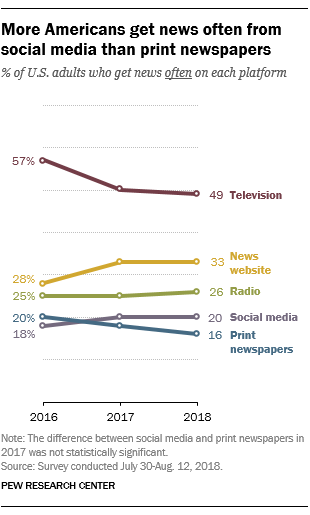
A clear majority of U.S. adults (86%) say they at least sometimes get news from a smartphone, computer or tablet, including 57% who say they do so often, according to the Pew Research Center , and a high number still get their news from television.  Americans turn to radio and print publications for news far less frequently. In 2024, just 26% of U.S. adults say they often or sometimes get news in print, the lowest number Pew’s surveys have ever recorded.

There are several different pathways Americans use to get news on their digital devices, Pew says. News websites or apps and search engines are the most common: About two-thirds of U.S. adults at least sometimes get news in each of these ways. A little more than half (54%) at least sometimes get news from social media, and 27% say the same about podcasts.

Younger people, in particular, get their news from digital devices, with 86% of people ages 18-29 and 72% of people ages 30-49 preferring digital devices as their news source. 

But is the wider availability of news making us all smarter, better informed, more responsible participants in the dialog of democracy? 

In a recent essay in The New Yorker, staff writer Adam Gopnik wrote that “the Internet age and the era of social media has led not so much to engagement as enragement, with algorithms acting out addictively on tiny tablets.” 

“The aura of the Internet age is energized, passionate, and, above all, angry,” Gopnik wrote. “The democratic theorists of old longed for an activated citizenry; somehow they failed to recognize how easily citizens could be activated to oppose deliberative democracy.”

The deluge of information posing as news has also left us in a constant rush, buried in misinformation and outright lies unchecked by gatekeepers like the editors of yore. As Hamish McKenzie, a co-founder of Substack, puts it, “With few exceptions, the media power brokers of yesterday now oversee a series of properties with dwindling reach and a limited ability to convince anyone of anything,”

One result – a growing lack of trust in all media. 

The just-released Trust in Media Survey results from Gallup “leave no doubt that members of my profession are officially America’s lowest life form,” Gopnik wrote.

The Gallup survey asked:

In general, how much trust and confidence do you have in the mass media — such as newspapers, T.V. and radio — when it comes to reporting the news fully, accurately, and fairly — a great deal, a fair amount, not very much, or none at all?

  • A great deal 7 
  • Fair amount 25 
  • Not very much 29 
  • None at all 39

That’s 68% saying they have “not very much” or “none at all” trust and confidence in mass media., which includes newspapers, magazines, radio, television, and the Internet.

In the current political environment, the fragmentation and declining reliability of the mainstream media has led to a decline of its influence. 

“One of the contradictions of the social-media age is that we can follow the campaigns incredibly closely—tracking every movement in the polls, listening to every concerning Trump remark—but somehow this flood of content makes us feel even more distant from the process, and less empowered,” Jay Caspian Kang, another staff writer at The New Yorker, asserts. “…the proliferation of content has actually weakened the mainstream media’s influence on voters, many of whom have moved on to alternative outlets of news and commentary.”

And those alternative outlets are often little more than collections of conspiratorial rubbish, like the manufactured news that Hillary Clinton was running a pizza-restaurant child-sex ring, accusations that FEMA prevented Florida evacuations in the recent hurricanes and claims that funding for storm victims was instead given to undocumented migrants. And all of this is reinforced by the echo chambers online news consumers occupy.

 “It used to be in this world that people could at least agree on the same set of facts and then they could debate what to do about those facts.,” says writer, Steven Brill. “We’re at a point where nobody believes anything. Truth as a concept is really in trouble.”

That has led to a widespread feeling of disappointment in America and its institutions.

Author and theater critic, Hilton Als, wrote of Joan Didion’s “romance with despair.” That’s where we are. Wallowing in such gloom can’t be good for this country.


[1] Rob Henderson is the author of “Troubled: A Memoir of Family, Foster Care, and Social Class.” A veteran of the U.S. Air Force, he holds a B.S. from Yale and a Ph.D. in psychology from the University of Cambridge (St. Catharine’s College).

Layoffs: Are Pamplin’s Former Oregon Outlets Next?

When Mississippi-based Carpenter Media Group announced its acquisition of Oregon’s Pamplin Media Group earlier this month, Todd Carpenter, the company’s chairman was effusive in his commitment to the continuation of quality journalism at Pamplin’s multiple Oregon new sites.[1]

“We are pleased to join this exceptional team of journalists, marketing and newspaper people in Oregon,” Carpenter said. “We share their high standards and business values, understand the importance of delivering high-quality journalism and marketing services to these communities and will work hard to support them in their efforts.”

That commitment may not hold long based on recent Carpenter actions at its Washington news properties.

According to the Seattle Times, Carpenter has just disclosed that it will lay off 62 people at Sound Publishing newspapers in Washington state, including more than half the unionized newsroom employees at the Daily Herald of Everett, WA.,  that it acquired in January. Sound Publishing operates 43 papers in Washington. 

Sound Publishing papers were already thinly staffed, the Seattle Times said, with some employing just a single reporter, so cuts may be into the bone. “To me that doesn’t look like preserving local journalism,” said Kaitlin Gillespie, executive officer of the Pacific Northwest Newspaper Guild, “but what do I know?”

On June 21, the Columbia Journalism Review reported that the Herald published a story describing the owners as having “gutted” the newsroom—but the story then disappeared from the Web, apparently at Carpenter’s request. After editors threatened to walk out, the story was republished with some modifications.

Next up on the acquisition block could be the EO Media Group, that is known to be looking for a buyer. The EO Media Group, formerly known as the East Oregonian Publishing Company, is a newspaper publishing company based in Oregon that publishes 17 newspapers in Oregon and southwest Washington.

The loss of local news across the country has had far reaching implications. “As everyone knows, the internet knocked the industry off its foundations, ” James Bennet,  former editorial page editor at The New York Times, wrote in The Economist in December 2023. “Local newspapers were the proving ground between college campuses and national newsrooms. As they disintegrated, the national news media lost a source of seasoned reporters and many Americans lost a journalism whose truth they could verify with their own eyes.”

Just since 2005, the country has lost one-third of its newspapers and two-thirds of its newspaper journalists. So far in 2023, an average of 2.5 newspapers have closed each week according to a State of Local News Report by Tim Franklin, Senior Associate Dean and John M. Mutz Chair in Local News and Director of the Medill Local News Initiative at Northwestern University.  Most were weekly publications, in areas with few or no other sources for news.

“The underlying infrastructure for producing local news has been weakened by two decades of losses of newsrooms and reporting jobs,” noted an October 2022 report from the Agora Journalism Center at the University of Oregon’s School of Journalism and Communication. “And news organizations today…often sense they are swimming against the tide of economic, technological, political, and cultural changes that threaten the long-term viability of local news production.”


[1] Pamplin news sites include: The Portland Tribune, Lake Oswego Review, West Linn Tidings, Wilsonville Spokesman, The News-Times (Forest Grove and Hillsboro), The Times (Tigard and Tualatin), Beaverton Valley Times, The Outlook (Gresham), Sandy Post, Estacada News, Columbia County Spotlight (Scappoose and St. Helens), The Herald-Pioneer (Canby and Molalla), Woodburn Independent, Newberg Graphic, Madras Pioneer, Central Oregonian (Prineville), Milwaukie Review, Oregon City News, Sherwood Gazette, Southwest Community Connection (Portland), The Bee (Portland), Business Tribune and Your Oregon News.

Could Sale of the Pamplin Media Group Threaten Local News?

The word is Pamplin Media Group, publisher of the Portland Tribune and 23 other local community papers in Oregon, is being shopped around for sale. 

Simultaneously, the Group is closing its Gresham Outlook printing facility and laying off its approximately 20 employees, an indicator of financial stress.

A Portland Tribune story noted earlier this year that the Pamplin Media Group “…has weathered numerous upheavals in the journalism business, three recessions that reduced advertising revenues and the COVID-19 pandemic that reduced revenues even more than the previous recessions.”

With all the bruising changes affecting the local newspaper industry, sale of the group may well lead to another upheaval. 

In early 2023, when Mark Garber handed off the position of president of the Pamplin Media Group to become president emeritus, he commented that when he’d started his newspaper career as a reporter in 1979, “We used manual typewriters and handed our copy to an editor, who marked it up, literally cut and pasted it, and then sent it to a human typesetter.”

The changes in the local newspaper business since those days have been massive, butchering a once robust news ecosystem in the United States.

The loss of local news has had far reaching implications. “As everyone knows, the internet knocked the industry off its foundations, ” James Bennet,  former editorial page editor at The New York Times, wrote in The Economist in mid-December. “Local newspapers were the proving ground between college campuses and national newsrooms. As they disintegrated, the national news media lost a source of seasoned reporters and many Americans lost a journalism whose truth they could verify with their own eyes.”

Just since 2005, the country has lost one-third of its newspapers and two-thirds of its newspaper journalists. So far in 2023, an average of 2.5 newspapers have closed each week according to a State of Local News Report by Tim Franklin, Senior Associate Dean and John M. Mutz Chair in Local News and Director of the Medill Local News Initiative at Northwestern University.  Most were weekly publications, in areas with few or no other sources for news.

“The underlying infrastructure for producing local news has been weakened by two decades of losses of newsrooms and reporting jobs,” noted an October 2022 report from the Agora Journalism Center at the University of Oregon’s School of Journalism and Communication. “And news organizations today…often sense they are swimming against the tide of economic, technological, political, and cultural changes that threaten the long-term viability of local news production.”

In Oregon’s current troubling time, when misinformation is on the rise, the civic damage from a decline in trusted, quality local newspaper coverage can be particularly severe. Even more so when local papers rip more of their content from national news outlets or run stories to satisfy distant corporate owners. “Communities that lack robust local news also tend to experience lower rates of civic engagement, higher rates of polarization and corruption, and a diminished sense of community connection,” the report said.

The recent acquisition of many legendary local newspapers by hedge funds and private equity groups shows what could await the Pamplin Media Group. 

The Register-Guard in Eugene was locally owned until 2018 when it was sold to GateHouse Media Inc.  In 2019, GateHouse Media’s parent company, New Media Investment Group, acquired Gannett, the parent company of USA Today and more than 100 other dailies, creating the largest newspaper company in the country, with the combined company adopting the Gannett name. 

Management of the new company was left to Fortress Investment Group, a private equity firm in New York City. Fortress, which controlled New Media Investment Group, the parent of GateHouse, was owned by SoftBank, a Japanese conglomerate. 

There were about 21,255 employees at Gatehouse and Gannett at the time of the merger; Gatehouse had 10,617, Gannett 10,638. Gannett has since dramatically cut costs, reducing its headcount to 11,200 at the start of 2023.

Over the years, the Register-Guard has suffered right along with Gannett. At the time of its sale to Gatehouse in 2018 the Register-Guard had over 40 employees. Its website currently lists just 3 News reporters, 3 Sports reporters and 1 Multimedia Photo Journalist. Hardly enough for robust local coverage.

The Alden Global Capital hedge fund is another company eviscerating local newspapers. Alden, which owns about 200 publications, including the Chicago Tribune, is the second-largest newspaper publisher in the country, behind Gannett. Alden is perhaps best known for acquiring and then gutting the Denver Post.

In July 2023, Los Angeles billionaire Dr. Patrick Soon-Shiong sold The San Diego Union-Tribune to an affiliate of the MediaNews Group, which is owned by Alden, for an undisclosed amount. The Voice of San Diego called Alden “the most terrifying owner in American journalism” and said the sale put the Union-Tribune “back in the American newspaper doom loop.” 

Word of cutbacks was swift. The same day as the sale announcement, the MediaNews Group sent an email to the paper’s employees saying cutbacks would be needed to “offset the slowdown in revenues as economic headwinds continue to impact the media industry” and informing staff that the new owner would be offering buyouts. If enough employees didn’t take buyouts, the company said it would lay off additional employees. 

As of the end of October 2023, employees estimated that somewhere between 60 and 80 people were left from the 108-person newsroom under Soon-Shiong.

The Voice of San Diego said the sale of the Union-Tribune to Alden put it “back in the American newspaper doom loop.” Let’s hope the sale of Pamplin Media Group doesn’t put its community newspapers in the same place.

It’s not just print newspapers that are dying; their readers are, too.

Cemeteries in Huntersville, NC | Gethsemane Cemetery & Memorial Gardens

Not that long ago, printed newspapers dominated the news landscape and seemed to have a promising future.

In 1940, daily circulation of print newspapers in the U.S. was 41.1 million, according to the Pew Research Center. It was a rare home that didn’t start the day with a newspaper at the breakfast table. At my home in Wallingford, CT, we had two papers delivered daily in the 1940s. In the morning, we got the Meriden Record; In the afternoon we got the New Haven Register. Established about 1812, the Register was one of the oldest continuously published newspapers in the United States.

In the mid-1980’s, weekday print newspaper circulation in the U.S. reached a peak of 63.3 million.  Americans avidly followed stories about events such as the assassination of Indian Prime Minister Indira Gandhi, the introduction of Apple’s original Macintosh personal computer (accompanied by a still heralded Orwellian-themed “1984” TV ad), the agreement between China and the United Kingdom to transfer power in Hong Kong from the UK to China in 1997 and Villanova’s stirring 66-64 upset victory over Georgetown in the NCAA championship. 

Onward and upward, thought media leaders. 

Print newspapers hung in there until the early 2000s. Then the bottom began to fall out. By 2012, daily print circulation was down to 43.4 million. By 2020, Pew Research estimated that print circulation had fallen to just under 24.3 million. What happened? The internet and age.

Print newspaper readers have always tended to be older, more affluent, and more educated. Publishers and advertisers used to like that. The problem is that as those older readers have aged and died, they have not been backfilled by subsequent generations. Instead, younger readers have been gravitating to digital communications channels.

And the shift has accelerated across print platforms where readers have been aging fast.

In a 2012 Pew Research Survey, just 23% of respondents said they read a printed newspaper the previous day. The highest readership, 48% was among those 65 and older. The lowest was those 18-24, at 6%, and 25-29, at 10%.

Pew – where people got news yesterday


The percentages saying they read a printed newspaper yesterday have continued to steadily decline.

A newer May 2021 survey revealed that most consumers never use newspapers as a source of news, and only 25 percent of adults aged 65 or above (those who engage with newspapers the most) reported reading newspapers every day. Meanwhile, even older folks are warming up to online news. Those over 50 are also warming up to the web. In 2016, 32% of the news readers in the 50+ age group expressed a preference for the web. This increased to 43% in a 2019 survey. Newspapers have become even less popular as a news source than radio, and are also among the least used daily news sources among adults aged 18 – 24.

If this young cohort keeps its print avoidance as it ages, print newspapers will eventually lose almost their entire audience.

The biggest threat is probably to local papers with smaller circulation. Papers with a significant number of print subscribers, such as the still profitable Wall Street Journal and The New York Times, are in a better position.

About five years ago, the Journal’s Editor-in-chief, Gerard Baker, was asked by a writer for the Nieman Lab whether he saw a day when there would be no print edition at all.

I don’t really foresee the day when there’s no print edition,” Baker said. ” I mean, who knows — we live in a rapidly changing world. Who can really say anything with conviction about what will be 10, 15, 20 years hence? But as things stand, we have a million print subscribers who really value the print edition of the paper. They really want it. They’re prepared to pay a significant amount of money for what they pay for a print newspaper. There continues to be strong demand for the print product, and we will continue to need to meet that demand. I don’t foresee any other changes in the foreseeable future.”

Notwithstanding this rosy prediction, in Sept. 2017 the paper announced it would stop publishing its European and Asian editions. Falling overseas sales and plunging print advertising revenue in recent years drove the decision, according to the Journal. In Oct. 2020, it took another step away from print, cutting print editions of its fashion and luxury lifestyle insert WSJ. Magazine from a dozen to eight.

Those are the drip drip signs of changing attitudes at the Journal about the viability of print.

Meanwhile, most of the paper’s subscription growth is on the digital side. In 2017, of the paper’s 2.1 million subscribers, 1.08 million were digital. Daily print readership now stands at about 734 thousand copies, while digital subscribers total about 2.7 million.

It’s a similar story at The New York Times. In 2017, the paper had 540,000 daily print and 2.2 million digital subscribers. Daily print readership now stands at about 795,000 copies, while digital subscribers total about 5.7 million.

A friend of mine told me he used to subscribe to the daily print version of the Columbus (Ohio) Dispatch, even after he moved away from Columbus, until he realized he was spending $1000 a year for the subscription. A 12-month digital subscription today is just $119.88.

In all three cases, it costs a lot less to be a digital subscriber, so you have to really love print to go that way. Fewer and fewer people do.

An added note: Covid-19 isn’t helping either. Covid-19’s devastation has hit the elderly the hardest. Of the more then 800,000 Americans who have died from Covid-19, 75% have been 65 or older, according to the Centers for Disease Control and Prevention. That’s the newspaper audience.

2020: Will the mainstream media make a difference?

trumpandreporters

There’s a lot of tortured handwringing going on among the mainstream media about how they covered the 2016 presidential race and what they need to do to fix things for 2020.

“…we have a chance to do things differently than we did the last time around – to redeem ourselves,” columnist Frank Bruni opined in The New York Times on Jan. 13, 2018. “Our success or failure will affect our stature at a time of rickety public trust in us.”

Bruni’s column focused on the role of the “mainstream, establishment media” and its responsibility to clean up its act, to avoid writing about the spectacle and cover, instead, substance, fitness for office and competing visions of government.

Sounds all very serious and high-minded. But Bruni’s angst is too late.

The fact is, what the mainstream, establishment print and television media have to say about politics simply doesn’t matter as much anymore because people are going elsewhere to find out what’s going on and what people think about it.

“The conversation that should concern everyone, in both media and politics, is not about what gets covered,” Peter Hamby recently wrote in Vanity Fair.  “It’s about what gets attention.”

“At a time when technology is transforming voter behavior at unprecedented speed, this is a problem that the mainstream media, even on its best behavior, cannot possibly solve without a drastic reimagining of what journalism is and how it reaches contemporary audiences.”

Diminishing influence

newspaperreaders1950

In 1950, almost every American household read a daily newspaper

In 1950, almost every American household read a daily newspaper. By 2000, only 50 percent of Americans read a printed newspaper on a daily basis.

As I write this in Jan. 2019, I’m sitting at a large, bustling coffee shop. A couple dozen people of all ages are busily engaged at their laptops. Not a single person is reading a newspaper.

The fact is fewer Americans read a daily newspaper today than in 1950, while the U.S. population has more than doubled. And the prognosis isn’t good. With just 2 percent of teenagers reading a newspaper on a regular basis, few are developing a newspaper reading habit.

Unlike the individualized, algorithm-determined, constantly updated news delivered to consumers online, print newspapers offer identical mass communications to their customers. And by the time the news in print newspapers reaches the intended audience, not only is it stale, but it has been superceded by newer news.

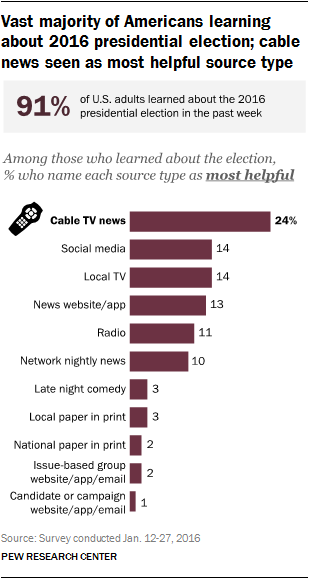
During the 2016 election, a survey of U.S. adults by the Pew Research Center revealed  that print versions of both local and national newspapers were named as key sources for election news and information by only 3% and 2% of respondents respectively. Late night comedy shows did just as well as sources at 3%.  (Maybe that explains why Sen. Kirsten Gillibrand (D-NY) announced she was forming a presidential exploratory committee during a Jan. 15 appearance on “The Late Show with Stephen Colbert”)
pewresearch2016electiontable

And even if you did read print newspapers during the election, policy issues — what the nominees would do if elected—got little press coverage in print outlets. In the 2016 general election, policy issues accounted for just 10 percent of the news coverage—less than a fourth the space given to the horserace between the candidates, according to a Shorenstein Center study.

And even if you did read print newspapers during the election, policy issues — what the nominees would do if elected—got little press coverage in print outlets. In the 2016 general election, policy issues accounted for just 10 percent of the news coverage—less than a fourth the space given to the horserace between the candidates, according to a Shorenstein Center study.

All this has translated into a drastic reduction in the influence of newspaper editorial endorsements.

“Once upon a time, a newspaper endorsement for a political candidate was about as good as it got,” Philip Bump wrote in the Washington Post  a couple weeks before the 2016 election. “In the era before the internet…big, important newspapers could shift the fortunes of people seeking the presidency. Nowadays, that’s … less of the case.”

Of the 269 U.S. newspapers that dispensed their wisdom by endorsing a presidential candidate in 2016, 240 endorsed Hillary Clinton and just 18 endorsed Donald Trump. Libertarian Gary Johnson secured nine endorsements and independent conservative Evan McMullin got one.

trumpendorsement

Of the top 100 largest newspapers in America with the largest circulations, just two endorsed Trump,

As Politico media reporter Hadas Gold tweeted when Trump’s stunning victory became clear, “… newspaper endorsements DO NOT MATTER.”

That may be partly due to slipping public respect for the mainstream media.  In a Pew Research Center survey taken shortly after the November 2016 balloting, only one in five respondents gave the press a grade of “B” or higher for its performance. Four of five graded its performance as a “C” or lower, with half of them giving it an “F.”

Declining newspaper circulation

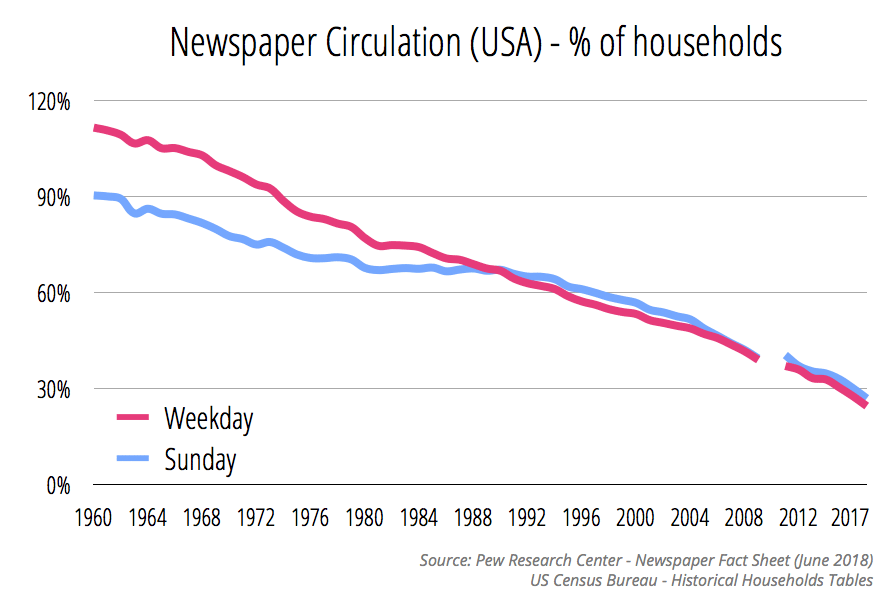
Much of the waning influence of print newspapers can also be attributed to circulation declines (or the reverse).
newspapercirculationpercentofhouseholds

In 1960, nearly 120 percent of households bought a daily newspaper (i.e. there were 1.2 papers sold per household). By 2017, fewer than 30 percent of households bought a daily newspaper.

In 1990, circulation of U.S. daily newspapers totaled 62.3 million weekday and 62.6 million Sunday. By 2009, circulation had sunk to 55.8 million daily and 59.4 million Sunday.

According to the Pew Research Center, in 2016, despite the excitement and turmoil of the national elections, weekday and Sunday circulation for U.S. daily newspapers – both print and digital – fell 8%, marking the 28th consecutive year of declines. Weekday circulation fell to 35 million and Sunday circulation to 38 million – the lowest levels since 1945.

The following year, the first of Tump’s term, was equally discouraging. Estimated total U.S. daily newspaper circulation (print and digital combined) in 2017 was 31 million for weekday and 34 million for Sunday, down 11% and 10%, respectively, from 2016.

Some of that decline is because the United States has lost almost 1,800 papers since 2004, including more than 60 dailies and 1,700 weeklies, leaving 7,112 in the country, according to The School of Media and Journalism at UNC.

California lost the most dailies of any state. In one case, the 140-year-old, 500-circulation Gridley Herald used to serve Gridley (population 6,000) in the central California county of Butte, 60 miles from Sacramento. On Aug. 29, 2018, the paper’s staff and the community were notified by the paper’s owner, GateHouse Media, that the final issue of the twice-weekly paper would be published the next day.

Daily newspaper circulation in California totaled about 5.7 million 15 years ago. In 2018, that was cut in half to 2.8 million.

If print circulation continues to drop at current rates, as many as one-half of the nation’s surviving dailies will no longer be in print by 2021, predicts Nicco Mele, director of the Shorenstein Center for Media, Politics and Public Policy at Harvard University..

One of the most striking examples of decline is in Silicon Valley. The San Jose Mercury News, rebranded as The Mercury News in 2016, was once an influential publication with about 400 reporters, editors, photographers, and artists.

According to The Columbia Journalism Review, the Mercury News was one of the first daily newspapers in the U.S. with an online presence, the first to put all its content on that site, the first to use the site to break news, and one of the first to migrate its growing online content to the web.

Its commitment to innovation and hard news led to daily circulation of 200,258 in 2009 making it the fifth largest daily newspaper in the United States.

But subsequent years of bad business decisions, declining classified advertising (including job listings), layoffs, McClatchy’s purchase of the paper’s owner, Knight Ridder, in 2006, and the subsequent sale of the Mercury News to the MediaNews Group caused the paper to slip. “…sadly the San Jose Merc is a mere shadow of its former self,” commented one online reviewer.

Not that long ago, the San Jose paper proclaimed itself “The Newspaper of Silicon Valley,” media business analyst Ken Doctor wrote in Newsonomics. “Silicon Valley has done quite well, becoming the global economic engine and driving great regional affluence. But the economically fecund region has become — in less than a decade — a news desert.”

Here at home, The Oregonian, a paper with a long and storied history, is a story of decline, too.

oregonianbuildingold

The Oregonian Building, at the corner at the intersection of S.W. Sixth and Alder, occupied by the paper during 1892-1948.

In 1950, when Advance Publications bought the paper, its daily circulation was 214,916. For quite a while, things looked promising.

I joined The Oregonian as a business and politics reporter in 1987. It was a robust, well-respected paper, with a proud past and a much-anticipated future. Daily circulation was 319,624; Sunday circulation 375,914.

When I left the paper 10 years later in 1997 to take a corporate communications job, daily circulation was 360,000, Sunday circulation 450,000. It looked like the paper was on a roll.

But good times were not ahead. By 2012, daily circulation had sunk to 228,599, only slightly higher than in 1950. In subsequent years, daily circulation continued to slump, despite robust population growth in the Portland Metro Area.

Meanwhile, talented reporters have fled in droves, some pushed out, others motivated by buy-outs. At the same time the once powerful paper’s clout has diminished as it has abandoned rural Oregon and 7-day-a-week print distribution.

By 2018, The Oregonian had a print circulation of just 158,000 and distributed  to 15 fewer counties in Oregon and Washington than it did in 2004, when it had a circulation of 338,000, according to a UNC report on The Expanding News Desert.

A few smaller local Oregon papers are thriving, but most are suffering, too. And all of them have a tough time covering state and national politics consistently and with any depth.

Oregon Public Broadcasting OPB recently reported that Western Communications, which owns seven newspapers across the West, including the Bulletin in Bend, the Baker City Herald and the La Grande Observer, “is on the brink of foreclosure.” The company hasn’t paid nearly $1 million owed in local property taxes and interest and is between three and five years behind on taxes in counties across Oregon, OPB reported.

Comprehensive political coverage by the Eugene Register Guard is threatened, too. On March 1, 2018, GateHouse Media, the same company that closed the Gridley Herald, acquired the Register Guard, which had survived more than 90 years of independent, family ownership.

GateHouse publishes 130 daily newspapers. It has a reputation for tightfisted financial management accompanied by staff layoffs. It’s impact on the Register Guard has fit that pattern. In Dec. 2017, before the GateHouse takeover, the editorial and news staff at The Register-Guard totaled 42, according to the paper’s staff directory. Today the directory lists 27, of which just 12 are identified as reporters..

Not only has the Register Guard staff shrunk; so has its daily circulation, dropping from 54,325 in 2011 to 41,280 today.

“What’s happening with the Guard isn’t unique to the Guard,” Tim Gleason,professor and former dean at the University of Oregon School of Journalism and Communication, told the Eugene Weekly. “It’s what’s happening all over the country as these venture capital firms buy newspapers and then largely gut them.”

Of course, newspapers are being gutted whether or not they are investment targets.

In early January 2019, the Dallas Morning News eliminated 43 jobs, according to the Columbia Journalism Review, half of them in the newsroom, with the cuts  hitting reporters covering immigration, transportation, the environment, and the courts.

On Friday, February 1, The McClatchy Company, which owns properties such as the Miami Herald and the Kansas City Star, emailed staffers to announce that 450 employees would be offered voluntary buyouts as part of a “functional realignment,” essentially signaling that the jobs have been marked out of the budget. The news was first reported by the Miami New Times.

If print newspaper circulation across the board continues to drop at current rates, as many as one-half of the nation’s surviving dailies will no longer be in print by 2021, predicts Nicco Mele, director of the Shorenstein Center for Media, Politics and Public Policy at Harvard.

None of this is good news if you want an educated, informed public in a position to make wise judgments about public policy.

“The way to prevent irregular interpositions of the people is to give them full information of their affairs through the channel of the public papers, and to contrive that those papers should penetrate the whole mass of the people,” wrote Thomas Jefferson in 1787.

That is as true today.

How about network television news?

Given the decline of local print media, local network TV news is one of the few remaining sources of locally-focused journalism covering political issues, but local TV news has been experiencing declines as well.

Just from 2016 to 2017, the portion of Americans who often rely on local TV for their news fell 9 percentage points, from 46% to 37%, according to the Pew Research Center. Still, local tv news shows have multiple opportunities to cover educate their audience. The problem is that covering public policy is rarely their forte and it’s not what their audience is seeking.

Instead, local TV news is the outlet of choice by adults for weather, breaking news and traffic reports, although young adults are more likely to turn to the Internet, according to Pew Research.

Public policy and politics coverage is also suffering with a decline in the audiences for the national network news shows of NBC, ABC and CBS, although some scholars believe television news viewing has little effect on issue learning. In other words,  watching increasing quantities of television news will not lead to greater knowledge about political issues because of the paucity of real issue information. You may know more about polls and personalities, but not so much about political issues that affect your life.

Remember when the family used to gather in the living room every night for the evening news, either the Huntley-Brinkley Report, CBS Evening News with Walter Cronkite or ABC Evening News with Frank Reynolds and Howard K. Smith? That was so long ago.

family-gathered-around-tv-500x214

All three network evening news shows have been losing audience steadily since then. By 1998, the three network evening newscasts reached a combined average of only about 30.4 million viewers in a country with a population of 276 million.

In 2016, even with a turbulent presidential campaign, the average viewership for the ABC, CBS and NBC evening newscasts was 24 million, according to a Pew Research Center  analysis.

Compare that to the ratings of a single showing of 2016’s number one primetime TV show, The Big Bang Theory, which averaged 19.9 million viewers, or with Super Bowl 50 on Feb. 7, 2016, which got 112.6 million average viewers, according to Nielsen.

By the 2017-18 television season, ABC’s evening news had an average of 8.6 million viewers, NBC Nightly News 8.15 million and CBS Evening News 6.2 million. That’s a total of 22.95 million.


lonesomerhodes

Lonesome Rhodes, a master manipulator.

In Elia Kazan’s classic movie “A Face in the Crowd,” Lonesome Rhodes, played brilliantly by Andy Griffiths, rises from an itinerant Ozark guitar picker to a local media rabble-rouser to TV superstar and a political power. “I’m not just an entertainer. I’m an influence, a wielder of opinion, a force… a force!”, he exclaimed at one point.

Newspaper publishers and TV news anchors may once have felt the same way, but their days are numbered.

This doesn’t mean, however, that the demand for news is going to collapse. It just means there’s going to be a need for more imagination in formatting and delivering it in ways that grab an audience and rewards them for their attention.

Vanity Fair’s Peter Hamby cited a twice-daily news show produced by NBC that runs on Snapchat. According to Digiday, the brief show, Stay Tuned, was created specifically for the vertical-screen mobile experience. In 2018, Stay Tuned averaged 25 – 35 million unique viewers per month on Snapchat, according to data provided to NBC News by Snap. Only one-third of that audience also watches, reads or listens to NBC News content on other platforms, so two-thirds are a new NBC audience.

To top it off, about 75 percent of the “Stay Tuned” audience is under 25 and 90 percent is under 34, according to Snapchat, a significant accomplishment given that reaching younger audiences has provers to be a challenge for traditional print and network TV.

So the future isn’t all grim. It will just be different.


Trump’s seven words: Who you gonna believe?

Ghostbusters-2-01-4

It’s not easy being right.

The Washington Post reported on Dec. 6 that, “The Trump administration has informed multiple divisions within the Department of Health and Human Services that they should avoid using certain words or phrases in official documents being drafted for next year’s budget.”

According to the Post, officials at the Centers for Disease Control and Prevention were told seven words or phrases were prohibited in budget documents: “vulnerable,” “entitlement,” “diversity,” “transgender,” “fetus,” “evidence-based” and “science-based.”

I’ve no doubt the two reporters who wrote the Post’s story, Lena H. Sun and Juliet Eipperin, were roundly celebrated for the scoop by their colleagues in the newsroom. It’s also likely that the Post was pleased to see its story picked up by multiple other major and minor newspaper, television and social media outlets.

I thought it was fascinating, too, partly because it tied in with all the current discussion about the misuse of words and the 1984 parallels.

“We’re becoming Venezuela, where doctors are warned not to diagnose a patient as suffering from ‘malnutrition’, likely because it would highlight the widespread hunger in the country where, according to a horrific story in the New York Times, starving children are regularly brought to hospital emergency rooms,” I wrote in a post on my blog.

But was the Washington Post’s story true?

On Dec. 18, National Review, a conservative publication said emphatically, “No”.

In a story titled, “No, HHS Did Not ‘Ban Words’,” Yuval Levin, the editor of National Affairs, a quarterly journal of essays on domestic policy and politics, forcefully challenged the Post’s version of events.

Levin, after talking with some HHS officials, argued that the budget office at the Department of Health and Human Services (HHS) sent divisions of the department a style guide to use in their budget-proposal language and “congressional justification” documents for the coming year. That style guide set out some words to be avoided, Levin said, because they are frequently misused or regularly overused in departmental documents. “The style guide does not prohibit the use of these terms, but it says they should be used only when alternatives (which it proposes in some cases) cannot be,” Levin wrote.

Why avoid certain terms? “The common practice of substituting the term “vulnerable” for “poor”, for example, has a long history of annoying some Republicans on Capitol Hill, and presumably that accounts for the instruction to avoid it in congressional-justification documents,” Levin said. In other words, he said, it wasn’t that retrograde Republicans in the Trump administration ordered career CDC officials not to use these terms but that career CDC officials assumed retrograde Republicans would be triggered by such words and, in an effort to avoid having such Republicans cut their budgets, reasoned they might be best avoided.”

“If all of that is correct… it does make for an interesting story,” Levin said. “But it’s not nearly as interesting as the Washington Post made it seem, and it doesn’t point to quite the same lessons either. In fact, it probably tells us more about the attitudes and assumptions of the career officials in various HHS offices than about the political appointees of the administration they are now supposed to be working for.”

So, slightly modifying the Ghostbusters line, “Who you gonna believe?”

With all the attention being given to so-called “fake news,” it’s becoming harder to know what’s true and what’s not. Sure, there are carefully planted tweets and Facebook posts that are clearly false, items posted not to inform but to sway public opinion. But what about all the stories by so-called legitimate media sources that, when closely examined, seem to some to be more an effort to advance an ideological agenda

The Post and the New York Times, for example, have come under fire from critics arguing that they are increasingly functioning as public relations arms of the Democratic National Committee. Equally, Fox News is routinely accused of just the opposite.

“Since its 1996 launch, Fox has become a central hub of the conservative movement’s well-oiled media machine,” says FAIR, a group that criticizes media bias from a progressive viewpoint. “Together with the GOP organization and its satellite think tanks and advocacy groups, this network of fiercely partisan outlets—such as the Washington Times, the Wall Street Journal editorial page and conservative talk-radio shows like Rush Limbaugh’s—forms a highly effective right-wing echo chamber.”

Perhaps we are just returning to the beginning.

The first newspaper produced in North America was Publick Occurrences, Both Foreign and Domestick, published on September 25, 1690, by Boston printer Benjamin Harris. The colonial government objected to Harris’s negative tone regarding British rule and the newspaper was banned after one issue.

Subsequent newspapers printed during the colonial period were highly opinionated, generally arguing one political point of view or aggressively pushing the ideas of whatever party subsidized the paper.

Mitchell Stephens, a New York University journalism professor and the author of History of News, said the purpose of newspapers “changed to the political and polemical after 1765—around the time of the Stamp Act-as tensions snowballed.”


“As the century began, the fledgling colonial press tested its wings,” James Breig, a newspaper editor, wrote in the Colonial Williamsburg Journal. “A bolder journalism opened on the eve of the Revolution. And, as the century closed with the birth of the United States, a rancorously partisan and rambunctious press emerged.”

It looks like it’s back.