“We have the best economy maybe in the history of the world,”President Trump insisted during his 60 Minutes interview on Nov. 2. Oregonians and other Americans who depend on food stamp benefits under SNAP, the Supplemental Nutrition Assistance Program, likely beg to differ.
While President Trump and his entourage were enjoying an over-the-top “Great Gatsby”-themed Halloween party at Mar-a-Lago last week, millions of Americans were worrying about the loss of their SNAP food benefits. The timing could not have been more unseemly.
On. display at Mar-a-Lago. “‘She’s got an indiscreet voice,’ I remarked. ‘It’s full of—’ I hesitated. ‘Her voice is full of money,’ [Gatsby] said suddenly.” – F. Scott Fitzgerald, The Great Gatsby
President Trump’s Great Gatsby-Themed Halloween Party at Mar-a-Lago, 2025
One-sixth of Oregon’s population. 0.16, 16%. No matter how you put it, a lot of Oregonians depend on SNAP benefits.
Currently, benefits average just over $6 per person per day. In fiscal year 2024, that translated into about 757,000 of our neighbors, including about 210,000 children and 130,000 adults aged 65 and older.
With the federal government shutdown, Oregon and other states have run out of money to distribute to the more than 42 million Americans who rely on SNAP. The Department of Agriculture has claimed it can’t spend $6 billion sitting in reserves, but two federal judges have ordered the Trump administration to use contingency funds to fund SNAP during the shutdown. The Trump administration responded in court filings that it would use contingency funds to provide partial SNAP benefits in November.
The administration said it would send partial payments this month, but eligible households may receive just half of their usual amounts and the partial payments could take weeks to arrive. (As of mid-day on Nov. 4, however, Trump muddied the waters by posting on Truth Social, “SNAP BENEFITS…will be given only when the Radical Left Democrats open up government, which they can easily do.”)
Further complicating matters, on Nov. 5 The New York Times reported that some normal food stamp recipients may receive nothing at all in November because of the way that the White House has chosen to pay partial benefits during the government shutdown.
“The problem stems from the way in which the administration has opted to fund benefits, and the intricate rules it has foisted on states this week to calculate aid amounts for the 42 million people enrolled in SNAP,” the New York Times said. “For nearly 1.2 million households, or almost five million people, the changes may result in benefits of $0 in November, according to the Center on Budget and Policy Priorities, a left-leaning group, which analyzed the government’s public filings and shared its findings early with The New York Times.”
On November 6, the situation changed again when a federal judge, John McConnell, ordered the Trump administration to fully fund November’s food-assistance benefits by November 6. Of course, the administration’s lawyers told the court it was appealing the order.
While the legal wrangling persists, it’s appalling that so many Oregonians, the majority children, disabled or seniors, are in such dire straits that the federal government has to step in to help them get enough to eat.
According to an analysis of USDA data by the Center on Budget and Policy Priorities (CBPP), Oregon ranks third in the percentage of the state’s population that relies on SNAP. Only New Mexico and Louisiana are in front of Oregon.
Meanwhile, in a reflection of the number of Oregonians living on the edge, Oregon food banks report they are being hit with a deluge of SNAP participants desperate for food, even though they got their last benefits as recently as last month. At the same time, food banks are seeing some of the thousands of federal employees who are going without pay during the government shutdown. That’s all consistent with the Federal Reserve’s report on America’s economic well-being in 2024 that found 37% of Americans couldn’t pay for an unexpected $400 expense without turning to a credit card and 60% of adults said that changes in the prices they paid compared with the prior year had made their financial situation worse.
In Oregon, high unemployment is partly to blame.
According to the most recent data from the Bureau of Labor Statistics, Oregon’s unemployment rate was 5.0% in August 2025, higher than the national rate of 4.3%, and has been climbing steadily for more than two years. The rate has been influenced by increasing layoffs and an overall cooling off of the state’s labor market. Oregon unemployment rate is higher than every state in the Pacific Northwest., including Alaska, Idaho, Montana, and Washington. .Too many Oregonians are also working less than they’d prefer, leading to a rising so-called “underemployment rate”.
Oregon’s economy also relies heavily on service, retail, and tourism jobs , many of which are seasonal, that pay lower wages, even with Oregon’s mandated hourly wage levels, resulting in many hard working families falling below the income threshold for SNAP eligibility.
And Oregon’s economy is retreating, diminished from job losses at Intel, PacificSource, Wells Fargo, Nike, OHSU and even Powell’s Books, which has had four rounds of layoffs this year. Despite President Trump’s claim he is leading a resurgence of manufacturing in the US, U.S. manufacturing has contracted for seven straight months—the exact opposite of what Trump and other tariff proponents predicted.
Overall, the number of jobs U.S. employers have announced they would cut in 2025 has reached 1,099,500, up 65% from the first 10 months of 2024, according to Challenger, Gray and Christmas, a Chicago-based outplacement firm.
Aggressive outreach is another reason for high SNAP usage. Some see getting more people on SNAP as a good thing, but that’s questionable when food stamp enrollment has surged from 17.3 million individuals in 2001 to 41.7 million in 2024, and that in the same period enrollment as a percentage of the population has doubled from 6.1 % in 2001 to 12.3 % in 2024.
Oregon’s SNAP error rate in fiscal year 2024 was 14.06%, eighth-highest in the nation. That was down from error rates of 16.7$ in fiscal year 2023 and 22.9% for fiscal year 2022, but there’s still really no excuse for such high error rates.
If anything, then, increasing dependence on food stamps by Oregon’s population reflects a failure of the state’s economy in providing opportunities for its people and holding down taxes. That’s not a good thing.
The annual release of data required by the SEC on the pay ratios of CEOs and the median worker at their company is out.
The data show that Nike CEO Mark Parker makes a heck of a lot more than a typical Nike employee. The estimated ratio of Parker’s annual total compensation ($9,467,460) to the median annual total compensation of all Nike employees ($24,955) was 379 to 1 in fiscal year 2018.
Comcast CEO Brian Roberts did even better in 2018. His compensation package ($35.003,000)compared with Comcast’s median employee’s compensation ($82,205) resulted in a CEO pay ratio of 426 to 1.
As expected, the release of the data is spurring all sorts of overheated grievances.
“Look at all the overpaid, greedy CEOs.” “The facts are in. Inequality is destroying America. This proves it.”
There’s no question that CEO compensation has been escalating.
The problem is the comparative CEO-worker data generated in response to the Dodd-Frank Wall Street Reform and Consumer Protection Act and implemented by the SEC is seriously flawed, misleading and unreliable and its collection a colossal waste of businesses’ time and money.
Passed in 2010 during the Obama administration, the pay ratio requirement took effect in 2017. Ostensibly, the purpose was to ensure that the devastating 2008 financial crisis wouldn’t be repeated, to increase the transparency of executive compensation and to provide investors with another piece of information to consider when determining whether the compensation of their CEO is appropriate.
“This simple benchmark will help investors monitor both how a company treats its average workers and whether its executive pay is reasonable,” said Sen. Robert Menendez (D-NJ), who introduced the pay ratio provision in the Dodd-Frank Act.
But the numbers really say nothing useful about how a company treats its workers or whether the CEO’s pay is reasonable.
That’s partly because the real motive of the pay ratio advocates was to give the left a tool to propel its inequality agenda. The proponents wanted to promote envy and class warfare, to argue that the once-great America as a land of opportunity is vanishing and that more aggressive government intervention guided by liberal principles is necessary.
As SEC Commissioner Michael S. Piwowar said in a dissenting statement on the pay ratio rule when it was approved, “Today’s rulemaking implements a provision of the highly partisan Dodd-Frank Act that pandered to politically-connected special interest groups and, independent of the Act, could not stand on its own merits. “
“The bottom line is that this is one of the sillier and more pointless disclosures that I have ever seen,” David Yermack, a professor of finance at NYU’s Stern School of Business, told The Atlantic.
Nike, for example, spelled out all sorts of qualifiers in disclosing its pay ratio figures:
“The SEC rules for identifying the median compensated employee and calculating the pay ratio based on that employee’s annual total compensation allow companies to adopt a variety of methodologies, to apply certain exclusions, and to make reasonable estimates and assumptions that reflect their compensation practices. As such, the pay ratio reported by other companies may not be comparable to the pay ratio reported above, as other companies may have different employment and compensation practices and may utilize different methodologies, exclusions, estimates, and assumptions in calculating their own pay ratios.”
The ridiculousness of the whole exercise is illustrated by some of the sharp swings in some companies’ ratios from 2017 to 2018, as the Wall Street Journal recently reported.
Shipbuilder Huntington Ingalls Industries Inc. and potash producer Mosaic Co.reported, for example, that the typical worker got half as much in 2018 as the year before. At Honeywell International Inc.,the data showed the typical worker’s compensation was 33 percent higher in 2018 than 2017.
The fact is, every company calculates the pay ratio differently, partly because the SEC rule gives companies wide leeway in identifying median workers.
Some year-to-year ratio fluctuations reflect acquisitions or spinoffs that revamp a company’s workforce. Others are attributable to whether the median employee has a traditional pension plan, or new ways of identifying that middle employee.
Companies don’t have to account for independent contractors if they don’t set their pay, for example, so, a company with a highly paid CEO and loads of low-paid independent contractors can massage its numbers to look better.
Companies can also manipulate the numbers by identifying their median worker in a variety of ways.
“To identify the median employee, the rule would allow companies to select a methodology based on their own facts and circumstances,” the SEC rule says. “A company could use its total employee population or a statistical sampling of that population and/or other reasonable methods. A company could apply a cost-of-living adjustment to the compensation measure used to identify the median employee.”
The pay ratio numbers also can fluctuate when there are different types of businesses. For example, at Goldman Sachs, an investment banking, securities and investment management firm where most employees are highly educated and highly paid professionals, the pay ratio figure will obviously be lower than at McDonalds where most employees are less educated and earn modest wages.
Businesses that employ a lot of part-time or seasonal workers, or that employ a lot of foreign workers in countries with comparatively lower wages, will also have high ratios.
Then there are the compliance costs borne by companies collecting and submitting the data. “The SEC total initial cost of compliance for all 3,571 registrants affected by the Section 953(b) requirements is expected to be approximately $1,315 million, “ the SEC said in the Final Rule in 2015.
To top it all off, the disclosures required by the SEC rule do little to help investors make decisions on trades. Not only is the pay ratio calculation based on wildly different data used by different companies, but CEO-worker pay ratios are not especially reliable indicators of how a company will perform.
It’s not that reporters and editorial writers don’t know the pay ratio numbers are pretty much worthless and politically motivated. It’s just that a story that gives them a chance to rail about inequality is too much to miss.
As Stanford University Professor Joseph Grundfest said when the SEC rule was finalized in 2015, “Ultimately, the ratios that companies will disclose in their SEC filings will not be grist for meaningful debate so much as fodder for shocking headlines. Individually, factoids about executive compensation can be truly, deeply bananas, and some media outlets capitalize on that.”
Portland’s pay ratio surcharge – more lunacy
Protesters demonstrate in Portland.
Given the unreliability of the pay ratio numbers, Portland’s pay ratio tax is a farce, too, just another tool to raise revenue.
In December 2016, the Portland City Council voted to impose a surtax on CEO compensation that would be added to the city’s business tax on publicly traded companies whose chief executives earn more than 100 times the median pay of their employees.
The surcharge was set at an additional 10 percent in taxes if their CEO’s compensation is greater than 100 times the median pay of all their employees and 25 percent if the pay ratio is greater than 250 times the median.
The city initially figured the surtax would generate about $2.5 to $3.5 million per year.
Only Commissioner Dan Saltzman showed wisdom in voting against the proposal by then-Commissioner Steve Novick.
As noted earlier, Portland’s tax is based on unreliable data and will fail miserably in meeting Novick’s hope that it “would prod corporate America back to equitable pay scales.” The tax is surely irritating to businesses, but it’s not likely to change their compensation practices.
Moreover, even if some shamed companies reduce their CEO’s pay and spread around the cut, it won’t mean much to other employees.
For example, The Kroger, Co which owns Fred Meyer, reported its CEO W. Rodney McMullen’s pay was $11,534,860in fiscal year 2018, which Kroger said was 547 times its median worker’s pay of $21,075.
Even if Kroger reduced its CEO’s pay to $1 million, and distributed the rest equally to Kroger’s 453000 employees, they would each see an annual raise of just $25.46.
In other words, the surcharge is just another way to pad the city’s coffers.
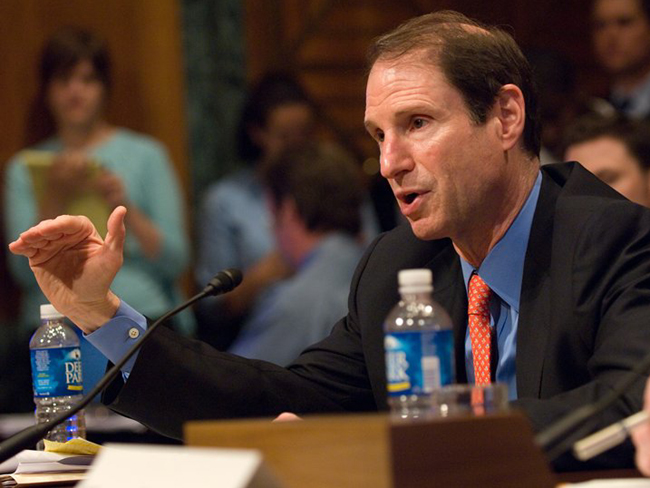
Senator Ron Wyden (D-OR) is running for-reelection. So he’s hitting up his constituents.
“Sign the petition calling for affordable housing solutions,” his email said on Sunday. “We need more affordable housing and we need it now. I’ve proposed new legislation to encourage, support, and accelerate the construction of affordable housing nationwide.”
And if you sign the petition, he asks for money, with choices ranging from $5 to $500 or more.
If you sign the petition, you also get a thank you message and another request for money, this time with choices of $7, $24, $36 or $125.
All these appeals from a Senator who, according to OpenSecrets.org, had $7,557,657 of campaign contributions in the bank as of his last fundraising report on June 30. In comparison, his Republican opponent in this 2016 Senate race, Mark Callahan, had a measly $4,546 on hand.
And just 27 percent of the money Wyden has raised for his current race has come from donors within Oregon, with 73 percent ($5,420,369) coming from out of state.
In the meantime, while asserting that big donors undermine democracy, Wyden has been pulling in money from big donors big time.
Over the past six years, the biggest donors have been some really big players, like Nike Inc., Intel Corp., and Berkshire Hathaway.
If you think about it, why does Wyden, who’s 67, need such a big war chest? If he’s re-elected, as he likely will be, he’ll be 73 at the end of his next term and will have spent 42 years in Congress. Won’t that be enough?
If Wyden truly believes there’s too much money corrupting politics, with big donors of particular concern, why not take a break from fundraising? A lot of us would welcome the time-out.
(Good grief. I just got one more email fundraising plea from Wyden. This time, he’s asking me to contribute $25, $50, $100, $250, $500, $1,000 or more. Will the next plea be for $10,000 or more?)
Donations to Senator Ron Wyden 2011-2016 (Source: OpenSecrets.org)
These numbers don’t reflect donations from organizations themselves, but from the organizations’ PACs, their individual members or employees or owners, and those individuals’ immediate families. Organization totals include subsidiaries and affiliates.
Members of the City Club of Portland voted Tuesday to support Measure 97, which proposes imposing burdensome gross receipts taxes on Oregon businesses that could total $6.1 billion in the 2017-19 biennium.
It’s hard to believe that such a distinguished civic group could support such a flawed scheme.
Oregon’s General Fund expenses are expected to grow by about 14 percent, or $2.7 billion, in the 2017-2019 biennium. The budget anticipates only about half that will be covered by new revenue, translating to a projected $1.35 billion shortfall.
Given such things as public employee pay increases, higher Medicaid expenses, and pension rate increases for state government and school district employees covered by PERS, some additional revenue may be justified. But not $6.1 billion. That’s highway robbery.
And collecting the additional revenue through an odious gross receipts tax, which ignores a business’s profitability, or lack thereof, is irresponsible. How well-educated City Club members, many of whom presumably work in the private sector, could endorse such a tax is inexplicable.
Also damning is the uneven applicability of Measure 97’s proposed taxes. Taxation of just C Corporations would create a vastly uneven playing field for Oregon businesses.
As the minority noted in the City Club’s committee report, “Many large businesses are LLCs and S corps, and they often compete with C corps in similar sectors. For example, Fred Meyer (Kroger) and Safeway grocery store chains are C corps and would pay the tax. New Seasons Market, a B corporation,47 and Albertson’s, a limited liability corporation (LLC),48 would not pay it. “
The flaws in the City Club’s arguments in favor of Measure 97 are evident right off the bat.
The City Club committee charged with determining the merit of Measure 97 said it “…presents a long-awaited opportunity to assure adequate investment in the health, education and the well-being of Oregonians.”
Nonsense!
The fact is there is absolutely no guarantee the legislature will apply Measure 97 revenue to early childhood through grade 12 public education, healthcare and services for senior citizens, in the coming years as the measure states.
If Measure 97 is approved by voters, the Legislature can appropriate its revenues “in any way it chooses,” Legislative Counsel Dexter Johnson said in an Aug. 1 letter to Rep. John Davis, R-Wilsonville, a member of the House Committee on Revenue. Not only are Legislators “not bound by the spending requirements” of Measure 97, they can “simply ignore” them,” Johnson added.
What is most likely is that over time Measure 97 revenue would be spread around like honey in response to pressure from self-serving special interests with access to, and influence on, decision-makers.
Rep. Mitch Greenlick (D-Portland) said when endorsing the measure, “If that passes, we’ll have a lot of money to pay for stuff.” The hundreds of groups that spend millions annually lobbying the legislature will have plenty of ideas on what “stuff” to spend the money on.
There’s also a high likelihood that some of those lobbyists will seek exemptions from all or part of the tax, just as Nike cut a deal with former Gov. John Kitzhaber and the legislature in 2012 to protect it from changes in the way the state calculates the company’s state income taxes.
Gov. Brown has already said she’d favor some “technical adjustments” if Measure 97 passes, including:
Allowing businesses to subtract a portion of their Oregon payroll from their corporate tax bill.
Prohibiting businesses from changing their corporate status “for the primary purpose” of evading the new gross receipts tax. (As written, the measure would exempt “benefit corporations” from the new tax)
Helping out software companies in Oregon by classifying sales of their services based on the location of the purchaser, rather than the location of the company selling the service.
The majority of the City Club committee that recommended a “yes” vote on Measure 97 also argued that “… the potential benefit of adequately funded state services outweighed any of the tax’s potential detrimental effects and that the consequences of prolonging the state’s revenue shortage where (sic) too great.”
Outweighed “any of the potential detrimental effects”? In other words, satisfying the state’s greed with $6.1 billion in additional revenue per biennium is more important that an expected dampening of income, job and population growth. Give me a break.
Finally, in endorsing Measure 97, the City Club is giving an easy out to liberal Democrats who want to avoid tackling difficult spending issues.
For example, as the minority pointed out, the unfunded PERS liability is $21-$22 billion. If nothing is done to deal with the creeping cost of PERS, even the Measure 97 windfall won’t be enough to avoid a funding crisis.
It’s not as though Oregon’s budget problems snuck up on the Democrat-controlled Legislature, leaving it no choice but to abdicate its responsibilities and leave it to a poorly crafted union-inspired ballot measure to fix things.
It’s been abundantly clear for a long time that trouble was coming. Where was the grit to fix things right?


 Appalling! What else can you say?
 ThinkingOregon