Oregon Bill to Give Free Food to Children in the Country Illegally Is a Mistake

Oregon’s Democratic lawmakers just can’t seem to stop finding new ways to spend money.

Oregon is facing a slew budget troubles. Congressional Republicans want to require an increase in state support for some federal programs. A budget reconciliation bill under consideration by Congress would put Oregon at risk of losing more than $1 billion in the 2027-29 biennium because of a provision that penalizes states that provide health insurance to undocumented immigrants. But Oregon Democrats keep coming up with proposals to spend money on dubious programs.

“Right now, some Oregonians face hunger on a daily basis (OCPP) simply because of where they were born,” the Oregon Center for Public Policy says, pleading for residents to “Tell the Oregon Legislature to pass Food for All Oregonians, SB 611“.

As originally introduced, the bill would have provided nutrition assistance to residents of Oregon who are under 26 years of age or 55 years of age or older and who would qualify for federal Supplemental Nutrition Assistance Program benefits but for their immigration status. Rather than just killing the bill, it was subsequently amended to specify that it would apply only to children six and younger. But it’s still a bad bill.

OCCP, which claims to have a “vision of an equitable Oregon”, doesn’t seem to have a vision of an Oregon that lives within its means. Nor, apparently, do a lot of other liberal groups across the state. 

Undocumented immigrants in the United States are generally ineligible for federal Supplemental Nutrition Assistance Program (SNAP) benefits, formerly known as the Food Stamp Program. Only U.S. citizens and certain lawfully present non-citizens may receive SNAP benefits, which currently consume $122.1 billion annually, or 53%, of the Department of Agriculture’s budget.

The Food for All Oregonians Program bill initially proposed providing nutrition assistance to residents of Oregon who are under 26 years of age or 55 years of age or older and who would qualify for federal Supplemental Nutrition Assistance Program benefits but for their immigration status.

SB 611’s sponsors were, of course, almost all Democrats. Its chief sponsors were Sen. Wlnsvey Campos and Rep. Ricki Ruiz. Regular Sponsors were 18 more Democrats and one Republican, Rep. Mark Owens. 

The bill proposed creating the Food for All Oregonians Program in the Department of Human Services, require the department to implement the program by January 1, 2027, and mandate that the department conduct statewide outreach, education and engagement to maximize enrollment.  The amount of benefits provided to a household participating in the program would be in the same amount provided to a household of equal size that is eligible for SNAP. 

As expected, the Oregon Food Bank, a hunger relief organization serving Oregon and S.W. Washington, supports the bill. In written testimony submitted to the Senate Committee on Human Services, which noted the bill is supported by a coalition of more than 165 organizations, Oregon Food Bank argued that many people in the state who work in food production, childcare, healthcare institutions, education, transportation and other critical services throughout the state don’t now get feed benefits and that “Immigration status shouldn’t exclude anyone from being able to feed themselves or their family.”

The committee has also received a deluge of supportive testimony from other individuals and organizations.

Some commenters justify their support for the bill by asserting that Washington and California already provide SNAP-equivalent benefits to non-citizens. That is not exactly so.

Washington has a state-funded Food Assistance Program, called FAP, is a state-funded program that provides food assistance to legal immigrants who aren’t eligible for federal Basic Food benefits solely because of their immigration status., but undocumented immigrants are not eligible. [1]

In California, the California Food Assistance Program (CFAP), a state funded program, provides benefits equivalent to SNAP (called CalFresh in CA) to qualified immigrants who are not eligible for CalFresh, but with limitations. Effective October 1, 2025, CFAP will expand to cover persons age 55 or older regardless of their immigration status. 

As for Oregon, SB 611 is being put forward as the state is confronting potential federal funding cuts, everybody and their brother seems to want higher spending on schools, affordable housing, transportation and healthcare, Trump tariffs are also threatening Oregon’s export-heavy  economy and fears of a national recession are growing.

The Legislative Fiscal Office projects the cost of providing benefits for the estimated 3,200 children eligible for Food for All Oregonians under the amended bill over the next four years would total $16 million from the general fund. 

But, what the heck. It’s only money, right?.

Say “No” to Oregon Republican Push for No Taxes on Tips

What’s in the water in Salem?

On one side you have a phalanx of Democrats proposing the ludicrous idea of paying strikers unemployment benefits, which would make Oregon the only State in the country to grant unemployment benefits to striking public and private sector workers.

Not to be outdone in making nonsensical proposals, now you have a raft of Republicans, mimicking President Trump, proposing that the state forego taxing tips.

Here’s a tip – exempting tips from state taxes is a bad idea.

In their determination to position themselves as supporters of the working man (and woman), 21 of Oregon’s House Republicans have proposed a bill, HB 3914, to end taxation of tips, which are generally perceived as discretionary payments determined by a customer that employees receive from customers.

As written, the bill would not count “service charges” as tips. A restaurant, for example, recently added an automatic service charge equal to 18% of my bill. Even if that was intended to cover for a “no tipping” policy, it would be part of the server’s wages because it was not discretionary.

The 129-word Oregon bill gets right to the point, “There shall be subtracted from federal taxable income any amount of tips properly reported as wages on the taxpayer’s federal income tax return.”  That would automatically subtract tips from taxable income in Oregon, too. 

The bill deserves a quick death.

According to the IRS, “All cash and noncash tips received by an employee are income and are subject to Federal income taxes. All cash tips received by an employee in any calendar month are subject to social security and Medicare taxes and must be reported to the employer.” So, tip income is taxable income.

Charges automatically added to a customer’s check by an employer and subsequently distributed to employees are not tips; they are “service charges”. These service charges, which are appearing more often on Oregon restaurant bills, are non-tip wages and are subject to Social Security tax, Medicare tax, and federal income tax withholding.

Many consumers think the expanding pressure on customers to leave tips is already out of hand. A no tax on tips policy would likely expand the use of tipped work even further, potentially leading to consumers being asked to tip on virtually every purchase everywhere. 

A  New York Times article about tipping generated a lot of comments, many of which lamented the seeming spread of tipping expectations to multiple businesses and regardless of the amount of actual service by an employee. “Collectively, we cringe when the iPad is swiveled into our face at the coffee counter or deli; we know it is extortion rather than appreciation for services rendered,” said one person.  

There’s also a sense that some businesses are customizing the tip configuration on screen to exploit customers. Most people tip between 15-20%. If you buy a $2.85 espresso and the screen offers 15%, 20% and 25% tip options, you are likely to hit 15%, generating a tip of 43 cents. If a business wants to jack that up, however, it can give you $1, $2, or $3 options on purchases below $10, instead of a percentage. If you pick $1, you have paid a 35% tip. Devious, but effective.

Despite the massive increase in tipping expectations in recent years at multiple businesses, tax experts say a relatively small share of the workforce depends on tips. Only about 2.5% of American workers are in occupations that depend on tips, according to the IRS.  Among those workers, 37% earn less than the federal standard deduction. So, they already don’t have to pay federal income taxes.

Other tipped workers benefit from the earned income tax credit (EITC) and/or child tax credit (CTC) to the extent that they don’t have any federal income tax liability. In addition, because tipped workers would keep more of their income, employers could use this law as a justification for lowering workers’ base pay if it is currently above the minimum wage.

In fact, exempting tips from taxation can actually lead to situations where low-income workers end up effectively losing income through losing eligibility to tax credits such as the Earned Income Tax Credit (EITC) and Child Tax Credit (CTC).

The Budget Lab at Yale, a non-partisan policy research center, estimates that less than 3 percent of families would benefit from a broad-based income tax deduction for tips in 2026, but it would still cost the federal government more than $100 billion over the next decade. Restricting eligibility to workers in the leisure and hospitality industries would reduce the cost by more than 40 percent, but that would still leave a big hit on the deficit unless taxes were raised elsewhere.

Even the liberal Oregon Center for Public Policy opposes the no tax on tips idea.

In October 2024, Daniel Hauser, Deputy Director of the Center, said that ending taxes on tips “makes the tax system less fair” because workers receiving tips would get a tax break, but not low-paid workers in general.

If you have two workers, one a bartender who earns about $10,000 of his $40,000 annual income in tips and the other a warehouseman who makes all of his $40,000 income in wages, it wouldn’t make sense to give the bartender a tax break but leave the warehouse worker hanging out to dry, Hauser argued. 

 It also “creates openings for people to think about, how can my income be categorized as a tip and get this tax break too?,” Hauser wrote.  Third, he said, “if the goal is to help the economic security of low-income workers, it’s not very effective…and there are much better ways for us to try and help low-income families in Oregon.” 

He’s right.


Free Food for Oregon’s Non-Citizens: Another Bad Budget-Busting Idea

With all the budget troubles facing Oregon, the Oregon Center for Public Policy wants it to spend more to feed immigrants in the country illegally. 

The way things are headed in Oregon there soon won’t be any difference between a citizen and someone here illegally except the right to vote. And some even want to change that, based on the 164,781 Multnomah County residents who voted for a 2022 ballot measure that would have allowed people who are not U.S. citizens to vote in county elections. The ballot measure was defeated, but only by a vote of 52.71% to 47.29%.

“Voting exclusion based on non-citizen censorship is arbitrary, it’s unfair and it disproportionately impacts people of color,” ACLU Senior Policy Associate Mariana Garciá Medina said after the 2022 vote. “It silences the voices of community members.” That logic is reflected in the views of today’s supporters of giving free food to immigrants in the country illegally. 

“Right now, some Oregonians face hunger on a daily basis simply because of where they were born,” the Oregon Center for Public Policy says, pleading for residents to “Tell the Oregon Legislature to pass Food for All Oregonians, SB 611“.

The left-leaning think tank, which claims to have a “vision of an equitable Oregon”, apparently doesn’t have a vision of an Oregon that lives within its means. 

Undocumented immigrants in the United States are generally ineligible for federal Supplemental Nutrition Assistance Program (SNAP) benefits, formerly known as the Food Stamp Program. Only U.S. citizens and certain lawfully present non-citizens may receive SNAP benefits, which currently consume $122.1 billion annually, or 53%, of the Department of Agriculture’s budget.

The Food for All Oregonians Program would provide nutrition assistance to residents of Oregon who are under 26 years of age or 55 years of age or older and who would qualify for federal Supplemental Nutrition Assistance Program benefits but for their immigration status.

SB 611’s sponsors are, of course, almost all Democrats. Its chief sponsors are Sen. Wlnsvey Campos and Rep. Ricki Ruiz. Regular Sponsors are 18 more Democrats and one Republican, Rep. Mark Owens. 

The bill would create the Food for All Oregonians Program in the Department of Human Services, require the department to implement the program by January 1, 2027, and mandate that the department conduct statewide outreach, education and engagement to maximize enrollment.  The amount of benefits provided to a household participating in the program would be in the same amount provided to a household of equal size that is eligible for SNAP. 

As expected, the Oregon Food Bank, a hunger relief organization serving Oregon and S.W. Washington, supports the bill. In written testimony submitted to the Senate Committee on Human Services, which noted the bill is supported by a coalition of more than 165 organizations, Oregon Food Bank argued that many people in the state who work in food production, childcare, healthcare institutions, education, transportation and other critical services throughout the state don’t now get feed benefits and that “Immigration status shouldn’t exclude anyone from being able to feed themselves or their family.”

The committee has also received a deluge of supportive testimony from other individuals and organizations.

Some commenters justify their support for the bill by asserting that Washington and California already provide SNAP-equivalent benefits to non-citizens. That is not exactly so.

Washington has a state-funded Food Assistance Program, called FAP, is a state-funded program that provides food assistance to legal immigrants who aren’t eligible for federal Basic Food benefits solely because of their immigration status., but undocumented immigrants are not eligible. [1]

In California, the California Food Assistance Program (CFAP), a state funded program, provides benefits equivalent to SNAP (called CalFresh in CA) to qualified immigrants who are not eligible for CalFresh, but with limitations. Effective October 1, 2025, CFAP will expand to cover persons age 55 or older regardless of their immigration status. 

As for Oregon, SB 611 is being put forward as the state is confronting potential federal funding cuts, everybody and their brother seems to want higher spending on schools, affordable housing, transportation and healthcare, Trump tariffs could lead to a trade war that hurts export-heavy Oregon and fears of a national recession are growing.

But what stands out even more in the current debate over the bill? All of its enthusiastic supporters haven’t the faintest idea what it would cost the state. 

But, what the heck. It’s only money.

Addendum

“It’s only money” appears to be the theory behind another bill now before the Oregon legislature that offers benefits to immigrants in the country illegally. On March 15, Pamela Fitzsimmons, writing for Portland Dissent on Substack, reminded Oregonians of a $15 million pilot project Oregon lawmakers approved in 2022 to provide immigrants facing deportation with free state-funded legal representation and of the 2025 bill , HB 2543, requesting another funding round. Fitzsimmons notes HB 2543 would maintain previous funding levels: $10.5 million from the General Fund to the Oregon Department of Administrative Services to be deposited in the Universal Representation Fund, and another $4.5 million from the General Fund to be transferred via the Judicial Department to the Oregon State Bar to provide legal services on immigration matters.


[1] https://shorturl.at/FniRa

Reshaping Oregon’s Kicker: If You Can’t Win the Game, Change the Rules

Like a casino that changes the Blackjack odds by shifting from one hand-held deck to multiple decks critics of Oregon’s kicker law are preparing for a stealth raid on your wallet.

State economist, Carl Riccadonna, hired in August by Gov. Tina Kotek, “has taken it upon himself to get the forecast more in line with reality” KGW reported in November. In other words, to try to minimize (or eliminate) it.

 “I think that the truing up of the calculation under the new chief economist is really going to be helpful to provide stability when we are trying to do budgeting every two years, ” Kotek said in November. 

The Oregon Legislature passed the “Two percent kicker” law in 1979.  It requires the state to refund surplus revenues to taxpayers when actual General Fund revenues exceed the forecast amount by more than two percent. The personal income tax kicker money comes from all state General Fund revenue sources, except for corporate tax revenues. Personal income tax is the largest contributor. In 2000, voters acting on a legislative referral put a large portion of the 2% surplus kicker statute into the state constitution (Article IX, Section 14).

In October 2023, the Oregon Office of Economic Analysis (OEA) confirmed a $5.61 billion revenue surplus in the 2021-2023 biennium, triggering a tax surplus credit, or kicker, for the 2023 tax year. The surplus—the largest in state history[1]—was returned to taxpayers through a credit on their 2023 state personal income tax returns filed in 2024. 

Democrats, never at a loss for ideas on how to spend more government money, in league with unions and liberal special interest groups, are eager to see the kicker refunds throttled.

Because the kicker is in the Oregon Constitution, a ballot measure would need to be referred to the people to get them to surrender their Kicker refund, but don’t put it past the Democrat-dominated legislature to get creative to facilitate higher government spending.

“Oregon’s inaccurate revenue forecasting costs billions needed for critical public services,” said a memo Service Employees International Union Local 503, Oregon’s largest public-sector union, sent recently to Gov. Kotek.

SEIU research director, Daniel Morris, has complained that poor economic forecasting has resulted in too much money going out the door as kicker refunds.  “Over the last five forecasts it’s been embarrassingly bad,” he told OPB. “There are real consequences for the families of Oregon.”

Joe Baessler, interim executive director of  American Federation of State, County and Municipal Employees Council 75, has lambasted the kicker as well. “They’re deciding to under-inflate our revenue,” said Baessler. “It forces budgeting that is not in line with how much revenue is coming into the state and rolls back the amount of money we have for services that Oregonians want.”

The Oregon Center for Public Policy regularly rails against the kicker too. “Oregon’s kicker is a policy that worsens income inequality, racial inequality and geographic inequality,” says the Center. 

With a new state economist committed to forecast reform, Democrats holding a supermajority in the Oregon House and Senate, Tina Kotek serving as governor, and special interest groups salivating over a bigger state budget, the generous kickers of the past are in jeopardy. Count on it. 


[1] Personal Income Kicker History

Two Percent Kicker, Biennia 1979-81 to 2021-23
BienniumTax YearSurplus/Shortfall ($ millions)PercentMean ($)
1979-811981-$141None
1981-831983-$115None
1983-851985$897.70%$80
1985-871987$22116.60%$190
1987-891989$1759.80%$130
1989-911991$186Suspended
1991-931993$60None
1993-951994/5$1636.27%$110
1995-971996/7$43214.37%$290
1997-991998/9$1674.57%$100
1999-012000/1$2546.02%$160
2001-032002/3-$1,249None
2003-052004/5-$401None
2005-072006/7$1,07118.60%$610
2007-092008-$1,113None
2009-112010-$1,050None
2011-132012$124None
2013-152014$4025.60%$210
2015-172016$4645.60%$250
2017-192018$1,68817.17%$910
2019-212020$1,89817.34%$990
2021-232022$5,61944.28%

Mark-to-Market: A Terrible Idea from the Oregon Center for Public Policy

The liberal Oregon Center for Public Policy (OCPP), in its never-ending quest to soak the well-off, is advocating a big change in how capital gains are taxed. 

The problem is the idea is misguided, unworkable and would hit Oregon’s middle class as well.

And if If you think the federal tax code is complex and labyrinthine now, you ain’t seen nothin yet if mark-to-market is put in place.

In the name of addressing income inequality, OCPP is proposing that capital gains on assets be paid annually rather than when the assets are sold, as under current law. In other words, if the value of your assets such as stocks, bonds, real estate, a business, or even a work of art. goes up, you would owe taxes on the increase, even if you didn’t sell anything. The proposed approach is called “mark-to-market”.

“Oregon currently has several tax breaks favoring capital gains income that collectively cost the state more than $1 billion per budget period,” the OCPP says in a just posted issue brief. “Lawmakers should reject any proposal to further cut taxes on capital gains income and reign in tax breaks that benefit capital gains income.”

The current system “allows the wealthy to amass vast fortunes,” OCPP argues. “Because such assets are highly concentrated in the hands of the rich, the income produced by the sale of those assets flow to the top,” the issue brief says. 

One major problem with the mark-to-market proposal is that, despite OCPP’s attempt to position it as a tax-the-rich idea, it would affect all investors.

OCPP’s proposal would also be a nightmare to implement, particularly because it would require taxpayers to value assets annually. 

And a share’s price at the end of a year reflects an unrealized gain or loss unless it is sold. As the Wall Street Journal has explained, ” A tax on unrealized capital gains thus amounts to a tax on unrealized future profits that in many cases will never be realized, except at losses—especially if added taxation increases the likelihood of unrealized profits. Remember Kmart, RadioShack and Blockbuster? Their stockholders once had unrealized capital gains.” At the end, they had nothing.

Changes in stock prices of publicly traded companies are usually easy to determine. Figuring the changing value of many other assets can be a lot tougher.

“Ownership of private businesses, artwork…and other luxuries, among other assets, are difficult to appraise,” according to the National Taxpayers Union Foundation. “These assets may have limited markets for them, or no markets at all, making valuation a guessing game. In such a scenario, naturally the incentive for a taxpayer will be to minimize the value of such assets while the incentive for revenue officials will be to maximize the value, setting up a highly-adversarial relationship that could lead to administrative difficulties from lack of independently-verifiable comparisons.”

OCPP’s proposal could also artificially drive down market prices. Savvy stock market investors, knowing their taxes will be impacted by their portfolio’s value at the end of each year, will be inclined to sell assets, driving down stock prices to minimize tax liability. 

In an October 28, 2021 paper, the Congressional Research Service said another concern about mark-to-market is liquidity. Some high-income individuals may have no problem coming up with the necessary cash. Others, particularly middle-income taxpayers, might have a hard time doing so. 

As S-Corporation Association of America put it, “…unrealized gains are not income.  You can’t spend them.  If you could, they’d be realized gains.  And while the (Washington) Post and other observers are fond of talking up the ability of billionaires to borrow, most S corporation owners don’t have unlimited borrowing capacity.  Depending on how leveraged their business is, they might have no capacity at all.”

Or as the National Taxpayers Union Foundation has opined, “Just because an investor’s underlying assets appreciate in a given year does not mean that the investor has sufficient cash to pay any tax liability.”

In short, OCPP’s mark-to-market proposal is a half-baked idea. It deserves a quick demise.

ADDENDUM:

On Jan. 17, 2023, the Washington Post reported that a group of legislators in statehouses across the country has coordinated to introduce bills simultaneously in seven states later this week, with the same goal of raising taxes on the rich.

“The point here is to make sure we do at the state level what is not being done at the federal level,” said Gustavo Rivera (D), a New York state senator who is part of the seven-state group.

The state legislators said they would like to try such ideas as a test case for future national policy while acting collectively to minimize the threat of people moving to a nearby lower-tax state. Sponsors told The Washington Post that they will introduce their bills on Thursday, January 19, in California, Connecticut, Hawaii, Illinois, Maryland, New York and Washington.,

Skeptics of wealth taxes say the idea might be even worse on a state level than a national level, since the rich can easily move to another state, the Post reported.

“High net-worth individuals are fairly mobile, and it is much easier to change residency to another state than it is to leave the country,” said Jared Walczak, who works on state tax policy at the right-leaning Tax Foundation.

In addition, he says, assessing the value of a person’s wealth would be challenging for state bureaucrats and sometimes lead to unfair results, as in the case of Silicon Valley founders, whose companies may have huge valuations on paper that are hard to assess or tax in a straightforward way.

“Just because a company might sell for hundreds of millions of dollars in the future doesn’t mean that its current owners have any significant wealth,” Walczak said. The on-paper net worth of billionaires fluctuates drastically as companies’ stock prices or valuations rise and fall, making it hard to figure out how much they should pay if taxed on that wealth, he added.

In four states, lawmakers say they will float versions of a tax on wealthy people’s holdings, or so-called “mark-to-market” taxes on their unrealized capital gains. But other states will pitch more conventional tax proposals.

Next Up on the Left’s Agenda: Racializing Taxes

Cart Before the Horse. Conner Kisiel // Creative Director | by Nacent  Creative Marketing Strategies | Medium

Talk about putting the cart before the horse.

Late last year, the left-leaning Oregon Center for Public Policy (OCCP) put out a podcast firmly asserting that “…Oregon’s tax system entrenches and even deepens racial inequality.”

The organization then proceeded to undercut its argument by admitting it doesn’t have the data to prove its point. So now it is including in its 2022 Legislative Agenda passage of a bill that would add a race and ethnicity question to Oregon’s income tax forms.

“We must also better understand how the tax code impacts racial equity,” the OCCP now says. “Tax justice is a racial justice issue. We need better data to see which tax loopholes worsen racial inequality, so that together we can craft solutions to fix the problem.”

In other words, OCCP wants the state to collect data that it hopes will prove its point. It’s kind of an Alice in Wonderland “Verdict first, trial later” situation.

But even if the bill, SB 1569*, passes, the data it produces and the “racial impact statements” the bill would require the Department of revenue to produce would be useless. 

That’s because the bill “Directs (the) Department of Revenue to develop schedule allowing personal income taxpayers to voluntarily report taxpayers’ self-identified race and ethnicity identifiers.” That’s right, the submission of the data the OCCP plans to rely on to prove its point would be voluntary. 

That would inevitably result in bias due to unrepresentative samples of taxpayers submitting data, known as selection bias. 

There could be under-coverage, for example, if some taxpayers are inadequately represented in the sample, or nonresponse bias, if respondents differ in meaningful ways from nonrespondents. Respondents might also be principally those who have strong opinions on the issue.  For example, the reliability of surveys on call-in radio shows that solicit audience participation on controversial topics such as abortion, affirmative action, gun control and the legacy of Donald Trump are typically unreliable. 

Unconvinced that this bill’s reliance on voluntary participation and potential sampling errors would undermine its value?

A while ago there was an election when a botched presidential poll conducted over the phone unintentionally oversampled Republicans because the well-off were more likely to have a phone.

Dewey Defeats Truman Newspaper


*The chief sponsors of  SB 1569 are: Senate Majority Leader Rob Wagner (D); Senator Kayse Jama (D); Representative Greg Smith (R); ​Senator James I. Manning Jr. (D);  Representative Courtney Neron (D); Representative Khanh Pham (D); Representative Andrea Valderrama (D).

The 18 regular sponsors, all Democrats, are: Senators DembrowFrederick, Gorsek, Lawrence Spence, Patterson, Representative Alonso Leon, Campos, Dexter, Grayber, Helm, Hudson, Kropf, McLain, Power, Ruiz, Schouten, Prusak, Williams


Enriching the rich: Trump’s opportunity zones

Another tax break for the wealthy sold as an economy-boosting innovation that will help the poor. We deserve better.

OZtrumpsignsbill

President Trump signs the Tax Cuts and Jobs Act, including Opportunity Zone provisions,            on Dec. 22, 2017

Stand in front of the vacant building at the corner of S.W. Pacific Hwy and Dartmouth St. in Tigard and you’ll be enveloped in activity.

IOZbuildingMG_3101 copy 2

11688 Pacific Hwy, Tigard

The traffic is heavy and constant. Nearby businesses include Costco, a thriving Car Toys store, a bustling shopping center and numerous restaurants. It doesn’t look much like an under-invested, economically distressed area badly in need of economic development and job creation.

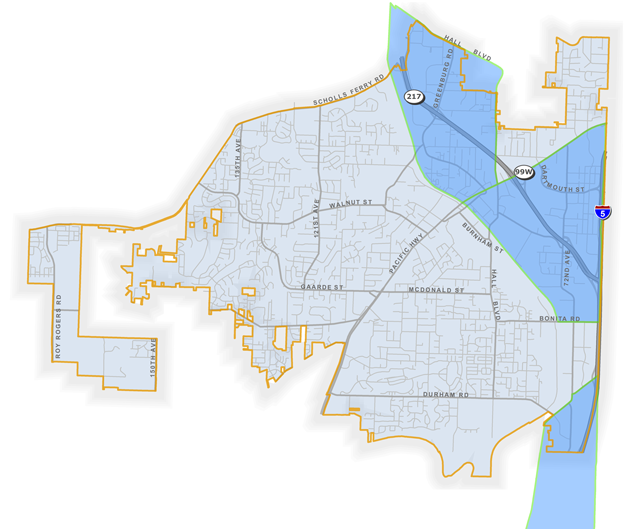
But the building on the corner, 11686 S.W. Pacific Hwy, is in one of Tigard’s three “opportunity zones.” All are tax-advantaged sites added to the tax code subsequent to President Trump signing the Tax Cuts and Jobs Act on December 22, 2017.

TigardOpportunity-Zones

Tigard’s Opportunity Zones (in dark blue)

The idea, proposed by Sen. Tim Scott (R-SC), was that high-poverty areas/distressed communities would get a leg up with new investments if they were eligible for generous preferential tax treatment. The program was originally proposed in the Investing in Opportunity Act, which Sen. Scott co-sponsored with Sen. Cory Booker (D-NJ) earlier in 2017. The program allowed investors to reduce and defer paying capital-gains taxes if they invested in a qualified opportunity zone fund which invested in an opportunity zone.

“The rich will not be gaining at all with this plan,” the president told reporters prior to a Sept. 2017 White House meeting with the bipartisan Congressional Problem Solvers Caucus.

Areas can qualify as opportunity zones if they have been nominated for that designation by the state and certified by the Secretary of the U.S. Treasury via the Internal Revenue Service.

Investors in a zone earn a 10% tax discount on their gains after five years, then a 15% discount after seven years. If they keep their opportunity fund shares for 10 years, they can sell them without paying any taxes on the money they made from that investment.

But investors have to act fast because to get the greatest potential tax break they need to leave their money in a fund by the end of this year. Under the law, they can defer paying taxes on their initial investment only until 2026. That’s motivating many investments in projects planned well before opportunity zones were designated.

“With Opportunity Zones, we’re drawing investment into neglected and underserved communities of America so that all Americans, regardless of ZIP code, have access to the American dream,” Trump said on Dec. 12, 2018.

But things got off on the wrong foot when real estate experts got hold of the law.  “…what we were greeted with, and I don’t think it’s unfair for me to say this, were eight pages of the most poorly written statute that I’ve come across in my time covering tax policy,” said Tony Nitti, a CPA, currently a Tax Partner with RubinBrown in Aspen, CO. and a Senior Contributor to Forbes.

It took almost a year after the Tax Cuts and Jobs Act became law before the IRS published a lengthy list of proposed regulations on Oct. 19, 2018.

Then the IRS had to address more questions with a second set of 44 pages of proposed regulations on May 1, 2019.

Another problem that has emerged is that not all of the country’s 8,764 certified opportunity zones encompass just under-invested, economically distressed areas badly in need of economic development and job creation. Some also include areas of relative affluence that would be ripe for investment even without the new tax break.

As Samantha Jacoby, a Senior Tax Legal Analyst at the Center on Budget and Policy Policies, a progressive think tank,  has warned, the opportunity zone law is “fundamentally flawed” and the “… tax benefits will flow to wealthy investors with no guarantee that the zones will help distressed communities.”

Even the Wall Street Journal recently  highlighted this problem, noting that, “a tax benefit intended to help poor areas is channeling money to places that are already relatively well-off.”

One such place in a Tigard opportunity zone is raw land at the corner of SW Dartmouth St & SW 72nd Ave.  The 1.69 acres of commercial land in an already prosperous and heavily developed area is being offered for sale for $3,300,000 by the Real Estate Investment Group.

OZDartmouthland

Because no structure is on the land to improve, it might seem like a speculator could buy this raw land, sit on it without adding anything and then sell the land after ten years tax-free.

But it’s not so simple. An owner must conduct a trade or businessand just holding raw land is not a trade or business. So the purchaser of raw land will also need to invest in substantial improvements on the property, though the owner would not be bound to as specific an amount of improvements..

It would also be quite a stretch to call 11646 S.W. Pacific Hwy, a 29,978 sq. ft. site with a vacant 11,260 sq. ft. building that’s for sale at the corner of S.W. Pacific Highway and Dartmouth St., “economically distressed.”

Marketing material for the site has highlighted that average household income was $71,601 within one mile and $89,792 within three miles in 2015. The material also points out that the site is in the middle of a bustling commercial area that includes retailers such as Costco, PetSmart. A Walmart Supercenter, WinCo Foods and Fred Meyer.

Some readers may remember when the building on the site was occupied by Magnolia Hi-Fi.  The building was constructed in 1996 and NTN Pacific, LLC bought the site from Toyama Hawaii Corp. for $3,100,000 on Jan. 7, 2004 It’s now being offered for lease or sale through Norris & Stevens, Inc.

The buyer of this property won’t automatically qualify for the opportunity zone tax benefits. Since the goal of the program is to improve distressed communities, substantial improvements will have to be made to the property within 30 months.

To be precise, the new owner will have to spend on improvements an amount at least equal to the purchase price of the building. If 60% ($1.5 million) of a $2.5 million purchase price is allocated to the building’s value and 40% ($1 million) to the land’s value, the purchaser will have to invest an additional $1.5 million on substantial improvements, such as redeveloping the building and building out spaces for incoming tenants.

One of Tigard’s stated objectives in creating opportunity zones was to spur the development of more affordable housing.  Tigard is considered a rent-burdened city with over 28 percent of residents spending over 50 percent of their income on rent/mortgages.

But it would be a mistake to assume new housing being built in Tigard’s opportunity zones will address this problem. For example, The 72nd, a 38-unit apartment building that’s under construction on S.W. 72ndAve. will be far from affordable housing.

OZhousing

The 72nd apartment complex under construction in a Tigard opportunity zone.

A 517 sq. ft. one-bathroom studio at The 72nd will start at $1263 a month; a 690 sq. ft. one-bedroom one-bathroom apartment at $1534 a month. And rents go as high as $1,776 a month for a one-bedroom one-bathroom apartment.

And then there’s the impact of the opportunity zone tax breaks on federal and state tax collections.

The new tax breaks will cost an estimated $1.6 billion in lost federal revenue over ten years, according to Congress’ Joint Committee on Taxation.

At the state level, all the tax breaks lower individuals’ and corporations’ “gross income,” as the Internal Revenue Code defines it. If states piggyback on that definition, as most do, the breaks will automatically flow through to state individual and corporate income taxes unless the state proactively “decouples” its law from the opportunity zone provisions. Without decoupling, states will miss out on collecting revenue needed to fund other priorities needed for healthy economy.

As the Oregon Center for Public Policy, a left-leaning think tank, put it, “Someone will have to pay for the subsidies going to the wealthy investors profiting from Opportunity Zones, and that someone will be schools and essential services.”

So it’s not cynicism to see the opportunity zone program as yet another misguided giveaway. As Caesar proclaims in David Staller’s adaptation of “Caesar and Cleopatra,”  “The power of accurate observation is commonly called cynicism by those who have not got it.”.

Welcome to opportunity zones — tax shelters for wealthy investors and real estate developers who can put their money to work in areas the least in need of assistance, reducing state and federal tax revenues and increasing already excessive federal deficits.

Another well-intentioned program gone awry.


Keep The Kicker

KICKERMaldonado-Fiesta-Krebial-e1371927310255

Oregonians learned earlier today that they may be up for another kicker.  And the progressive Oregon Center for Public Policy is already bitching about “lost revenue.”

“Should it come to pass, this unanticipated, automatic tax cut would cost the state about $400 million at a time when Oregon schools and essential services are at risk from budget cuts and suffer from long-term underfunding,” the Center said in an e-mail blast.

“Lost revenue?” “Cost the state?” Give me a break.

It’s not the state’s money. It’s yours. But progressives keep finding reasons to take it away.

In 2015, when an improving economy triggered a “kicker” rebate of about $400 million, State Rep. Tobias Read, D-Beaverton, sponsored a bill that would have diverted half of that $400 million to education and half to the state’s general reserve. Fortunately, Read’s bill didn’t get a committee hearing.

According to The Oregonian, Sen. Alan DeBoer, R-Ashland, plans to introduce a bill to redirect the kicker to K-12 education. If it passes, voters will make the final decision.

Oregonians already made it perfectly clear what they think of this idea. In 2016, Oregon taxpayers were given an opportunity to donate their kicker rebate to the state’s Common School Fund when they filled out their tax forms. Hardly any did. At one point, records showed fewer than one-half of one percent of taxpayers were choosing to do so. Hardly a magnanimous endorsement of the idea.

The state got itself into a real mess with its constant spending increases and ever-expanding pension obligations. Don’t let that be an excuse for ending the kicker.