Oregon’s K-12 Public Schools Are Failing Their American Indian Students

Shana McConville Radford of the Confederated Tribes of the Umatilla Indian Reservation has joined Gov. Tina Kotek’s administration as Oregon’s first Tribal Affairs Director.

Shana McConville Radford

I have a job for her. 

Tackle the embarrassingly poor academic achievement and embarrassingly high absenteeism rates of K-12 American Indian and Alaska Native students in Oregon.[1]

Some truth-telling is essential here. It is painfully clear that Oregon’s schools are failing these young people and that somebody needs a good kick in the shins to set things right.

We need to give kids, all kids, the tools they need to make their own way. Allowing academic failure is not the way to do that.

The numbers from tests given during the 2022-2023 school year tell the story. A predominant share of the American Indian/Alaska Native students taking the tests were American Indian.

All the academic achievement numbers come from reams of data posted online by the Oregon Department of Education showing downloadable files of state assessment results in English Language Arts (ELA)Mathematics, and Science. Absenteeism figures come from data posted online by the Oregon Department of Education in Annual Performance Progress Reports on Attendance and Absenteeism. 

Some of the more egregious low proficiency scores were at districts that also have chronic student absenteeism, defined by the Oregon Department of Education as absent from school for more than 10% of the academic year.

The Department requires that there be no fewer than 265 consecutive calendar days between the first and last instructional day of each school year at each grade level, so missing 10% of school days would mean missing at least 26 days. 

It’s a lot of numbers, but they are worth examining closely..

SubjectStudent GroupGrade LevelPercent Proficient
English Language ArtsAmerican Indian/Alaskan NativeAll Grades25.6
English Language ArtsAmerican Indian/Alaskan NativeGrade 320.5
English Language ArtsAmerican Indian/Alaskan NativeGrade 424.0
English Language ArtsAmerican Indian/Alaskan NativeGrade 527.2
English Language ArtsAmerican Indian/Alaskan NativeGrade 622.1
English Language ArtsAmerican Indian/Alaskan NativeGrade 728.7
English Language ArtsAmerican Indian/Alaskan NativeGrade 825.6
English Language ArtsAmerican Indian/Alaskan NativeGrade HS (11)31.1

SubjectStudent GroupGrade LevelPercent Proficient
MathematicsAmerican Indian/Alaskan NativeAll Grades13.6
MathematicsAmerican Indian/Alaskan NativeGrade 322.2
MathematicsAmerican Indian/Alaskan NativeGrade 418.2
MathematicsAmerican Indian/Alaskan NativeGrade 514.7
MathematicsAmerican Indian/Alaskan NativeGrade 610.0
MathematicsAmerican Indian/Alaskan NativeGrade 713.7
MathematicsAmerican Indian/Alaskan NativeGrade 810.9
MathematicsAmerican Indian/Alaskan NativeGrade HS (11)5.7
SubjectStudent GroupGrade LevelPercent Proficient
ScienceAmerican Indian/Alaskan NativeAll Grades16.3
ScienceAmerican Indian/Alaskan NativeGrade 514.1
ScienceAmerican Indian/Alaskan NativeGrade 814.7
ScienceAmerican Indian/Alaskan NativeGrade HS (11)20.8

A review of the performance of American Indian/Alaska Native students at individual districts is also revealing.

The details below show all Oregon school districts reporting enrollment of American Indian/Alaska Native students, in all grades, 2022-2023 and the % of students proficient of those tested.

Not all districts administered the Science test. Less than 5% means fewer than 5% of students who took the test achieved Level 3 or 4 / Meets or Exceeds. Absenteeism rates for American Indian/Alaska Native students in selected districts are also noted.

Athena-Weston SD 29RJ       

English language arts.  40%

Mathematics.  Less than 5%

Beaverton SD 48J

English language arts.  43.3%

Mathematics. 31.8%

Science. 21.2%

Bend-LaPine Administrative SD 1

English language arts.  33.3% 

Mathematics. 31.3%

Science. 36.8%

Bethel SD 52

English language arts.  25.9% 

Mathematics. 20.8%

Science. 9.1%

Brookings-Harbor SD 17C

English language arts.  20% 

Mathematics. Less than 5%

Science. 27.3%

Cascade SD 5

English language arts.  42.9% 

Mathematics. 21.4%

Science. 20%

Centennial SD 28J

English language arts.  17.4% 

Mathematics. Less than 5%

Central Point SD 6

English language arts.  32.1% 

Mathematics. 17.9%

Central SD 13J

English language arts.  31.3% 

Mathematics. 5.9%

Coos Bay SD 9

English language arts.  20% 

Mathematics. 8.9%

Science. 25%

Corvallis SD 509J

English language arts.  Less than 5% 

Mathematics. 8.3%

Creswell SD 40

English language arts.  30.8%

Mathematics. 21.4%

Crook County SD

English language arts.  26.3% 

Mathematics. 16.7%

Dallas SD 2

English language arts.  29.5% 

Mathematics. 14.8%

Science. 12.2%

David Douglas SD 40

English language arts. 16.1%

Mathematics. 10.0%

Science. 9.1%

Dufur SD 29

English language arts.  10.5%

Mathematics. Less than 5%

Eagle Point SD 9

English language arts.  47.4% 

Mathematics. 31.6%

Science. 40%

Eugene SD 4J

English language arts.  37.8%

Mathematics. 31.6%

Science. 38.5%

Forest Grove SD 15

English language arts.  25.0%

Mathematics. 16.7%

Grants Pass SD 7

English language arts.  50% 

Mathematics. 7.1%

Greater Albany Public SD 8J

English language arts.  26.7% 

Mathematics. 21.4%

Science. 27.3%

Gresham-Barlow SD 10J

English language arts.  35.5%

Mathematics. 17.2%

Science. 28.6%

Harney County SD 3

English language arts.  13.3%

Mathematics. 6.7%

Hillsboro SD 1J

English language arts.  32.6%

Mathematics. 23.3%

Science. 13.6%

Hood River County SD

English language arts.  29.4% 

Mathematics. 5.9%

Jefferson County SD 509J

English language arts.  17.5%

Mathematics. 6.4%.

Science. 8.4%

NOTE. 49.7% of American Indian/Alaska Native students in Jefferson County SD 509J were chronically absent in the 2022-23 school year.

Junction City SD 69

English language arts.  60%

Mathematics. 30%

Klamath County SD

English language arts.  27.1%

Mathematics. 14.6%

Science. 17%

NOTE: 38.5% of the American Indian/Alaska Native students in the  Klamath County SD were chronically absent in the 2022-23 school year..

Klamath Falls City Schools

English language arts.  20.8% proficient

Mathematics. 11.3%

Science. 9.1%

NOTE: 69.5% of American Indian/Alaska Native students in the Klamath Falls City Schools district were chronically absent in the 2022-23 school year.

Lincoln County SD

English language arts.  16.5%

Mathematics. 5.9%

Science. 9.3%.

NOTE: 57.9% of the American Indian/Alaska Native students in the Lincoln County SD were chronically absent in the 2022-23 school year.

McMinnville SD 40

English language arts.  45.9%

Mathematics. 40%

Science. 47.1%

Medford SD 549C

English language arts.  51.3%

Mathematics. 21.1%

Science. 29.4%

Molalla River SD 35

English language arts.  16.7% 

Mathematics. 15.4%

Myrtle Point SD 41

English language arts.  30%

Mathematics. 10%

Newberg SD 29J

English language arts.  Less than 5%

Mathematics. Less than 5%

North Bend SD 13

English language arts.  32% 

Mathematics. 36%

Science. 33.3%

North Clackamas SD 12

English language arts.  20%

Mathematics. 17.6%

Science. 10%

North Wasco County SD 21

English language arts.  26.1%

Mathematics. 8.7%

Science. 9.1%

Oregon Trail SD 46

English language arts.  42.9%

Mathematics. 28.6%

Pendleton SD 16

English language arts. 27.8% 

Mathematics. 9.1%

Science. 14%

NOTE: 51.3% of the American Indian/Alaska Native students in the Pendleton SD 16 district were chronically absent. in the 2022-23 school year.

Phoenix-Talent SD 4

English language arts.  9.1% 

Mathematics. Less than 5%

Portland SD 1J

English language arts.  17.2% 

Mathematics. 11.6%

Science. 15.2%

NOTE: 66.1% of the American Indian/Alaska Native students in the Portland SD 1J district were chronically absent in the 2022-23 school year. 

Redmond SD 2J

English language arts.  40.0% 

Mathematics. 26.7%

Reynolds SD 7

English language arts.  23.3%

Mathematics. 13.3%

Science. Less than 5%

Salem-Keizer SD 24J

English language arts.  21.8%

Mathematics. 8.5%.

Science. 18.3%

NOTE: 58.2% of the American Indian/Alaska Native students in Salem-Keizer SD 24J district were chronically absent in the 2022-23 school year.

Santiam Canyon SD 129J

English language arts.  20%

Mathematics. 20%

Sheridan SD 48J

English language arts.  12.9%

Mathematics. 6.7%

Science. Less than 5%

South Lane SD 45J3

English language arts.  12.5%

Mathematics. 12.5%

South Umpqua SD 19

English language arts.  20%

Mathematics. 10%

Springfield SD 19

English language arts.  31.4%

Mathematics. 13.9%

Science. 29.4%

St Helens SD 502

English language arts.  18.8%

Mathematics. 6.7%

Sutherlin SD 130

English language arts.  13.3%

Mathematics. 13.3%

Three Rivers/Josephine County SD

English language arts.  27.9%

Mathematics. 11.6%

Science. 5.3%t

Tigard-Tualatin SD 23J

English language arts.  33.3%

Mathematics. 33.3%

Umatilla SD 6R

English language arts.  20%

Mathematics. 10%

Willamina SD 30J

English language arts.  25.4%

Mathematics. 8.7%

Science. Less than 5%

Winston-Dillard SD 116

English language arts.  23.1%

Mathematics. 16.7%


[1] American Indian/Alaskan Native – As defined by the Oregon Department of Education, includes all students identified as having origins in any of the original peoples of North America and not Hispanic.

The Pronoun Police Are Patrolling Oregon Schools

The Human Rights Campaign once tweeted that we should all “Begin conversations with “Hi, my pronouns are _____. What are yours?” 

Not so fast, critics have responded.

“Coercing people into publicly stating their pronouns in the name of “inclusion” is a Trojan horse that empowers gender ideology and expands its reach,” said Colin Wright, a fellow at the Manhattan Institute. “It is the thin end of the gender activists’ wedge designed to normalize their worldview. The effort to resist gender ideology is reality’s last stand. We simply can’t ignore fundamental realities of our biology and expect positive outcomes for society. “

The battle is on.

Much of the conflict has arisen in academic settings, including K-12 schools and colleges.

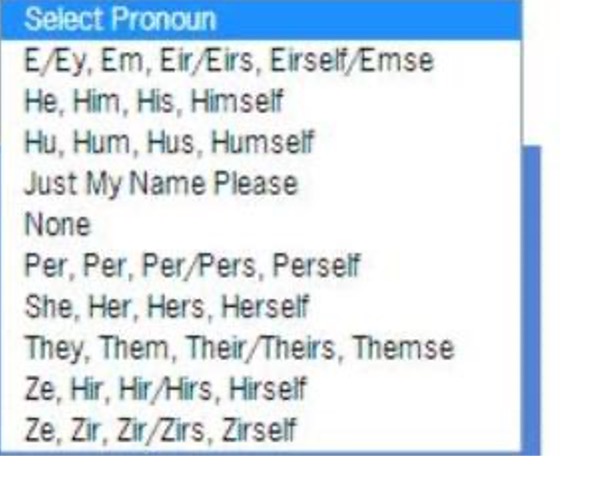
Students at Scripps College in Claremont, CA. have been advised that they can choose which of numerous different pronouns they want professors to use in addressing them.

Pronoun options were:

One student said the options were necessary protection from “institutionalized violence.”

Not to be left behind, the State of Oregon has embraced the same pronoun policies, turning appropriate pronoun usage into compelled speech.

In October 2021, Colt Gill, then Director of the Oregon Department of Education, used his Education Update email message to urge Oregonians to “Celebrate International Pronoun Day with ODE.”

“When we collectively share our names and pronouns, we can share the burden of fighting against injustice,” he wrote. “Pronoun sharing within the workplace and throughout school communities is an important opportunity to build trust and connection with transgender, non-binary, two-spirit colleagues, students, friends, and community members.”

Gill told educators:

  • If you are comfortable, share your pronouns when you’re introducing yourself at the start of a meeting: “I’m (Name) and I use she and they pronouns” 
  • Change your Zoom name to include your pronouns, every time: Name, (she/they), ODE 
  • Include pronouns in your ODE email signature 

In January 2023, ODOE issued Supporting Gender Expansive Students: Guidance for Schools. Included in the guidance is the following:

  • Gender expansive students may choose to change the name assigned to them at birth to an asserted name that affirms their gender identity. Gender expansive students may also ask to be referred to by the pronouns that affirm their gender identity.
  • Even if a student does not update their records, they should be referred to by their asserted name and pronouns Intentional or unintentional continuous misgendering of a student by refusing to use their asserted name and pronouns can potentially create a hostile environment. 
  • Schools should engage in student-led support planning for name and pronoun changes. Once the school and student have decided on a supportive action plan, the school should immediately take action to implement the plan.”

The guidance cautioned about disclosing the decisions students make. “To the extent possible, schools should refrain from revealing information about a student’s gender identity, even to parents, caregivers, or other school administrators, without permission from the student.”

When a local news outlet asked ODOE about the policy providing leeway to keep parents in the dark on official school transitions, ODE said this was for a “safety concern.”

On Oct. 19, 2023, the State Board of Education lent its weight to the pronouns dispute, adopting new health K-12 education standards that include:“Demonstrate ways to treat all people with dignity and respect, including people of all genders, gender expressions and gender identities” starting in the 4th grade. 

The new standards will come into full effect in Oregon public schools by the 2025-26 school year. 

Educators and other Oregonians who are less than enthusiastic about the progressive pronoun push may hope the campaign will abate, but it looks like the beatings will continue until morale improves and educators with the courage to challenge the received wisdom of the education establishment will be at risk.

An ever-growing list of pronouns have now become expressions of one’s self-proclaimed identity, a claim that proponents insist everyone must affirm—or else.

Some critics argue that all this is just capitulating to a politically correct, Orwellian effort to validate social progressive doctrines.

Others argue that the controversy is just a way for ideologues to browbeat people, to claim authority over how people speak and to allow language commissars to monitor incorrect speech in schools, workplaces and life.

 Compelling expansive pronoun usage is a dramatic curtailment of freedom of speech, critics assert. As Graham Hillard, managing editor at the James G. Martin Center for Academic Renewal, put it, “When Big Brother arrives in the 21st century, he will appear not on posters but in grammar handbooks, HR manuals, and social media”

In the meantime, how should you navigate the rocky shoals of the pronoun wars without being chastised, harassed, berated and charged with insensitivity?

‘Tis a puzzlement.

The Scourge of Absenteeism: Oregon Kids of Color Are Cutting Too Many Classes

Our children are not alright.

In the 2015-16 school year, alarms went off when one in six K-12 children were chronically absent at Oregon’s public schools.. 

The legislature was so concerned it enacted a bill which directing the Oregon Department of Education and the Chief Education Office to jointly develop a statewide education plan to address the problem. 

So much for that. 

In the 2021-2022 school year, the most recent year for which data is available, 36.1% of Oregon’s K-12 students were chronically absent from school, absent for  more than 10% of the academic year. Only Hawaii at 37%, Michigan at 38.5% and the District of Columbia at 48.1%, had higher rates of chronic absenteeism.

Children who are chronically absent in their early years of schooling are likelier than their peers to struggle to read at grade level by the end of second grade and students still struggling at the end of third grade are four times more likely to drop out of high school, according to research supported by the Annie E. Casey Foundation and the Center for Demographic Analysis, University at Albany, State University of New York.

For the worst readers, those who could not master even the basic skills by third grade, the rate is nearly six times greater. 

By the ninth grade, every week a student misses reduces that student’s chance of graduating by about 20 percentage points.

“The fact that absenteeism has gone up is the biggest issue right now and has been overlooked,” says the Lewis-Sebring Director of the UChicago Consortium on School Research, Elaine Allensworth. “People keep focusing on the test scores, but our research shows over and over again that student attendance is an incredibly strong predictor of pretty much every outcome you care about: High school graduation, college ready, college enrollment, college graduation. It’s vital that students actually come to school every day.”

Oregon media have reported on rising absenteeism, but the general take has been that it is a system-wide problem.  What they’ve mostly missed is the high rates of absenteeism among kids of color.

An exhaustive review of Oregon Department of Education data on absenteeism at Oregon school districts in the 2021-2022 school year reveals substantial differences in rates of absenteeism between white students and students of color.

“The long-term consequences of disengaging from school  are devastating,” says Hedy Chang, executive director of Attendance Works, a nonprofit addressing chronic absenteeism. For children of color, the consequences can be particularly severe.

In other words, for all the money Oregon is pouring into its schools to improve the academic performance of kids of color, it’s not going to make any damn difference if kids of color don’t show up.

School DistrictCategory% Chronically Absent
Corvallis School District 509J         White33.5
Hispanic/Latino43.5
West Linn-Wilsonville SD 3J               White27.9
Black/African American32.9
Hispanic/Latino43.9
American Indian/Alaska Native76.2
Native Hawaiian/Pacific Islander45.2
North Clackamas SD 12                         White28.5
Black/African American33.2
Hispanic/Latino41.1
American Indian/Alaska Native40.5
Native Hawaiian/Pacific Islander50.8
Gladstone SD 115                                        White32
Black/African American 46.7
Hispanic/Latino52.3
Astoria SD1                                                     White35.1
Hispanic/Latino43.1
American Indian/Alaska Native58.3
Bend-LaPine SD1                                               White39.6
Black/African American40
Hispanic/Latino54.5
American Indian/Alaska Native49.3
Redmond SD 2J                                                         White37.8
Hispanic/Latino43.4
Native Hawaiian/Pacific Islander47.8
American Indian/Alaska Native57.4
Douglas County SD4                                                   White44.4
Hispanic/Latino50.4
American Indian/Alaska Native62.9
Native Hawaiian/Pacific Islander54.5
Springfield SD19White41.9
Black/African American52.3
Hispanic/Latino47.9
Native Hawaiian/Pacific Islander72.3
Salem-Keizer SD 24JWhite39.7
Black/African American41.9
Hispanic/Latino53.7
Native Hawaiian/Pacific Islander63.7
Portland SD 1JWhite27.1
Black/African American55
Hispanic/Latino47.1
American Indian/Alaska Native68.8
Native Hawaiian/Pacific Islander63.1

Is An Oregon School District Exploiting The State’s Charter School Law To Enrich Itself?

It looks like the really tiny town of Mitchell (pop. approx. 137) in a rugged Eastern Oregon canyon has figured out how to bring in big bucks – sponsor public virtual schools. 

Mitchell, Oregon

Since Oregon enacted a charter school law in 1999, virtual charters in the state have spread like a rash, with 20 now offering online courses to some or all grades of K-12 students. Enrollment at the virtual charters in 2022-2023 was 15,711, representing 37.79% of total charter school enrollment.

Charter schools in Oregon, including virtual charters, are publicly funded, so parents don’t pay tuition. Instead, the Oregon Department of Education distributes money from the State School Fund to each school district that sponsors a charter school based upon that school’s enrollment. 

Oregon law provides that a sponsoring district must pass on to its charter school at least 80 percent of its per-pupil grant for K-8 students and 95 percent of its per pupil grant for grade 9-12 students. 

While the rest of Oregon school districts sponsoring virtual charter schools sponsor only one, the Mitchell School District is taking full advantage of the funding model, sponsoring three virtual public charter schools with total enrollment of 1054 students in 2022-2023:

 Insight School of Oregon Painted Hills, serving students in grades 7-12

 Cascade Virtual Academy , serving students in grades K-12

Destinations Career Academy of Oregon, serving students in grades 9–12.

Each of the virtual charter schools sponsored by the Mitchell School District  contracts for the use of technology and curriculum from K12, a profit-driven Stride Company (NYSE: LRN).

I asked Melissa Hausmann, Head of School at all three schools, for copies of their contracts with K12 to get a better understanding of payments made by the charter schools to K12. Although Oregon Public Records law requires that a public body acknowledge receipt of a public records request within 5 business days of receipt, Hausmann has not responded to repeated requests for the contracts.. 

Given the voluminous data maintained by the Oregon Department of Education (ODOE), I assumed securing information on the state money going to the Mitchell School District because of its sponsorship of the three virtual charter schools would be a simple request. Accordingly, I asked ODOE:

  • How much money did the State School Fund distribute to the Mitchell School District for the 2022-2023 school year for each of the three virtual public charter schools the district sponsors?
  • School district sponsors are allowed to keep a portion of per-pupil funding provided by the state, usually 20% for K-8 schools and 5% for high schools. The rest goes to the charter school. I asked what percentage, and how many dollars, of per pupil funding provided by the state to each of these three schools was retained by the Mitchell School District in the 2022-2023 school year?

Surprisingly, ODOE said it was not the custodian of records that contained the specific information I requested. It suggested I contact the school district directly.

The Oregon Department of Education says it doesn’t know how much it is spending in support of virtual charter schools.

Mitchell School District Superintendent Vincent Swagerty acknowledged that the district had some of the records requested, but said it would cost $800 “to summarize, compile, review and forward these records.”

Oregon’s public records law allows for “reasonably calculated” fees to be imposed for responding to a public records request, but I considered an $800 fee exorbitant, prohibitive and even silly. Was the district really not able to quickly and easily find out. how much money it’s getting from the state in connection with its sponsorship of three virtual charter schools?

So I pursued an alternative, calculating estimated state payments using ODOE guidance on available data posted online by the department. A review of the Mitchell School District’s contracts with the three virtual charter schools then revealed the percentages of state school fund money passed on to the virtual charter schools. 

Those calculations led to a rough estimate that the Mitchell School District retained the astonishing amount of approximately $727,000 of the state school fund money it received because of its sponsorship of the three virtual charter schools in the 2020-2021 school year.

The estimated total broke down as follows:


INSIGHT SCHOOL OF OREGON – PAINTED HILLS

The state sent an estimated $3,777,660 to the Mitchell School District. An estimated $130,656 (20% of the state’s money for students in grades 7-8) and $156,773 (5% of the state’s money for students in grades 9-12) was retained by the Mitchell School District. The remaining $3,392,445 went to Insight.

CASCADE VIRTUAL ACADEMY

The state sent an estimated $7,622,080 to the Mitchell School District.  An estimated $357,764 (5% of the state’s money) was retained by the Mitchell School District.  The remaining $6,797,516 (95% of the state’s money) went to Cascade.

DESTINATIONS CAREER ACADEMY OF OREGON

The state sent an estimated $1,681,164 to the Mitchell School District. An estimated $84,058 (5% of the state’s money) was retained by the Mitchell School District. The remaining $1,597,105 (95% of the state’s money) went to Destinations. 

Estimate of $ retained by the Mitchell School District in 2020-2021

From Insight contract: $287,429

From Cascade contract: $357,764

From Destinations contract: $84,058

TOTAL: $729,251

Does the Mitchell School District agree with these numbers?

I asked Superintendent Swagerty. He responded that he had accepted a position in a new school district and referred me to two officials from the Mitchell School District. Neither responded to my follow-up inquiry spelling out estimated payments retained by the Mitchell School District in the 2020-2021 school year.. 

Whether or not my calculations are on the money, is the Mitchell School District using Oregon’s charter schools law as a cash cow to generate revenue for minimal effort? 

Are the estimated 2020-2021 revenue numbers typical of annual payments retained by the Mitchell School District?

Does this put conservatives who oppose reckless government spending, but support school choice, in a quandary?

Are the district, the virtual charter schools and K12 in a parasitic relationship, each feeding off the other and Oregon taxpayers?

Is the funneling of so many taxpayer dollars to public school districts sponsoring virtual charter schools what the legislature intended with the charter school law?

For that matter, is it acceptable that the Oregon Department of Education, which dispenses millions of taxpayer dollars to school districts sponsoring virtual public charter schools, can’t, or won’t, tell the public precisely how much money it is sending to the sponsoring districts, how much those districts are keeping for themselves and how much they are sending on to the charter schools? Is that responsible governance?

The time has come for oversight that ensures public money is meeting its public purpose.

And then, of course, there’s the question of whether the taxpayer-supported virtual public charter schools are a public good in any case.

A June 2023 analysis from the US Census Bureau linked statewide education records from Oregon with earnings information from IRS records housed at the U.S. Census Bureau to provide evidence on how virtual charter students fare as young adults. “Virtual charter students have substantially worse high school graduation rates, college enrollment rates, bachelor’s degree attainment, employment rates, and earnings than students in traditional public schools,” the study concluded. “Although there is growing demand for virtual charter schools, our results suggest that students who enroll in virtual charters may face negative long-term consequences.”

BACKGROUND

Insight School of Oregon

Insight opened its doors in Oregon in 2012 as Insight School of Oregon Charter Option sponsored by the Crook County School District in Central Oregon. To operate the school, its board contracted with K12, Virtual Schools LLC, a wholly owned subsidiary of publicly traded for-profit K12 Inc. (LRN:NYSE] ). Insight’s Oregon headquarters was located in a nondescript one-story office building at 603 NW. 3rd St. in Prineville.

In its first three years, Insight’s K-12 enrollment grew to more than 500 students from around the state.

But all was not well.

K12 Inc. argued that. its education program was “proven effective,” but the numbers told a different story to the Crook County School District. Even though the district netted $231,592 in the first year of its contract with Insight and $436,554 in the second, it began to have serious reservations about continuing the relationship.

In Nov. 2014, the Crook County School District sent a blistering letter to Insight expressing grave concerns about the school’s operations and academic performance. School Superintendent Dr. Duane Yecha and school board Chair Doug Smith told the school they had major concerns about Insight’s: inadequate tracking of student attendance and enrollment; academic achievement; poor test participation; low four-year graduation rate (16.18 percent in 2013-2014); and failure to meet financial requirements stipulated in the district’s contract with Insight.

“…these issues have given the district reason to consider whether Insight is able to meet its ongoing obligations under the Charter Agreement and under ORS Chapter 338,” the letter said.

In 2015, even though the district was set to net $480,710 from its sponsorship of Insight in the 2014 – 2015 school year, it decided not to renew the sponsorship.

So Insight went shopping.

It quickly found a new partner, signing a sponsorship contract with the Mitchell School District 55 on April 29, 2015. The district had just one school serving a few local kids, some teens from around Oregon and a few international high students from Germany, Thailand, and Hong Kong. The international and regional students all lived in a school dormitory at the school.

With a new sponsor in hand, Insight changed to a grade 7-12 school and renamed itself Insight School of Oregon – Painted Hills.

Another change was the financial arrangements. Under its contract with the Crook County School District, Insight had agreed to the district keeping 5 percent of the State School Fund money it received for Insight students in grades 9-12 and 20 percent of what it received for kindergarten-8 students. Under the new contract with the Mitchell School District, the district agreed to keep just 10 percent of the total State School Fund money.

Destinations Career Academy of Oregon

Destinations Career Academy of Oregon, a full-time online public charter school authorized by the Mitchell School District, began its inaugural school year on September 4, 2018. It initially served students in grades 9-11, expanding to offer 12th grade for the 2019-20 academic year.

As part of the Oregon public school system, Destinations Career Academy is tuition-free, providing parents and families the choice to access the curriculum provided by K12 Inc. (NYSE: LRN) a provider of K-12 proprietary curriculum and online education programs.

Cascade Virtual Academy

Cascade Virtual Academy, a full-time online public charter school, began its inaugural school year sponsored by the Mitchell School District on September 4, 2018, offering a tuition-free to option students statewide in kindergarten through eighth grade.

Confusingly, there is also a Cascade Virtual Academy based in Aumsville, Oregon that provides a comprehensive online education for students in grades six through 12 who live within Cascade School District #5. The district , which operates six schools, serves approximately 2,500 students living in Aumsville, Turner, and Marion, Oregon.

Portland (And Oregon) Public Schools: What the Hell?

I posted a story recently that showed how much money Portland Public Schools is really spending per student.

In April, Willamette Week reported that the National Center for Education Statistics  put the per pupil expenditure in Oregon’s K-12 public schools at $14,829.  

When I sought clarification from Portland Public Schools, the District said its per pupil expenditure is actually  closer to $11,000.

“If you include services like transportation, nutrition, SpEd, English as a Second Language Programs (ESL), other central office supports and operations, from a whole system perspective the budgeted per pupil expenditure number doubles and is closer to $22,000, including both GenFund and Special Revenue, but not bond dollars,” the District said.

But that’s not really the whole story, either. 

In fact, considering all funds available to the District in the 2022-23 school year, totaling $1.9 billion, per student expenditures came out to $45,533.

That’s right, an astounding $45,533 per student for what can only be described as abysmal academic performance by the District’s students.

Where’s the anger?

Look at the situation with all that spending in the 2021-2022 school year:

  • 3rd grade students who failed to meet state grade-level expectations in English Language Arts: 44%
  • 8th grade students who failed to meet state grade-level expectations in mathematics: 62%
  • Students failing to earn a high school diploma within 4 years: 16%
  • Students with chronic absenteeism (in attendance less than 90% of school days): 33.5%

– African Americans chronically absent: 55%

-Hispanic Latino students chronically absent: 48.1%

-American Indian/Alaska Native students chronically absent: 68.8%

-White students chronically absent: 27.1%

-English learners chronically absent: 42.5%

-Grade 12 students chronically absent: 64.7%

And these numbers are for the Portland Public Schools System as a whole. Some individual schools did appreciably worse.

At Cesar Chavez K-8 School, for example, only 17% met state grade level expectations in English Language Arts and only 11% met state grade level expectations in mathematics and science. At Kellogg Middle School, 34% of students met grade level expectations in English Language Arts, 25% met state grade level expectations in mathematics and 18% met state grade level expectations in science.

The National Assessment of Educational Progress (NAEP), also known as The Nation’s Report Card, provides additional information about student achievement and learning experiences in various subjects by state and 27 urban districts. Although the district-specific analyses do not separate out Portland Public Schools, the state reports are illuminating as a supplement to the data noted above. 

NAEP is a congressionally mandated program that is overseen and administered by the National Center for Education Statistics (NCES), within the U.S. Department of Education and the Institute of Education Sciences.

NCES reports results at the state level, most often in grades 4 and 8, in four subjects—mathematics, reading, science, and writing. 

In 1922, NAES tested in mathematics, reading and writing. Oregon students performed poorly in all three areas:

  • Just 28.61% of Oregon 4th graders performed at or above the NAEP Proficient level in mathematics, lower than in 2019.
  • Just 27.99% of Oregon 4th graders performed at or above the NAEP Proficient level in reading, lower than in 2019.
  • Just 22.31% of Oregon 4th graders performed at or above the NAEP Proficient level in writing.
  • Just 22.03% of Oregon 8th graders performed at or above the NAEP Proficient level in mathematics, lower than in 2019.
  • Just 27.79% of Oregon 8th graders performed at or above the NAEP Proficient level in reading, lower than in 2019.
  • Just 33.15% of Oregon 8th graders performed at or above the NAEP Proficient level in writing.

I raise all this not as an act of self-flagellation by a disenchanted Oregonian, but as a concerned citizen. Oregons political and business leaders say they want the state to be a magnet for investment, particularly in technology. With this kind of academic malfeasance, it’s not going to happen. More broadly, we  cannot sustain American freedom and prosperity if the abysmal academic performance of our children, including low-income communities and communities of color, is not righted.

“…gaps between the highest and lowest scoring students, already growing before the pandemic, are widening into chasms,” warns the Brookings Institution, —. “At the pace of recovery we are seeing today, too many students of all races and income levels will graduate in the coming years without the skills and knowledge needed for college and careers.” 

And Oregon and America will pay the price. 

4-Day School Weeks: Dumbing Down Oregon Public Schools

Oregon seems determined to undermine academic success in its public schools.

With Oregon’s public school students already suffering from abysmal scores on national reading and mathematics tests, earning declining scores in civics and history tests, and with one in five students failing to graduate from high school in four years, Oregon seems determined to shortchange its young people even further as an increasing number of the state’s school districts are adopting 4-day school weeks (4dsw).

In the 1975-1976 school year, just one Oregon school district operated on a 4dsw, according to the Oregon Department of Education. By the 1986-87 school year, the number of 4dsw districts had grown to 7. 

Oregon now has the fourth-highest number of schools on a 4dsw in the country, with 137 schools across 80 districts opting for the shorter school week, according to EdSource. That’s roughly 11% of the more than 1,200 K-12 schools in the state. The majority of these schools are in rural areas, particularly in Eastern Oregon.[i]

The newest addition to the 4dsw in Oregon is the Imbler School District in Union County near the Blue Mountains. It recently announced it will be moving to a 4dsw in the 2023-24 school year. It will start with a two-year pilot program, after which the program will be evaluated. The Imbler School Board voted that “it was in the best interest of students and staff to move forward with the four-day school week.” 

Imbler High School graduation, 2022

According to the Rand Corporation,  an American non-partisan nonprofit global policy think tank and research institute, qualitative data supports the view that the  4dsw model helps attract and retain teachers. Families and students reported highly valuing the extra time that the schedule allowed them to spend together, and the data showed that, overall, stakeholders experienced high levels of satisfaction with the shortened week.

BUT, Is a 4dsw really “in the best interest” of students?

While a 4dsw is gaining adherents, research is showing that meaningful learning losses result. Less classroom time correlates directly with progressively lower test scores and academic achievement.

Data gathered by RAND researchers shows that even though student achievement at 4dsw districts was generally trending upward over time, this growth was not as large as what the 4dsw districts would have attained with a 5dsw schedule. In other words, there is mounting evidence that children in 4dsw programs fall behind their peer a little every year.

A comparison of English language arts and math test scores showed that students on the 4-day week have meaningfully lower scores, over time, when compared with peers on a five-day schedule. Students in elementary school and middle school that switched to a 4dsw schedule were the most negatively impacted by the change academically.

six-state analysis, published in 2022 by the Annenberg Institute at Brown University, found lower student achievement in four-day schools, with larger negative effects among Hispanic students, as well as in those in towns and the suburbs, as compared to rural areas.

A 4dsw “unambiguously hurts student achievement over time,” Christopher Doss, a RAND policy researcher, told the news site, Axios.

Rand also concluded, “Debates about 4dsw adoption should acknowledge that there is only weak support for the three main reasons that districts typically adopt the 4dsw: saving money, reducing student absences, and attracting and retaining teachers.”

The desire to save money, for example, is often a big motivator for choosing a 4dsw, a common assumption being that one less school day will translate into 20% of savings. RAND’s research concluded that most school costs—salaries and benefits—don’t vary by the length of the school week and that switching to a 4dsw would be more likely to save less than 5%.

A 4dsw doesn’t reduce absenteeism either. Kids who don’t show up consistently on a 5dsw don’t become more responsible on a 4dsw. A time series analysis by RAND found no statistical difference between the absenteeism rates of students in 4dsw districts and 5dsw districts.

So much for 4dsw.


[i] The shift to 4-day weeks has been occurring nationally, too. At the beginning of 2020 there were 650 U.S. school districts on a four-day schedule. Now there are 850, according to Paul Thompson, an associate professor of economics at Oregon State University who has done extensive research on the topic. The schedule is most popular in small, rural districts. In Colorado, which has the largest percentage, 124 of the state’s 178 districts (70%) follow a four-day schedule.

Addendum: Shifting to a four-day week didn’t help improve teacher turnover in Colorado, a new report finds. Nearly two-thirds of the state’s school districts operate on a four-day week, often in an attempt to recruit and retain teachers. But the schedule shift often isn’t enough to outweigh other reasons teachers leave, like low pay. Read also: Four-day school weeks have exploded across Colorado districts — and are setting students back, Colorado Sun.

School Choice In Oregon: Proceed With Caution

Parents of Oregon’s K-12 public school students are between a rock and a hard place. Stay with their faltering public school or push for more school choice.

As a whole, it’s a dark moment for Oregon’s public schools:

  • One of every five Oregon high school students don’t graduate in four years.
  • A depressingly small percentage of Oregon students in grades 4 and 8 tested at a proficient level or higher in mathematics and reading in 2022 in the National Assessment of Educational Progress (NAEP)
  • Severe mental health challenges and behavioral issues have ramped up in schools as students have shifted from online to hybrid learning and back to in-classroom learning.
  • Oregon’s young people have been abandoning public schools at an distressing rate. Enrollment declined 3.7%. in the 2020-2021 school year, another 1.4% in the 2021-2022 school year and 0.1% in the 2022-2023 school year. Public school enrollment statewide dropped by more than 30,000 students, or 5%, from October 2019 to October 2022 statewide, the second highest in the country, according to Stanford University.  Only Mississippi, not a state we want to envy, lost a larger share.

Conservative public policy research organizations such as the Portland-based Cascade Policy Institute, say the time is ripe for more school choice. 

“Oregon families urgently need more options so they can find the right fit for their children to learn effectively and safely,”  says Cascade. “Traditional public schools, charter schools, magnet schools, online learning, private and parochial schools, homeschooling, and tutoring are all paths to success for students.”

The frustration many parents have with Oregon’s underperforming public schools is understandable as well. 

As a conservative, it’s tempting to unreservedly join the school choice chorus and to think that going full speed ahead in broadening school choice will calm down the tempest and enhance learning. 

But some caution is needed.

The problem is that for all the handwringing about traditional brick-and-mortar public schools by school choice evangelists, they too often fail to acknowledge that the “do your own thing” alternatives aren’t necessarily better. And some are worse, much worse.

No matter how bad some public schools are, the fact is bad teachers, weak curriculum. incompetence and sloth are not found just in public brick-and-mortar schools.

Options school choice advocates usually trumpet include public brick-and-mortar charter schools, public online charter schools, private schools and homeschooling.

There are currently 133 public charter schools serving 46,275 students in Oregon, according to the Oregon Department of Education. Of those, 102 are physical brick-and-mortar schools and 31 are virtual/online/cyber schools. 

Under Oregon law, a charter school is a separate legal entity operating under a binding agreement with a school district sponsor. Charter schools in Oregon, including online charters, are publicly funded, so parents don’t pay tuition. Instead, the Oregon Department of Education distributes State School Fund money to each school district that sponsors a charter school.

Unfortunately, the performance of Oregon’s charter schools is all over the map in terms of tested proficiency in key areas, graduation rates, parent satisfaction and other criteria. 

For example, at Oregon Charter Academy (formerly Oregon Connections Academy), a heavily advertised online charter school sponsored by the Santiam Canyon School District, just 35.1% of all students taking the state assessment in Mathematics, 54.6% of all students taking the state assessment in English Language Arts and 51.4% of all students taking the state assessment in Science tested “Proficient” in 2021-2022.

Some other online public charter schools in Oregon are much worse.

At Cascade Virtual Academy, an online charter school sponsored by the Mitchell School District, just 21.7% of all students taking the state assessment in Mathematics, 35.2% of all students taking the state assessment in English Language Arts and 24.8% of all students taking the state assessment in Science tested “Proficient” in 2021-2022.

The experiences of many Oregon children during the pandemic also revealed that exclusive online schooling led to depression, undue stress, low levels of social inclusion, anxiety and learning losses for many students. 

Oregon’s brick-and-mortar charters have an uneven record as well.

For example, at The Academy for Character Education, a K-12 public charter school in Cottage Grove, 58% of all students taking the state assessment in Mathematics, 63.8% of all students taking the state assessment in English Language Arts and 48.8% of all students taking the state assessment in Science tested “Proficient” in 2021-2022.

In contrast, at the Ione Community Charter School, a K-12 public Charter school in Ione, just 26.8% of all students taking the state assessment in Mathematics, 40.8% of all students taking the state assessment in English Language Arts and 13.3% of all students taking the state assessment in Science tested “Proficient” in 2021-2022.

The same variability in quality exists with private schools in Oregon. 

At private schools, parents, not the state, pay the bills. There are 483 private schools serving 57,768 K-12 students in Oregon, with about half religiously affiliated (most commonly Christian and Catholic) according to Private School Review. 

The Cascade Policy Institute, which asserts that the K-12 public school system is a “dysfunctional government school monopoly,” wants to establish an Empowerment Scholarship Account program under which a portion of state-level education funding would be converted to portable accounts for students to use wherever they want, which would benefit private schools. 

Cascade praises a new Arkansas law which creates Educational Freedom Accounts for all K-12 students, to be phased in by 2026. Individuals choosing a Freedom Account will get 90% of what public schools get per student in state funding from the previous school year, equal to $6,600 for the current year. They can spend this money on private school tuition, textbooks, tutoring, and other approved educational expenses.

But “private” does not automatically mean “superior”. The academic performance of private schools can vary widely and it can be hard to pin down their performance because they are not required to participate in statewide testing.

So parents take their chances when they send their children to private schools.

School choice could become an even more contentious issue in Oregon if there’s pressure to provide taxpayer dollars to religious schools.

Wisconsin, Iowa and Utah already offer vouchers to parents to enroll their children in approved private and religious schools. An effort is also underway in Oklahoma to extend publicly paid vouchers to online religious schools. The Catholic Church in Oklahoma City and Tulsa wants to create St. Isidore of Seville Catholic Virtual School, which would be the country’s first publicly-funded religious charter school. 

(NOTE: On Oct. 9, 2023, the Oklahoma Statewide Virtual Charter School Board (OSVCSB) voted 3-2 to approve the contract with St. Isidore of Seville Catholic Virtual School to make the first religious public charter school in the country. The school’s application was approved in June and is already facing legal action. The OSVCSB hired an outside legal team after Attorney General Gentner Drummond denied representing the board in litigation since the board went against his prior legal advice. Now, the board has approved a contract to outline how the board expects the first taxpayer funded religious charter school to operate.)

For many Oregon parents, the preferred alternative to public or private schools is homeschooling. 

Oregon law (ORS 339.035) allows a child (between ages 6, and 18, grades 1-12) to be taught by a parent, guardian, or private teacher in the child’s home. Homeschool families may choose their own curriculum, and may use the Oregon’s Academic Content Standards to guide their instruction; however, there is no requirement to adhere to Oregon academic standards. 

Oregon education officials estimate that most of the more than 20,000 students in Oregon who are not in public schools are being homeschooled, about 40% more than in 2019, before the pandemic moved classes online. 

Parents of students between the ages of 6-18 are supposed to notify their local Education Service District (ESD) of their intent to home school within 10 days of beginning to home school, but compliance is not comprehensive.

A homeschooler is expected to take standardized testing by August 15 of the summer following the completion of 3rd, 5th, 8th, and 10th grades, as long as the child has been homeschooled since at least February 15 of the year preceding testing (18 months before the test deadline).

The required tests include grade-level math (concepts, application, skills), reading (comprehension), and language (writing, spelling/grammar, punctuation, etc.)

With the above information, you might think that public oversight of homeschoolers is comparable to that of public school because the state knows how all homeschooled students are performing. You’d be wrong.

As Earthsong Homeschool says, “Homeschooling in Oregon is easy. There are no laws specifying record keeping, attendance, or mandatory subjects. You do not need a college degree or teaching degree to teach your child. You register your child as homeschooled and test every few years. It’s that easy. In Oregon, you do not have to use grade level curriculum. Your child does not have to do what their public-school counter parts are doing.”

Homeschooled students are not required to take common standardized tests that measure academic progress. They can opt out, and many of them do.

Homeschoolers’ tests are also scored on a percentile, so the score a child gets represents how many people taking the same test got a lower score. In other words, the scores don’t represent how well the child knows the material, only how well the child performs relative to every other homeschooler taking the test. Even then, if a child scores at the 15th percentile or above, then the ESD simply files the report and there’s no follow-up.

Homeschoolers also don’t have to report their scores to anybody unless their education service district (ESD) asks for them. But the state cares so little about how these children are doing that ESDs almost never request test scores, according to the Oregon Department of Education.

Not that it would make much difference if ESDs did request the scores.

That’s because homeschoolers only need to report their composite percentile score. This is an almost useless single percentile representing a child’s performance on all three subjects together. It’s almost as though the state doesn’t really want to know how homeschoolers are doing.

Earthsong points out that Oregon homeschooling parents “can even legally be radical unschoolers”, relying on a child’s innate curiosity and desire to learn by not following any set homeschool curriculum.

Psychologist Peter Gray, author of “Free to Learn,”  wrote in Psychology Today that unschooling parents  “allow their children freedom to pursue their own interests and to learn, in their own ways, what they need to know to follow those interests,”

Unschooling advocate Akilah Richards frames it as a social justice practice, defining unschooling as a “child-trusting, anti-oppression, liberatory love-centered approach to parenting and caregiving.”

Critics of unschooling assert that it ignores research on the benefits of direct instruction for mastering skills in math and reading, which can leave children without basic literacy or numeracy skills, and is correlated with higher rates of drug use, delinquency, social isolation, and poor academic performance.

So, what to do?

As King Mongkut reluctantly cries in the play, The King and I, “Tiz a puzzlement!”

There is some validity to the view that the traditional public school system in the United States, a monopoly financed by taxes whether or not your child attends, and a one‐​size‐​fits‐​all approach that doesn’t respond to the needs of diverse students, provides few incentives to innovate or respond to families’ needs.

It’s also true that opinion on public education is souring, with Americans now giving lower grades to schools both locally and nationally than before the pandemic. Today, only about one in five Americans give the nation’s schools an A or B. Last year, Gallup found public satisfaction with K-12 schools was at its lowest level in more than 20 years.

In a June 2022 poll, Gallup found that only 13 percent of Republicans and 43 percent of Democrats have “a great deal” or “quite a lot” of confidence in U.S. public schools.

A shift to an education system that offers more choices could drive quality improvements in traditional public schools, because there would be a financial incentive for them to retain students.

Broader school choice would also allow parents to seek educational institutions that fit their children’s needs better than their traditional public schools. 

 “A universal (school choice) program would generate enough demand for robust market entry in the long run, meaning more choices for all families,” argues the Cato Institute, a Washington, D.C.-based conservative think tank. “If parents do not perceive that certain schools or services will be appropriate for their children, they will not choose them—enticing schools to improve or force them to close down. The schools that are a quality match for many children will be financially rewarded and expand in the long run.”

“If the primary school choice mechanism is the supply of high‐​quality schools, we should allow the market to determine which institutions are high quality,” says the Cato Institute. “The choices of individual parents, rather than bureaucrats, can determine which schools remain open and which ones close.”

Clearly, it’s criminal to keep children in lousy underfunded public schools with lousy teachers and lousy administrators, and with no ability to opt out, to choose a better alternative. 

But let’s not fool ourselves. More choices could mean a further splintering of the body politic.

A shift to an education system that offers a multitude of taxpayer-funded choices could end up shattering efforts to foster national identity and rich common values that foster mutual respect and active citizenship. 

As Kwame Anthony Appiah, a British-American philosopher and writer, put it in a graduation address at the University oi Pennsylvania, education is “a means both to foster the autonomy of the child—the capacities to make his way in the world—and to promote the welfare of the polity.”

If American parents all “do their own thing”, as many school choice evangelists advocate, the divisiveness and polarization inflicting American society today is likely to increase and we’ll become even more atomised.

Disadvantaged and vulnerable children may also be shortchanged in the maelstrom. And as more children are taught only what their parents want them to learn, shared values will erode. School choice shouldn’t be a license for parents to handicap their children. America has an interest, after all, in an educated populace.

In short, the pell-mell rush toward more school choices will not be an unalloyed good if it undermines academic achievement, community, justice, common principles, mutual respect and political coexistence.

All this suggests teacher unions, parents and the legislature need to move forward with care if Oregon’s children are to be well-served in their education.

So, yes to school choice, but be damn careful.

Coming Soon: The Museum of Me

In another bow to ethnic division, on June 13, 2022, President Biden signed into law a bill (H.R.3525) authorizing a commission to build a possible National Asian American and Pacific Islander (AAPI) museum in Washington, D.C.

Introduced by Rep. Grace Meng (D-New York) in May 2021, the bipartisan bill cleared the House on April 26 and the Senate on May 18, both by unanimous consent.

The signing was couched as a way to counter Asian Americans and Pacific Islanders remaining on the margins of American education, with little mention in classes beyond the topics of Pearl Harbor, immigration and the U.S.’s territorial interests in the Pacific. A museum would be key to combating the stereotypes and misconceptions that drive anti-AAPI discrimination, supporters say.

If built, an AAPI Museum would follow on the National Museum of African American History & Culture, which opened on the National Mall in Washington, D.C. in 2016.

It would also supplement the National Museum of the American Latino. Legislation calling for the Smithsonian to establish that $800 million dollar museum passed in Dec. 2020.  “The new museum will be the cornerstone for visitors to learn how Latinos have contributed and continue to contribute to U.S. art, history, culture, and science.,” according to the Smithsonian. “Additionally, it will serve as a gateway to exhibitions, collections, and programming at other Smithsonian museums, research centers, and traveling exhibition services.”

At the rate things are going, today’s pandering politicians, who, as Blake Smith, says, eagerly “offer cultural victories instead of substantive ones,” will eventually advocate the creation of museums for every single ethnic group in America. Where they will be put in an already crowded mall is unknown. 

Some might argue that recognition of America’s diversity through such museums is a good thing. I’d offer a “Yes, but”… There’s no question that education about our multifaceted country can combat stereotypes and misconceptions, but excessive focus on identity is not such a good thing when it exacerbates divisiveness and encourage a splintering of the populace.

Oregon’s new K-12 Ethnic Studies standards, for example, were well-intentioned, but are a prime example of identity politics run amok. 

Kindergarten Standards, for example, include the following: *Describe how individual and group characteristics are used to divide, unite and categorize racial, ethnic, and social groups” and *Develop an understanding of one’s own identity groups including, but not limited to, race, gender, family, ethnicity, culture, religion, and ability.” Good grief!

Colt Gill, the Director of the Oregon Department of Education, clearly sees the K-12 education universe as nothing more than an assemblage of distinct and maligned minorities. This is the kind of identity politics that foments perilous division of our state and our country. Rather than emphasizing common values and interest, Gill’s identity politics stresses differences and creates a feeling of ‘zero-sum’ competition between groups. 

One problem with this kind of identify politics is that it leads to even more minority designations. “Once identity politics gains momentum, it inevitably subdivides, giving rise to ever-proliferating group identities demanding recognition,” says Amy Chua in Political Tribes.

And that leads to an AAPI Museum.

As for highlighting Asian Americans with a new museum, one problem is they are far from a monolith. Instead, they have a complex history and cultures.  Even the term “Asian American” encompasses dozens of ethnic groups of Asian descent. Just Southeast Asians, for example, includes Filipino, Vietnamese, Cambodian, Thai, Hmong, Laotian, Burmese, Indonesian and Malaysian. 

 An analysis from Common App, a nonprofit that allows prospective students to apply to more than 1,000 member colleges using one application, noted that the term Asian American can refer to around 50 ethnic groups. “While Asian American was a term established by activists in the 1960s as a means to build political power, it’s also been criticized for obscuring the immense diversity among those it purports to cover…,” notes a Vox article, part of an Asian American identity series.

The analysis also points out a “prominent shortcoming” of the “Hispanic” category for completely concealing the racial identities of its members. The analysis found that, in 2021, half of the applicants identified as white.

What are craven politicians going to endorse next? A German Museum and an Irish Museum? The high immigration numbers in the 1800s were largely fueled by Irish and German immigrants.  A Hungarian Museum? The Hungarian revolution in 1956 led to a burst of Hungarian refugees coming to the United States, including some families who settled in my hometown in Connecticut. Maybe an Eastern European Museum?

The 1959 Cuban revolution drove hundreds of thousands of Cubans to the United States. Given their concentration in Florida, Gov. Ron DeSantis and other politicians seeking the Cuban vote could probably be counted on to endorse a Cuban Museum on the National Mall.

The way things are going, we’ll end up with a Museum of Me. Or a Museum of You.

The Oregon Department of Education’s Ever-Expanding List of Maligned Minorities

A just-released Education Update sent out by Colt Gill, the Director of the Oregon Department of Education, notes that his department and the Oregon Health Authority have created a toolkit centering on safety, health and belonging as schools transition to face covering optional policies.

In his determination to cover all his bases, he says the goal of the toolkit is to create safe, supportive, welcoming schools, particularly for “students who experience disability and those who are Black, Indigenous, Latina/o/x/e, People of Color, Tribal members, and/or are members of the LGBTQ2SIA+ community.”

Good grief! 

Gill clearly sees the K-12 education universe as nothing more than an assemblage of distinct and maligned minorities. This is the kind of identity politics that foments perilous division of our state and our country. Rather than emphasizing common values and interest, Gill’s identity politics stresses differences and creates a feeling of ‘zero-sum’ competition between groups. 

In a Medium article, Benjamin Morawek posited that there are two types of identity politics.

“The first kind is what I call inclusive identity politics and it is synonymous with the term “common-humanity identity politics” used by Greg Lukianoff and Jonathan Haidt in their book, The Coddling of the American Mind. This kind of identity politics, they explain, mobilizes identity “in ways that emphasize an overarching common humanity while making the case that some fellow human beings are denied dignity and rights because they belong to a particular group. This is the identity politics of the civil rights movement and a shining example of its use is Rev. Dr. Martin Luther King, Jr.’s “I Have a Dream” speech.”

 “… the second kind of identity politics, exclusive identity politics, calls for the value of marginalized groups based on the very identity that makes them different,” Morawek wrote.  As Oberlin College professor Sonia Kruks said in Retrieving Experience, “The demand is not for inclusion within the fold of ‘universal humankind’ … nor is it for respect ‘in spite of’ one’s differences. Rather, what is demanded is respect for oneself as different.”

One problem with Gill’s identify politics is that it leads to even more minority designations. “Once identity politics gains momentum, it inevitably subdivides, giving rise to ever-proliferating group identities demanding recognition,” says Amy Chua in Political Tribes.

Gill’s reference to “the LGBTQ2SIA+ community” illustrates this point. 

The Oregon Department of Education says this  “…means a term that encompasses multiple gender identities and sexual orientations including Lesbian, Gay, Bisexual, Transgender, Queer, Questioning, Two-Spirit, Intersex, and Asexual. The plus sign (“+”) recognizes that there are myriad ways to describe gender identities and sexual orientations.”

“Originally LGB, variants over the years have ranged from GLBT to LGBTI to LGBTQQIAAP as preferred terminology shifted and identity groups quarreled about who should be included and who come first,” Chua wrote. 

“How can we come together on anything big…when we keep slicing ourselves into smaller factions?”, wrote Carlos Lozada in The Washington Post. “Down this road lies, ultimately, state breakdown and failure,” warns Stanford University political scientist, Francis Fukuyama, in Identity: The Demand for Dignity and the Politics of Resentment.

At some point, the left is going to tie itself up in knots trying to categorize everybody. In the meantime, the country will slowly break down into warring factions and we will all pay the price.

More to read

Teaching Race in Kindergarten: Oregon’s new standards for social science exchange colorblindness for racialism. This is not progress.

Oregon’s New Ethnic Studies Standards: Identity Politics Run Amok

Oregon’s New Ethnic Studies Standards: Identity Politics Run Amok

The Oregon Ethnic Studies Bill signed into law
Gov. Kate Brown signs ethnic studies bill

Say it ain’t so, Colt.

Colt Gill, appointed by Governor Brown as Deputy Superintendent of Public Instruction, serves as Director of the Oregon Department of Education.

Oregon HB 2845, signed into law by Governor Kate Brown in June 2017, called for an advisory group to create recommendations for ethnic studies standards. A panel of K-12 teachers aligned the recommendations to 2018 social science standards for use in the classroom. After engaging with the public, the Oregon Department of Education made adjustments to the standards. 

The new standards were approved for classroom use in March 2021. School districts will be required to address the ethnic studies standards beginning in the 2026 – 2027 school year.

The theory behind the new standards was that commonly used textbooks and classroom lessons had too narrow a focus of the history, politics, and human geography and that students would benefit from a more complete and inclusive understanding of U.S. and Oregon history. 

So far so good.

Then not so good.

The Kindergarten Standards with Ethnic Studies, yes kindergarten, start off with the following:

Civics and Government

* Engage in respectful dialogue with classmates to define diversity comparing and contrasting visible and invisible similarities and differences. 

 *Develop an understanding of one’s own identity groups including, but not limited to, race, gender, family, ethnicity, culture, religion, and ability. 

History

* Identify examples of unfairness or injustice towards individuals or groups and the “change- makers,” who worked to make the world better. 

Historical Thinking

* Make connections identifying similarities and differences including race, ethnicity, culture, disability, and gender between self and others. 

Social Science Analysis

* Identify possible solutions to injustices 

The questionable guidance continues for later grades. First grade standards, for example, include: 

*Define equity, equality and systems of power” 

*Describe how individual and group characteristics are used to divide, unite and categorize racial, ethnic, and social groups.”

How, in heaven’s name, do 5-year-olds conduct “respectful dialogue” over “visible and invisible similarities and differences.” How and why should they “develop an understanding of one’s own identity groups,” and identify racial, ethnic and cultural differences?

How and why should 1st graders “define…systems of power”?

“In reality, the point of the exercise is to make children hyper-sensitive to racial differences and encourage them to internalise an identity-based consciousness,” Prof. Frank Furedi wrote in Spiked. “The main objective of this curriculum is to introduce youngsters to an identitarian worldview. When small children are exposed to topics suitable for mature adults it is clear that indoctrination rather than education is taking place.” 

Did anybody outside the education establishment read these standards before they were adopted?

Is this really how Oregon parents want their children taught?