Vote? Fuhgettaboutit

A bunch of folks won in Oregon’s May  20 primary elections, but that doesn’t mean they enjoy the enthusiastic support of Oregonians. In fact, far too often a small number of Oregonians are determining the winners and losers in Oregon politics. Only about one-third of registered voters bothered to vote in the May primaries.

And this doesn’t take into account the fact that significant numbers of eligible adults 18 years and older are not even registered to vote.

non_voters

In the hotly contested Republican primary for the U.S. Senate race against Jeff Merkley, candidate Monica Wehby captured 132,501 votes, 49.99 percent. That allowed her to overcome her principal challenger, Jason Conger, who pulled in 99,706 votes, 37.61 percent.

Wehby’s victory sounds impressive until you realize that there are 650,176 Oregonians registered as Republicans. That means Wehby won the primary with the votes of just 19.77 percent of registered Republicans. Those are the only people who can vote in Oregon’s Republican primary in the state’s closed primaries.

Votes in Washington County Commission races were similarly low. There are 284,138 registered voters in the county.For the nonpartisan Commissioner-at-large position, Andy Duyck won with 43,837 votes. That’s 15.4 percent of registered voters.

The fact is, despite Oregon’s much-vaunted vote-by-mail system, the May primary had one of Oregon’s lowest voter turnouts ever and turnout has been falling for years.

Why?

In races where there seems to be no real contest, motivating voters to turn out is damn hard. Jeff Merkley won the Democratic primary for U.S. Senator with 271,344 votes, just 33 percent of registered Democrats.

In other cases, it’s hard to get excited when there truly is no contest. For example, in three Metro races the incumbent candidates, Carlotta Collette, Shirley Craddick and Kathryn Harrington, had no opponents.

In some cases the ideological split in a voting district is so unbalanced, with Democrats or Republicans firmly in control, that going to the polls if you’re in the minority seems like a total waste of time. A Republican in Multnomah County may feel that way as may eligible voters in most Congressional districts in the U.S. According to the Pew Research Center, political scientists and analysts disagree on why so few House districts are competitive; some blame gerrymandering, while others say the district maps reflect a politically polarized America where people are more likely to live among those who think like they do.

Then there are the races that just don’t engage voters, where few voters feel any connection to whoever wins and probably couldn’t even name the incumbent if asked.

Of course, Oregon’s closed primary system is also a guilty party. With 648,146 Oregonians registered as Nonpartisan (nonaffiliated, minor parties & others), a number that’s been growing steadily, none of them can vote in a Republican or Democratic primary.

There’s also the growing disenchantment with politics and politicians in general in Oregon and across the country. In Kentucky, for example, turnout was only 26 percent in a nationally covered intensely competitive primary between U.S. Senate Republican Leader Mitch McConnell and Matt Bevin.

Merkley’s money: pick your poison

I got a friendly personal note from Senator Jeff Merkley the other day. Well, it was addressed to me and had his signature, so I think it was personal.

Anyway, he told me that if I’m “fed up with special interests always getting their way in Washington” he needs my help because “the special interests that are used to calling the shots are hell-bent on defeating me in 2014.” And in a kind of ironic twist, he said he needs lots of money because every supporter he adds today will be “a rejection of the big money politics that’s created a government by and for the powerful.”

This is the same man who has raised nearly $8 million from the special interests that he embraces, particularly unions, lawyers and law firms, and real estate interests. In the DC game, it’s more a matter of picking your poison than staying pure.

specialinterests

During 2009 -2014, principal contributors to Merkley’s campaign have been:


Industry    Total raised       From Individuals From PACS
lawyers/law firms $337,313 $259,615 $77,698
Leadership PACs $166,500 0 $166,500
Real estate interests $146,868 $74,358 $72,510
Building trade unions $117,000 0 $117,000


The lawyer/law firm contributors include the American Association for Justice, also known as the Association of Trial Lawyers of America ($26,000) and the Boston-based law firm, Thornton & Naumes ($25,000). Thornton & Naumes is a heavy hitter in the contributions game, having contributed $326,250 so far during the 2014 election cycle. That made it the top contributor to 23 members of Congress, all but one a Democrat.

The trial lawyers have been long-time big-time money machine for the Democratic Party. Already losing tort-reform battles in states run by Republican governors and legislatures, and threatened by the GOP-led House, the trial lawyers are deathly afraid of having to deal with a GOP-led Senate, too, so they’re manning the barricades and handing out cash..

Another special interest heavily invested in Merkley is the real estate industry, blamed by some for exacerbating the housing collapse by promoting easy-credit policies.

Then there are the unions. Now there’s a special interest.   Unions making big contributions to Merkley in the 2014 election cycle include:

  • International Brotherhood of Electrical Workers, $30,000
  • Communications Workers of America, $25,000
  • National Electrical Contractors Assn., $25,000
  • International Association of Fire Fighters, $23,500
  • Operating Engineers Union, $20,000
  • Teamsters Union, $20,000
  • Painters & Allied Trades Union, $18,000
  • International Longshoremen’s Association, $18,000
  • International Association of State/County/Municipal Employees, $16,500.

In 2013, the union membership rate–the percent of wage and salary workers who were members of unions–was 11.3 percent, according to the federal Bureau of Labor Statistics. The number of wage and salary workers belonging to unions, was 14.5 million.

The strongest union representation in 2013 was with public-sector workers, which had a union membership rate (35.3 percent) more than five times higher than that of private-sector workers (6.7 percent). This reflects a fairly steady decline in union membership over the years. Thirty years ago, for example, the union membership rate was 20.1 percent, and there were 17.7 million union workers.

Unions in the United States are waging an aggressive effort to maintain their membership and to support union-friendly government policies. And Merkley’s on board.


I just can’t keep up; who am I supposed to deplore now?

It’s just getting hard to keep up.

So many people with so many different points of view is proving to be a real conundrum.

Brandeis University recently invited Ayaan Hirsi Ali,

Ayaan Hirsi Ali

Ayaan Hirsi Ali

a visiting fellow at the conservative American Enterprise Institute , a campaigner for women’s rights and a critic of intolerance, to receive an honorary degree at the school’s commencement on May 18.

Some of her comments allege a link between Islam and mistreatment of women. “The connection between violence, particularly violence against women, and Islam is too clear to be ignored,” she said in a Wall Street Journal piece. “We do no favors to students, faculty, nonbelievers and people of faith when we shut our eyes to this link, when we excuse rather than reflect.”

An outcry of opposition to her appearance arose from some Brandeis students and The Council on American-Islamic Relations, a civil rights and advocacy group. “She is one of the worst of the worst of the Islam haters in America, not only in America, but worldwide,” Ibrahim Hooper, a spokesman for the Council, told the New York Times.

Unwilling to face the heat, Brandeis cancelled its invitation to Ayaan Hirsi Ali. “We cannot overlook that certain of her past statements are inconsistent with Brandeis University’s core values,” the university, that bastion of free speech and academic inquiry, said in a statement explaining its decision.

So, if Ayaan Hirsi Ali comes to Portland to speak, should I go and listen or publicly deplore her, start a social media campaign against her and urge that everybody boycott her appearance?

I’ve also been reading about how upset some people are with Chauncy Childs, the owner of a planned Moreland Farmers Pantry in Sellwood. When it was discovered that she’d posted comments on Facebook about her opposition to same-sex marriage, some folks went ballistic.

Chauncy Childs

Chauncy Childs

According to The Oregonian, the outrage even extended to people who came to Childs’ defense. “The idea of blacklisting and boycotting people for their thoughts and beliefs, as opposed to their actions leads to a world that is less tolerant, less caring and more segregated,” Nick Zukin, co-founder of Kenny and Zuke’s delis, told The Oregonian. Gay rights activist Byron Beck lambasted Zukin and urged people to boycott his businesses, too.

“They’re choosing to open a business in a very open-minded neighborhood,” Tom Brown, president of the Sellwood Westmoreland Business Alliance, said without apparent irony to The Oregonian. “I think their personal views are going to hurt.”

Given this situation, should I stop by the Moreland Farmers Pantry if I’m in the neighborhood or deplore its owner’s views and pass it by?

And, by the way, I’m debating whether to install the Firefox browser on my laptop, but I’m conflicted.

Not long ago it was discovered that Brendan Eich, the newly appointed CEO of Mozilla, developer of the open source browser, Firefox, donated $1,000 in 2008 to support the campaign for Proposition 8, a California ballot proposition that aimed to ban gay marriage in California.

Brendan Eich

Brendan Eich

The donation was uncovered in 2012 when Eich was Mozilla’s Chief Technology Officer, but it didn’t become a huge controversial public issue until he was appointed CEO in late March 2014.

At that point Eich came under heavy fire from some Mozilla employees, gay-rights activists, executives of companies active in the Firefox marketplace and others.

Will Oremus, senior technology writer at Slate, said Eich’s departure was a sign of the times.

“There was a time when supporting gay marriage made you a radical,” Oremus wrote. “Then there was a time when it made you a progressive. Now we’ve reached a point where not (emphasis in the original) supporting gay marriage makes you unfit to lead a major Silicon Valley organization.”

The National Organization for Marriage, initially created to support Proposition 8, has jumped into the fray, too. It has called for a boycott of Firefox “to protest the company forcing out its CEO over his support of Proposition 8.” A conservative website, TruthRevolt.org, has urged people to uninstall the Firefox browser in protest of “Mozilla’s decision to fire Eich.” (Note: Eich resigned)

Others took the anti-Eich crowd to task for attempting to quell free speech and silence those who hold dissenting views.

So, what do I do? Should I deplore Mozilla for giving in to the pressure of the crowd and intentionally get a Firefox browser or should I bond with the critics of Eich’s donation and boycott Mozilla products?

And while I’m thinking about it, what should I do about all the other companies whose employees, including some executives, made donations in support of Proposition 8?

FiveThirtyEight put together a table of thousands of dollars of Prop. 8 donations by major Silicon Valley companies that showed money coming from employees of firms such as Google, Apple, Intel, Oracle and Yahoo.

A further analysis of the data showed that 83 percent of the donations by Californians were in opposition to Proposition 8, but there was a lot of variation between companies. At one big tech company based in California 60 percent of employee donations were in support of Proposition 8.

Should I deplore that company, maybe boycott its products?

Oh, I almost forgot Chick-fil-A. You may remember how, in 2012, the chain’s president, Dan Cathy, was reported to have said, “”We are very much supportive of the family — the biblical definition of the family unit…We want to do anything we possibly can to strengthen families.” His comments spawned outrage among some gay rights activists and politicians and calls for a boycott of Chick-fil-A.

Dan Cathy

Dan Cathy

I know there aren’t any Chik-fil-A’s in Oregon, but if I come across one out of state can I stop for a bite to support free speech or am I still supposed to be deploring them?


Merkley’s money: what a difference a term makes

HandsOut

Things are different now.

When Democrat Jeff Merkley first ran for the U.S. Senate in 2008, he raised a total of $6,512,231.

Now that he’s a Senator, he’s already reported raising $6,286,013 for his reelection and the 2014 race, in theory, hasn’t even begun. The Republicans haven’t even chosen who will run against him.

That means Merkley’s total haul is likely to go much higher as individuals, special interests and Democratic Party funds ramp up their donations to keep him in office.

The two parties are in a no-holds-barred struggle for control of the Senate, where pollsters and analysts think the Republicans have a shot at taking control with a good showing in the November 2014 elections. Merkley isn’t often mentioned as being in a high-risk race, but then former Senator Gordon Smith wasn’t thought to be vulnerable early on either.

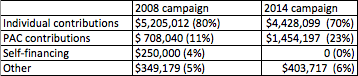
With 5 years as a U.S. Senator now behind him, the sources of Merkley’s donations are shifting. A smaller share is coming from individual contributors and twice as much from political action committees (PACs). Also, more unions are stepping up as big contributors, his big donors have less of an Oregon focus and Merkley isn’t having to dig into his own pocket.

merkleySenate

According to the Center for Responsive Politics, contributions to Merkley’s campaign committee for his 2008 campaign and for his 2014 campaign as of Dec. 31, 2013 break down as follows:

Screen Shot 2014-03-26 at 10.18.34 PM

For his 2008 Senate race, Merkley’s largest 10 contributors (individuals and PACs) to his campaign committee were:

JStreetPAC $78,180
Council for a Livable World $55,889
State of Oregon employees $35,050
Oregon Health & Science University $33,964
Moveon.org $26,731
Stoel, Rives et al $23,323
League of Conservation Voters $21,500
Intel Corporation $17,920
Newmark Knight Frank $17,300
Intl. Brotherhood of Electrical Workers $17,200

The largest contributor to his 2008 campaign, Washington, D.C-based JStreetPAC, makes contributions to candidates who support a two-state solution for Israel and Palestine and robust American military aid to Israel. “I am and will continue to be a staunch supporter of the special relationship between the U.S. and Israel,” Merkley said during his 2008 campaign.“I will always seek to ensure its strength and foster its growth.”

The second largest contributor to his 2008 campaign, Council for a Livable World, is a Washington, D.C.-based non-profit advocacy organization dedicated to reducing the danger of nuclear weapons. Merkley subsequently voted in 2010 for a new Strategic Arms Reduction Treaty (START) with Russia and in February 2014, Merkley and Senator Edward J. Markey (D-Mass.) introduced legislation that would cut $100 billion over the next decade from the U.S. nuclear weapons budget.

The bill, S. 2070, would shut down all U.S. missile defense activities, reduce from 12 to eight the number of SSBN(X) ballistic-missile submarines that are set to replace the retiring Ohio-class fleet and limit to eight the number of Ohio-class submarines that can currently be fielded. The bill has been referred to the Senate Committee on Armed Services where its languishing.

The largest 10 contributors (individuals and PACs) to Merkley’s campaign committee for his 2014 race as of the end of 2013 are significantly different, with much less of an Oregon focus:

Votesane PAC $31,250
Thornton & Naumes $25,000
Intel Corporation $22,050
Honeywell Intl. $20,000
Operating Engineers Union $20,000
Intl. Association of Firefighters $18,500
Blue Cross/Blue Shield $17,100
League of Conservation Voters $15,314
American Crystal Sugar $15,000
Communications Workers of America $15,000

Votesane PAC, a non-partisan channel for political donations, has funneled $1.6 million to candidates in the 2014 election cycle, with almost all of it going to Democrats.

The only union showing up in Merkley’s list of top 10 contributors for his 2008 race was the International Brotherhood of Electrical Workers at $17,200. Three unions show up as his biggest contributors for the 2014 race so far with a total of $53,500.

Also making their debut as major Merkley contributors are individuals from Thornton & Naumes, a Boston, Mass. law firm with class action expertise that has represented people claiming they were victims of asbestos and toxic exposure, defective products, financial fraud, and personal injury accidents.. Law firms and lawyers have been the top contributors to Merkley’s 2014 campaign as of Dec. 31, 2013, donating a total of $296,363.

This only reveals, of course, donations up the end of 2013. Expect a lot of shifts as the campaign progresses.

Merkley has already spent $3,045,241, or almost half, of the funds he’s raised since 2008. Recently, the largest single amount has gone to Mandate Media,a Portland-based internet strategy,services,and advertising firm specializing in progressive political candidates and advocacy organizations. Mandate is also associated with BlueOregon, a widely distributed progressive e-newsletter.

The top 5 recipients of the campaign’s recent expenditures were:

Mandate Media $200,485
CHS Mailing $141,305
Kauffman Group $125,163
Linemark Printing $ 71,639
Benenson Strategy Group $ 47,000

It’s important to recognize that much of the money now being spent on campaigns is so-called independent expenditures, spending by groups and individuals who claim they are not coordinating their activities with a candidate’s campaign committee.

In Merkley’s 2008 race, for example, according to FindTheBest, the following outside groups spent about $675,000 in support of his candidacy:

Committee Amount

Service Employees International
Union Committee on Political Education
(SEIU Cope) $430,238
League of Conservation Voters Inc. $145,317
Democratic Senatorial Committee $ 47,746
League of Conservation Voters
Action Fund $ 40,862
Moveon.org Political Action $ 7,026

It’s likely that similarly large amounts of independent expenditures will occur in the 2014 race.

Data sources: The Center for Responsive Politics (http://www.opensecrets.org), a non-profit, non-partisan research group based in Washington, D.C.; FindTheBest (www.findthebest.com; http://bit.ly/1nYKKSA),a network of for-profit websites connected to help consumers and businesses make informed decisions.

merkleySenate

Ignore the busybodies

RosenblumIgnore the busybodies.

That’s my advice after learning that Oregon’s attorney general, Ellen Rosenblum, and attorneys general representing 27 other states and territories, have signed a letter to big pharmacy chains, including Rite Aid, Walgreens, Kroger, Safeway and Walmart, calling on them to stop selling tobacco products in stores that also have pharmacies. (http://nyti.ms/1ht1aLl)

“Pharmacies and drug stores, which increasingly market themselves as a source for community health care, send a mixed message by continuing to sell deadly tobacco products,” said Attorney General Eric Schneiderman of New York, a leader of the effort.

Following the line of thinking that it is immoral or contradictory for these businesses to sell tobacco products alongside healthcare products, are the attorneys general as outraged over all these company’s stores also selling tooth-decaying candy, life-destroying alcohol, and snacks like Twinkies that are contributing to an epidemic of obesity? And good grief, what about guns? WalMart sells guns. Talk about something that can ruin your health.

What individual stores stock should be based on customer preferences, not the headline-grabbing antics of state attorneys general eager to impose their views on the marketplace.

Redefining “reporting” – the erosion of journalistic integrity by Metro

Metro is misusing the term "reporter"

Metro is misusing the term “reporter”

Traditional journalists have long been defined by their independence and integrity, beholden to no one but the public, producing the news without fear or favor.

But lately, with trust of American media already at an all-time low, media are being complicit in their own decline, undermining their authenticity and trustworthiness by allowing publicists to pose as reporters and blurring the line between editorial content and paid advertising.

One of the more egregious abuses of the journalism standard is at Metro, the Portland area’s regional elected government, where a former Hillsboro Argus news writer pretends to be a “reporter” providing “objective, written news coverage” of Metro. Metro created the position in 2010, insisting that the new hire would provide “objective, written news coverage” of the agency. The “reporter” would get style, spelling and other editorial support, but could decide what topics to pursue and would not have his or her work edited for content.

The eventual hire, Nick Christensen, came from the Hillsboro Argus, where he had covered Metro and western Washington County. Pror to that he served as managing editor of the Summerlin Home News near Las Vegas and as a reporter at the Las Vegas Sun.
Now reporting to Metro’s Communications Director, Jim Middaugh, Christensen is referred to as “Metro News editor” and as a “news reporter” for Metro on the agency’s website.

Access by a true reporter to the inner corridors of power can translate into aggressive, groundbreaking, fiery media stories, but it’s not likely that Metro’s in-house “reporter” will produce such stories. It’s clear from a review of his prosaic, process-oriented writing to date reveals that he’s not going to be a Woodward or Bernstein exposing seamy government practices or, for that matter, an investigative reporter in the tradition of the journalists at Willamette Week who exposed Neil Goldschmidt’s rape of a 14-year-old babysitter.

Instead, Christensen’s stories are carefully crafted press releases masquerading as independent news reporting. Metro even asks, “In the interest of disclosure to readers”, that media attribute content from Christensen‘s (stories) to him and identify him as a news reporter for Metro.
Making things worse, local media, including the Portland Business Journal, Willamette Week and the Portland Tribune have bought into Metro’s ruse, frequently citing Christensen’s comments as those of a reporter. This even though Middaugh has admitted that Christensen’s work is “definitely public relations”. Middaugh has justified Christensen’s identification as a “reporter” on the basis that government has a responsibility to keep people informed in the face of public cynicism, apparently unaware that misleading the public feeds that cynicism.

Christensen’s stories are, let’s be honest, the equivalent of advertising disguised as news. In that respect, he fits right in with the deliberate blurring of the divide between advertising and editorial content that’s going on across the media landscape, eroding public trust in journalism.

In case you haven’t noticed, digital and print media are increasingly featuring sponsored content, or “native advertising” created or developed by a business or special interest seeking to influence viewers.

In a prominent case, The Atlantic magazine found itself in the middle of a reputation debacle in January 2013 when it featured a native advertisement package submitted by the Church of Scientology which, though identified as “sponsor content,” looked otherwise like a regular story.

The Internet exploded with negative comments, some criticizing The Atlantic for promoting the controversial Church of Scientology, but more for allowing paid advertising to be subtly disguised as editorial content.

To put it simply, the news business is slowly being corrupted by practices like native advertising and media’s willingness to go along with things like Metro’s attempt to pass Christensen off as a reporter. If it isn’t controlled, readers’ trust will be lost.

So, let’s all get on the same page here and call a P.R. guy a P.R. guy. For Metro, that would be good P.R.

Woodfold Manufacturing redefining business success

Some businesspeople want to do more than just build a successful enterprise; they also want to be a force for good.

In Forest Grove, the leaders of Woodfold Manufacturing believe in the capacity of business to do more than just produce jobs and profits.

Founded in 1957, Woodfold has continued to thrive as an employee-owned and operated company that’s a leading supplier of custom-crafted accordion doors, roll-up doors, hardwood shutters and bookcase doors for residential and commercial installations.

Woodfold has also become a company dedicated to the idea that true business sustainability considers the relationships between the environment, community and people.

Over the years that has meant big reductions in electricity and natural gas use, increases in recycling, achievement of a Forest Stewardship Councilcertification, and even providing free gardening space for a local charter school.

Setting higher bar

On May 14, 2013, Woodfold took a further step by becoming a Certified B Corp. “We became certified because we have always held certain core values at Woodfold, such as working for the long term and measuring things in regard to the triple bottom line,” said Justin Norman, Woodfold’s vice president for business development.

A company’s B Corp status is conferred by B Lab, a 501(c)3 nonprofit, on business entities that meet certain criteria. A certification means the company’s policies and practices have been verified to be sustainable through a rigorous process called the B Impact Assessment.

“Woodfold’s first commitment is to our people and doing the right thing,” said the company’s CEO, Mark Lewis. “It just so happens that a commitment to those to things makes it pretty easy to meet the B Corp certification standards.”

A company can become a B Corp regardless of its legal structure so long as it scores well on B Lab’s assessment and verification process. There are currently 894 certified B Corporations in 29 countries.

By voluntarily meeting higher standards of transparency, accountability, and performance, Certified B Corps are distinguishing themselves in a cluttered marketplace by offering a positive vision of a better way to do business, B Lab says.

Simply seeking B Corp certification can have benefits, too. “Despite scoring relatively well on the certification, we still have a long way to go, as do almost all B Corps, because neither us nor anyone to my knowledge has ever attained a perfect score,” Norman said. “Since we are big into continuous improvement, it would not make any sense for us to stand still and not try to keeping improving things here at Woodfold, which in turn will lend itself to a higher score down the road.”

There are also rewards to just participating in the B Lab review because companies become more aware of evaluation standards and can set goals for improvement.

B Corps vs. Benefit Companies

As we begin 2014, Woodfold faces another decision: whether to also become a Benefit Company. B Corps and Benefit Companies sound similar, but they are quite different and the difference goes beyond semantics.

A state law permitting businesses to become Benefit Companies took effect in Oregon on January 2, 2014. Securing a B Corp designation is more a branding effort than a legal step. To embrace legally binding sustainability obligations, a business must register as a Benefit Company.

Benefit companies write into their governing documents that management is permitted to pursue social and environmental benefits alongside shareholder interest. That means they can are make business decisions that run contrary to maximizing shareholder value, putting purpose over profits.

According to the MIT Sloan Management Review, this goes beyond traditional corporate social responsibility, where companies support social and charitable programs that improve the corporation’s image. It is, instead, about managing and holding organizations accountable for performance targeted at optimizing a combination of financial, social and environmental outcomes.

“We want to make sure that things play out as expected before we go for Benefit Company status in Oregon,” said Lewis. “One of the things we try very hard not to do at Woodfold is whipsaw our people by constant course changes. The first thing we wanted to do is use the B Corp standards to test our management philosophy. We will explore the pros and cons of becoming a Benefit Corp and make a decision on that later in 2014.”

Tigard man is enthralled by tin toy trucks

By Bill MacKenzie

It all started, as so many good things do, with his father.

John Venheim’s father, Georg, a decorated veteran of World War II, came to the United States from Norway in 1945 to marry his 17-year-old sweetheart from New York. When Venheim was in kindergarten, his father brought home a 1955 Tonka Metro van he’d bought at Goodwill. Venheim was hooked.

In 2010, the year his father passed away, Venheim bought his first Tonka tractor-trailer set on Craigslist, followed by the purchase of several collections of Tonka parts from which he crafted some trucks. When he sold an orange 1958 Tonka flatbed truck carrying a bulldozer for $300, he knew his hobby had taken a turn.

“I realized I had to get organized,” he said, “so I put together a complete shop in my garage in 2011.” The cluttered 480-square-foot garage is now packed with a raft of tin toy truck-making equipment, including a sandblaster, woodworking tools, a painting cube, a Thumler’s Tumbler machine that shines chromed parts in vibrating corn cob grit, a metal polisher and a wood jig used to make identical wooden stakes for a Tonka Farm Stake truck.

In a corner of the garage are 7-foot-tall wooden racks with shelving. One rack contains already painted projects, another a collection of parts, a third a jumble of supplies. A fourth rack is used to dry newly painted projects at a constant 80 degrees. In another corner is a large metal rack filled with old tin trucks and parts acquired over time.

On a shelf is a collection of original, colorful crate labels found on the Internet that he uses to adorn the sides of trucks. “Minton’s. Choice Bartlett Pears packed by C.D. Minton Inc., Forest Grove, Oregon, U.S.A.,” read one.

by: JONATHAN HOUSE - John Venheim refurbishes vintage pressed-steel toy trucks that he then sells through his Custom Tin Toy Trucks business.by: JONATHAN HOUSE – John Venheim refurbishes vintage pressed-steel toy trucks that he then sells through his Custom Tin Toy Trucks business.

For the past three years, Venheim has been busily building, repairing, buying and selling tin toy trucks and parts made not just by Tonka, but also by Buddy L. Wyandotte, Nylint, Structo and others. He said he spends about 10 hours a week in the garage immersed in his hobby, but with his non-stop enthusiasm, it’s probably much more as he builds his business, Custom Tin Toy Trucks.

He buys and sells on eBay and Craigslist and on specialized websites such as tonkapartsandsupply.com.

“You can buy just about anything connected with old Tonkas online,” he said, “including whole trucks, grills, hubcaps, headlights, truck tailgates, and tires, which are real expensive.”

His most recent acquisition, a red Texaco Fire Chief fire truck made by Buddy L. in the 1960s, was purchased on eBay for $40

Venheim also seeks out deals at garage sales. “Lots of people with tin toy trucks have no idea what they have,” he said. At a garage sale he encountered a woman selling a 1955 tin toy truck for $10. He told her the truck was worth much more and bought it for $80. After he fixed up and polished the truck, he sold it for $127.

Some online sellers buy old model trucks online, strip them down and sell all the parts individually. “Most people selling these old trucks don’t realize that if they took them apart and sold the parts, they could get three times as much,” he said.

The truck Venheim got the most for was a worn vintage unrestored Steelcraft Streamlined City Trucking Co. truck. What made it special is that it was designed by Viktor Schreckengost, a legendary American industrial designer often called “the American DaVinci.” Venheim sold the truck on eBay for $600.

by: JONATHAN HOUSE - Once finished, John Venheims custom tin trucks bring back the nostalgia of these old toys.by: JONATHAN HOUSE – Once finished, John Venheims custom tin trucks bring back the nostalgia of these old toys.

Some people only want to buy completely original vintage trucks, which tend to cost more. An original 1958 Big Mike dump truck with snow plow and dual hydraulic in mint condition with its original box can go for $1,000 or more. Other collectors are fine with new toy trucks. For them, there are companies like Smith-Miller Inc. of Lake Havasu City, Ari., which sells handmade scale trucks in miniature. A 41.5-inch-long, 21-pound Navajo Freight Lines Hauler is for sale on its website at $1,295.

Venheim’s trucks cost considerably less. That’s partly because he hasn’t built a solid reputation yet. It’s also because his creations often have added parts or parts that are different from the original. Once in a while, he even does whimsical add-ons such as a tiny spotted owl he placed on a logging truck.

As much as he’s able to make a little money from his tin trucks, he wants to keep it as a hobby and hold down a steady job for a while. “It’s an avocation now,” said Venheim, 55. “Hopefully, it’s going to be an established business when I retire.”

At that point, he expects to concentrate on mass-producing a highly sought after type of model gas turbine toy truck. “My intent is to get businesses like breweries to buy 10 or 15 of them, put their label on the side and then use them for promotional purposes,” he said. “That will be my bread and butter.”

In the long term, Venheim’s goal is to create a legacy. “My intent behind this company is that 50 years from now people will see one of my trucks and say, ‘Oh, wow, that’s a Custom Tin Toy Truck.”

Bill MacKenzie is a former congressional staff member, newspaper reporter and communications manager for a Hillsboro company.

Originally published in the Hillsboro Tribune,  Dec. 5, 2013


View a video, Custom Tin Toy Trucks with John VenheimImage

Sometimes it pays to go with the crowd

By Bill MacKenzie

It seems like nearly everybody is trying to raise money for their personal use through online “crowdfunding.” It’s clearly not just for start-up businesses.

Crowdfunding — funding a project by raising many small amounts of money from a large number of people — is exploding in Hillsboro, throughout Oregon and across the United States.

Even Caroline Channing, the tall blonde in the TV show “2 Broke Girls,” is a believer. In a recent episode, she went on a crowdfunding website, gofundyourself.com, in an attempt to raise $1,500 for a new pair of pants.

If you believe in the wisdom of the crowd, the Internet is bursting with opportunities to join others investing in people.

Keith Merrow of Hillsboro recently sought to raise $15,000 on a crowdfunding website, Indiegogo.com. His band, Conquering Dystopia, wanted to use the money to record an album.

In just 45 days, his campaign raised $35,320, more than double his goal, from 792 contributors, some as far away as Australia.

Typical of arrangements on Indiegogo, contributors got no financial return on their investment, but could pick a gift based on the amount of their donation. A $10 donation spurred a digital download of the album; a $500 donation earned a VIP dinner with band members at the Hard Rock Cafe in Seattle.

Matt Peterson of Hillsboro tried to raise $3,000 on another crowdfunding website, GoFundMe.com, so he could go to a 28-day intensive wrestling camp. He reached $1,750 from 16 people in six months, then secured the rest from family.

At GoFundMe, participants usually raise money for themselves, a friend or a loved one for purposes such as medical expenses, education costs, volunteer programs and youth sports. Fundraisers can keep every donation they get or get the donations only if they reach a pre-set goal.

A different approach is offered by the crowdfunding website pave.com, an online funding platform that allows individuals to support promising high achievers. Pave claims it’s “a new investment option, not a donation.” If the investees achieve financial success, they agree to share that with their investors.

Oren Bass, who co-founded Pave in 2012, said his motivation was basic: “To provide people with what I consider a better financing option than debt — one that allows risk-taking plus the collaboration and support of the community; and to build something with both social and macro-economic impact.”

At Pave, the percentage of income an investee commits to sharing with investors varies depending on the amount of funding raised, along with how much the recipient is expected to earn.

Stephanie Walker, an engineering student at Oregon State University, recently launched a campaign on Pave. She hopes to raise $50,000 to pay off her student loans so she can pursue a career in sustainable engineering and product design with a focus on creating sustainable materials.

Close to 30 prospects have already raised over $400,000 through Pave, and a few have started making payments to their backers.

Though crowdfunding is gaining wide acceptance, there is reason to be cautious.

To guard against fraud, Pave does extensive checks to verify identities, review credit histories and check any “structured data” a prospect supplies, such as college attendance, GPA, and work employment history.

GoFundMe is much looser in its oversight.

“With hundreds of thousands of campaigns, it’s not feasible for GoFundMe to investigate the claims stated by each campaign organizer,” reads an excerpt from the GoFundMe website.

I’m not sure what motivates people to give money online to complete strangers. Maybe a lot of people who have had good fortune want to pay it forward. Maybe it’s just a charitable impulse.

But you can’t check the veracity of a lot of crowdfunding proposals. Some are the equivalent of the infamous Nigerian email scams where mass emails promise great riches to potential victims. The entire personal crowdfunding platform relies largely on trust, something scammers have always known how to exploit. So prudence should be the watchword.


Bill MacKenzie is a former congressional staff member, newspaper reporter and communications manager for a Hillsboro company.

Originally published in the Hillsboro Tribune,  Nov. 15, 2013


Turning unemployment into self-employment

By Bill MacKenzie

Ronald Reagan once wisecracked, “The nine most terrifying words in the English language are, ‘I’m from the government and I’m here to help.’”

But sometimes, the government gets it right.

Julie Thomas knows that. Thomas recalls with sadness when her beloved black lab, Barney, had cancer. Wanting desperately to ease Barney’s pain, Thomas, an employee at Intel’s Hillsboro site, studied small animal massage and began treating her pet. When Thomas learned she was going to be let go by Intel, she decided to take a risk and change careers to work in canine water therapy.

But how could she get the business off the ground while unemployed? Oregon’s Self Employment Assistance Program (SEAP) came to her rescue.

The regular Unemployment Compensation program requires unemployed workers to be actively seeking work to get benefits. SEAP allows unemployed people to collect allowances equal to their benefits while devoting all their time to starting a business, rather than looking for another job.

The program was created in 1993 after passage of federal legislation championed by then-U.S. Rep. Ron Wyden. SEAP is now active in seven states, including Oregon. In 2012, legislation sponsored by Wyden — now Oregon’s senior U.S. Senator — provided for $35 million in grants to states to improve administration and promotion of the program.

With the economy still struggling, SEAP offers a lifeline to some entrepreneurs.

“It seemed a perfect fit for me,” Thomas said.

Thomas opened her business, Doggie Paddle, in Portland in October 2010.

“I’m not making the money I made working in a corporation,” she said, “but I’m doing something with animals, something of service, something for which I have a passion.”

Thomas is just one of several thousand Oregonians who have taken advantage of SEAP, including 55 now enrolled from Washington County, with seven of those from Hillsboro.

With SEAP support, Dave Crosswhite of Tigard started Oregon Backflow Testing, which tests backflow prevention devices that help to prevent hazardous materials from entering drinking water. He said SEAP was a huge factor.

“It took the pressure off of needing to produce an income right away and allowed me to focus on building the business and not having to job search in order to receive benefits,” he explained.

Glen Wagner and Steve Bauer signed up after they both lost their technology jobs. They decided to start a company called Open Lore in Beaverton that would deliver assisting technology to people having difficulty reading English, primarily those with dyslexia.

“Unfortunately, with multiple kids in college and still relatively young, at least at heart, we did not have the complete means to meet our family obligations and the capital expenses of starting a new technology business,” Wagner said. “With SEAP, we could put our heart and soul into the business.”

But SEAP is not without its weaknesses.

Key SEAP performance data is based only on surveys returned by program participants, but a lot of participants don’t return the surveys. For example, a recent Oregon survey sent out to 356 SEAP participants got only 78 replies — a 22 percent return.

So the state doesn’t know how many people sign up for SEAP, exhaust their benefits and end up with no business and no job. Some of those missing may be in worse shape than when they started.

Another glaring weakness is, success in Oregon hasn’t been determined on the basis of how many SEAP participants start and maintain a successful business. Rather, success has been judged by how well the state promotes SEAP and how much money is distributed to participants. Only government could think that way.

In addition, although SEAP requires that potential participants fill out an application scored to determine the feasibility of their proposed business, there’s no real follow-up. That means no assurance participants will take advantage of the array of support programs available to help grow and sustain a business. Failure may too often be the consequence.

Only about half of all new businesses survive five years or more, and only about one-third survive 10 years or more. To improve their odds, SEAP-related businesses need continuing guidance. After all, although new businesses create new jobs, it’s only when they succeed and expand that real job growth occurs.

Bill MacKenzie is a former congressional staff member, newspaper reporter and communications manager for a Hillsboro company.

Originally published in the Hillsboro Tribune,  Sept. 13, 2013