PGE and Why the EV Revolution is Stalling

Update 9/24/2025: I see a lot of electric vehicles (EVs) around town, but apparently looks are deceiving. As of May 2025, 119,850 “zero emissions vehicles” (ZEV) were registered in Oregon, equaling 3.2 percent of the total vehicle fleet, according to the Cascade Policy Institute. Of those, only 84,636 were true zero-emission vehicles powered entirely by a battery. The remaining 35,214 vehicles were plug-in hybrids, which still rely on gasoline. The numbers show Oregon has reached just 34 percent of former Governor Kate Brown’s EV Adoption Targets established during her era.

The hoopla was energizing.

On Oct. 26, 2019, PGE celebrated the grand opening of its Eastport Plaza Electric Avenue EV charging station at 4000 SE 82nd Avenue in Portland.

“These charging stations are important to the mission of PGE, because we are committed to doing our part in solving global warming and Climate Change,” said PGE’s President & CEO, Maria Pope.

The Eastport Plaza location joined already operating Electric Avenue operations in Milwaukie, Hillsboro, Wilsonville, and downtown Portland.

Smiling PGE officials, representatives from TriMet, the City of Portland, and Multnomah County enthusiastically cut a ribbon to officially open the new 82nd Ave. charging station.

The national mood on EV’s was optimistic, too.

Global plug-in vehicles come in two basic varieties—all-electric (BEV) and plug-in hybrids (PHEV). Ddeliveries reached 2.1 million units for 2018, 64% higher than for 2017.  About 69% of sales were BEV and 31% were PHEV. Global BEV sales in 2019 were increasing at a slower pace than previously, but global plug-in vehicle deliveries still were headed toward 2.3 million units in 2019. Electrification was clearly on the minds of most forward-looking utilities. 

More than four years later the mood is considerably less upbeat.

The pace of adoption has markedly slowed, and analysts have suggested the country is no longer likely to hit the federal government’s sales targets. Government targets for EV sales in 2024 call for each car manufacturer to hit 22% electric vehicle sales or face hefty fines. EV experts are warning the growth rate in electric vehicle uptake simply isn’t strong enough to make that target. 

Earlier this week, dealers representing about 5,000 stores wrote to President Biden saying the charging infrastructure remains scattershot and unsold EVs are piling up on their lots. The letter urged Biden to “hit the brakes” on an EPA proposal that could codify the agency’s strictest-ever tailpipe emissions limitsproposed last April

“Mr. President, we share your belief in an electric vehicle future,” the latest letter says. “We only ask that you not accelerate into that future before the road is ready.”

This followed an earlier November letter from about 4,000 dealerships calling on Biden to reconsider the proposed regulations, which they argued would mandate an unrealistic shift to battery-electric vehicles in the U.S.

A recent visit to the Eastport Plaza Electric Avenue charging site offers some reasons why manufacturers and dealers are getting antsy about EVs. And potential buyers, too.

The site has four DC fast chargers and two Level 2 chargers.[1] When I pulled in riding in a Nissan Leaf, one of the charging ports was broken. I was later told it had been broken for months. The three other fast chargers were in use. One vehicle was at 86% charged, one at 39% and the third at 22%. Only the 86% vehicle was occupied.

Broken charger at Eastport Electric Avenue

 Choices open to us were to use a slow Level 2 charger or sit and wait for one of the fast charger slots to open up. Unlike at a gas station, there’s no assurance the vehicles ahead of you will move on in a timely manner.

We encountered similar issues at PGE’s Electric Avenue site in the heart of downtown Milwaukie at the corner of SE McLoughlin Blvd. and Jackson St. 

As at Eastport, the Milwaukie site has six charging ports, four DC fast chargers and two Level 2 chargers. All four fast charging stations were occupied with no drivers in the vehicles. One vehicle was at 59%, one at 74%, one at 59% and one at 89%. One of the slow Level 2 chargers was being used, with the driver in the vehicle. 

It is considered acceptable to leave your vehicle unoccupied while it’s charging, It used to be common EV etiquette, however, that when your vehicle was at 80% you would make way for another vehicle if others were waiting.

The U.S. Department of Energy still says, “Unless you truly need every ounce of driving range available in your vehicle, consider unplugging your electric vehicle when it has reached 80 percent charge or an acceptable charge level for your immediate driving needs.” 

EV owners tell me the 80% rule is, however, now commonly abused. Another common abuse is leaving a fully charged vehicle unoccupied for an extended period, with no way for a waiting driver to know how long the wait will be. One EV driver can tell how much longer another EV needs to charge by reading the digital readout on the charger stating the EV’s current degree of charge and the length of time for its charging, but that doesn’t guarantee the vehicle owner will unplug in a timely manner. 

The Department of Energy also urges EV owners not to consider charging sites as resting places. An EV owner will often use a charge point as an hours-long parking spot versus a place to recharge and go,” the Department says.  Doing so, of course, adds an extra problem in that extra-long periods of charging time tops off the battery, which is not optimal for EV performance.

Then, of course, there are gas and diesel vehicle owners who see open charging spaces as prime parking spots. “In a crowded parking lot, the sight of any open electric car charging spot can be too tempting for some to resist,” the Department of Energy warns.

PGE’s charging stations accept all major credit cards, but if you want to sign up for pre-paid or monthly subscription pricing for Electric Avenue chargers, things get a little more complicated because PGE has partnered with Shell Recharge to accomplish that.[2]

First, you have to download the Shell Recharge app to your phone in the Apple App store Google Play store or order a Shell Recharge RFID card.

When you’re ready to charge your vehicle, you have to activate a charging session through the Shell Recharge app or scan your Shell Recharge charging card. If you are at an Electric Avenue charger, you can select “subscription” in the app if you’d like to pay just $25 per month for unlimited charging at Electric Avenue chargers or choose another preferred payment option. When you’re done, your card will automatically be charged for the session.

Charging prices at PGE’s sites are:
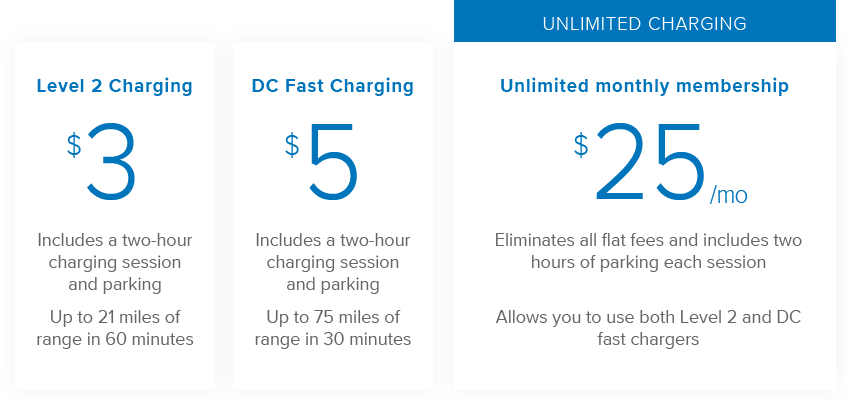
                                                                             Source: PGE

Unlike at a gas station where the price per gallon generally stays the same 24/7, prices may vary during peak times (weekdays from 3 to 8 p.m.) During this period, PGE says $0.19/kWh will be charged to your credit card or Shell Recharge account in addition to your $3, $5 or $25 unlimited pricing structure.

Whatever the price, Oregon’s hyper-projections for electric vehicle adoption are proving to be wishful thinking. And it’s probably not just about EV prices, battery life and range. Unless you have a charging station at home, you are forced to rely on public chargers, and that, as we discovered, can be a frustrating challenge. 

On Nov. 6, 2017, Gov. Kate Brown signed Executive Order 17-21 stating “It is the policy of the State of Oregon to establish an aggressive timeline to achieve a statewide goal of 50,000 or more registered and operating electric vehicles by 2020.” (emphasis in original). 

In 2019, Senate Bill 1044  set a target of 250,000 registered Zero Emission Vehicles on Oregon roads by 2025. In December 2022, Gov. Brown, in a burst of environmental overreach that slavishly followed California’s lead, announced that all new cars sold in Oregon would have to be emissions-free starting in 2035.

The number of Oregon-registered zero emission vehicles on Oregon roads as of September 2023 was just 70,000.  

The likelihood that this number will grow to 250,000 over the next 12 months is nil.


[1] There are three power levels at EV charging stations. Level 1 is the standard wall plug found in homes that delivers 120V. You will generally get only 2-5 miles worth of charging power every hour. Level 2 delivers twice the amount of power with 240V, offering 40-65 miles of charging power every hour. DC Fast Charge is the delivers 480V, which can fill 80% of most car batteries in 30 to 40 minutes.

No new taxes or fees in Portland: Don’t Believe It!

No new taxes or fees!

That was one of the recommendations of Gov. Tina Kotek’s Portland Central City Task Force convened to consider the city’s most challenging problems and recommend ways to address them. 

“Declare a moratorium on new taxes…” urges the Task Force report.…elected officials should consider a three-year pause, through 2026, on new taxes and fees…”

Oh well, so much for that.

Your Portland property taxes, which were due Nov. 15, probably already went up and will likely go up again in 2024. According to the Lincoln Institute of Land Policy and the Minnesota Center for Fiscal Excellence, Portland ranked fifth highest nationally for effective property tax rate — a homeowner’s tax bill as a percentage of a property’s value — on a median-value home in 2022.

And Portland Commissioners Dan Ryan and Rene Gonzalez are already floating a November 2024 ballot measure that would raise property taxes to cover a $800 million bond for maintenance and new construction projects for the city’s parks and fire departments. 

Oregonians are also already paying higher gas taxes. Oregon’s gas tax increased to 40 cents as of Jan. 1, 2024. That’s an increase of two cents per gallon from last year. The new rate keeps Oregon among the ten states in the U.S. with the highest gas taxes. Propane and Natural Gas Flat Fee increases also went into effect for qualified vehicles on Jan. 1.

Portlanders (and many more folks) are also facing increases in electricity rates. PGE customers can expect to pay 18% more on their power bills starting Jan. 1. The 2024 rate increase will cost the average single-family household an extra $24.59 each month.

And then there are all the taxes and fees the 2003 Legislature gleefully enacted. 

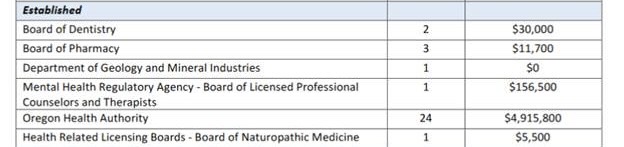
According to the Taxpayer Association of Oregon, Oregon lawmakers passed 185 fee increases (increasing existing fees and establishing new fees) in 2023 that will mean $47 million in higher costs.

Of those, 77 new or increased fees will directly impact the cost of medicine, hospitals and health care, which are all already straining the budgets of Oregonians.  Another 47 fee increases will impact Oregon’s agriculture industry and consumers.

A list of 2024 fee increases by agency is below: 

And then there are the new fees the 2023 Legislature created:

Portlanders and almost all Oregonians are also going to be paying a new cell phone tax this year. Starting January 1, 2024, a 988 Coordinated Crisis Services Tax will be added to the existing Oregon Emergency Communications (911) Tax. The new tax was implemented by the Oregon Legislature with the passage of House Bill 2757. The $50 million a biennium tax is slated to fund the state’s new 9-8-8 suicide prevention hotline.  

DMV fees have gone up, too, touching just about everybody with a vehicle. For example:

  • Class C driver license or restricted Class C driver license, increased from $54 to $58
  • Commercial driver license, increased from $75 to $160
  • Instruction driver permit, increased from $23 to $30
  • Commercial learner driver permit, increased from $23 to $40
  • Hardship driver permit application, increased from $50 to $75
  • Fee for renewal of a commercial driver license, increased from $55 to $98
  • Fee for knowledge test for a motorcycle endorsement, increased from $5 to $7
  • Fee for a skills test for any commercial driver license, increased from $70 to $145

And the list of fee increases goes on, nickeling and diming Oregonians.  

And of course legislators are busy thinking of new taxes.

For example, because the Oregon Department of Forestry wants more money to fight wildfires, Sen. Elizabeth Steiner, D-Portland, wants to charge every property owner in the state an annual fee to pay for what she perceives as a statewide issue.

And then, of course, there’s always inflation. It has been pushed down by aggressive Federal Reserve action, but in its long-term economic projections from December, the Federal Open Market Committee forecasted core Personal Consumption Expenditures Price Index inflation will drop from 3.2% in 2023 to 2.4% in 2024 and 2.2% in 2025.

But, still, hold on to your wallet. The state is considering tolls on I-205, I-5, U.S. 26 and Highway 217.

And the beat goes on.

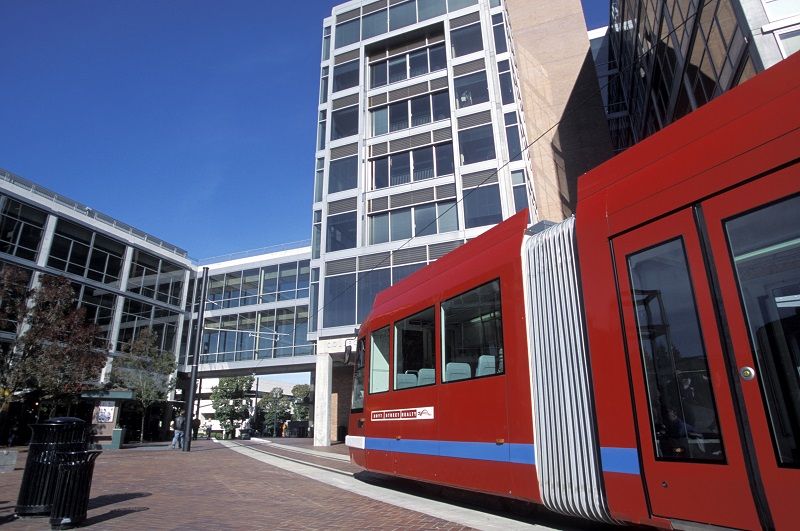
Is TriMet “riding the winds of change”? Not really.

Portland-Streetcar-cm

Think TriMet’s New Electric Buses Run on Wind Power? Think Again.

By Rachel Dawson

TriMet unveiled five new battery-electric buses (BEBs) in April 2019, the sides of which all donned images of windmills and sweeping gusts of wind. The BEBs each cost around $1 million, nearly twice as much as a traditional diesel bus. And these buses are just the beginning: The TriMet board voted last year to replace the entire fleet with battery-electric buses for $1.18 billion by 2040, a $500 million premium over a diesel fleet.

TriMet has been hailed an environmental hero for “riding the winds of change.” TriMet Spokesperson Roberta Altstadt claimed that TriMet was the first in the United States to “operate an electric bus on 100% renewable energy.” Without further research, it would be easy to think that TriMet’s new buses ran on clean wind energy. And that is exactlywhat TriMet is hoping you would think. But you would be wrong.

If the buses don’t run on 100% wind power, how is TriMet able to get away with saying they do?

TriMet spends $228.75 per month on what are known as renewable energy certificates (RECs) from PGE. RECs are a tradable commodity sold by renewable energy facilities (such as wind farms) to the wholesale market, that purport to represent the “environmental amenities” of certain renewable energy projects. By purchasing the RECs, TriMet has bought the legal right to claim it is using renewable energy; however, the agency has not purchased any energy itself.

This would be like my paying someone else to exercise at the gym for me, and then telling my family and friends I go to the gym. The person I pay reaps both financial and physical benefits while I merely get to pretend I have them.

Supporters of RECs claim the certificates offset fossil fuels and pay for the generation of new renewable energy. However, these claims are not entirely accurate. According to Daniel Press, a Professor of Environmental Studies at UC Santa Cruz, “RECs do little to reduce emissions in the real world because they have become too cheap to shift energy markets or incentivize businesses to build new turbines.” The income generated from RECs does not come close to the millions needed to construct more wind turbines, which means that RECs themselves don’t offset fossil fuels.

Despite its claims, it would be impossible for TriMet to run on 100% wind power unless it disconnected from the regional mixed grid and hooked up to its own personal wind farm. Even then, TriMet would be forced to rely on other backup power sources due to the volatility of wind generation.

While a wind turbine may be available to produce energy around 90% of the time, the average wind farm in the United States in 2018 had a capacity factor of only 37.4%. The capacity factor refers to the amount of energy produced in a year as a fraction of the farm’s maximum capacity. Wind farms produce electricity when winds reach about nine miles per hour and stop at roughly 55 mph to prevent equipment damage. If the wind isn’t blowing (or isn’t blowing strongly enough), little to no power can be generated.

This poses problems, as the electrical grid requires constant equilibrium or blackouts will result—power supply must meet energy demand. Every megawatt of wind power has to be backed up by an equal amount of traditional, “non-green” sources like coal and natural gas to account for times when wind energy isn’t generated. This would be like keeping a car constantly running at home in case the one you’re driving on the road fails.

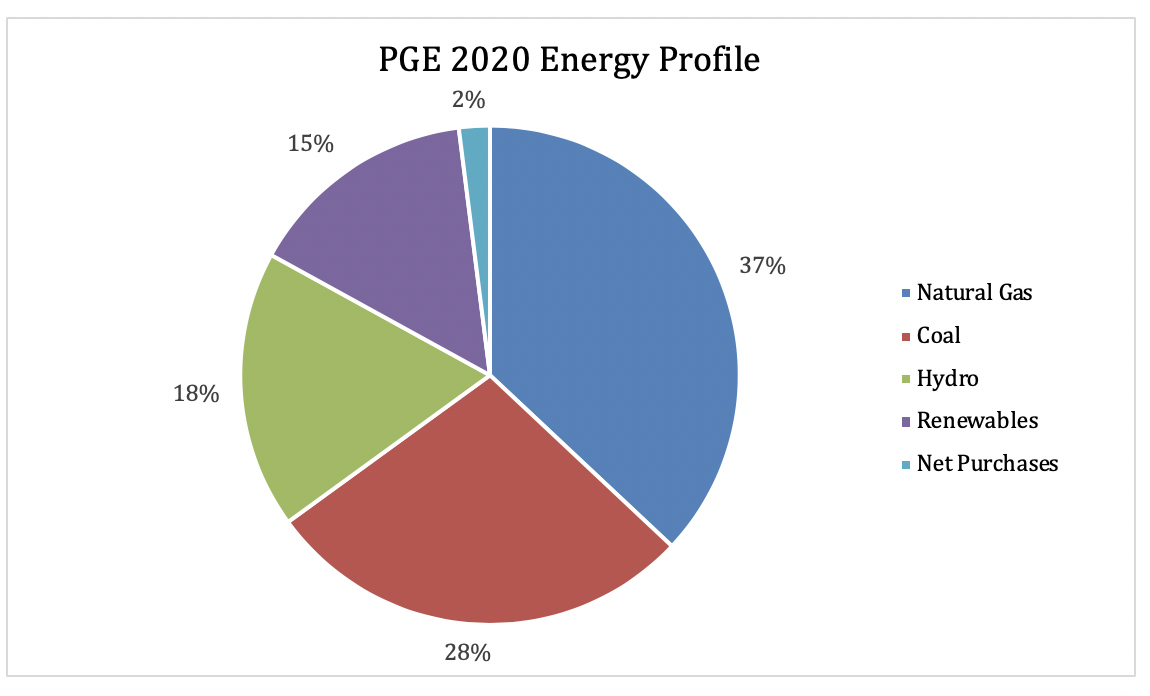
Instead of a wind farm, TriMet receives its electricity from Portland General Electric, the same mixed grid your home is likely powered by. In 2020, this mixed grid will be made up of 37% natural gas, 28% coal, 18% hydro, 15% renewables, and 2% purchased power (power purchased on the wholesale market). Since wind only makes up a portion of renewables used by PGE, less than 15% of the electricity used by the “wind” buses is powered by wind. A greater percentage of the electricity used by TriMet’s BEBs comes from coal plants than wind farms.

If TriMet were honest with its riders, it would replace the windmills on the sides of the new buses with coal, natural gas, and hydroelectric power plants. In the name of accuracy, TriMet could place a windmill in the corner, demonstrating the small percentage of power generated by wind farms.

So instead of riding the “winds of change,” keep in mind that you’re just riding a really expensive bus.

Rachel Dawson is a Policy Analyst at Cascade Policy Institute, Oregon’s free market public policy research organization.


Risky business: Corporate messaging and abortion.

Remember when people used to buy products because they were well made, priced right and met their needs?

Corporate meddling in politically contentious issues to signal virtue of one kind or another has put an end to that.

Businesses have been trying to position themselves as good corporate citizens for years in order to bring about a more favorable operating environment, but earlier efforts focused on neutral moves like raising public awareness of such things as charitable contributions, employee volunteerism and hiring veterans.

Recently, however, companies have been more willing to take public stands on truly controversial issues in order to raise their public profile… and sell more products.  And it just happens to be that federal and state lawmakers are simultaneously using abortion politics to rile their voters ahead of the 2020 election.

An example of this new outspokenness is the response to restrictive abortion legislation recently enacted in several states, including Missouri, Georgia, Mississippi, Kentucky, Alabama, and Ohio.

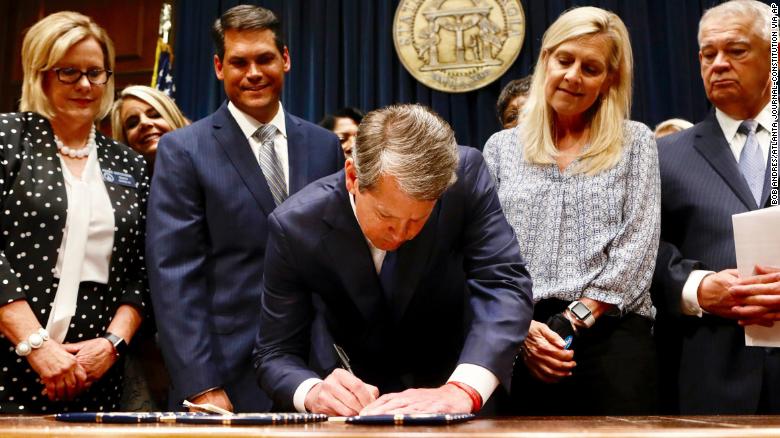
On May 7, 2019, Georgia Governor Brian Kemp signed a law that would ban abortion as soon as physicians can detect a heartbeat, which can be as soon as six weeks (before some women are aware they’re pregnant).

brianKempabortion

Georgia Governor Brian Kemp signing abortion law.

“Georgia is a state that values life,” Kemp said at the bill signing. “We protect the innocent, we champion the vulnerable, we stand up and speak for those that are unable to speak for themselves.”

On May 15, Alabama’s governor, Kay Ivey, signed a law defining a fetus as a legal person “for homicide purposes” and making performing an abortion in the state a felony.

Netflix, Disney and WarnerMedia responded that they might stop producing television shows and movies in Georgia, and multiple actors threatened that they wouldn’t work in Georgia if the state’s law takes effect.

“I think many people who work for us will not want to work there, and we will have to heed their wishes in that regard,” said Disney CEO Bob Iger. “… we will work with the ACLU and others to fight it in court,” said Netflix chief content officer Ted Sarandos.

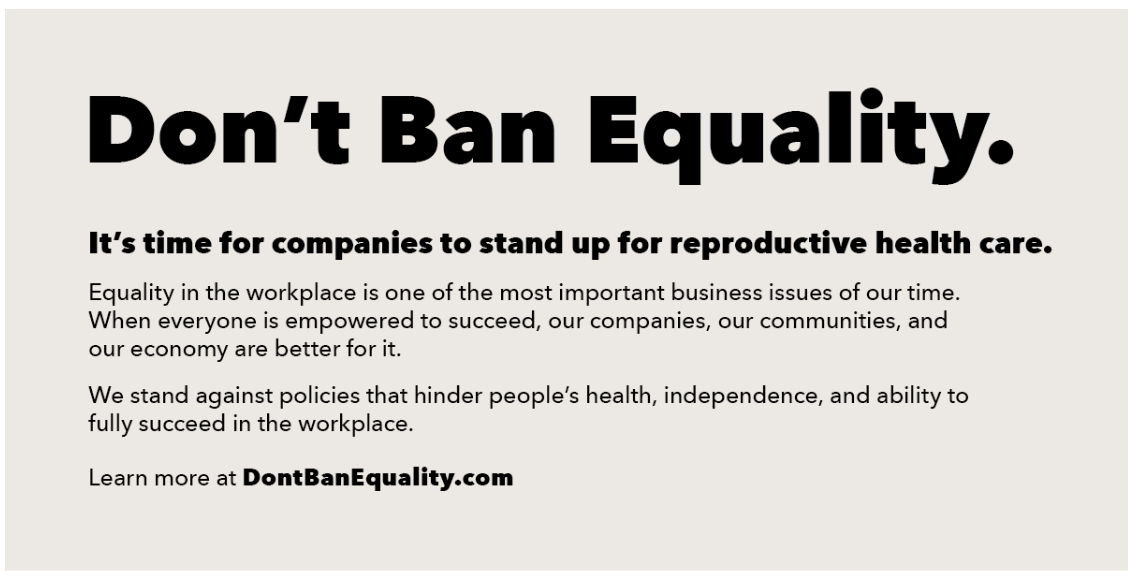
Earlier this month, leaders of more than 180 businesses, including Maria Pope, President and CEO of Portland General Electric, signed a letter that ran as an ad in The New York Times opposing the restrictive abortion laws enacted recently in multiple states.

mariapopePGE

Maria Pope, President and CEO of PGE, signed the “Don’t Ban Equality” letter.

“It’s time for companies to stand up for reproductive health care,” the Don’t Ban Equality letter said. Restricting abortion is “bad for business.”

dontbanequality


A problem with corporate virtue signaling like this as a marketing strategy is that it assumes the company has other people’s best interests at heart, that it’s not driven by profit seeking. There’s a risk that even altruistic millennials passionate about social causes will see through that, increasing cynicism, not brand loyalty.

Another issue with corporations trying to sell themselves as social justice warriors is that, as Tara Isabella Burton wrote in Vox, companies are pushing the spending of money “as a ritualistic as well as transactional act.” That can backfire. Purchases based on product quality are more likely to be sustained than those based on ever-changing corporate advocacy.

Public policy positions taken by corporate leaders on social issues may also not reflect the views of many employees or consumers, despite the presumptions of executives that others must be in alignment.

On abortion, for example, polling shows that Americans are actually fairly evenly split between those who identify as pro-life and those who identify as pro-choice. A majority of Americans, including many Democrats, support abortion restrictions in the second and third trimesters. In short, corporate honchos are mistaken if they believe most Americans are unrestricted abortion supporters.

As columnist David Byler wrote in the Washington Post, “… neither Republican nor Democratic voters unanimously want the total victory that activists on both sides are agitating for. Republicans are generally pro-life and Democrats are mostly pro-choice, but there’s real dissent among the rank-and-file voters in both camps. Our constantly shifting status quo may be unnerving to the most engaged pro-choice and pro-life advocates. But whatever they might say, the average U.S. voter wants a negotiated compromise in the abortion wars.”

Corporate evangelizing on all sorts of social issues can run afoul of public and employee attitudes, particularly with toxic social media serving as a megaphone for unhinged mobs of ever-smaller tribes determined to play a role in a debate.

Ideology-driven public positioning can also alienate employees and potential hires who are not in sync with a company’s cultural alignment or simply value open thinking.

”Internally, if leaders can create safe avenues for employees with different values and beliefs to voice their ideas (about CSR practices, products, or other business-related issues), this may lead to greater innovation, not to mention goodwill among those who value ideological tolerance as an over-arching feature of their workplace,” several U.S. business professors wrote in United States Politics and Policy.

Then there’s the fact that organizations and individuals who praise corporate intervention on sensitive public issues are generally much less enthused when the intervention has a conservative bent.

A striking example of this is the left’s outrage over comments made in July 2012 by Dan Cathy, Chick-fil-A’s CEO, to the Baptist Press. Cathy said he was “guilty as charged” in his support of what he described as traditional marriage. “We know that it might not be popular with everyone, but thank the Lord, we live in a country where we can share our values and operate on biblical principles,” Cathy said.

To say the least, all hell broke loose, with liberals and LGBTQ activists condemning Cathy and endorsing Chick-fil-A boycotts.

Controversy resurfaced with a March 2019 report by the progressive organization Think Progress that the chain’s foundation donated $1.8 million in 2017 to groups Think Progress said have anti-LGBTQ agendas.

Then there’s the shifting attitudes in the corporate world, which make executives unreliable moral leaders. “Americans ought to be cautious before making corporations their moral compass or primary vehicle for reform,” Adam Winkler, a professor of law at UCLA, wrote recently in The New Republic. “The policy positions taken by U.S. companies on social issues today lean in the direction of inclusion. But tomorrow might be different, if the country—or a business’s particular consumer base—turns in a different direction.

If all this keeps up, you may soon be nostalgic for the days when companies tried to sell their products with simple “plop, plop, fizz, fizz” jingles.