Rep. Suzanne Bonamici: No Friend of Working Families

U.S. Rep. Suzanne Bonamici, D-OR, is thrilled with President Biden’s actions cancelling student loan debt. She shouldn’t be. 

Even though she has a bachelor’s degree and a law degree from the University of Oregon, it’s clear she’s no economist. And even though she’s a member of the House Progressive Caucus and tries to package herself as an advocate for the common man (and woman), her support for student loan forgiveness suggests she’s no friend of working families either.  

That’s because, for one, the billions in student debt aren’t, in fact, being cancelled. The loans will still be paid off. The issue is by whom?

“The idea that the government is footing the bill for this policy is a bit misleading,” the American Institute for Economic Research points out.   “The cost of the program does not fall on the government. It falls on those who miss out on expenditures that would have otherwise occurred, those who pay higher taxes as a result of the program, those who pay higher interest rates or are crowded out due to additional government borrowing, or those who see the purchasing power of their dollars reduced more than usual.”

Even though the Supreme Court ruled that the Biden administration overstepped its authority in 2022 when it announced that it would cancel up to $400 billion in student loans, Biden has since been rolling out a series of debt forgiveness alternatives using a variety of executive actions.

Biden’s ingenuity in coming up with more loan repayment exceptions seems to have no bounds.  

On April 8, 2024, the White House announced an initiative that would:

  • forgive interest balances built up to date for 25 million borrowers, with 23 million likely to have all of their balance growth forgiven.
  • automatically cancel debt for borrowers eligible for loan forgiveness under several loan programs.
  • cancel student debt for borrowers who entered repayment over 20 years ago.
  • cancel student debt for loans associated with institutions or programs that lost their eligibility to participate in the Federal student aid program or were denied recertification because they cheated or took advantage of students.
  • cancel student debt for borrowers experiencing hardship paying back their loans.

While there’s no question student debt has become a burden for many Americans, Biden’s escalating efforts to relieve borrowers of obligations to repay student loans will add to the government’s annual deficits and the national debt. In other words, current student loan holders may escape repayment, but future taxpayers will have to pay the bill since Biden isn’t proposing any new revenue collections to cover the cost.

On April 11, the University of Pennsylvania’s Penn Wharton Budget Model estimated that Biden’s April 8 plans, if they are implemented, will cost the government $84 billion, in addition to the $475 billion that Penn Wharton previously estimated for Biden’s plans.

Rep. Bonamici must not care about that.  

Biden’s student debt forgiveness policies also raise serious questions about fairness. For example, according to Penn Wharton, eliminating student debt for borrowers in repayment for more than 20 years (or for more than 25 years with graduate debt) will provide debt relief for about 750,000 individuals residing in households that, on average, earn $312,977 in annual household income.

There’s also inequity in Biden’s plan to cancel up to $20,000 in interest for borrowers who have accrued or capitalized interest on their loans since entering repayment.  Low and middle-income borrowers enrolled in the SAVE Plan or other income-driven repayment (IDR) plans would be eligible for their entire interest balance since entering repayment to be cancelled if they make:

  • $120,000 or less per year individually or as married filing separately
  • $180,000 or less per year as a head of household, or 
  • $240,000 or less per year as married borrowers who file joint taxes.

Real median personal income in the United States was only $40,480 and the national median household income was just $74,580 in 2022. In other words, many college educated borrowers in Bonamici’s district who are eligible for relief under Biden’s plan are hardly struggling. And despite her assertion that she’s “standing up for working families,” many of her constituents with much lower incomes will end up covering the bills of their better-off neighbors.

Then, of course, a lot of Bonamici’s responsible working family constituents have probably made sacrifices to pay down their student loans, foregoing vacations, nice cars and restaurant meals. They will get no benefits at all from Bonamici’s generosity. 

Tough beans for them, I guess.

The Oregon State Bar Should Be Ashamed

The Oregon State Bar Association is blatantly failing its responsibility to Oregonians.

On Oct. 9, 2023, I filed a complaint with the Oregon State Bar Association asserting that a number of Oregon lawyers are misrepresenting their credentials, that they are acting in an unethical manner by asserting to potential and current clients that their selection as “Lawyers of Distinction” by a Florida-based business is evidence of their legal skills and achievements. I filed a second, more detailed complaint on Feb. 17, 2023 and followed up with an email asking whether the association intends to respond.

Lawyers of Distinction, incorporated in 2014, is in fact just like a diploma mill, an outfit that claims to be a higher education institution, but only provides illegitimate academic degrees and diplomas for a fee.

The Oregon Rules of Professional Conduct (as amended effective January 1, 2024) for Oregon attorneys is explicit about how attorneys must communicate about themselves:

Rule 7.1 A lawyer shall not make a false or misleading communication about the lawyer or the lawyer’s services. A communication is false or misleading if it contains a material representation of fact or law, or omits a fact necessary to make a statement considered as a whole not materially misleading. 

Rule 8.4 It is professional misconduct for a lawyer to…engage in conduct involving dishonesty, fraud, deceit or misrepresentation that reflects adversely on the lawyer’s fitness to practice law. 

An Oregon attorney claiming he or she is a exceptional because of membership in “Lawyers of Distinction” is clearly making “a false or misleading communication” and engaging in “professional misconduct” involving “dishonesty” “deceit” and “misrepresentation”.

The Oregon Bar Association’s response to my complaint? Nothing. Nada. Crickets. 

Here are the facts.

According to the Lawyers of Distinction’s website, a Charter Membership, for $475 a year, comes with a Customized 14″ x 11″ genuine rosewood plaque. A Featured Membership, for $575 a year, brings the plaque and inclusion in a membership roster published in USA Today, The New York Times, The American Lawyer and the National Law Journal.

Then there’s the Distinguished Membership, for $775 per year, the most expensive choice (described on the organization’s website as “Most Popular”), which brings the rosewood plaque, the membership roster ads and an 11″tall translucent personalized crystal statue.

The Lawyers of Distinction website describes the application review process as complex and rigorous.

Don’t believe it.

 It’s just pay-for-play. It’s selling badges.  It’s paying for meaningless accolades. Apply, pay the annual membership fee and you’re in. The result? People relying on the Lawyers of Distinction accolade in choosing an attorney are being duped.

According to the Florida Division of Corporations, “Lawyers of Distinction Inc.” is a private for-profit company with a principal address of 4700 Millenia Boulevard, Suite 175, Orlando, FL 32839. Robert B. Baker, at the same address, is listed as the Owner in the company’s 2023 Annual Report. 

But don’t go to the office address expecting to be ushered into a space with a clean, modern aesthetic that communicates success. The address is only a virtual office.

If the Oregon State Bar Association and its 14,000 members are honestly committed to accountability, excellence, fairness, and leadership in the legal profession, as it claims, it should insist that Oregon attorneys immediately halt falsely advertising themselves as Lawyers of Distinction or holders of other unearned accolades.

 To do otherwise diminishes the law. 

11/13/2024 UPDATE: Oregon State Bar Refuses To Prohibit Deceit and Misrepresentation By Its Members

Money Talks: It looks Like a Bynum / McLeod-Skinner Race in the 5th District Democratic Primary

Janelle Bynum and Jamie McLeod-Skinner are running neck-and-neck in the money race in the contentious Democratic primary for the 5th Congressional District seat occupied by Kurt Schrader until replaced by Lori Chavez-DeRemer.

The race is a top target for Democrats trying to flip the U.S. House, which is now narrowly in Republican hands. The district, which voted for Joe Biden in 2020 and has more registered Democrats than Republicans, stretches from Bend to Portland. 

According to campaign finance numbers posted today by the Federal Election Commission (FEC), Bynum and McLeod-Skinner had raised almost equal amounts and had almost equal cash-on-hand as of the end of 2023.  Bynum had raised $439,286.38 and had $233,246.16 cash-on-handMcLeod-Skinner had raised $438,831.45 and had cash-on-hand of $242,300.59.

Two of the other three other Democrats in the primary race, Kevin Easton and Matthew Davie, haven’t yet filed their campaign finance reports for all of 2023. The third, Metro President Lynn Peterson, had raised $254,603.76, but had just $52,834.13 cash-on-hand, as of the end of 2023.

Going forward, Bynum may have the advantage given that the Democratic Congressional Campaign Committee announced its support for her on January 29, noting that it had put her on its “Red to Blue” list of key candidates running to replace Republican members as part of the Democrats’ strategy to reclaim the House majority.

Bynum may also have an edge because she’s attracting more out-of-state money. Recent out-of-state contributions include $4,500 from Brian Hairston, owner of Dunham Management Group in Englewood, NJ, $3,300 from James Williams owner of Estel Foods in Saint Louis, MO and $3,300 from Troy A. Carter Sr., a congressman from Louisiana. 

The primary winner will take on Republican U.S. Rep. Lori Chavez-DeRemer, who won her seat in 2020, defeating Democrat McLeod-Skinner 51% – 49%.

Chavez-DeRemer’s end-of-the-year campaign finance report with the FEC shows she had raised $2,529,913.60 and had cash on hand of $1,608,021.56. Her aggressive fundraising is expected to make her a strong candidate in the race against her eventual Democratic opponent. 

Despite the Democratic lead in registrations in the district, the Cook Political Report rates the race as a toss-up. 

Lynn Peterson is in Trouble

Lynn Peterson was primed and ready.

In June 2023, Metro President Lynn Peterson announced she was running in the Democratic primary for the 5th Congressional District seat occupied by Kurt Schrader until replaced by Lori Chavez-DeRemer.

“I’ll bring a track record of developing common sense solutions and getting things done to Congress,” Peterson said. “I’m going to fight not only for needed investments in housing, public safety, transportation and education, but also our fundamental rights to vote and seek reproductive health care.”

The race is a top target for Democrats trying to flip the U.S. House, which is now narrowly in Republican hands. The district, which voted for Joe Biden in 2020 and has more registered Democrats than Republicans, stretches from Bend to Portland. 

Peterson jumped out of the gate with an endorsement from DeFazio and over 50 endorsements from officeholders and community leaders from throughout the 5th District and the state.

What could go wrong?

Well, money.

In an email blast today, Peterson said, “For the next few months, our fundraising numbers will help set the narrative as we approach the primary and look toward the general election. (emphasis in originalFor many, these numbers serve as a proxy metric for viability.”

According to campaign finance numbers posted today by the Federal Election Commission (FEC), Peterson had just $52,834.13 cash on hand as of the end of 2023.

The other four Democratic primary candidates, Janelle Bynum, Kevin Easton, Jamie McLeod-Skinner and Matthew Davie, haven’t filed their campaign finance reports for all of 2023, but Bynum and McLeod-Skinner had healthy balances as of Sept. 30, 2023 (Bynum: $217,842.324; McLeod-Skinner: $154,767.48). 

In addition, The Democratic Congressional Campaign Committee gave Bynum a lift when it announced its support for her on January 29, noting that it had put her on its “Red to Blue” list of key candidates running to replace Republican members as  part of the Democrats’ strategy to reclaim the House majority.

 The primary winner will take on Republican U.S. Rep. Lori Chavez-DeRemer, who won her seat in 2020, defeating Democrat Jamie McLeod-Skinner 51% – 49%.

Chavez-DeRemer hasn’t filed her end-of-the-year campaign finance report with the FEC, but as of Sept. 30, 2023, she had cash on hand of $1,290,581.19. It’s expected that her aggressive fundraising efforts continued in the fourth quarter of 2023, making her a strong candidate in the race against her eventual Democratic opponent. 

Despite the Democratic lead in registrations in the district, the Cook Political Report rates the race as a toss-up. 

Oregon Gov. Tina Kotek’s Housing Production Advisory Council: What Were They Thinking?

Gov. Kotek has apparently decided not to immediately pursue multiple money-raising proposals put forward by her Housing Production Advisory Council to address the affordable housing crisis in Oregon. But you have to wonder, who are these people and what in God’s name were they thinking? How could they have been so oblivious, so tone-deaf to, the public mood?

Oregonians are in no mood for massive tax hikes, particularly to pay for more wasteful programs run by a parasitic government determined to hoover up hard-earned private income .

The proposals in the Council’s ill-advised 20-page draft report, HPAC Policy Recommendations, all of which would have continued until sunsetting in 2032, include: 

  1. Increase all personal income tax brackets by ½ percentage point
  2. Establish a special $1 per $1,000 real property tax assessment outside of Measure 5.
  3. Implement a 0.5% retail sales tax
  4. Implement a 0.5% payroll tax
  5. Double the current state fuel tax
  6. Targeted Measure 50 Reform:
  7. Increase annual Maximum Assessed Value change from 3% to 5%.
  8. Authorize voters to increase the permanent levy of their local
    jurisdiction.
  9. Exempt cities and counties from compression.
  10. Adopt Land Value Tax
  11. Eliminate Mortgage Interest Deduction for Second Homes (i.e., abolish income tax deduction for interest paid on second homes).
  12. Enact temporary property tax exemption for new housing at 120% AMI or below.
  13. Reduce or Eliminate Tax Expenditures (i.e., tax exemptions) not related to housing.

Total projected ANNUAL new revenue from just the first five proposals would be $2.4 billion. If enacted in 2024, and maintained until sunsetting in 2032, they would would fill state coffers by grabbing almost an astonishing additional $27 billion from taxpayers. Measure 50 reform surely would grab millions more. 

Who came up with this stuff?

The report notes that four lawmakers sat as members on Kotek’s Council:

  • Senator Dick Anderson (R – Lincoln City)
  • Senator Kayse Jama (D – Portland)
  • Representative Vikki Breese-Iverson (R – Prineville)
  • Representative Maxine Dexter (D – Portland)

I can understand the two liberal Democrats, given their party’s predilection for government spending.

Jama represents Oregon’s 24th Senate District, which includes parts of Multnomah and Clackamas Counties. He co-founded the Center for Intercultural Organizing, now Unite Oregon, and served as the director until 2021. He was appointed unanimously by the Clackamas and Multnomah County Boards of Commissioners to replace Shemia Fagan after she was elected Secretary of State.  He won election by 58.7% in 2022. 

Dexter represents Oregon’s 33rd House District, which covers the Northwest District and Northwest Heights of Portland, plus Cedar Mill, Oak Hills and most of Bethany. She was appointed in June 2020 after the death of Democrat Mitch Greenlick. She won election by 84.8% in 2022.

It’s harder to understand why Republicans Dick Anderson of Lincoln City and Vikki Breese-Iverson of Prineville signed on to the Advisory Council’s massive tax proposals, unless you accept the proposition that the two parties are actually a duopoly focused on expanding government through mock competition..

Anderson squeaked into office after the incumbent Democrat decided not to run for re–election. He defeated Democrat Melissa Cribbins in the 2020 general election by just 49.4% to 46.5%.  

Breese-Iverson, who formerly served as minority leader of the Oregon House, is an even more surprising advocate of higher taxes. Her Prineville home is in conservative Sen. Lynn Findley’s district. He’s one of one of six Republican senators who might be unable to run for reelection in 2024 because of his 2023 walkout. If he doesn’t run, Breese-Iverson may run in his place.

Then there are all the gubernatorial appointees to the Council.[1] With broad experience in affordable housing, finance and architecture, and most with a long Oregon presence, you’d think they would be sensitive to the public mood. They weren’t.

The reality is that the optimism and liberal tolerance so long present in Oregon has been degrading for quite a while.

A January 2022 statewide survey conducted by the Oregon Values and Beliefs Center found Oregonians questioning government spending, with half of respondents saying more than 44 cents of every dollar in state spending is wasted. 

“We spent way too much money on programs without any evidence that those programs are SOLVING the problems they are meant to address,” said one male respondent aged 45-54 in Multnomah County. “It seems that spending money is seen as a solution, but it isn’t. I want problems SOLVED and then the program must end. The programs go on forever and accomplish little, if anything.”

Young adults (18-29)—a group likely to exhibit strong support for tax increases to fund social programs—reported the highest perceived waste in the state budget of any demographic group. The median response among young adults was that a whopping 56 cents per dollar of state spending are wasted.

Liberal patience has degraded most noticeably in the Portland Metro area, where about half of Oregon’s population resides.

In a May 2023 poll carried out by GS Strategy Group for People for Portland, 75% of Multnomah County voters said homelessness in the area was “an out-of-control disaster”.

More than half (55%) said “Portland has lost what made it a special place to live”.  And even worse, 65% agreed that elected officials in the Portland area were listening to “a small group of insider political activists” on important issues, rather than the public at large.  

The erosion of once reliable liberal tolerance for the homeless and community crime was also evident in the overwhelming support (67%) for compelling drug addiction and mental health treatment for people in crisis. 

Similar shifts in public mood were evident in a December 2023 survey of Portland voters by DMH Research for the Portland Police Association. About two-thirds of respondents said the city was on “the wrong track” and more than half said they would leave if they could afford to.  Almost 70 percent of those surveyed said the city was “losing what made it special” and only about 20% said the city’s best days lie ahead.

Against this backdrop, the members of the Housing Production Advisory Council were way off track in their revenue-raising proposals. Simply put, they clearly failed to “read the room” .

_____________ 

  1. Gubernatorial appointees to the Housing Production Advisory Council

Ernesto Fonseca is the CEO of Hacienda Community Development Corp., which provides affordable housing, homeownership support, economic advancement and educational opportunities.

Elissa Gertler, former executive director of the Northwest Oregon Housing Authority, is Clatsop County Housing Manager, leading the county’s efforts in developing more affordable housing.

Riley Hill is a longtime local contractor in Eastern Oregon and former Ontario mayor from 2019 to 2022.

Natalie Janney is Vice President at Multi/Tech Engineering, which designs subdivision and multi-family projects throughout Oregon.

Robert Justus was co-founder of housing company Home First.  With its development partners, the company has built 1,425 units of affordable housing with a development cost of more than $381 million. Justus stepped away from the company at the end of 2023. 

Joel Madsen is Executive Director at Mid-Columbia Housing Authority and Columbia Cascade Housing Corporation. Both work towards promoting and administering affordable housing in the Columbia River Gorge.

Ivory Justice was selected as Executive Director of Home Forward, Oregon’s largest provider of low-income housing, in January 2023. She previously worked as Chief Executive Officer for Columbia Housing and Cayce Housing in South Carolina.

Erica Mills is Chief Executive Officer at NeighborWorks Umpqua in Roseburg. The private non-profit works with residents in Coos, Curry, Douglas, Jackson and Josephine Counties on affordable housing development, education, training, and homeowner assistance as well as lending, loan servicing and other financial services.

Eric Olsen is the owner of Monmouth-based Olsen Design and Development, Inc., a design-build land development company focusing on small to midsize projects with emphasis on residential.

Gauri Rajbaidya is a principal at Portland-based SERA Architects.

Karen Rockwell has been Executive Director with the Housing Authority of Lincoln County since late 2022. She served previously as Executive Director of Benton Habitat for Humanity in Corvallis, a commissioner on the Linn Benton Housing Authority and as vice chair of the Corvallis Housing and Community Development Advisory Board.

Margaret Van Vliet is a Portland-based consultant focusing on strategy development, organizational improvement and project management. Her specialties are housing homelessness and wildfire recovery. 

Justin Wood is a Portland developer and vice president of Fish Construction NW Inc.

No new taxes or fees in Portland: Don’t Believe It!

No new taxes or fees!

That was one of the recommendations of Gov. Tina Kotek’s Portland Central City Task Force convened to consider the city’s most challenging problems and recommend ways to address them. 

“Declare a moratorium on new taxes…” urges the Task Force report.…elected officials should consider a three-year pause, through 2026, on new taxes and fees…”

Oh well, so much for that.

Your Portland property taxes, which were due Nov. 15, probably already went up and will likely go up again in 2024. According to the Lincoln Institute of Land Policy and the Minnesota Center for Fiscal Excellence, Portland ranked fifth highest nationally for effective property tax rate — a homeowner’s tax bill as a percentage of a property’s value — on a median-value home in 2022.

And Portland Commissioners Dan Ryan and Rene Gonzalez are already floating a November 2024 ballot measure that would raise property taxes to cover a $800 million bond for maintenance and new construction projects for the city’s parks and fire departments. 

Oregonians are also already paying higher gas taxes. Oregon’s gas tax increased to 40 cents as of Jan. 1, 2024. That’s an increase of two cents per gallon from last year. The new rate keeps Oregon among the ten states in the U.S. with the highest gas taxes. Propane and Natural Gas Flat Fee increases also went into effect for qualified vehicles on Jan. 1.

Portlanders (and many more folks) are also facing increases in electricity rates. PGE customers can expect to pay 18% more on their power bills starting Jan. 1. The 2024 rate increase will cost the average single-family household an extra $24.59 each month.

And then there are all the taxes and fees the 2003 Legislature gleefully enacted. 

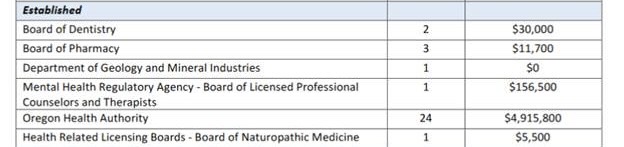
According to the Taxpayer Association of Oregon, Oregon lawmakers passed 185 fee increases (increasing existing fees and establishing new fees) in 2023 that will mean $47 million in higher costs.

Of those, 77 new or increased fees will directly impact the cost of medicine, hospitals and health care, which are all already straining the budgets of Oregonians.  Another 47 fee increases will impact Oregon’s agriculture industry and consumers.

A list of 2024 fee increases by agency is below: 

And then there are the new fees the 2023 Legislature created:

Portlanders and almost all Oregonians are also going to be paying a new cell phone tax this year. Starting January 1, 2024, a 988 Coordinated Crisis Services Tax will be added to the existing Oregon Emergency Communications (911) Tax. The new tax was implemented by the Oregon Legislature with the passage of House Bill 2757. The $50 million a biennium tax is slated to fund the state’s new 9-8-8 suicide prevention hotline.  

DMV fees have gone up, too, touching just about everybody with a vehicle. For example:

  • Class C driver license or restricted Class C driver license, increased from $54 to $58
  • Commercial driver license, increased from $75 to $160
  • Instruction driver permit, increased from $23 to $30
  • Commercial learner driver permit, increased from $23 to $40
  • Hardship driver permit application, increased from $50 to $75
  • Fee for renewal of a commercial driver license, increased from $55 to $98
  • Fee for knowledge test for a motorcycle endorsement, increased from $5 to $7
  • Fee for a skills test for any commercial driver license, increased from $70 to $145

And the list of fee increases goes on, nickeling and diming Oregonians.  

And of course legislators are busy thinking of new taxes.

For example, because the Oregon Department of Forestry wants more money to fight wildfires, Sen. Elizabeth Steiner, D-Portland, wants to charge every property owner in the state an annual fee to pay for what she perceives as a statewide issue.

And then, of course, there’s always inflation. It has been pushed down by aggressive Federal Reserve action, but in its long-term economic projections from December, the Federal Open Market Committee forecasted core Personal Consumption Expenditures Price Index inflation will drop from 3.2% in 2023 to 2.4% in 2024 and 2.2% in 2025.

But, still, hold on to your wallet. The state is considering tolls on I-205, I-5, U.S. 26 and Highway 217.

And the beat goes on.

Selling Freedom: The Libertas Institute is Coming to Oregon

Histrionic stories about Prager U, a nonprofit (not a university) which produces and distributes conservative videos and online programming aimed at millions of young people in homes and schools across the country, are commonplace in the media.

“PragerU and its right-wing propaganda machine spreads racist poison,” says Daily Kos. 

“…more than a few (of PragerU’s videos ) function as dog whistles to the extreme right ,” says the Southern Poverty Law Center.

Regardless of such reproval, in September 2023 PragerU won state approval to offer online classes to high school students in New Hampshire, in July 2023, the Florida Department of Education approved PragerU materials for use in classrooms as supplemental resources and recently PragerU became a state licensed vendor in Texas. Oklahoma and Montana are also allowing videos from PragerU in classrooms.

Meanwhile, flying under the radar almost unnoticed by media, there’s another outfit pursuing similar outreach efforts, the Lehi, UT-based Libertas Institute. 

The Libertarian Institute describes itself as “a 501(c)3 non-profit “think tank” and educational organization” with a “mission to change hearts, minds, and laws to build a freer society…” and an “educational media platform dedicated to promoting pro-American values.” 

And now it has set its sights on Oregon.

Founded in 2011, in the policy arena Libertas works on reforming state and local laws in Utah, but it also partners with similar free market-oriented groups and legislators in other states to pursue reforms initiated by Libertas. 

Some of its current policy focus areas are affordable housing, legal services, employing ex-offenders, consumer privacy and portable benefits for gig workers.

Reaching outside Utah, Libertas, like PragerU, produces what it considers “educational materials” aimed at children. This includes a variety of print and audio books and YouTube videos, as well as a free-market curriculum that teaches economics to children. To some extent, Libertas is a provocateur in this space.

It also runs a Children’s Entrepreneur Market program “to provide a direct experience for youth to apply their knowledge and experience the benefits of operating a small business”. The program is described as facilitating “A farmers’ market…run entirely by KIDS!”

In December 2023, Libertas appealed for donations so it could expand The Tuttle Twins’ Children’s Entrepreneur Markets into 11 more states, including Oregon. 

The Institute supplements all this material with free market-focused books such as “Mediocrity: 40 Ways Government Schools are Failing Today’s Students”.

Libertas also supports homeschooling with its Tuttle Twins Free Market Rules! Curriculum, a comprehensive resource for teaching students about money and economics.

And then there’s the Libertas Institute Hoodie for $27.99. “You’ll become an evangelist for freedom as friends ask you what Libertas is all about — be ready to spread the good word!”, says the Libertas website.

Arguing that there’s a rot inside American culture that needs to be confronted and that liberals have made a squalid mess of things, Libertas asks, “Are your children being brainwashed? …most curriculum is dumbed down and leaves out the essential civic truths that children and adults need to know. That’s why we’ve made it our mission to create books and curriculum materials that teach students the values of a free society — ideas that support your family values.”

The Tuttle Twins books are a core element of Libertas’ proselytizing efforts. Libertas says it has sold 4 million copies of the Tuttle Twins books, endorsed by right-wing radio host Glen Beck, that “help you teach your kids how the world really works…” 

                                  The Tuttle Twins Books

Some of the books are available at Oregon libraries. “We had several patron requests for The Tuttle Twins books at our library,” Beka Murcray at the Molalla Public Library told me. “So, we purchased them and they have circulated fairly okay.”

A cartoon on the Tuttle Twins website has a mother wielding a Tuttle Twins shield while protecting her frightened children, absorbing the arrows of socialism, Marxism, collectivism, and media lies.”

In The Tuttle Twins and the Road to Surfdom, the twins “find in their latest adventure, central planning can ruin people’s lives.” In The Tuttle Twins and the Little Pink House, “When a greedy corporation schemes to take over Grandma’s land and push her house into the river, can the twins stop it and come to her rescue?”

According to reports submitted to the IRS, Libertas’ revenue totaled $13,904,104 in 2022 and $14,360,260 in 2021. Of that, $10,841,883 came from “Education Material Sales” in 2022 and $10,638,576 in 2021. “We sell a lot of books and things, but the bulk of the revenue is from our Tuttle Twins books, curricula, and other materials,” Connor Boyak, Libertas’ president, told me in an email. Libertas reported selling1.55 million books in 2021 and 975,000 in 2022.

Some are fulsome in their praise of the books. “The Tuttle Twins is a set of beautiful books that use storytelling to teach about economics, civics, socialism, and entrepreneurship. So basically everything that is NOT taught in public school.” writes Homeschool Curriculum Reviews. “I am learning right along with my kids as we explore how money works, what the free market really is, and what our freedom actually means.”

Others are almost apoplectic in their condemnation of the series. Rob Larson, a professor of economics at Washington’s Tacoma Community College, describes the books in Current Affairs as “…jammed…with pro-market economic vocabulary and stale right-wing life lessons”. 

Larson goes on to acidly condemn them as “…among the most wretchedly contrived, grotesquely unethically indoctrinating, cliché-ridden heaps of steaming garbage I’ve ever had the misfortune to read. Written to bring young people into one of the most disgraceful political tendencies in the world before they have the critical thinking skills to recognize it, it is a hideous fraud and an ugly twisted farce.”

Though not yet a broadly recognized brand, Libertas clearly aspires to be one. Having grown its revenue almost ten-fold since its founding and vastly expanded its products and programs, it has simultaneously extended its presence across the country.  

Whether you see it as a force for good or malignant propaganda, expect to hear more about this crusading Libertarian outfit in Oregon.

Messages of Doom Aren’t Reaching Trumpers

A friend recently praised the The Atlantic’s January/February 2024 edition for turning over an entire issue to 24 writers offering dystopian warnings about a second Trump presidency. 

“In his first term, Trump’s corruption and brutality were mitigated by his ignorance and laziness, “ wrote David Frum. “In a second, Trump would arrive with a much better understanding of the system’s vulnerabilities, more willing enablers in tow, and a much more focused agenda of retaliation against his adversaries and impunity for himself.”

“Trump’s bullying of military leaders, journalists, and judges was never merely the ranting of an attention seeker, and that behavior—backed by the credible threat of violence from radicalized supporters—will likely become even more central to his governing style,” wrote Juliette Kayyem.

That should have a real impact on public discourse about Trump, my friend said.

Not likely.

The Atlantic, The New York Times, The Washington Post, The New Yorker, Vanity Fair, The Washington Monthly and multiple other elite liberal/progressive/left-leaning publications are preaching to the choir in covering politics and so much more of the cultural landscape. Far too often, their attention is on things the vast majority of Americans are simply not focusing on. 

As former New York Times editor James Bennet wrote in The Economist, “The reality is that the Times is becoming the publication through which America’s progressive elite talks to itself about an America that does not really exist.”

The New York Times illusions are reflected in its coverage of the HBO show “Succession”, described by one critic as “an amoral look at the stupidity of capitalism”. The paper droned on about the show interminably after its debut in June 2018. 

“…time has hardly dulled the beige sheen of “Succession”, New York Times reporter Alexis Soloski effused in the paper’s Dec. 3, 2024 edition. “In January it will likely dominate the Emmy Awards — all of the main cast received nominations and Armstrong earned two, for writing and as an executive producer — and no other show has come to replace it in the cultural consciousness.”

But the fact is Succession was a niche show, not even on the radar of most Americans. Succession’s May 2023 finale drew 2.9 million viewers, a series high. Even counting delayed viewing, “Succession” averaged just 8.7 million viewers per episode in its fourth and final season.

That’s with a total U.S. population of 341 million, with just about every household having a television or computer screen for streaming.

That’s how it is with the New York Times. Even though it now has about 10 million subscribers, and still claims it runs “All the News That’s Fit to Print”, it’s not really talking to America. 

According to the paper’s readership demographics, 91% of its readers identify as Democrats, only 7% of the readership doesn’t have a higher education degree and most of its readers are white and well-off. 

In other words, most people who read the New York Times and other liberal-leaning publications do so because they already share the political sensibilities of these publications.

And frankly, there’s not much incentive for pundits to go off the beaten track. As Osita Nwaney put it in a Columbia Journalism Review article about political writing, “…What’s worth writing about and how? The morsels of rage and misery we offer might not have much political effect, but they do feed an online writing economy that rewards speed, quantity, and deference to algorithms designed for the profit of three or four tech companies—an economy that offers few incentives to generate writing that lingers in the mind longer than half a day or half an hour…The whole system is one of the bleakest forms of entertainment imaginable.”

Similar limiting factors are present with most “elite” news outlets in the United States. 

Even television news and opinion shows reach a narrow audience. The days when Walter Cronkite dominated the scene,  reaching an estimated 27-29 million viewers per night, when the nation’s population was just over 200 million, are long gone. 

ABC World News Tonight with David Muir finished the week of November 27 at No. 1 in the evening news ratings race with an average of just 8.45 million viewers. That same week, NBC Nightly News with Lester Holt averaged 7.075 million viewers and The CBS Evening News with Norah O’Donnell averaged 5.05 million total viewers. In other words, the combined viewership of all three top evening network news shows totaled 20.56 million, about one third fewer viewers than Cronkite alone reeled in more than 40 years ago when America’s population was much smaller.

The proliferation of liberal political comment on social media  and in reams of political punditry also likely has less of an impact on the broad public than is often assumed. 

This is likely one big reason why all the hand-wringing about Trump in progressive publications and network news shows, isn’t denting Trump’s support. He’s still crushing his GOP presidential primary opponents and surpassing President Biden in the polls, even in a poll pitting Trump against Biden, Kennedy, West and Stein. 

Put simply, Trump’s supporters just aren’t listening. 

Celebrities and Politics: Why Are Voters Attracted to Shiny Objects?

What is it about celebrities?

Democrat Jon Ossoff wants to win an open primary on April 18 so he can represent Georgia’s 6th Congressional District.

alyssa

Actress Alyssa Milano canvassed Ossoff’s district for him in March and offered voters a ride to an advance polling location.

According to various media, actors Alyssa Milano and Christopher Gorham‏, want Ossoff to win, too. Media tell us lots of other liberal celebrity actors support Ossoff as well, including Chelsea Handler, Kristen Bell, John Leguizamo, Sam Waterston, Connie Britton, Jessica Lange, Lynda Carter, Jon Cryer, Debra Messing, George Takei and Rhea Perlman.

I’m not sure yet where Kim Kardashian, who’s so well known for her political sophistication and deep thinking, stands on Ossoff’s race, but I’m sure the media will tell us if she ever blurts out something.

How did we get to the point where this matters, or at least reporters, reporters, pundits and political consultants think it does?

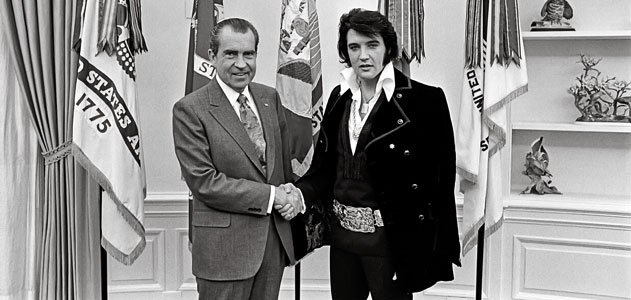
Did you know Elvis Presley supported Democrat Adlai Stevenson in the 1956 presidential election and John F. Kennedy in 1960, or that he shared his strong opinions on America’s cultural decline with President Nixon?

Indelible-Nixon-Elvis-631.jpg__800x600_q85_crop

President Nixon and Elvis Presley at the White House, 1970

Elvis was particularly incensed about the behavior of actress Jane Fonda, who was photographed at an anti-aircraft gun placement in Hanoi during the Vietnam war.

Fonda_Vietnam_3171436b

Actress Jane Fonda at an anti-aircraft position in North Vietnam in July 1972

Like an updated Tokyo Rose, she’d also gone on Hanoi radio and petitioned American fighting men stationed to the south to lay down their arms because they were fighting an unjust war against the peace-loving North Vietnamese.

Did any of us care what Elvis thought about political issues? I don’t think so.

Did anybody vote for Adlai Stevenson because Elvis endorsed him? I doubt it.

How did we reach a point where the political opinions of pampered, self-absorbed, and often empty- headed celebrities influence our voting? It’s a virulent, ugly form of anti-intellectualism.

 Maybe we shouldn’t be surprised.

Americans are woefully uninformed about history and public policy. According to a Pew Research project, about a quarter of American adults (26%) say they haven’t read a book in whole or in part in the past year, whether in print, electronic or audio form.

A recent Fairleigh Dickinson University survey revealed that only 34 percent of registered voters can name the three branches of government, only 69 percent know which party controls the House of Representatives and just 21 percent can name the current Chief Justice of the Supreme Court.

Hard to believe, but according to Newsweek, 70 percent of Americans have no idea what the constitution, the country’s most important historical, political, and legal document even is.

But Americans do know the names, sexual proclivities, marital history, makeup choices, fashion choices and car crash-like personal lives of celebrities and, increasingly, they pay attention to their political opinions. And the media is thrilled to offer celebrities a platform to say what they think about climate change, refugees, the electoral college or whatever, no matter how nonsensical or shallow those views are or how hyping their views is a devaluation of actual expertise.

If there’s any hope it’s helpful to remember that celebrities like Katy Perry came out for Hillary in droves….and we know how that ended.

HillaryandKaty

Algorithm Politics: A Threat to Democracy

It’s not the Russians or fake news, the overhyped threats du jour, I’m most worried about. It’s algorithms.

facebooknews-feed-algorithm-1000x605

We’re all being sliced and diced like in an autopsy, analyzed and scrutinized so we can be messaged and manipulated. We are being told what we want to hear or what fits our biases. We accept lies because we’re being trained to do so.

As Howard Beale shrieked about television’s voice in the movie Network, “But, man, you’re never going to get any truth from us. We’ll tell you anything you want to hear; we lie like hell…We deal in illusions, man! None of it is true!”

We’ve gotten so used to the manipulation we usually don’t recognize it.

While recently strolling about the Washington Square mall’s new Amazon bookstore, I noticed that some of its racks had embraced the a fortiori tactic of many online sellers, “If you like …, you’ll love ….”

ifyoulikethisthen

On one shelf, printed notes said that if I liked Emma Donoghue’s novel “Room”, I’ll love Paul Pen’s “Light of the Fireflies” (“which deals with some very deep and disturbing topics, including incest”), Gillian Flynn’s “Sharp Objects” (featuring “…an incredibly flawed and fragile character…”) and Wally Lamb’s “I know this to be True” (an Oprah Book Club Pick in 1998).

It looks like the store is just being helpful, but it it is really steering your purchasing decision  in a particular direction based upon your characteristics and previous behavior.

It’s like LinkedIn alerting you to job openings that might appeal to you and Twitter feeding you promoted tweets based on your profile information, mobile device location, IP address or apps on your device.

It’s like Facebook delivering information to you on topics you’ve already signaled an interest in with a bias you’ve already displayed, and cutting out contrasting views, or not showing you certain ads based on your ethnicity (as it did until recently).

In Sept. 2016, ProPublica, an independent, non-profit that produces investigative journalism, wrote about Facebook having a comprehensive set of dossiers on its more than 2 billion members.

“Every time a Facebook member likes a post, tags a photo, updates their favorite movies in their profile, posts a comment about a politician, or changes their relationship status, Facebook logs it,” ProPublica said. “When they browse the Web, Facebook collects information about pages they visit that contain Facebook sharing buttons. When they use Instagram or WhatsApp on their phone, which are both owned by Facebook, they contribute more data to Facebook’s dossier.”

And in case that wasn’t enough, ProPublica said, Facebook also buys data about users’ mortgages, car ownership and shopping habits. Talk about invasive.

In a TED Talk, Eli Pariser, Moveon.org’s Board President, called this the “invisible algorithmic editing of the web.”

It’s like Breitbart and The Daily Beast satisfying their conservative and progressive audiences with red meat, allowing each group to retreat to what University of Wisconsin Journalism Prof. James Baughman has called “safe harbors”.

Algorythms are being used to personalize all your communications, constantly reaffirming and constraining your current perspectives, establishing and solidifying your opinion silos. As they get more sophisticated and widely used algorithms are creating what Pariser calls your “filter bubble”, accentuating rifts and perverting our democratic system.

When you log on to Facebook, an algorithm takes into account countless variables to predict what you want to see. Facebook also uses algorithms to categorize your political bent, taking into account your full range of interactions, including the pages you like and the political leanings of people who like the same pages you do.

If you want to know how Facebook categorizes you, just go to facebook.com/ads/preferences. Under the “Interests” header, click the “Lifestyle and Culture” tab. You may have to click on “More” to find it. Then look for a box titled “US Politics.” In parentheses, it will describe how Facebook has categorized you, such as liberal, moderate or conservative.

This and other information is used by opinion influencers to target you. Among those influencers are media of all stripes and politicians of all persuasions.

Politicians have long sought to appeal to different segments of voters with targeted messaging and carefully constructed personas, but until recently the process has been fairly rudimentary.

The image-making tactics described in Joe McGinnis’ groundbreaking book “The Selling of the President” about marketing Richard Nixon in the 1968 presidential race, came as a shocking surprise to a naive general public back then.

But the tactics that were pathbreaking almost 50 years ago are now old hat. They’ve been superseded by once unimaginable data collection and analysis and unforeseen content delivery systems.

Algorithm advocates are adamant that what’s being done is good for you. “Humans are facing an increasing number of choices in every aspect of their lives,” Netflix’s VP of Product Innovation Carlos A. Gomez-Uribe and Chief Product Officer Neil Hunt wrote in a co-published paper last year. “We are convinced that the field of recommender systems will continue to play a pivotal role in using the wealth of data now available to make these choices manageable, effectively guiding people to the truly best few options for them to be evaluated, resulting in better decisions.”

Gomez-Uribe and Hunt argued that Netflix’ impressive system, which breaks down films into over 75,000 hyper-specific sub-genres and uses those, and your past behavior, to make recommendations, is obviously a great thing because 80% of hours streamed at Netflix end up being of recommended films.

But Issie Lapowsky, at Wired, is less sanguine about the implications of algorithms, arguing that there’s a dark side to their use. “This (2016) election has shown us how the same platforms that put a world of facts and information at our fingertips can just as easily be used to undermine basic truths,” she wrote on Nov. 7.

In Weapons of Math Destruction, Cathy O’Neil argued that algorithms pose as neutral tools, but too often exploit people and distort the truth, contributing to the erosion of democracy.

“The social network (i.e. Facebook) may feel like a modern town square, but thanks to its tangle of algorithms, it’s nothing like the public forums of the past,” she said. “The company determines, according to its interests and those of its shareholders, what we see and learn on its social network. The result has been a loss of focus on critical national issues, an erosion of civil disagreement, and a threat to democracy itself.”

Algorithms cause us to “contribute to our own miseducation”, reinforcing echo chambers and making us more partisan, O’Neil said.  “Thanks in part to filtering and personalization… our information has become deeply unbalanced, skewed, and has lost its mooring.”

The increasing sophistication of data gathering and analysis reflected in algorithms is also allowing politicians to shape shift for almost each individual voter. A politician used to be one person, or maybe two if you didn’t like him. It used to be that a presidential candidate delivered similar personas and key messages to  all audiences. If he didn’t, his duplicity was exposed. Today, multiple personas and positions are carefully constructed  and messages are carefully targeted so they can be delivered to tiny slices of the electorate, often with no broader public awareness.

Micro-messaging allows specific online messages to be delivered to a certain group, such as just to attendees of the 2016 National Right to Life Convention at the Hilton Washington Dulles Airport  in Herndon, VA, or even to two members of a family in the same house with different views.

Often the dissection of voters allows a message to be massaged such that the recipient on social media or other channels believes she and the politician are in agreement, even if that’s not the case.  For example, an anti-union Congresswoman might tell a same-minded constituent of by her support for a right-to-work bill, while telling a union supporter about her vote for higher infrastructure spending that tends to reward unions.

Stanford Prof. Neil Malhotra’s research led him to suspect that this kind of  hypocrisy helps explain how members of Congress can get away with voting in a highly partisan or polarized way when their constituents are actually much more moderate.

“These people are good strategic communicators who can potentially take very extreme positions that are out of step with their constituents but then massage them with language,” Malhotra said in a Stanford Business article.

Of course, targeting voters is hardly a new thing; politicians have been doing it forever. But now the databases are substantially more comprehensive, sometimes scarily so, the messaging vehicles, such as social media, can be much more individualized and the political elite are fully embracing the new technology.

“Algorithms show us what we like, not what is ‘right’ ”, said Sebastian Buckup on Quartz. “As a result, they increase ideological segregation rather than creating a digital agora. Influencers no longer waste their time with facts…Rather than seeking truth, the age of data is creating its own.”

That new truth will put more power in the hands of manipulators who won’t have our best interests at heart.

Asked, “How did you go bankrupt?”, Ernest Hemingway replied, “Two ways. Gradually, then suddenly.”

That’s how our democracy will collapse, too, if algorithmic tools aren’t tamed to function in our best interest.