That’s what it sounds like some Portland voters are saying when they voice support for Measure 26-260 to maintain the city’s parkswith a five-year levy that would increase the rate of taxation from 80 cents to $1.40 per $1,000 of assessed value, a massive 75% increase.
What business would reward a division’s mismanagement and profligacy by giving it more money?
What citizen would tolerate giving more money to a bureaucracy that has consistently failed in its mission while boosting its employment ranks? In 2020, Portland Parks and Recreation had 566 full-time employees. As of January 31, 2025, it had 792 full-time employees, almost a 30%increase. Good grief.
What voters already burdened with absurdly high taxes in an uncertain economy would purposefully burden themselves even more? What voters are unconcerned about the Legislature passing the $4.3 billion gas tax/wage tax bill Governor Kotek is eventually going to sign, particularly when, as numerous economists are observing, folks at the top part of the income and wealth distribution are doing fabulously well, but the other 80% are getting worried.
According to the Tax Foundation, an independent, nonpartisan non-profit research think tank, Portland residents already face some of the highest taxes in the country. “City, county, regional, and state taxes on individual and both net and gross business income combine to create a crushing tax wedge, yielding some of the highest marginal rates on wage income nationwide,” the Tax Foundation says.
What citizen would reward a bureaucracy that, according to a fiscal management audit released on Oct. 15 by the Portland City Auditor’s Office, “…has not taken a systematic approach to finding and implementing cost-saving, revenue-generating or service-reduction strategies.”
Then again, Portland voters have a history of tolerance for, even endorsement of, ineffective government.
In a May 2025 special election, Portland voters, ignoring cautionary arguments, supported Measure 26-259, a $1.83 billion bond to completely rebuild or renovate three high schools, the largest school bond in Oregon history, ignoring projections that there won’t be nearly enough students to fill them. The Oregonian also reported that the new schools would be three of the most expensive high schools ever built in the United States.
The massive spending will also result in space for 15,300 high school students, while Portland State University’s Population Research Center projected in July 2024 that the Portland School District will only have about 10,700 students by 2039.
The last thing Portland needs now is another irresponsible spending measure. Vote NO on Measure 26-260.
Portland may be “The City That Works”, but the city’s speed camera program doesn’t. And that’s costing a bundle.
Portland started using fixed speed cameras to identify and fine drivers in 2016. It began by issuing warnings starting on Aug. 25 of that year for violations occurring on the SW Beaverton-Hillsdale Highway corridor. The program started issuing formal speeding tickets at the end of a 30-day trial period on Sept. 24, 2016.
But a persistent problem quickly emerged. Every photograph had to reviewed and every citation had to be issued by a sworn police officer. That was creating a backlog in processing citations and hindering the city’s ability to expand its automated enforcement program.
In 2020, Portland’s fixed speed cameras issued 38,502 tickets. Each one had to be reviewed by a sworn police officer, a massive time sink to say the least.
Finally, in 2022 a solution was found when the Legislature took up HB4105, which allowed the City of Portland to utilize non-police staff (specifically, “duly authorized traffic enforcement agents”) to review and issue citations based on photographs from fixed speed cameras, thereby freeing up police officers to focus on other duties.
Support for the bill was widespread.
“Allowing duly authorized enforcement agents to review citations will create more review capacity – while at the same time ensuring that appropriate training and certification for reviewing personnel are in place,” the City of Portland testified before the House Committee on Rules. “This will address police capacity as well as traffic safety needs.”
Multnomah County testified that requiring police officers to review and issue citations “reduces the capacity (of sworn police officers) for other police priorities and also creates a costly barrier to use of automated enforcement.”
Dana Dickman, at the Portland Bureau of Transportation (PBOT), testified that not only was each traffic safety camera violation being reviewed by a sworn police officer, but “100% of traffic safety camera violation review occurs on police overtime. Expanding the pool of qualified reviewers would lower the cost of this function.”
Reporting on HB 4105, Willamette Week noted that Portland was then advertising a starting salary for officers of $66,934. “In a 2,000-hour year, that’s $33.47 an hour. At time-and-a-half, an officer would be paid $50 an hour to review photo radar tickets.” Willamette Week said those payments explained why the Portland police union opposed changing the law.
Maybe that’s why once the bill passed in 2022, any sense of urgency in implementing it seemed to evaporate.
In December 2024, Jonathan Maus, publisher/editor of BikePortland’s news site, reported that he had asked the Portland Bureau of Transportation’s (PBOT) Communications Director, Hannah Schafer, about the status of implementing the new authority given to them in HB 4105. “PBOT is currently developing the program that will result in PBOT staff reviewing and issuing citations for moving violations from the automated enforcement cameras,” Schafer replied.
Well, here we are in October 2025, 34 months after the effective date of the law, and sworn police officers are still reviewing each and every moving violation recorded by one of the city’s cameras.
Earlier this year, Willamette Week reported that even though speed cameras have been effective, more have not been installed because, as PBOT spokesman Dylan Rivera put it, police officers are currently the ones to review all citations, mostly on overtime shifts, and the bureau is limited by police availability. They’re also hamstrung by capacity at the Multnomah County Circuit Court, which adjudicates the citations.
Meanwhile, the cost of all that overtime? I filed a public records request to find out and it took repeated requests to get the precise numbers I asked for:
Year
Overtime Hrs.
Cost ($)
2022
501.83
41,964.57
2023
411.59
36,963.07
2024
423.00
40,991.56
2025
628.21
60,423.17
Total
1,964.63
$180,342.37
It comes out of the fines paid by speed scofflaws, not the city budget, but still, that’s $180,342.37 down the drain and into police officers’ pockets.
The overtime rule has obviously been quite lucrative for some Portland Police officers. A complete annual breakdown in overtime payments each year is provided in the footnote.[1]
In July 2025, PBOT’s Speed Safety Camera Program Manager, Steve Hoyt-McBeth, told me he’s “very eager to get the ( duly authorized enforcement agents ) program up and running” but “the current holdup is funding”.
Hiring the positions had been held for approximately six months because of PBOT’s budget challenges, he said. “I was hopeful that I’d be able to begin the recruitment this summer, but the lack of a funded state transportation package, which puts an approximately $11 million hole in PBOT’s FY25-26 has kept the pause button pressed.”
Hoyt-McBeth said part of the holdup is also tied to staff capacity to develop the program. “No municipality in Oregon currently utilizes the statutory authority to have Agents issue citations, so we have to develop the training and program ourselves without a template from another jurisdiction,” he said.
So, when are the Portland Police going to relinquish their lucrative overtime work on speed camera violations and pass it on to non-police staff?
There’s a saying of uncertain providence, “Give a Man a Fish, and You Feed Him for a Day. Teach a Man to Fish, and You Feed Him for a Lifetime”.
Portland Mayor Keith Wilson wants to give the homeless in the Pearl District a fish.
Wilson wants to turn an industrial building at NW 15th Avenue and NW Northrup Street into a so-called “low-barrier” overnight-only homeless shelter able to accommodate up to 200 people. An all-night warehouse for the homeless. According to the NW Examiner last month, the city and property owner Vanessa Sturgeon of Sturgeon Development Partners signed a 12-year lease in May that Mayor Keith Wilson has described as a two-or-three-year deal. The $18,000-a-month lease covers the main floor and part of a basement, a total of 16,000 square feet, to be used only for shelter for unhoused individuals.
Low-barrier means the people who stay there from 8pm to 6am wouldn’t have to show an ID, be sober (there’s be no sobriety checks) or drug-free, although alcohol and drugs would not be allowed. The 200- bed shelter at Northwest 15th will have only two showers and sex offenders will be allowed inside the low- barrier shelter because no one will be checking for IDs.
A critic posted on reddit: “It’s basically a night prison. 200 people, 6 toilets, low barrier, barely a snack, no meals, no counseling, no fresh clothing. And then they are going to “disperse” these people every morning near parks and schools.”
Potential overnighters could access a bed by standing in line before the shelter opened. At a July 28, 2025, public forum at the Armory, Skyler Brocker-Knapp, who oversees the city’s shelter plan, said people will be handed a card with information about where to receive social services after leaving the shelter.
I still remember going to a free lunch for the homeless program in an underground Portland parking garage a number of years ago. Tables spread out across the center of the garage displayed a bounty of meal options put together by multiple well-meaning social justice volunteers, from sandwiches and lasagna to potato chips and hot ethic dishes. Homeless people streamed in, wearily assembled in slow-moving lines, grabbed hold of what they wanted and found a spot on the concrete floor to sit and eat.
It wasn’t uplifting. It was depressing.
Nobody was there to help the struggling people get their lives back on track, to inquire about the welfare of their children, or to make them aware of accessible pathways towards lasting change. The whole thing was a misguided feel-good effort at charity by naïve good Samaritans.
More recently, I saw a group of fresh-faced, eager suburban teenage girls handing out sandwiches from the trunk of their car to homeless people at the Tom McCall Waterfront Park. That might have eased their consciences, but how, exactly, did that drive change?
As Kevin Dahlgren has noted in his Substack, @truthonthestreets, “We don’t have a homeless crisis; we have a mental health and addiction crisis. Unfortunately, many still treat the homeless crisis as if it’s a housing crisis and push for more and more shelter beds. The problem is these shelters are far too low a level of care for the majority of our mentally ill.”
“Many advocates for the homeless assume that homelessness is primarily due to the unaffordability of housing, rather than drug use, antisocial behavior, criminal activity or mental illness,” says Devon Kurtz,director of public safety policy at the conservative Cicero Institute. “From this assumption flows misguided confidence that living on the street is an unfortunate but preferable alternative to institutions that curb the civil liberties of individuals who are simply poor. This assumption is wrong. In the largest survey of homeless Americans ever conducted, only 4% cited high housing costs as the primary reason they were homeless. Significant majorities said they had mental-health issues, had used illegal substances and had been to jail or prison for extended periods.”
A woman who directed a social service agency in the Portland area that served low-income families once told me the whole free food approach was “antiquated”, a long-ago discredited tactic , and that unrestricted aid was counterproductive.
So’s the proposed low-barrier Pearl District homeless shelter.
Portland started using fixed speed cameras to identify and fine drivers in 2016. It began by issuing warnings starting on Aug. 25 of that year for violations occurring on the SW Beaverton-Hillsdale Highway corridor. The program started issuing formal speeding tickets at the end of a 30-day trial period on Sept. 24, 2016.
But a persistent problem quickly emerged. Every photograph had to reviewed and every citation had to be issued by a sworn police officer. That was creating a backlog in processing citations and hindering the city’s ability to expand its automated enforcement program.
In 2020, Portland’s fixed speed cameras issued 38,502 tickets. Each one had to be reviewed by a sworn police officer, a massive time sink to say the least.
It took until 2022 for a solution to be found, a notable victory for Portland. That was when the Legislature considered HB4105, which allowed the City of Portland to utilize non-police staff (specifically, “duly authorized traffic enforcement agents”) to review and issue citations based on photographs from fixed speed cameras, thereby freeing up police officers to focus on other duties.
Support for the bill was widespread.
“Allowing duly authorized enforcement agents to review citations will create more review capacity – while at the same time ensuring that appropriate training and certification for reviewing personnel are in place,” the City of Portland testified before the House Committee on Rules. “This will address police capacity as well as traffic safety needs.”
Multnomah County testified that requiring police officers to review and issue citations “reduces the capacity (of sworn police officers) for other police priorities and also creates a costly barrier to use of automated enforcement.”
“We are very concerned about the epidemic of traffic fatalities trending upward across Oregon,” said The Street Trust. “We would like you to rethink trac enforcement as an administrative function in order to increase municipal capacity to enforce traffic laws and to reduce costs to expand their automated traffic enforcement (ATE) programming in ways that meet local community’s needs.”
Dana Dickman, at the Portland Bureau of Transportation (PBOT), testified that not only was each traffic safety camera violation being reviewed by a sworn police officer, but “100% of traffic safety camera violation review occurs on police overtime. Expanding the pool of qualified reviewers would lower the cost of this function.”
Reporting on HB 4105, Willamette Week noted that Portland was then advertising a starting salary for officers of $66,934. “In a 2,000-hour year, that’s $33.47 an hour. At time-and-a-half, an officer would be paid $50 an hour to review photo radar tickets.”
Willamette Week said those payments explained why the Portland police union opposed changing the law.
Once the bill passed, any sense of urgency in implementing the new law seemed to evaporate.
In December 2024, BikePortland noted that the change still wasn’t in place, even though the bill had been on the books for nearly two years. Jonathan Maus, publisher/editor of BikePortland’s news site, reported that he had asked the Portland Bureau of Transportation’s (PBOT) Communications Director, Hannah Schafer, about the status of implementing the new authority given to them in HB 4105. “PBOT is currently developing the program that will result in PBOT staff reviewing and issuing citations for moving violations from the automated enforcement cameras,” Schafer replied.
Bike Portland said PBOT expected to have about 40 cameras in operation and to be issuing 100,000 citations by 2025.
So here we are in July 2025 and sworn police officers are still reviewing each and every moving violation recorded by one of the city’s cameras.
Earlier this month, Willamette Week reported that even though speed cameras have been effective, more have not been installed because, as PBOT spokesman Dylan Rivera put it, police officers are currently the ones to review all citations, mostly on overtime shifts, and the bureau is limited by police availability. They’re also hamstrung by capacity at the Multnomah County Circuit Court, which adjudicates the citations.
According to Willamette Week, PBOT says “it’s looking to hire three people who can review citations to alleviate the burden on police staffing and increase the number of tickets the city can process.”
PBOT’s Speed Safety Camera Program Manager, Steve Hoyt-McBeth, tells me he’s “very eager to get the program up and running” but “the current holdup is funding”.
Hiring the positions has been held for approximately six months because of PBOT’s budget challenges, he said in an email. “I was hopeful that I’d be able to begin the recruitment this summer, but the lack of a funded state transportation package, which puts an approximately $11 million hole in PBOT’s FY25-26 has kept the pause button pressed.”
Hoyt-McBeth said part of the holdup is also tied to staff capacity to develop the program. “No municipality in Oregon currently utilizes the statutory authority to have Agents issue citations, so we have to develop the training and program ourselves without a template from another jurisdiction,” he said.
Clearly, this entire situation with the speed cameras has been mishandled by Portland, which continues to shell out overtime money to cops . But it seems the City Council is clueless. Meredith Washington, Community Liaison for Councilor Angelita Morillo, read this post and responded to me, “I’m unsure what your message is here.”
So, when are the Portland Police going to relinquish their lucrative overtime work on speed camera violations and pass it on to non-police staff?
Back in January, Portland’s new mayor, Keith Wilson, highlighted Portland’s commitment to its sanctuary city status, supported by Oregon’s sanctuary state laws and the Sanctuary Promise Act of 2021 that limit law enforcement’s cooperation with federal immigration authorities.
“We stand together in solidarity with our immigrant families,” he wrote. “Their lives, families, and businesses are part of the fabric of our community and we must support them during these challenging times,” Wilson wrote in a letter to the City Council. “We must come together to live our city’s shared values of freedom from fear and sanctuary from federal overreach in the days ahead, no matter what our city may face.”
Governor Tina Kotek has also publicly and consistently affirmed her commitment to upholding Oregon’s sanctuary state laws. The governor “will not back down from a fight and believes these threats undermine our values and our right to govern ourselves,” a spokesperson for Kotek said, adding that the state “will not be bullied to deport people or perform immigration enforcement.”
A lot of Oregon’s politicians, particularly Democrats, may be on board with this pro-illegal-immigrant stance. But it looks like commerce trumps morality for much of the state’s business community. A long list of companies with operations in Oregon are perfectly happy to go after government contracts aimed at helping Immigration and Customs Enforcement (ICE) with immigrant deportations.
Open Secrets, a Washington, D.C.-based nonprofit that tracks and publishes data on campaign finance and lobbying, has recently reported on for-profit companies in the United States benefiting from President Donald Trump’s plans to increase ICE deportations.
The coming windfall in deportation dollars could be immense. The House of Representatives approved a spending bill in early May that sets aside $175 billion for immigration enforcement – about 22 times ICE’s annual budget.
The bill includes the following provisions:
$46.5 billion for border barriers, including 701 miles of border wall, 900 miles of river barriers, 629 miles of secondary barriers, and 141 miles of vehicle and pedestrian barriers
$5 billion for Customs and Border Protection (CBP) facilities
$4.1 billion for hiring additional CBP personnel, including 3,000 new Border Patrol agents and 5,000 new Office of Field Operations (OFO) officers at ports of entry
$2 billion for retention bonuses and signing incentives for CBP personnel
$2.7 billion for border surveillance technology, including surveillance towers and tunnel detection capabilities
$500 million for grants to state and local law enforcement to track and monitor threats from unmanned aircraft systems
$450 million for Operation Stonegarden to support cooperation between CBP and state and local law enforcement
Open Secrets identified a slew of companies that are poised to benefit from President Trump’s plans to increase deportations. Every single one of them has operations in Oregon. According to Open Secrets, the companies and their contracted work are:
Palantir Technologies: In April 2024, ICE awarded software company Palantir Technologies a $29.8 millioncontract for developing ImmigrationOS, a tool to help ICE with identifying and prioritizing the deportations of individuals who are considered a risk, such as violent criminals; tracking who is self-deporting; and managing cases from the individual’s entry through detention, hearing and deportation. The tool is an extension of systems that Palantir has already delivered as part of its almost $128 million contract signed in 2022.
Deployed Resources: This emergency management company has been awarded over $4 billion in government contracts to build and operate border tents since 2016. On April 12, 2024, ProPublica reported that ICE awarded a new contract worth up to $3.8 billion to Deployed Resources to operate a migrant detention camp at Fort Bliss, a United States Army post in New Mexico and Texas. On April 17, ICE submitted a $5 million proposal for Deployed Resources to deliver unarmed guard services for 30 days at an ICE facility in El Paso, Texas. ICE has housed detainees at a tent facility in El Paso operated by Deployed Resources since March. The Trump administration used the Department of Defense to award Deployed Resources an unannounced $140 million contract to run the site for ICE, The facility can house up to 1,000 detainees, and ICE started transferring detainees on March 10.
Axon Enterprise: The company (formerly TASER International), which develops technology and weapons for public safety, law enforcement and the military, was awarded a year-long $5.1 million contract in March to deliver body cams and equipment and a $22,376 contract to deliver tasers that have been used specifically in deportations. Several law enforcement agencies in Oregon use Axon tasers. Rick Smith, the CEO of Axon Enterprise, had a special distinction in 2024. His annual compensation, $165 million, topped CEO compensation charts in 2024 That propelled him past Apple’s Tim Cook, whose 2024 compensation totaled $74.61 million.
Parsons Government Services: The company is wrapping up a one-year $4.2 million contract for the transportation and guard services of ICE detainees in Newark, NJ. It was awarded a contract worth up to $8.9 million for COVID-19 testing supplies in February, as well as an $87,467contract in March and a $118,758 contract in April with ICE, both to provide “mobile biometric collection devices in support of the biometric identification transnational migration alert program.”
General Dynamics: This weapons company was awarded new $101,034 and $80,050 contracts in March to purchase non-lethal ammunition for training purposes for ICE’s Office of Firearms and Tactical Programs.
Sig Sauer Inc.: A firearms company, Sig Sauer was awarded more than $200,000 worth of contracts with ICE for firearms and firearm accessories in the first months of 2025: $57,163 in February, and$19,824,$35,106 and $90,854contracts in April.
Paragon Professional Services: Awarded a $1.1 million contract on April 1 for transporting people who are detained by ICE in the New York City area and a $458,400month-long contract to provide transportation of ICE detainees in Baltimore on April 17. ICE has also signed a five-year, $395,534 firm-fixed-price delivery order to Paragon Professional Services LLC, an Alaskan Native Corporation-owned small disadvantaged business. The contract provides transportation and guard services to support ICE’s Enforcement and Removal Operations in the Newark, New Jersey area. This award is part of a larger Indefinite Delivery Contract valued at $315.1 million that Paragon holds with ICE for security and detention services.
GlobalX Air is a US 121 domestic flag and supplemental airline flying the Airbus A320 family of aircraft. Our services include domestic and international ACMI and charter flights for passengers and cargo throughout the US, Caribbean, Europe, and Latin America. GlobalX is IOSA certified by IATA and holds TCO’s for Europe and the UK.
GEO Group: A private prison company, GEO Group announced in February a 15-year contract with ICE for 1,000 beds at its Delaney Hall Facility in Newark, New Jersey. The company said the contract is expected to add $60 million to its annual revenue in the first year. In March, GEO announced a contract with ICE for a 1,800 bed facility in Baldwin, Michigan. The contract is expected to generate $70 million in annual revenue. The company also announced in March that it altered its contract agreement for the 1,328-bed Karnes ICE Processing Center in Karnes City, Texas, to host “mixed populations” instead of solely single males. That contract is expected to generate $79 million in the first year, including $23 million in incremental revenue. Accusations of abuse and neglect of immigrants waiting for detention hearings have surfaced at Moshannon Valley Processing Center in Philipsburg, Pennsylvania, one of GEO’s facilities and one of the largest facilities of its kind in the nation, according to the Pittsburgh Post-Gazette. The paper reported that a special office of the U.S. Department of Homeland Security launched a sweeping investigation in 2024 into a litany of allegations at the center, but while the probe was still underway, the federal government gutted the special office in March 2025, raising questions about whether the investigation is still active as well as other inquiries into complaints of dangerous conditions and abuse against immigrants at centers across the country.
CoreCivic: In March, CoreCivic, a private prison company, signed a five-year contract to reopen a 2,400-bed family detention center in Dilley, Texas. Annual revenue once fully operational is expected to be $180 million. In February, the company announced it would increase capacity for up to 784 ICE detainees at its 2,016-bed Northeast Ohio Correctional Center, its 1,072-bed Nevada Southern Detention Center and its 1,600-bed Cimarron Correctional Facility in Oklahoma. In addition, CoreCivic has modified a contract so that ICE may use up to 252 beds at its 2,672-bed Tallahatchie County Correctional Facility in Mississippi.
CSI Aviation: This New Mexico-based company is ICE’s current prime air charter contractor. CSI has signed contracts worth more than $650 million with ICE in the past three years. Included in that total is a no-bid contract awarded to CSI for deportation flights, worth up to $219 million. The contract began on March 1, runs until August and has the possibility to be extended until February 2026.
Air Carrier Subcontractors: CSI Aviation subcontracts deportation flights to several companies. Historically the vast majority of the flights were operated by World Atlantic and iAero, but now by Miami-based GlobalX, part of Global Crossing Airlines Group. Tom Cartwright, an immigration activist and watchdog, has noted that “Eastern Air, OMNI, and Kaiser operate flights rarely and Gryphon small jets are only used for long distance flights occasionally to Africa, the Pacific and Europe.” Budget carrier Avelo Airlines, which operates from the Salem-Willamette Valley Airport (SLE), Redmond Municipal Airport (RDM) and the Eugene Airport, recently signed a contract with ICE to fly three planes for deportations from Mesa, Arizona.
To date, activists and others in Oregon concerned about President Trump’s immigration policies have generally been silent about the actions of companies with Oregon operations that are facilitating those policies. Some activists around the country, including in Eugene, Oregon, have protested against Avelo Airlines, accusing it of profiting from deportation-related flights.
Demonstrators at Tweed New Haven, CT Airport on May 12, 2025 protesting Avelo Airlines’ decision to operate deportation flights for U.S. Immigration and Customs Enforcement.
Generally, however, opposition to companies assisting ICE has been mild and barely noticed, unlike the raucus protests against American companies supplying U.S. armed forces in Vietnam, such as Dow Chemical, the primary manufacturer of napalm.
But that relative calm may not last. The Trump administration has dramatically stepped up its pace of deportations, according to Immigration and Customs Enforcement data. In April, the latest month for which the data is available, ICE deported about 17,200 people and deportation numbers are expected to rise as more detention space is set up, deportation flights increase, and enforcement intensifies.
Meanwhile, anti-Trump administration protests around the country are ramping up. On the horizon is the so-called “No Kings Day” protest on June 14, the same day as a massive Trump-initiated military parade in Washington, D.C. and Trump’s 79th birthday.
The more such protests spread and grow, the more likely protest targets will expand as well. Count on it.
A wolf sculpture by native artists Marie Watt and Cannupa Hanska Luger made in collaboration with PGF for exhibition at the Denver Art Museum.
Portland, Oregon may be struggling, but there are some promising green shoots.
All the creative American garment design and manufacturing has gone offshore and it’s likely to stay there. That’s what some pessimists say. Britt Howard, Founder and Creative Director of Portland, Oregon-based PGF, doesn’t buy it.
When Intel Corp. wanted to celebrate its 50th anniversary in 2018, it turned to PGF. The assignment? Breathe life into some garment ideas.
The result? Slick, comfortable updated replicas of “bunny suits” worn in Intel’s super clean microprocessor manufacturing fabs. Then suit up some employees for a lively, eye-catching flash mob on an Intel campus.
Intel flash mob by PGF
In 1960, 1,233,000 Americans were employed in the manufacturing of apparel, 5.5% of the total manufacturing workforce, according to the U.S. Department of Labor. In 2024, only about 84,000 employees were part of the apparel manufacturing industry in the United States.
Now PGF is bringing back some of those “Made in America” jobs with a full-service creative design and fabrication studio.
“At PGF, we combine expert intuition with creativity, design, and flawless execution,” says Howard, who has been shepherding PGF’s evolution since 2008.
Britt Howard at PGF
Howard showed she had some real entrepreneurial chops when she was just 25.
She started Portland Garment Factory in 2008 with $2400 in start-up capital from a supportive friend. A brief contract with the friend essentially said, ‘If you ever get successful, maybe you’ll pay me back.” Eight years later, Howard did so. “And very handsomely,” the friend said.
Howard started out in a 250 sq. ft. Portland studio. The company began as a sole proprietorship, then shifted to a limited liability company (LLC) one year later.
After moving around a bit, the company settled in at a building at 408 S.E. 79th Ave. in Southeast Portland.
Over its first 12 years Howard continued to grow the business, accruing an impressive list of clients, including Nike, Adidas, Cotopaxi and the global advertising agency, Wieden+Kennedy.
In some cases, the company created prototypes of products a company was considering for mass production. Other work included creating product marketing displays and specialty items that could be featured in retail stores to wow customers with their ingenuity.
The company also created sculptures. In one case, it worked with native artists Marie Watt and Cannupa Hanska Luger to create Each/Other, a monumental wolf sculpture with a fabric “hide” attached to the steel frame that was exhibited at the Denver Art Museum.
The company made a foray into making baby clothes, too. “We used to make retail products, such as thousands of baby clothes, but we almost went out of business,” Howard said. “The seller wanted to put out a product that sold for $6, but it cost us $40 to make it because of all our overhead. It was really hard to make affordable garments in the United States.”
That was one reason why Howard changed the name of her company to PGF in 2018. “I really needed to recalibrate because we couldn’t survive as just a garment manufacturing company,” Howard said. “We needed to get away from making retail products and get into more commercial work.”
As time went by, everything seemed on track and the company’s future looked bright.
Then, disaster!
Early on the morning of April 19, 2021, a massive three-alarm fire, later determined to have been set by an arsonist, tore through the company’s building, destroying just about everything.
Aftermath of the fire
The potential for failure was breathing down Howard’s neck. But Howard wasn’t out.
A broad network of friends and supporters came to her rescue, starting with a team of nine women who set up a GoFundMe account to help Howard resume her business.
“The morning of April 19th, an arsonist set fire to PGF and everything was burned from the brick walls to sewing machines to skews of clothing for clients,” the account said. “Britt lost years and years of hard work and she needs help from us to re-build her business which employs many women and is a pillar in our community. She has gotten so many fashion labels started, contributed charitably and taken risks to help people build their brands. This money will go toward replacing all the machines that were lost, a deposit for a new location and securing the jobs of her beloved employees.”
An astonishing 1200 donors responded with contributions ranging from $5 to $5,000, generating a total of $119,125.
“Britt has created a Portland mainstay, and Portland needs PGF!,” a $100 donor wrote. “Not to mention, she’s an inspiration and positive force of nature in the B Corp and broader business community here. Sending PGF love.”
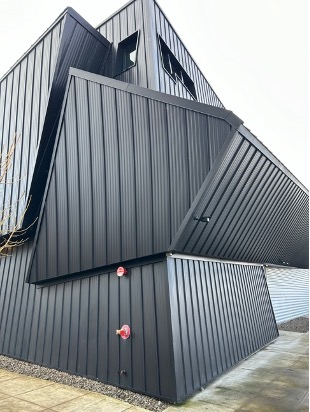
While grieving her loss, Howard embarked on a what she saw as an urgent need for recovery. Within 10 months, with the GoFundMe money, insurance coverage and a mortgage, in hand, Howard was able to buy another headquarters building in Southeast Portland, a 10,000 sq. ft. corrugated metal-clad building that had previously been a gym.
PGF Building
The three-level building is usually a beehive of activity for 17 employees, including designers, artists, expert fabricators and a Marketing and Community Coordinator.
Many of the fabricators are Vietnamese who have been with PGF for more than 10 years. “They are skilled sewers and they are really proud of the work they do,” Howard said.
Sewers at work at PGF
“We’re now a full -service cut-and-sew manufacturing company,” Howard said. “We make soft goods, that includes wearables, clothing, accessories, curtains, upholstery items, sculptures. We also do design work in-house and we source the material, so we’re completely one-stop.”
Reflecting her commitment to responsible business practices, Howard has also secured certification of PGF as a B Corp, a company that meets high standards of verified social and environmental performance, and public transparency to balance profit and purpose.
Part of PGF’s commitment to sustainability is the reuse of materials. In 2023, for example, it created cushions using fabric scraps from past PGF projects and designed to invoke 90’s zine culture married to frenetic, modern-era multimedia art. All the cushions were stuffed with pulverized factory scraps, the result of PGF’s zero-waste manufacturing initiative.
To reward and retain her employees, Howard provides them with generous benefits, including health insurance. A particularly useful benefit that came into play when the fire hit PGF’s building in 2021 was payroll protection insurance. That allowed Howard to give paychecks to her employees for 10 months until the business could restart.
Howard has also focused on improving PGF’s operations, hiring a COO for five months in 2023. “She really helped me turn around a lot of the problems we were having, to look at them in a different way, “Howard said. “She created a reporting tool that’s very specific to this business and changed the structure of the business so more responsibility is placed on designated managers instead of everybody reporting to me,” Howard said.
In its new building, PGF has continued to create specialized products for a wide range of clients, including kimono-style uniforms for volunteers at Portland’s Japanese Garden, jackets for Oregon’s Tillamook Cheese company to highlight the launch of a shredded cheese product and Mad Hatter and White Rabbit costumes for an outdoor electronic dance music festival.
It has even created custom blue Nike tracksuits for the cast of the sports comedy-drama Ted Lasso to wear at the PEOPLE’s Post Screen Actors Guild Awards Gala in Feb. 2024.
With the pandemic, the 2023 fire and the fluctuating economy, Howard says business has been uneven in the past several years, but she maintains her optimistic spirit, tempered with acknowledgement that trouble can lurk just around the corner.
In a sign of her continuing optimism and willingness to take risks, in April 2024, Howard bought the assets of Cotton Cloud Futons in Portland’s Slabtown district and rebranded the company’s manufacturing space as “Oregon Natural Fiber Mill.” She hopes the acquisition will enhance her company’s commitment to sustainable textile manufacturing.
Oregon Business covered the deal, noting that the factory milled U.S.-sourced cotton and wool into usable materials with a focus on organic cotton, regular cotton and polyester and that its equipment included a 100-year-old Garnett machine, a massive textile processing mechanism that converts waste into a uniform fiber to be used in other applications.
Never satisfied with standing still, Howard is aggressively pursuing new opportunities “It’s not a chill business, but we’re here to stay,” she says. “There’s lots going on, lots of opportunities everywhere. I just have to know where to put my energies.”
Now we know it was a towering mistake, indeed, a fiasco, a classic misreading of the market.
Keller Williams Realty Professionals began marketing individual condos at prices ranging from $1,1000,000 for a one bedroom 2 bath 1,105 sq. ft unit to $8,999,000 for a 3 bedroom 4 bathroom 3,256 sq. ft unit. Principal and interest on the mortgage, plus property taxes and condo fees, could have translated to an $8000 a month expense for the 1 bedroom.
Willamette Week’s Anthony Effinger reported today that only 8% of the 132 Ritz-Carlton condominiums have sold, a failure of massive proportions that could have potentially major repercussions for the City of Portland and its struggling downtown core. His entire article is reproduced below:
In July 2025, Ready Capital Corp., based in New York, said it had taken possession of Block 216, the 35-story building in Portland’s West End that has ground-floor retail, five floors of office space, a 251-room Ritz-Carlton Hotel and 132 Ritz-Carlton residences.
The lender to Block 216, Walter Bowen’s gleaming West End skyscraper, sounded an ominous note about the property in an earnings report Monday.
New York-based Ready Capital said the best strategy for its $503 million construction loan would be to take possession of the property, instead of waiting for repayment.
“Ownership is [the] best net present value outcome for RC,” Ready Capital wrote in a 25-page supplement to its fourth-quarter earnings.
Ready Capital CEO Thomas Capasse went into more detail on a conference call.
“While the original strategy was to refinance the construction into a bridge loan, the current appraisal and other factors favored ownership and serial asset disposition on the components as the best net present value outcome,” Capasse said, according to a transcript of the call.
Translation: foreclose on the 35-story building and sell it in chunks.
Block 216 has ground-floor retail, five floors of office space, a Ritz-Carlton Hotel and Ritz-Carlton Residences. Ready Capital acquired the Block 216 loan in March 2022, when it bought Mosaic Real Estate Credit LLC, the building’s original construction lender.
Like so many downtown towers, Block 216 has struggled to land office tenants. Just 23% of the office space is leased, according to Ready Capital. Nor has Bowen been able to sell many of the 132 Ritz-Carlton condominiums. Only 8% have sold, according to Ready Capital’s earnings report, at an average of $1,105 per square foot.
The hotel is underperforming, too, Ready Capital said. Its average revenue per available room was $188 in 2024, compared with $343.28, the average for all Ritz-Carlton hotels during the same period. The chain is owned by Marriot International Inc., which provided the average figure in its full-year earnings report.
Ready Capital said it plans to stabilize the three components of the angular glass tower—commercial, condo and hotel—then sell the office space and hotel portion within two years. Unloading the condos will take three years, Ready Capital said.
Neither Block 216 management nor Bowen’s company, BPM Real Estate Group, returned calls and emails seeking comment. Ready Capital’s press office didn’t return an email. Nor did its chief financial officer, Andrew Ahlborn.
One bright spot: Block 216’s retail space, where a food hall called Flock opened in January, is 100% leased, Ready Capital said.
The earnings report spurred a 27% decline in Ready Capital shares on Monday, mostly because the company halved the quarterly dividend it pays to investors to 12.5 cents a share to “better align the dividend with projected cash earnings in the short-term and to preserve book value,” Capasse said on the conference call.
Concern about the Block 216 loan also may have also weighed on the stock. In addition to the $503 million loan, Ready Capital also owns $62 million of preferred equity in the project, for a total of $565 million.
Ready Capital said it has set aside $130 million to cover the declining value of Block 216. Given that reserve, Ready Capital values it at about $435 million. At that valuation, Block 216 accounts for about one-quarter of common shareholders’ equity in Ready Capital.
Ready Capital shares closed at $4.95 today, down from $8.39 a year ago.
During the recent Legislative session, lawmakers passed Senate Bill 5701 to set aside $2 million for the Old Town Community Association. The bill proposed putting the money toward establishing a 30,000-square-foot green manufacturing facility in the Old Town section of Portland that would help get new companies off the ground and existing companies develop new products and technologies for the footwear and apparel industry.
WHY?
The proposed facility would potentially be part of a $125 million Made In old Town (MiOT) project that would eventually include 100,000 square feet of manufacturing space, 120,000 square feet of housing and 145,000 square feet of office and retail space in eight largely vacant Old Town buildings.
MiOT’s backers need to raise $5 million from the private sector to fund the green manufacturing facility, which they hope to open by this fall. Elias Stahl, a MiOT Board Member and CEO and co-founder of Hilos, an Old Town-based 3D-printed footwear company, told The Oregonian in March he was “extremely confident” they could raise the money.
In early April 2024, it looked like Oregon Gov. Tina Kotek might throw a monkey wrench into the deal when she said she was considering vetoing the $2 million item. “My office is awaiting more information from the development group about the viability of financing for the entire project before I make my decision,” Kotek said.
But on April 17, 2024, Kotek announced she would allow the expenditure for the project to move forward. “I am grateful to legislators for responding to our state’s most pressing needs,” she said. “In the days following last week’s notice of potential vetoes, I received adequate information to have confidence in signing…Senate Bill 5701…”
On April 11, 2024, Vince Porter, Kotek’s Economic Development and Workforce Policy Advisor, informed the governor and key staff that he had received a letter from the Old Town Project and followed up with a conversation with Jonathan Cohen, the Old Town Community Association’s treasurer, who made a “commitment that they will not request (state) funding until they have raised their own funding,” referring to the $5 million to be raised from the private sector.
“I think the letter along with written confirmation from me will meet the requirements we specified for the project, Porter said. “ Hopefully you all feel the same. Jonathan will provide documentation during the DAS funding process demonstrating that the other financing is secured to match the state funds. This will include “seller financing” which they are counting on to complete the project.”
The MiOT project’s website announces it will be building “An Innovation Campus in a Thriving Neighborhood Creating the Next Generation of Footwear & Apparel.” The website says MiOT is currently accepting tenancy applications, with various lease terms and spaces available, and that MiOT plans to announce the first cohort of brands that have signed on as founding members early in 2025.
Democratic State Treasurer-elect Elizabeth Steiner, who previously served as a state senator representing Oregon’s 17th district, including the Old Town neighborhood, said in April, “As somebody who both cares about her district and cares about the City of Portland and the state as a whole, creative ideas like that—that revitalize a part of the city that has really been neglected, if not abandoned for a long time, and do so in a way that meet a bunch of different goals simultaneously—are a very exciting prospect for me.”
The collaborative nature of the project, its potential to revitalize a neighborhood and support re-shoring manufacturing in the U.S. has merit. But, given all the state’s “pressing needs” and the wealth and resources already available to MiOT’s key backers, plus the presence of hundreds of companies in the Portland metropolitan area tied to the footwear and apparel industry, why did the governor sign this ill-advised bill that would siphon money from Oregon taxpayers for private gain?
I can understand why politicians like Steiner would go for MiOT. Politicians love the spectacle of ribbon-cutting ceremonies and the prospect of jobs (and voters). But that shouldn’t drive this corporate welfare. that is more “free money” than “seed” money. Oregon does, indeed, have other “pressing needs” that should take a higher priority in the allocation of public dollars.
If the players behind the entire MiOT project are confident of its viability, let them provide the start-up money. If they make their vision a reality, taxpayers will have been spared the diversion of public dollars and the backers of the project can take full credit for MiOT’s success.
Christmas is coming and the Made In Oregon company is ready, drawing throngs of shoppers eager to celebrate their ties to the Beaver State.
When I moved to Oregon from the East Coast 40 years ago, on my first trip back I carried with me a large green bag filled with “Made In Oregon” presents, solidifying my allegiance to my new home.
“Fifty years ago, nobody thought a store that sold only Oregon made products was possible,” says Made In Oregon’s website. “As an Oregon native, Sam (Naito) knew there was an opportunity to showcase locally made goods and was committed to bringing the Made In Oregon concept to life. A few months later, he did just that.
But stroll through a Made In Oregon store today. Look closely and you will see “Made In Oregon” is a slippery term. “Made In Oregon”opened its first store at Portland International Airport in 1975,” the company says. “Since then we have worked hard to build a trusted reputation as a source for high-quality products that are made, designed, or grown in Oregon.”
The fact is “made, designed, or grown in Oregon” leaves a lot of wiggle room and the company takes advantage, allowing companies with limited Oregon connections that manufacture their products out of state , including in other countries, to sell their products at the Made in Oregon stores. It’s the word “designed” in Oregon that opens the door wide enough to drive a truck through, enabling “localwashing” to prosper.
At the Washington Square store, for example, dozens of Hydro Flask bottles highlight that they are “Designed in Bend, Oregon”. The company’s website reinforces the message: “Our HQ is nestled in a Pacific Northwest wonderland–Bend, Oregon. We’re ridiculously lucky to have always been surrounded by mountains, rivers and lakes. It’s in our DNA. It shapes our products, people, and what we’re about as a company.”
But I looked closer at the bottom of the bottle and noticed, “Made in China”
Then I checked out a “Comfort Colors” t-shirt. Turns out that was “Made in Honduras”.
Then I examined a “Greetings from Oregon” postcard.
That was “Made in. Missoula, Montana”.
How about the Super Stretch “Replant Pairs” Portland Airport design socks I discovered? They were “Made by craftsman in JAPAN”.
How about the “Night-Night Portland” book for children. Surely that was made in Oregon.
Nope. Published by an Illinois company and “Printed and bound in China”.
Despite Made In Oregon’s deception, the state’s Travel Oregon agency still promotes the company’s website at TravelOregon.com, saying visitors will access “Local products made, caught or grown in Oregon”.
All you Portland voters. Remember how you voted 58.1% to 41.9% on Measure 26-228 to switch to a ranked choice voting (RCV) system for the Portland City Council?
“In the end, we saw monumental wins that will change the landscape of our local democracy and advance opportunity for communities of color,” enthused the Coalition of Communities of Color after the vote.
“Portlanders made history by demanding a government that is effective, accountable and representative,” said Debra Porta, co-chair of the Charter Commission, which initially recommended voters consider the sweeping changes .
“The passage of Measure 26-228 is an historic step towards a democracy that truly gives all Portlanders a seat at the decision making table and a government that meets their basic needs,” said Sol Mora of the group Portland United for Change, which advocated for the measure. “This victory was powered by the people for the people.”
Well, supporters got what they wanted. But while Measure 26-228 required mote than 50% yes votes in Portland to pass, the 12 new city councilors elected under the the quirky new system didn’t need 50% to win in the 4 new districts.
This is how the RCV reform proposal described the system:
“If no candidate receives a majority of the vote in the initial round, subsequent rounds are counted in which (i) candidates retain the number of votes counted for them in the first and any subsequent rounds that already occurred; and (ii) the candidates having the fewest votes are successively eliminated in rounds and their votes are counted as votes for the candidates who are ranked next on the ballots that had been counted for the eliminated candidates. The process of eliminating candidates and transferring their votes to the next-ranked candidate on ballots repeats until a candidate has a majority of the vote.”
The Councilors of each district were elected using a proportional method of RCV known as “single transferable vote” (STV). In this system, voters rank the candidates and if a candidate gets more votes than needed to be elected the extra, or surplus, votes get transferred to the voter’s next choices. The charter reform proposal was so convoluted it took almost 300 words to explain how it would work (See below for complete text).
Under this system, a candidate running for a seat in a multimember district could win a position on the Council with as little as 25% of the vote, or maybe even less.
And that’s exactly what happened.
Eleven of the twelve Councilors were elected with 25% of the vote in their district. One newly-elected Councilor, Jamie Dunphy in East Portland’s District 1, was even elected with just 22.8% of the vote.
District 1’s three final winners were Candace Avalos, Loretta Smith and Dunphy. In the 1st round, Avalos was the first choice of just 19.4% of the vote, Smith was the first choice of 13.1% and Dunphy was the first choice of 11.9%.
One consequence of all this is that the newly elected Councilors may be able to remain in office by consistently satisfying just that small segment of eligible voters and ignoring those who are disenchanted with their performance because it would require 75% of voters to vote against the entrenched councilor to remove him or her.
As Tim Nesbit, a former chief of staff to former Democratic Governor Ted Kulongoski and a critic of the ballot measure before its passage, wrote in the Portland Tribune, “This will be a ‘welcome to the Hotel California’ for candidates who seek office in the first council election to follow. It will be easy to check in to the council, but much harder to be forced to leave.”
Charter reform’s explanation of how “single transferable vote” (STV) would work:
“Councilors of each district are elected using a proportional method of ranked choice voting known as single transferable vote. This method provides for the candidates to be elected on the basis of a threshold. The threshold is determined by the number of seats to be filled plus one, so that the threshold is the lowest number of votes a candidate must receive to win a seat such that no more candidates can win election than there are seats to be filled. In the initial round, the number of first rankings received by each candidate is the candidate’s vote count. Candidates whose vote counts are at least the threshold are declared elected. Votes that counted for elected candidates in excess of the threshold are called surplus. If fewer candidates are elected in the initial round than there are seats to be filled, the surplus percentage of all votes for the candidates who received a surplus are transferred to the next-highest ranked candidates in proportion to the total numbers of next-highest rankings they received on the ballots that counted for the elected candidate. If, after all surpluses have been counted in a round, no additional candidates have a vote count that is at least the threshold, the candidates with the lowest vote counts are successively eliminated in rounds and their votes are counted as votes for the candidates who are ranked next highest on the ballots that had been counted for the eliminated candidates, until another candidate has a vote count that is at least the threshold or until the number of candidates remaining equals the number of seats that have not yet been filled. The process of transferring surpluses of elected candidates and eliminating candidates continues until all positions are elected.”




























 ThinkingOregon