
Cost and Complexity Should Defeat Portland Charter Reform

No question. Portland is “The City That doesn’t Work”. But Ballot Measure 26-228, the charter reform proposal, isn’t the answer.

Driving support for the measure is a commonly held view that Portland’s government is an unwieldy mess that doesn’t serve citizens well.

A recent poll commissioned by the Portland Business Alliance validates that voters are up for change. 

Presented with the text of the ballot measure, 63% of 420 respondents said they would vote for it and 21% said they would vote no. 

The 63% figure makes it sound like approval is a slam dunk, but the devil may be in the details. 

Of that 63%, only 26% were sure they’d vote for it; 36% were less certain, but leaned toward a yes vote and 16% were undecided. In my view, even though the vote is just weeks away, that means there are an awful lot of persuadables.

The task ahead for opponents is to raise enough awareness of the measure’s complexity and cost to raise doubt about the wisdom of the whole proposal.

For example, Portlanders may think more City Council members will mean better representation. But the proposal for four districts, each represented by three city counselors, won’t necessarily translate into that result. 

One reason is because the ballot measure doesn’t specify the boundaries of the new districts. If the measure passes, a separate districting commission would be convened in January and assigned the task of drawing the boundaries. Nobody knows now where those lines will be drawn.

Things get more complicated and uncertain because the measure proposes that the councilors of each district be elected using a proportional method of ranked choice voting known as “single transferable vote” (STV). 

In this system, voters rank the candidates and if a candidate gets more votes than needed be elected the extra, or surplus, votes get transferred to the voter’s next choices. The process is so convoluted the measure takes almost 300 words to explain how it would work.

Under this system, a candidate running for a seat in a multimember district could win a position on the Council with as little as 25% of the vote. One consequence could be a councilor able to remain in office by consistently satisfying just that small segment of eligible voters and ignoring those who are disenchanted with their performance because it would require 75% of voters to vote against the entrenched councilor to remove him or her.

As Tim Nesbit, a former chief of staff to Democratic Governor Ted Kulongoski and a critic of the ballot measure, wrote in the Portland Tribune, “This will be a ‘welcome to the Hotel California’ for candidates who seek office in the first council election to follow. It will be easy to check in to the council, but much harder to be forced to leave.”

And then there’s the potential cost of the new governance system proposed in the measure. Talk about buying a pig in a poke. Frankly, nobody’s really sure what the cost of the massive changes would be. 

The City Budget Office estimates the cost of implementing the measure could be up to a whopping $8.7 million annually. 

One unknown is transition costs. Then a Salary Commission that would need to set the salaries of all the newly elected officials. And all those new City Councilors will have staff. And the fact is, government tends to grow. As George Roche wrote in a booklet published by the Mackinac Center for Public policy, bureaucracies “tend to swell up like toadstools on a rotting log.”

Do Portlanders really want to spend MORE on their government? Charter reform proponents don’t tend to talk about this.

The key task ahead is to convince the “less certain” and “undecided” voters to move into the “No” column.

There’s still time. 
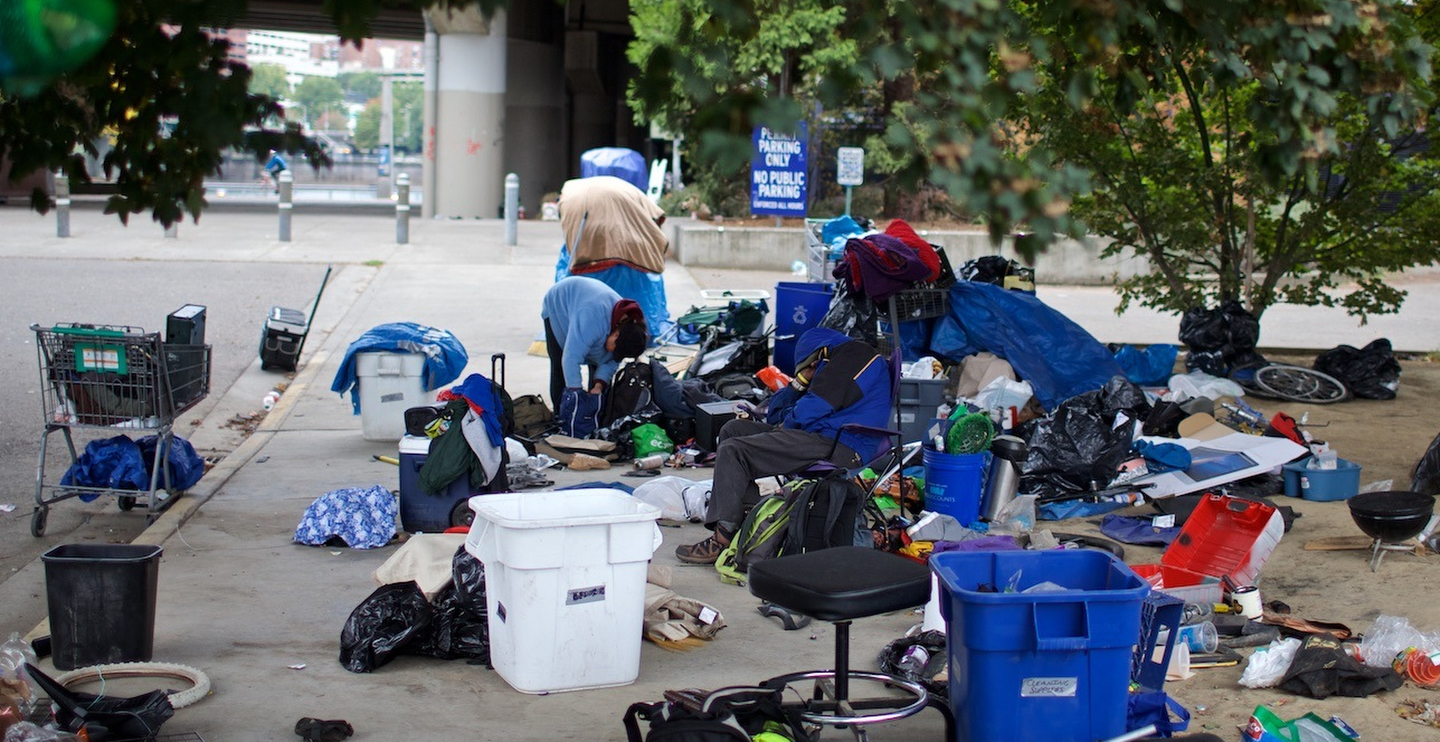
Confronting the homeless: after Denver, whither Portland?

It hasn’t gotten much media coverage in Oregon, but on May 7, 2019, Denver voters defeated a ballot initiative that would have allowed homeless people to camp in outdoor public spaces like parks, sidewalks and vehicles.

Fed up voters didn’t just soundly reject the initiative; they pummeled it 83% to 17%.

Portland Mayor Wheeler says he’s going to run again. If he doesn’t resolve Portland’s homelessness crisis, he’s likely to face the same level of public rancor.

portlandcampers2

Portland, OR campers.

In 2011, only 1% of those surveyed an annual poll of Portland-area voters by DHM Research that was commissioned by the Portland Business Alliance said homelessness was the biggest issue facing Portland. By 2017, the share of those polled identifying homelessness as Portland’s biggest problem had risen to 24%.

In a Jan. 2019 telephone survey of 510 likely voters in the Portland Metro Region, including an oversample of City of Portland voters, homelessness remained the top-of-mind issue, jumping to 33% overall and 47% among voters in the City of Portland alone. Nearly one in three who said the Portland City Council was ineffective pointed directly to its failure to address homelessness as the reason.

At the same time, half the people polled said they felt the Portland area was headed in the wrong direction. A majority of voters said the region’s quality of life was declining— continuing a trend from a December 2017 study. Only 7% said the quality of life in the Portland Metro Region was getting better.

“just last weekend, a homeless couple set up a tent next to my house in broad daylight…, “ wrote a commenter on OregonLive.” I find more and more used condoms and needles by my house (which I have to dispose of), while my neighborhood experiences daily burglaries and car thefts, all of which the city does nothing about. These problems have exploded just in the past few years. I pay thousands of dollars in property and other taxes per year and get nothing in return. When is enough, enough?”

“Wheeler keeps putting more and more money in to coddling them and tells police to not help residents when harassed or attacked by transients,” wrote another commenter. “Transients have more rights in this city than tax paying voting residents and thus more and more keep coming. We need a tough policy and kick them out. Portland is slowly becoming the shelter for America’s homeless by choice, mentally ill and young lazy transients.”

Even though Portland still has a reputation as an ultra-left city, it’s clear Portlanders’ tolerance and patience are slipping.

That’s clearly what happened in Denver. another liberal (some would say more of a live-and-let-live libertarian) city,

Responding to an explosion of complaints by downtown businesses, Denver began enforcing an urban camping ban to keep people from spending the night on city sidewalks, in parks and other public spaces. In 2016, the city began sweeps to enforce the ban, picking up tents, sleeping bags and other detritus.

denverhomelesssweep

Police sweep homeless camps in downtown Denver, CO in 2016

Still, surveys in 2018 showed the homeless population increasing, with more people camping instead of staying in shelters.

“Something needs to happen. It’s gotten to the point where it is hard to live down there,” River North (RiNo) resident Josh Rosenberg, told Denver’s Channel 7 in late 2018. “It’s not just one or two homeless guys sleeping on the street; there’s been times where they will set up camp and have tarps and suitcases and shopping carts and kind of make a little village out of it and they’ll be there until somebody calls the police.”

In late 2017, homeless advocates submitted enough signatures to get Initiative 300, referred to as the “Right to survive initiative, on the ballot. The initiative wouldhave effectively overturned Denver’s urban camping ban.

“Denver faces a choice: to do nothing, and let Denverites experiencing homelessness struggle to survive, to sleep at night, and to make it to their jobs, or to take action, and take the first step toward empathy, dignity and realistic solutions,” the Yes on 300 supporters said.

But opposition quickly became obvious. “The election was a referendum on quality of life,” said one online Denver Post commenter. “If you just moved here you don’t know, but those of us that have lived in Denver for 30 years have drastically seen quality of life decrease…”

An increasing number of Portlanders feel that way as well. If he’s not careful, Ted Wheeler could get pummeled, too.

_____________

You can find more about the survey and results at the Portland Business Alliance:

https://portlandalliance.com/assets/pdfs/2019-PBA-Jobs-Economy-DHMReport-January.pdf