“Madame Secretary” and Washington: It’s all show business

“Washington is Hollywood for ugly people,” the saying goes.

The manifest connection between the two has been particularly pronounced in the promotion of CBS’ new television show, “Madame Secretary”.

Washington’s denizen’s feel a kinship with actors, who practice a craft of role-playing much like their own, and, being so self-absorbed, they like nothing better than stories about themselves.

Politico, an influential political journalism organization that normally focuses on the inside workings of politics, devoted almost 400 words yesterday to last night’s debut of “Madame Secretary”. The coverage included lengthy comments by actor Tim Daley, who plays the husband of actress, Tea Leoni, who plays the Secretary of the State. It also included a link to a 5-minute video “First Look” at the show and comments by Leoni on playing the Secretary of State character.

This was preceded by an almost 300 word item on Sept. 19, inviting Politico’s audience to a high-powered luncheon at the Hyatt Regency on Capitol Hill with the stars and executive producers of “Madam Secretary.” There, Mike Allen, author of the Politico Playbook, and Maggie Haberman, a Politico reporter, would talk with Téa Leoni, Tim Daly, and Executive Producers Barbara Hall, Lori McCreary and Morgan Freeman.
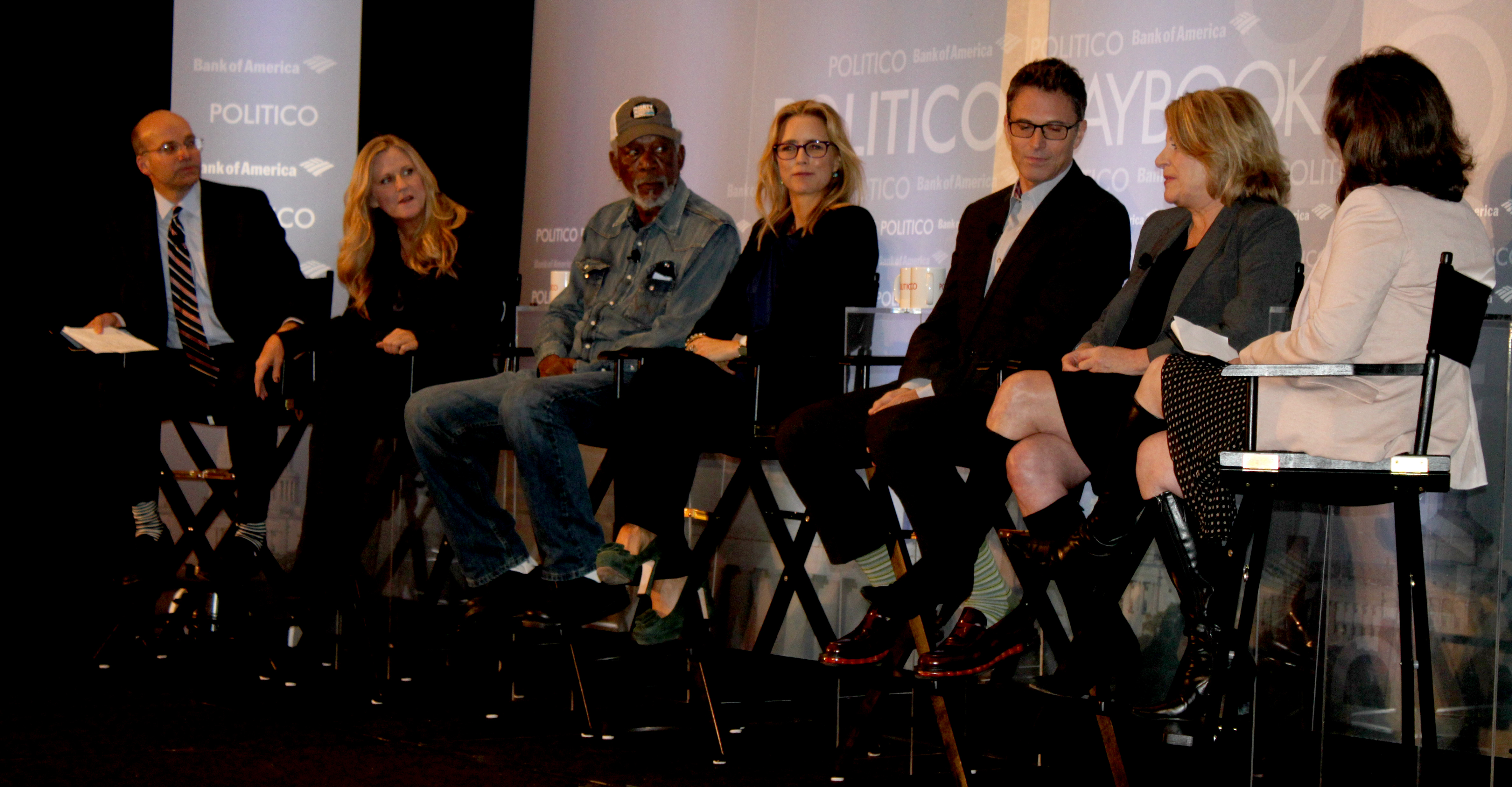
From left at Washington event promoting CBS’s ‘Madam Secretary’: Politico’s Mike Allen; executive producers Lori McCreary and Morgan Freeman; stars Téa Leoni and Tim Daly; executive producer Barbara Hall; Politico’s Maggie Haberman. (Photo: Melissa Quinn/Daily Signal)

From left at Washington event promoting CBS’s ‘Madam Secretary’: Politico’s Mike Allen; executive producers Lori McCreary and Morgan Freeman; stars Téa Leoni and Tim Daly; executive producer Barbara Hall; Politico’s Maggie Haberman. (Photo: Melissa Quinn/Daily Signal)

Allen also noted that National -security influencers packed the theater at the U.S. Institute of Peace on Sept. 18 to see the premier episode, with an introduction by Freeman. Guests munched on crab cakes, sushi, grilled shrimp BLTs and crispy wonton cones – with Georgetown Cupcakes after the show.

Some of the government-media complex who attended the star-studded schmooze-fest included: CBS TV journalist, Bob Schieffer, (who also had a cameo in last night’s show); Huma Abedin, a long-time aide to Hillary Clinton married to the infamous former Democratic Congressman Anthony Weiner; N.Y. Times columnist, Maureen Dowd; Nick Merrill, press aide to Hillary Clinton; and Jen Psaki, Deputy Communications Director and Deputy Assistant to President Obama.

I’m sure they all enjoyed themselves immensely, because for politicians, political junkies, the media and actors, it’s all theater, all razzle-dazzle, as Billy Flynn, the silver-tongued lawyer in “Chicago”, so aptly put it.

“It’s all a circus, kid,” Flynn said. “A three ring circus…the whole world – all showbusiness.”

The Merkley Razzle-Dazzle: Both ways is the way I want it

Senator Jeff Merkley (D-OR) can’t seem to make up his mind.

In 2012, he voted for a bill to reform the federal flood insurance program, a bill everybody knew would mean higher insurance premiums for property owners to deal with a $24 billion debt the program had built up.

Now he’s portraying himself as a champion of the besieged middle class by lambasting those premium increases and voting to roll them back.

Merkley’s situation is captured perfectly in A.R. Ammons’ terse poem: One can’t have it both ways
 and both ways is the only way I
 want it.”

Merkley is obviously assuming that Oregonians just don’t know his voting record or have very short memories.

RazzleDazzle

In 2012, the National Flood Insurance Program (NFIP) was $24 billion in debt, partly because of big losses associated with damage from hurricanes Sandy and Katrina.The program was widely criticized for its below-market insurance rates and huge losses associated with multiple claims on homes and businesses that had flooded repeatedly.

Merkley voted for a bill designed to improve the program’s solvency by having property owners pay insurance rates that better reflected flood risks and reimbursement costs. The bill became law as PL 112-141 on July 6, 2012.

It was abundantly clear from the get-go that affected property owners were going to have to pay a lot more money for federal flood insurance. “The solvency and debt-reduction requirements imposed…by the 2012 reforms…virtually ensures that premiums will be going up across the board,” said an Association of State Floodplain Managers’ summary of the legislation.

But then Congress started hearing from constituents outraged that their flood insurance premiums were rising, some by hefty amounts.

Merkley responded by adopting the “Give ’em the old Razzle Dazzle approach, holding a September 2013 Senate hearing that gave him and others an opportunity to vent about problems with the flood insurance reform.

“The flood insurance bill, in combination with flood zone remapping, is delivering a massive financial blow to middle class families,” Merkley said. “This is unacceptable and substantial changes in the program are needed.”

In March 2014, Congress backtracked on the reform law, passing the Homeowner Flood Insurance Affordability Act that reversed some rate hikes and capped annual increases.

In a March 18, 2014 e-newsletter to his constituents, Merkley called the 2012 flood insurance reform law (that he had voted for) “misguided” and said he’d been hard at work to fix the huge rate increases resulting from it. Didn’t he understand what was in the 2012 legislation when he voted for it? If not, why did he vote for a bill he didn’t understand?

President Obama signed the rollback bill on March 21, 2014, even though his administration had argued in January that abandoning the 2012 reforms would “further erode the financial position of the NFIP.”

Members of Congress from both parties and around the country fell all over themselves in an effort to celebrate and take credit for the rollback of the 2012 reforms.

But negative reaction was also swift. “The new legislation will perpetuate a broken system by keeping premiums unrealistically low, encouraging coastal communities to continue to build — and rebuild — in high flood-risk areas, exposing them to growing risks and costs,” said Rachel Cleetus, an economist at the Union of Concerned Scientists. “It makes no sense for taxpayers to continue to subsidize flood insurance in high-risk areas that are only going to become riskier with rising seas and worsening storm surges.”

The rollback of the flood insurance hikes may take the heat off Congress for now, but it will have to tackle the issues again because the program’s debt problems have not been fixed. But, hey, that’s for another Congress to worry about.